
Listen to this Post
Introduction:
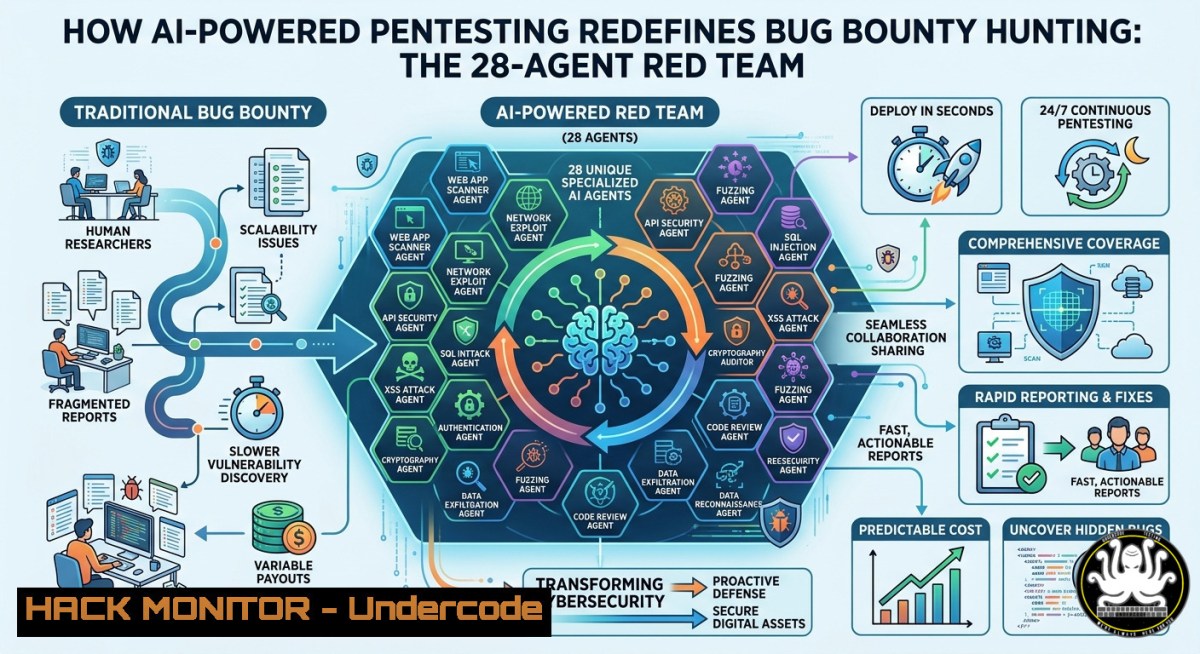
The days of relying solely on manual effort for reconnaissance and vulnerability discovery are rapidly fading. A new wave of open-source frameworks, such as pentest-ai by security researcher 0xSteph, is integrating Large Language Models (LLMs) directly into offensive security workflows. This AI-native approach breaks down complex penetration testing tasks into specialized, automated agents that can handle everything from initial scouting to report generation, acting as a force multiplier for ethical hackers.
Learning Objectives:
- Understand how a multi-agent AI architecture automates the complete penetration testing lifecycle, from reconnaissance to proof-of-concept (PoC) validation.
- Learn to deploy and configure AI-driven reconnaissance and exploitation tools like pentest-ai, NightWatch, and God’s Eye on both Linux and Windows platforms.
- Master practical commands and techniques to enhance API security testing, web application fuzzing, and local LLM integration for privacy-focused bug bounty operations.
You Should Know:
1. Deploying pentest-ai: From Installation to Execution
The `pentest-ai-agents` project revolutionizes how security researchers leverage AI. Instead of a generic chatbot, it transforms Claude Code into a specialized assistant by distributing tasks across 28 distinct subagents, each an expert in a specific domain like Active Directory attacks, mobile testing, or exploit chaining. The installation is remarkably simple and built for a seamless developer experience.
Step‑by‑Step Guide:
- One‑Line Installation: Open your terminal and run the following command. This script clones the repository and copies all agent files to `~/.claude/agents/` directory. It’s idempotent, meaning you can run it repeatedly to safely update your agents without breaking existing configurations.
curl -fsSL https://raw.githubusercontent.com/0xSteph/pentest-ai-agents/main/install.sh | bash
- Verify Installation: Ensure Claude Code is installed and authenticated. Then, simply open Claude Code and describe your pentesting task.
- Launch a Reconnaissance Task: Start by pasting the output of a standard `nmap` scan directly into the chat. The Recon Advisor agent automatically activates, parses the results, and provides prioritized analysis and suggestions for further enumeration. For example, you might ask: “Analyze this Nmap scan for potential web attack vectors.”
- Using Tier 2 Execution (Linux/macOS): For more aggressive automation, use a tier‑2 agent like the Web Hunter. It can directly invoke tools like
ffuf,sqlmap, or `dalfox` after you grant approval for each command it proposes to run.This agent can intelligently fuzz a parameter it discovered ffuf -u 'https://target.com/page?param=FUZZ' -w /path/to/smart_wordlist.txt
- Project‑Level Deployment: To deploy agents only for a specific project directory, use the `–project` flag to keep your global configuration clean and isolated.
curl -fsSL https://raw.githubusercontent.com/0xSteph/pentest-ai-agents/main/install.sh | bash -s -- --project /path/to/project
2. Automating Reconnaissance with AI-Powered Attack Surface Mapping
Traditional subdomain enumeration often yields thousands of results, creating a bottleneck for manual analysis. AI-powered reconnaissance tools like NightWatch and God’s Eye have evolved to include ML prediction and local LLM analysis, dramatically reducing the time from discovery to exploitation by intelligently triaging findings.
Step‑by‑Step Guide (Linux):
- Install NightWatch: This framework unifies certificate transparency logs, DNS bruteforce, and CVE correlation into a single pipeline.
git clone https://github.com/BiswasM21/NightWatch.git && cd NightWatch
pip install -r requirements.txt && pip install -e .
- Create a Project & Run a Scan: Define your target and execute a full reconnaissance scan with CVE checking enabled.
nightwatch project create mytarget --target example.com --description "Bug bounty target"
nightwatch scan mytarget --target example.com --subdomains --http --cve
This command performs asynchronous DNS bruteforcing and HTTP probing, and then cross-references discovered services against a built-in CVE database.
- Enable AI-Powered Subdomain Prediction: For more advanced discovery, use samoscout which uses a transformer model to predict subdomains that don’t exist in any wordlist.
git clone https://github.com/samogod/samoscout.git && cd samoscout
go build -o samoscout cmd/samoscout/main.go
./samoscout -d example.com -o results.txt
- Local, Private Analysis with God’s Eye (macOS/Linux): For environments where data privacy is paramount, use a tool that integrates with Ollama to run its AI analysis completely offline.
curl https://ollama.ai/install.sh | sh
ollama pull deepseek-r1:1.5b  Pull a lightweight local model
git clone https://github.com/Vyntral/god-eye.git && cd god-eye
go build -o god-eye ./cmd/god-eye
./god-eye -d target.com --enable-ai  The tool analyzes JS secrets and detects cloud providers locally
-
Fuzzing Web Applications and APIs with Intelligent Automation
Generic fuzzing is becoming obsolete as WAFs evolve. Modern AI-powered fuzzers use reinforcement learning and LLMs to generate context-aware payloads that can bypass rule-based and ML-based web application firewalls (WAFs). For bug bounty hunters, this means a higher success rate against targets protected by solutions like Cloudflare or ModSecurity.
Step‑by‑Step Guide (Windows & Linux):
- Enhance Burp Suite with AI (Windows/Linux): Install the Shadow Repeater BApp from the Burp Suite Extender store. This extension monitors your manual requests and automatically generates and tests intelligent variations for you.
Use case: After you manually test for SQLi on a parameter, Shadow Repeater will autonomously attempt dozens of permutations, reporting any anomalous responses back to the Organizer tool. - Automated Vulnerability Exploitation (Linux): Use the Automated Web Exploitation Bot which crawls an application, extracts all input points, and uses a smart fuzzer to test for XSS, SQLi, and RCE.
git clone https://github.com/Akashcp111/Automated-Web-Exploitation-Bot.git && cd Automated-Web-Exploitation-Bot
pip install -r requirements.txt
python main.py -u 'http://testphp.vulnweb.com'  Example: scan a deliberately vulnerable target
The tool integrates with OWASP ZAP and SQLMap APIs to handle the heavy lifting of exploitation logic, but it’s the AI-powered NLP-enhanced payload generation that adapts the fuzzing strategy in real-time.
- Multi-Agent WAF Bypass: For advanced challenges, frameworks like AutoWAFuzzer (recently detailed in Elsevier research) deploy parallel agents—a generative LLM agent and an RL-based policy optimizer—that work together to iteratively refine evasion techniques. While this is a research-level tool, it sets the standard for next-gen API hardening and testing.
4. Proactive Defense: Hardening Against AI-Powered Attacks
As offensive tools become autonomous, defenders must shift left. AI can’t just find bugs; it can also fix them. Frameworks like the Raptor (Recursive Autonomous Penetration Testing and Observation Robot) not only find vulnerabilities but also autonomously generate patches and validation code. Similarly, integrating tools like `trivy` or `snyk` into a CI/CD pipeline alongside AI agents can automatically reject builds that contain patterns similar to those exploited by tools like HexStrike AI, which runs 150+ security tools to find vulnerabilities.
Step‑by‑Step Guide (Cloud & CI/CD):
- Cloud Hardening on AWS: Deploy a pre-configured BlackArch Linux VM from the AWS Marketplace to instantly access a full suite of pentesting tools for validating your own cloud security posture against AI-led attacks.
- API Security Testing: Use an MCP server integration (like the one in
pentest-ai) to let an AI agent autonomously test your API endpoints with `curl` and custom Python scripts, reporting any authorization bypasses or injection flaws before they reach production.
What Undercode Say:
- Efficiency is the New Skill: “Hackers using AI will always move faster than those who don’t.” This is the core takeaway. AI doesn’t replace the hunter; it amplifies their ability to focus on logic flaws and complex chaining by automating the noisy, tedious work of reconnaissance and payload generation.
- The Paradigm Shift from Tools to Teammates: Tools like pentest-ai aren’t just scanners; they are autonomous teammates. They possess domain expertise in MITRE ATT&CK mapping, can chain exploits automatically, and even write PoC code, signaling a move away from memorizing command syntax toward high-level strategic direction.
- Accessibility and Scale: The open-source nature and one-line installers mean that a solo bug bounty hunter can now wield the equivalent of a 28-person red team. This democratization of advanced offense changes the game for both attackers and defenders, who must now assume that adversaries have access to similar, if not superior, automation.
Prediction:
Within the next 12 to 18 months, the bottleneck in bug bounty hunting will shift from finding a vulnerability to reporting it. Autonomous frameworks will become so proficient at identifying and validating low-to-medium severity bugs (XSS, SQLi, misconfigurations) that the competition will be solely focused on the novel, business-logic flaws that still stump AI. Consequently, we will see the rise of adversarial AI for defense—WAFs and API gateways powered by their own LLMs, engaged in a real-time, machine-speed battle of wits with offensive AI agents, each trying to outpace the other in a zero-day cold war.
▶️ Related Video (70% Match):
🎯Let’s Practice For Free:
IT/Security Reporter URL:
Reported By: Deepak Saini – Hackers Feeds
Extra Hub: Undercode MoN
Basic Verification: Pass ✅


