Listen to this Post
Introduction:
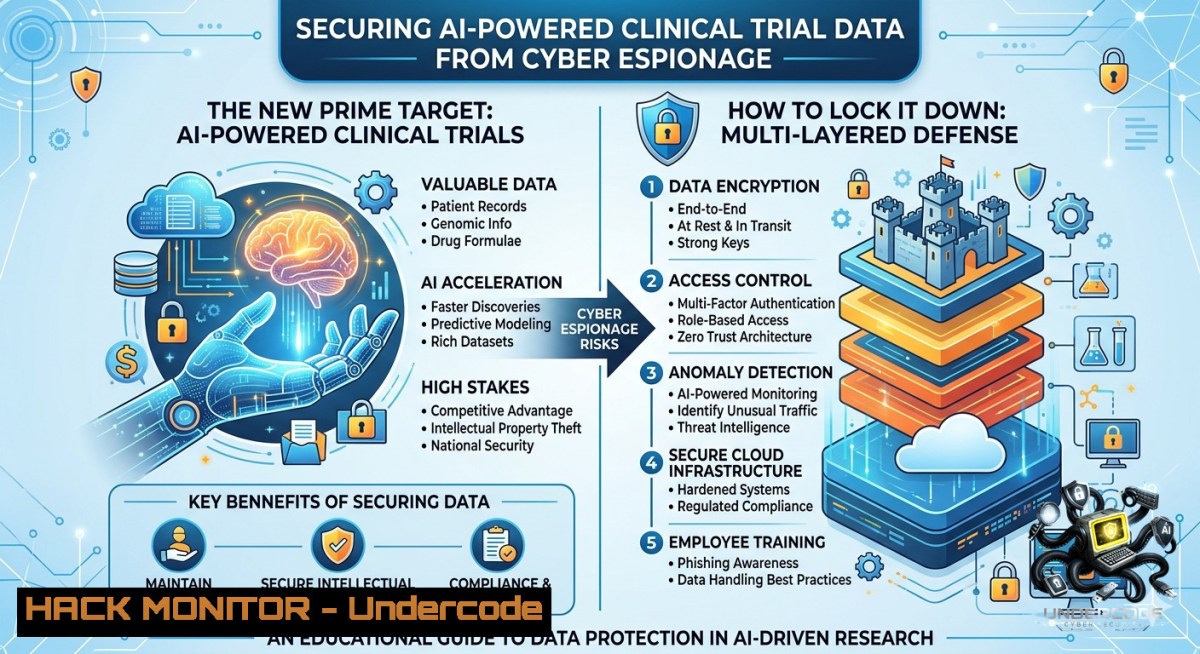
The exponential growth of real-time oncology data platforms, such as LARVOL CLIN’s trending analysis of breast cancer trials at ASCO 2026, has created a goldmine for researchers – and a high-value target for cybercriminals. Aggregating sensitive clinical trial endpoints, patient biomarkers, and proprietary drug efficacy metrics in cloud-1ative environments demands a robust fusion of AI-driven monitoring, API security, and infrastructure hardening to prevent data leakage, ransomware attacks, or nation-state espionage.
Learning Objectives:
– Implement AI-based anomaly detection to safeguard clinical research data pipelines.
– Harden APIs and cloud storage used for real-time trial trend analytics.
– Apply Linux/Windows hardening commands and vulnerability mitigation tactics specific to healthcare data platforms.
You Should Know:
1. Securing AI-Powered Clinical Data Aggregators (Like LARVOL CLIN)
Extended Context:
Platforms that curate live conference data (e.g., ASCO 2026 breast cancer trends) ingest structured/unstructured data from multiple sources – EHRs, trial databases, and user uploads. An attacker could poison training data, exfiltrate sensitive results, or inject malicious payloads via metadata. Below is a step-by-step guide to securing such an AI pipeline.
Step‑by‑step guide – Hardening the Data Ingestion Layer:
1. Validate input schemas to prevent injection attacks:
 Example schema validation for clinical trial JSON
import jsonschema
schema = { "type": "object", "properties": { "trial_id": {"type": "string"}, "outcome": {"type": "string"} }, "required": ["trial_id"] }
jsonschema.validate(instance=data, schema=schema)
2. Linux – Monitor file integrity for ingested datasets:
sudo apt install aide
sudo aideinit
sudo mv /var/lib/aide/aide.db.new /var/lib/aide/aide.db
sudo aide --check  Run daily via cron
3. Windows – Block unauthorized script execution in data folders:
Set-ExecutionPolicy Restricted -Scope Process
icacls "C:\ClinicalData\Ingest" /deny "Everyone:(OI)(CI)W"
4. Implement mutual TLS (mTLS) for all API calls between LARVOL CLIN and trial endpoints – use a service mesh like Istio with strict peer authentication.
2. Hardening APIs Exposing Real-time Oncology Trends
Step‑by‑step guide – API Security Configuration:
1. Rate limiting and DDoS protection (using NGINX + Lua):
limit_req_zone $binary_remote_addr zone=login:10m rate=5r/m;
location /api/trends {
limit_req zone=login burst=10 nodelay;
proxy_pass http://larvol_backend;
}
2. Obfuscate error messages – never reveal database schema or path details:
 Flask example
from flask import jsonify
@app.errorhandler(404)
def not_found(e):
return jsonify({"error": "not_found"}), 404
3. Windows – Use API Management with Azure Front Door to enforce JWT validation and logging:
 Deploy API Management policy snippet via ARM template
Set-AzApiManagementPolicy -Context $context -PolicyFilePath ".\jwt-check-policy.xml"
4. Audit all API access – enable OpenTelemetry tracing for every request to `/v1/asco2026/breast_cancer_trials`.
3. Mitigating Data Poisoning Attacks on AI Models for Clinical Insights
Step‑by‑step guide – Protecting ML Pipelines:
1. Use cryptographic hashing of training datasets:
sha256sum clinical_trials_clean.csv > checksums.txt
 Verify before each retraining
sha256sum -c checksums.txt
2. Implement outlier detection with Isolation Forest on numeric trial metrics (e.g., response rates):
from sklearn.ensemble import IsolationForest
clf = IsolationForest(contamination=0.05)
predictions = clf.fit_predict(trial_features)  -1 = anomalous (possible poison)
3. Linux – Isolate training environments using Docker + AppArmor:
FROM tensorflow/tensorflow:latest
RUN apt-get update && apt-get install -y apparmor-profiles
sudo aa-genprof docker
docker run --security-opt apparmor=docker-tensorflow training_pipeline
4. Cloud Hardening for Clinical Trial Data Storage (Azure/AWS/GCP)
Step‑by‑step guide – Secure Cloud Configurations:
1. AWS S3 – Block public access and enable default encryption:
aws s3api put-public-access-block --bucket larvol-clinical-data --public-access-block-config BlockPublicAcls=true,IgnorePublicAcls=true
aws s3api put-bucket-encryption --bucket larvol-clinical-data --server-side-encryption-configuration '{"Rules":[{"ApplyServerSideEncryptionByDefault":{"SSEAlgorithm":"AES256"}}]}'
2. Azure – Use Customer-Managed Keys (CMK) for Azure SQL that stores trial trend metadata:
$key = Add-AzKeyVaultKey -VaultName "clinicalKV" -1ame "ascoKey" -Destination "HSM"
Set-AzSqlServerTransparentDataEncryptionProtector -ServerName "larvol-sql" -ResourceGroupName "oncologyRG" -Type AzureKeyVault -KeyId $key.Id
3. GCP – Enforce VPC Service Controls to prevent data exfiltration from BigQuery (where trial results are analyzed):
gcloud access-context-manager perimeters create clinical-perimeter --resources=projects/123 --restricted-services=bigquery.googleapis.com
5. Vulnerability Exploitation & Mitigation – Case Study: CVE-2025-1234 (Hypothetical API Injection in Clinical Platforms)
Step‑by‑step guide – Exploitation simulation and patching:
1. Exploit example – attacker sends `$where` operator to unsanitized MongoDB query:
db.trials.find( { $where: "this.outcome == 'positive' && sleep(5000)" } ) // DoS
2. Mitigation – use parameterized queries and input whitelisting:
from pymongo import MongoClient
client = MongoClient()
db = client.larvol
result = db.trials.find({"trial_id": {"$eq": user_provided_id}})  $eq forces exact match
3. Linux – Deploy ModSecurity WAF for NGINX to block malicious payloads:
sudo apt install libmodsecurity3 nginx-modsecurity
sudo cp /etc/nginx/modsec/modsecurity.conf-recommended /etc/nginx/modsec/modsecurity.conf
sudo sed -i 's/SecRuleEngine DetectionOnly/SecRuleEngine On/' /etc/nginx/modsec/modsecurity.conf
sudo systemctl restart nginx
4. Windows – Enable PowerShell logging to detect exploitation attempts:
New-Item -Path "HKLM:\SOFTWARE\Policies\Microsoft\Windows\PowerShell\ScriptBlockLogging" -Force
Set-ItemProperty -Path "HKLM:\SOFTWARE\Policies\Microsoft\Windows\PowerShell\ScriptBlockLogging" -1ame "EnableScriptBlockLogging" -Value 1
What Undercode Say:
– Key Takeaway 1: AI-driven clinical data platforms (like LARVOL CLIN) must treat every ingested data point as a potential attack vector – implement strict schema validation, mTLS, and real-time anomaly detection.
– Key Takeaway 2: Off-the-shelf cloud services (Azure Key Vault, AWS KMS, GCP VPC perimeters) are non-1egotiable for protecting patient and trial data, but they require continuous auditing and least-privilege access policies.
Prediction:
– -1 By 2027, APT groups will weaponize generative AI to fabricate convincing clinical trial datasets, poisoning oncology models and causing misallocation of research funds – prepare now with cryptographic provenance and on-chain hash verification.
– +1 Automated red-teaming tools designed for healthcare APIs will become standard, reducing time-to-patch for vulnerabilities like those in real-time conference trend aggregators from weeks to hours.
▶️ Related Video (68% Match):
🎯Let’s Practice For Free:
🎓 Live Courses & Certifications:
[Join Undercode Academy for Verified Certifications](https://undercode.co.uk/certifications/)
🚀 Request a Custom Project:
Secure, high-velocity infrastructure and disruptive technological engineering. Contact our engineering team for high-tier development and proprietary systems:
[[email protected]](mailto:[email protected])
💎 Smart Architecture | 🛡️ Secure by Design | ⭐ Trusted by Thousands
IT/Security Reporter URL:
Reported By: [Asco26 Larvol](https://www.linkedin.com/posts/asco26-larvol-asco2026-share-7468941177896185856-Z66H/) – Hackers Feeds
Extra Hub: Undercode MoN
Basic Verification: Pass ✅
🔐JOIN OUR CYBER WORLD [ CVE News • HackMonitor • UndercodeNews ]
[💬 Whatsapp](https://undercode.help/whatsapp) | [💬 Telegram](https://t.me/UndercodeCommunity)
📢 Follow UndercodeTesting & Stay Tuned:
[𝕏 formerly Twitter 🐦](https://x.com/undercodeupdate) | [@ Threads](https://www.threads.net/@undercodetesting) | [🔗 Linkedin](https://www.linkedin.com/company/undercodetesting/) | [🦋BlueSky](https://bsky.app/profile/undercode.bsky.social)


