Listen to this Post
Introduction:
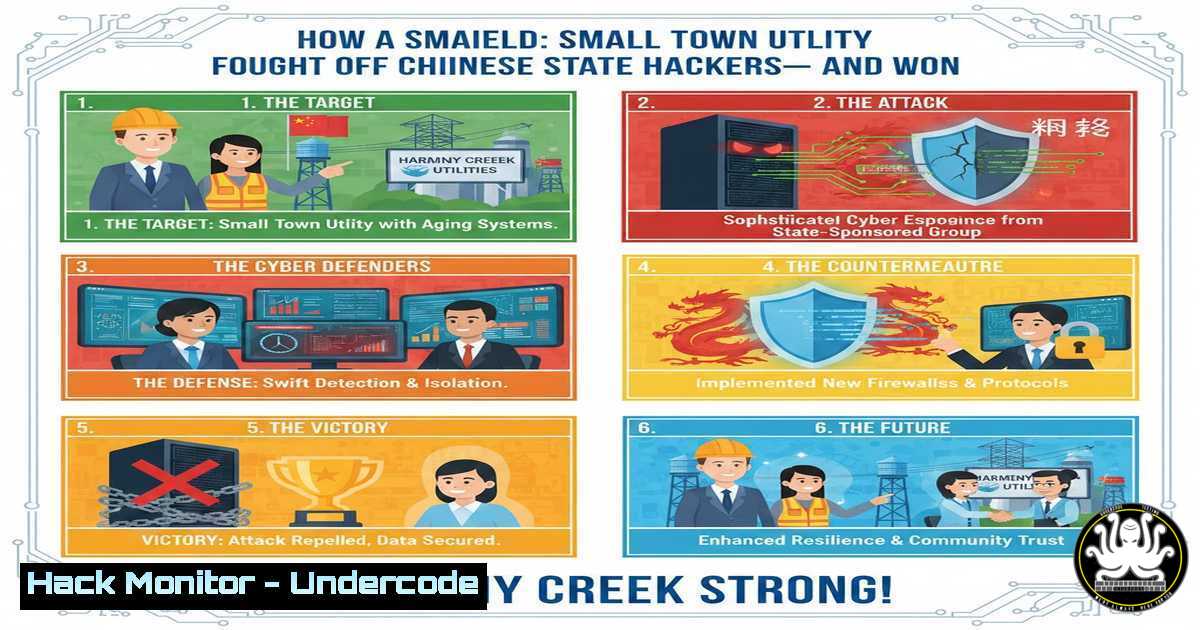
In an era where nation-state actors are increasingly targeting critical infrastructure, the recent case of the Littleton Electric Light and Water Departments (LELWD) stands as a beacon of proactive defense. Facing an intrusion by the notorious Chinese state-sponsored group Volt Typhoon (also known as VOLTZITE), this small Massachusetts utility, with the help of the FBI, CISA, and Dragos, successfully detected, contained, and eradicated the threat without customer data compromise or operational disruption . This article dissects the technical playbook used in Littleton, providing a step-by-step guide on how to defend against similar advanced persistent threats (APTs) targeting Operational Technology (OT) environments.
Learning Objectives:
- Understand the Tactics, Techniques, and Procedures (TTPs) used by the Volt Typhoon threat group against US critical infrastructure.
- Learn how to implement asset visibility and network monitoring to detect living-off-the-land (LOTL) attacks in OT networks.
- Master the techniques for network segmentation and incident response to prevent lateral movement from IT to OT systems.
You Should Know:
- The Initial Compromise: The Danger of Unpatched Perimeters
The breach at LELWD originated from a surprisingly common vulnerability: an unpatched firewall. The utility’s then-managed service provider had failed to update the firmware on an edge device, which featured a known security flaw that the Volt Typhoon actors exploited for initial access . This highlights a critical rule in cyber hygiene: patch management is not just an IT issue, but a safety issue.
Step‑by‑step guide: Auditing and Hardening Perimeter Devices
To ensure your organization does not fall victim to the same initial access vector, conduct a thorough audit of all internet-facing devices.
- Inventory Extraction: Use a network scanning tool like Nmap to identify all devices on your perimeter.
Linux command to identify devices with open ports commonly targeted (e.g., 80, 443, 8443, 22)
sudo nmap -sS -sV -p 80,443,22,8080,8443,161 <your_public_ip_range>
-
Firmware Version Verification: Cross-reference the discovered devices (firewalls, routers, VPN concentrators) with the latest vendor firmware versions. For Windows-based management servers, use PowerShell to check installed software.
Windows PowerShell command to list installed updates and hotfixes Get-HotFix | Where-Object { $_.Description -match "Security" } | Format-Table -AutoSize -
Configuration Hardening: Ensure that default credentials are changed and that management interfaces are not exposed to the public internet unless absolutely necessary. If remote management is required, implement a jump box or VPN with multi-factor authentication (MFA).
-
Detection and Visibility: Hunting for LOTL in OT
Once inside, Volt Typhoon is known for its stealth, emphasizing “living-off-the-land” (LOTL) techniques and “hands-on-keyboard” activities to avoid triggering signature-based alerts . In the LELWD case, the Dragos platform identified “server-message-block traversal maneuvers and remote desktop protocol lateral movement” . This means the attackers were moving laterally using native Windows protocols.
Step‑by‑step guide: Setting Up OT Network Monitoring
You cannot stop what you cannot see. Implementing passive network monitoring is key to detecting anomalies without disrupting sensitive OT processes.
- Span Port Configuration: Configure a span port (port mirror) on your OT switches to send a copy of all traffic to your monitoring interface.
Example Cisco switch configuration for port mirroring
configure terminal
monitor session 1 source interface gi0/1 both
monitor session 1 destination interface gi0/24
end
-
Detecting RDP Lateral Movement: Use a packet analyzer like Zeek (formerly Bro) to identify unexpected RDP traffic. The following Zeek script logic can alert on RDP connections originating from unexpected subnets (e.g., from the Historian network to the PLC network).
Zeek script snippet (detect-rdp.zeek) event rdp_connect_request(c: connection, cookie: string) { if ( c$id$orig_h in unexpected_ot_subnets && c$id$resp_h in critical_asset_subnets ) { NOTICE([$note=WeirdActivity::RDP_Lateral_Movement, $msg=fmt("Unexpected RDP connection from %s to critical asset %s", c$id$orig_h, c$id$resp_h), $conn=c]); } } -
Command-Line Monitoring: Since Volt Typhoon uses commands like `net user` and `quser` for account discovery , monitor process creation events. In Windows environments, enable command-line logging via Group Policy or Sysmon.
3. Containment and Architecture Resilience
After the FBI and CISA installed sensors to monitor the hackers, LELWD did not just eject the intruders; they fundamentally changed their network architecture. The utility “changed its network architecture to remove any advantages for the adversary” and rendered any stolen information “unusable” . This is a crucial step: simply removing the threat actor does not fix the underlying architectural flaws.
Step‑by‑step guide: Implementing IT/OT Segmentation and “Unusable” Data
To prevent credential theft from leading to OT access, strict segmentation and credential rotation are mandatory.
- Implement VLAN Segmentation: Separate IT and OT traffic at the switch level. Use Access Control Lists (ACLs) to restrict traffic flows.
Example Cisco ACL to block IT-to-OT RDP traffic (except specific jump host)
access-list 101 deny tcp 192.168.1.0 0.0.0.255 10.10.10.0 0.0.0.255 eq 3389
access-list 101 permit ip any any
-
Credential Rotation and Hygiene: Following the Volt Typhoon playbook, assume credentials are compromised. Rotate all service account passwords and implement Group Managed Service Accounts (gMSA) in Windows to automate password changes.
Windows PowerShell: Find and reset all service account passwords (requires domain admin) Get-ADUser -Filter {ServicePrincipalName -like ""} -Properties ServicePrincipalName | ForEach-Object { Set-ADAccountPassword -Identity $<em>.SamAccountName -Reset -NewPassword (ConvertTo-SecureString -AsPlainText "NewComplexPassword!" -Force) Write-Host "Password reset for $($</em>.SamAccountName)" } -
Decoy Files (Honeypots): Place decoy files (honeypots) on file servers that appeared to be accessed by the attackers (like the GIS server). Monitor for any access to these files from unauthorized users or systems, which can serve as a high-fidelity alert for a breach.
4. Threat Hunting and Intelligence Integration
LELWD utilized threat hunting services to identify the adversary’s actions close to their OT environment . According to the MITRE ATT&CK framework, Volt Typhoon utilizes techniques like T1005 (Data from Local System) and T1071.001 (Web Protocols) . Threat hunting involves proactively searching for these indicators rather than waiting for an alert.
Step‑by‑step guide: Proactive Threat Hunting Queries
Use SIEM or log aggregation tools to hunt for specific Volt Typhoon TTPs.
- Hunt for Web Shells (T1505.003): Search for processes spawned by web servers (like w3wp.exe or httpd) that launch command shells.
Splunk query to find web shells index=windows EventCode=4688 ParentProcessName="w3wp.exe" NewProcessName=("cmd.exe" OR "powershell.exe") | table _time, host, User, NewProcessName, CommandLine -
Hunt for Volume Shadow Copy Access (T1006): Attackers often use `vssadmin` to copy the NTDS.dit database. Hunting for this command can reveal credential access attempts.
Linux/Unix: Grepping through collected Windows Event Logs for vssadmin usage
cat Security.evtx | grep -i "vssadmin" | grep -i "create shadow"
What Undercode Say:
- Proactive Defense Wins: The LELWD case proves that even small organizations with limited budgets can defend against nation-states by prioritizing asset visibility, network monitoring, and partnership with agencies like CISA. They were prepared before the FBI called.
- Transparency is a Force Multiplier: Despite facing “unkind media articles” and personal attacks, LELWD’s decision to go public with their breach details has educated the entire utility sector, forcing others to harden their defenses . In cybersecurity, sunlight is truly the best disinfectant.
- Architecture Over Reaction: The most critical takeaway is that LELWD didn’t just kick the hackers out; they rebuilt the network architecture to ensure that even if credentials were stolen, they couldn’t be reused. This “assume breach” mentality is the gold standard for critical infrastructure defense.
Prediction:
This case will set a legal and operational precedent for how small and medium-sized critical infrastructure providers handle nation-state intrusions. We will likely see a surge in “LLM-derived” regulatory frameworks mandating specific OT visibility tools and network segmentation practices, mirroring the LELWD playbook. Furthermore, as threat groups like Volt Typhoon continue to target the “soft underbelly” of the supply chain, we predict that cyber insurance carriers will begin requiring policyholders to implement passive OT monitoring (similar to Dragos Platform) as a mandatory condition for coverage, fundamentally reshaping the cybersecurity economics for rural utilities and manufacturers.
▶️ Related Video (86% Match):
🎯Let’s Practice For Free:
IT/Security Reporter URL:
Reported By: Robmichaellee It – Hackers Feeds
Extra Hub: Undercode MoN
Basic Verification: Pass ✅


