Listen to this Post
Introduction:
Insecure Direct Object Reference (IDOR) vulnerabilities remain one of the most devastating authorization flaws in web applications, often leading to massive data breaches and full system compromises. A recent critical finding, where an attacker could add themselves as an Admin to any organization by manipulating an identifier, underscores the catastrophic consequences of missing server-side checks. This incident serves as a stark reminder that client-provided parameters can never be trusted and that tenant isolation must be enforced rigorously at the backend.
Learning Objectives:
- Understand the mechanics of a real-world IDOR vulnerability leading to horizontal and vertical privilege escalation.
- Learn how to test for IDOR flaws using manual techniques and proxy tools.
- Implement robust server-side authorization controls to prevent organization-wide takeover.
You Should Know:
- The Anatomy of the Exploit: From User to Super-Admin
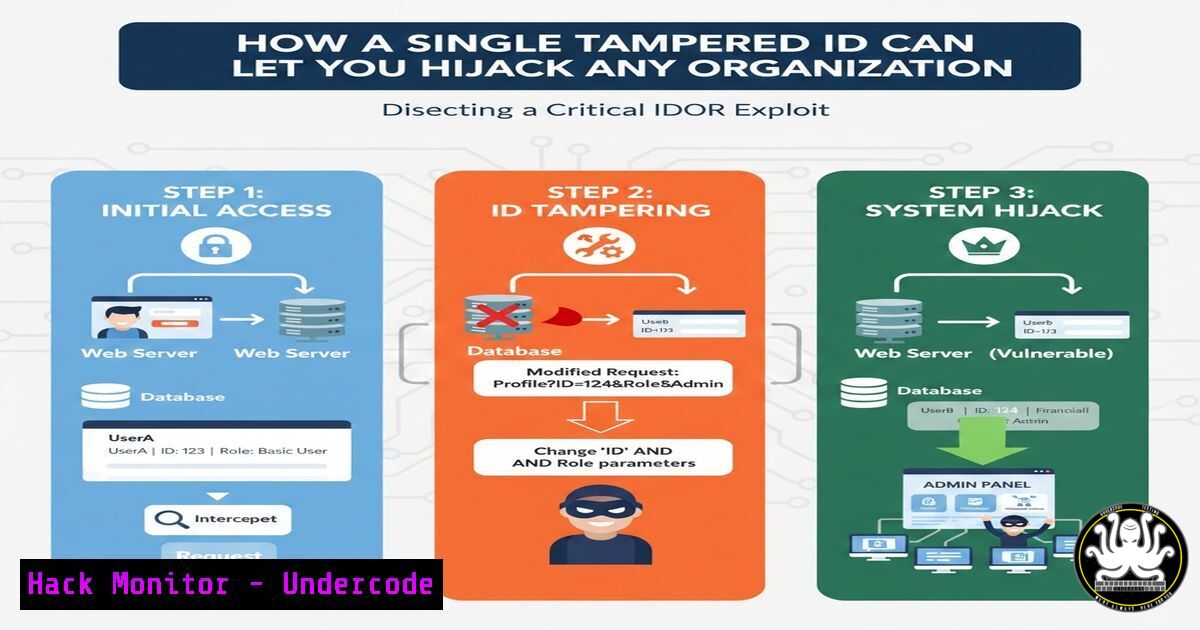
This vulnerability existed in a user-management feature. The application allowed authenticated users to edit their own details within their organization. The HTTP request to add or modify a user role included a client-controlled parameter for the organization ID (e.g.,org_id=123). The backend processed this request without verifying if the authenticated user had the legal right to perform actions within the specified organization.
Step-by-Step Guide:
Step 1: Reconnaissance
The attacker first needs a valid low-privilege account on the platform. This is often obtained through standard registration.
Step 2: Intercept Legitimate Request
Using a proxy tool like Burp Suite or OWASP ZAP, the attacker intercepts a legitimate request to edit their own user profile.
POST /api/user/update HTTP/1.1
Host: target.com
Authorization: Bearer <user_jwt_token>
Content-Type: application/json

{"user_id": "attacker_id", "org_id": "attacker_org_789", "role": "member"}
Step 3: Tamper and Exploit
The attacker changes the `org_id` parameter to that of a target victim organization and modifies the `role` to “admin”. They then forward the tampered request.
{"user_id": "attacker_id", "org_id": "victim_org_456", "role": "admin"}
Step 4: Successful Takeover
The vulnerable backend, lacking authorization checks, blindly processes the request. The attacker’s account is now added as an administrator to victim_org_456, achieving a full organization takeover.
2. Manual and Automated Testing for IDOR Flaws
Testing for IDOR requires a methodical approach to parameter manipulation.
Step-by-Step Guide:
Step 1: Enumerate Referenced Objects
Identify all parameters in requests and responses that reference objects (IDs for users, accounts, files, orders). Common parameters: id, user_id, account, uid, file, number.
Step 2: Modify Parameters Systematically
For every state-changing action (GET, POST, PUT, DELETE), try modifying these IDs. Use sequential (123, 124), predictable (email, username), or decoded Base64 values.
Step 3: Use Tools for Scale
Automate the process with Burp Suite’s Intruder or the `ffuf` tool for fuzzing IDs.
 Example using ffuf to fuzz for user IDs on an API endpoint
ffuf -w /usr/share/wordlists/seclists/Usernames/Names/names.txt -u 'https://target.com/api/user/FUZZ/profile' -H 'Authorization: Bearer <token>' -fs 0
3. Building the Defense: Server-Side Authorization Patterns
The core fix is to implement strict authorization checks on every endpoint that accesses an object.
Step-by-Step Guide:
Step 1: Implement Access Control Middleware
Create a middleware function that runs before the request handler. It should:
1. Extract the authenticated user’s identity and tenant/organization from their session or JWT token.
2. Extract the target object ID from the request parameters.
3. Query the database to validate the user’s membership and permissions within that specific tenant.
 Python/Flask Example Middleware Snippet
def check_org_access(org_id):
user_org = get_user_org_from_token(request.token)  From JWT
user_role = get_user_role_from_token(request.token)
if str(user_org) != str(org_id) and user_role != 'platform_admin':
abort(403, description="Unauthorized cross-tenant access attempted.")
Step 2: Use Indirect Reference Maps
Avoid using sequential, guessable IDs. Use UUIDs or map user-provided indirect references to internal IDs on the server.
-- Database check example in the handler
UPDATE user_roles ur
SET role = 'admin'
FROM organization_members om
WHERE ur.user_id = :target_user_id
AND ur.org_id = :requested_org_id
AND om.user_id = :authenticated_user_id -- From session
AND om.org_id = :requested_org_id
AND om.role IN ('owner', 'platform_admin'); -- Authorization check
Step 3: Apply the Principle of Least Privilege
Ensure user roles and permissions are clearly defined and enforced at the data access layer, not just the UI.
- Secure Coding Practices for Tenant Isolation in Cloud APIs
In multi-tenant SaaS applications, isolation is paramount.
Step-by-Step Guide:
Step 1: Context-Aware Data Access Layers
All database queries must automatically include a tenant filter. Use frameworks that support row-level security (RLS) or build it into your data layer.
-- PostgreSQL RLS Policy Example
CREATE POLICY org_isolation_policy ON users
FOR ALL USING (org_id = current_setting('app.current_org_id')::INTEGER);
Step 2: Validate and Sanitize All Inputs
Treat all incoming IDs as untrusted input. Validate data types, ranges, and ownership.
Step 3: Implement Comprehensive Logging and Alerting
Log all authorization failures (WARN level) and successful admin role changes (INFO level with full context) for audit trails and SIEM alerts.
- Incident Response: What to Do If You Suspect an IDOR Breach
If an IDOR exploit is detected, immediate action is required.
Step-by-Step Guide:
Step 1: Containment
- Immediately patch the vulnerability by deploying the server-side checks.
- Identify and disable the attacker’s account(s).
- For cloud environments, review IAM roles and API keys for any unauthorized additions.
Step 2: Investigation
- Query logs for all requests to the vulnerable endpoint, filtering for unusual `org_id` values.
- Use command-line tools (
grep,jq) to parse application logs.Search for potential exploit patterns in JSON logs grep "update" application.log | jq 'select(.request_body | contains("admin"))' | jq '.remote_ip, .request_body' - Identify all organizations the attacker may have accessed and all user accounts they modified.
Step 3: Recovery & Communication
- Roll back unauthorized role changes using database scripts.
- Notify affected organizations per your incident response plan and regulatory requirements (e.g., GDPR, CCPA).
- Force password resets for compromised admin accounts.
What Undercode Say:
- The Client-Server Trust Boundary is Absolute: The most critical security logic—who can do what to which data—must be executed unimpeachably on the server. Client-side validation is a usability feature, not a security control.
- Authorization is Contextual: Authentication confirms who you are, but authorization must define what you can do in a specific context (e.g., within Organization X). This context must be derived from the trusted session, never from client-controlled parameters.
This case study is a classic example of a broken object-level authorization (BOLA) flaw, now a top category in the OWASP API Security Top 10. The simplicity of the attack—changing a number—belies its severe impact, demonstrating that the most dangerous vulnerabilities are often failures in fundamental logic rather than complex technical exploits. The recurrence of such flaws highlights a gap in secure development lifecycle (SDLC) practices, where user story acceptance criteria often lack explicit security requirements for multi-tenancy.
Prediction:
IDOR/BOLA vulnerabilities will continue to be a primary attack vector for data exfiltration and SaaS platform compromise, especially as applications become more API-driven and complex. However, the future impact will be magnified by automation. Attackers will increasingly use AI-driven fuzzing to discover these flaws at scale, while defenders will integrate authorization logic testing directly into CI/CD pipelines. The proliferation of microservices will further complicate authorization, pushing the industry towards standardized, declarative authorization policies (e.g., using OpenFGA or OPA) that can be centrally managed and audited, moving away from hard-coded checks scattered across the codebase.
🎯Let’s Practice For Free:
IT/Security Reporter URL:
Reported By: Amit Khandebharad – Hackers Feeds
Extra Hub: Undercode MoN
Basic Verification: Pass ✅


