
Listen to this Post
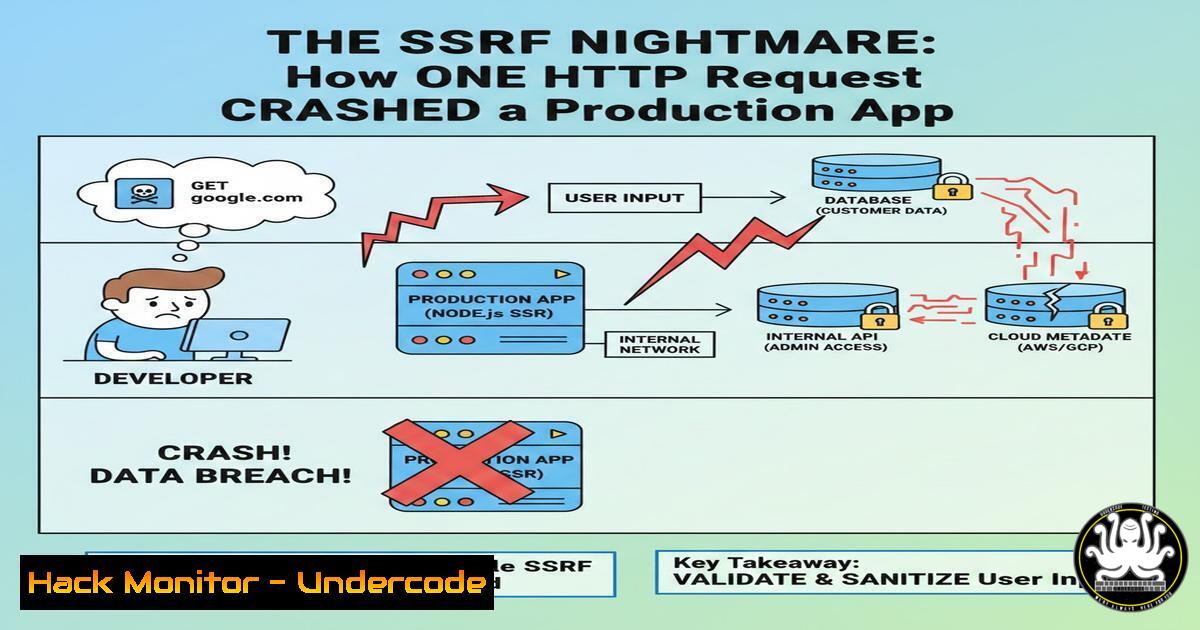
Introduction:
Server-Side Request Forgery (SSRF) remains one of the most insidious and high-impact vulnerabilities in modern web applications. As detailed in a recent security researcher’s blog post, a seemingly innocent misconfiguration can allow an attacker to pivot from a public-facing endpoint to critical internal infrastructure, leading to complete application compromise. This article deconstructs a real-world case where an SSRF flaw not only exposed sensitive data but also caused a full application outage, netting a $2,000 bounty and a critical lesson in defensive security.
Learning Objectives:
- Understand the mechanics and severe impact of a blind SSRF vulnerability.
- Learn practical techniques to probe for and exploit SSRF to access cloud metadata and internal services.
- Master defensive coding practices and network segmentation to mitigate SSRF risks.
You Should Know:
- Decoding SSRF: The Internal Network Proxy You Never Wanted
SSRF occurs when an attacker can trick a server into making arbitrary HTTP requests to an internal or third-party system. The server, often possessing higher trust levels within a network, becomes a proxy for the attacker, bypassing firewalls and access controls. In the highlighted case, a webhook or document processing feature accepted a user-supplied URL. The application fetched this URL without proper validation, believing it to be a legitimate external resource.
Step-by-Step Guide to Basic SSRF Probing:
Step 1: Identify the Vector. Look for parameters like url, path, feed, api, or `upload` that might cause the server to fetch a resource. Use Burp Suite or OWASP ZAP to intercept and modify these requests.
Step 2: Test with Internal Addresses. Replace the parameter value with common internal IPs and hostnames.
 Linux/curl example to test if a parameter triggers a fetch
 First, set up a listener to see if the server connects to you:
nc -lnvp 8080
 Then, in the intercepted request, change the target parameter to your public IP or a Burp Collaborator payload.
Common test targets: `http://127.0.0.1`, `http://localhost`, http://169.254.169.254` (cloud metadata), `http://192.168.0.1`.
Step 3: Analyze the Response. A "Blind" SSRF gives no direct output. Success is inferred from application behavior changes, delayed responses (if the server tries to connect to a closed port), or by triggering callbacks to your listening server.
2. Bypassing Filters: It’s Not Just About IP Addresses
Applications often implement weak SSRF filters that simply blacklist "localhost" or "127.0.0.1". Skilled attackers use numerous bypass techniques.
Step-by-Step Guide to Filter Bypass:
Step 1: Use Alternative IP Encodings.
- Decimal: `http://2130706433` = `127.0.0.1`
- Hexadecimal:http://0x7f000001` = `127.0.0.1`
– Octal: http://0177.0.0.1` (less common)@
<h2 style="color: yellow;"> Step 2: Leverage URL Parser Tricks.</h2>
- Using:http://[email protected]`
– Using “: http://127.0.0.1expected-domain.com`127.0.0.1`.
- Using DNS wildcard/CNAME: Point a subdomain you control via a DNS A record to
Step 3: Target the Cloud Metadata Service. The ultimate prize in modern SSRF is the instance metadata service. An unfiltered request to this endpoint can leak credentials, keys, and configuration.
 Example curl to AWS EC2 metadata endpoint (if vulnerable):
 From the vulnerable app parameter, try to reach:
http://169.254.169.254/latest/meta-data/
http://169.254.169.254/latest/meta-data/iam/security-credentials/
 For Google Cloud:
http://metadata.google.internal/computeMetadata/v1/
 Use the 'Metadata-Flavor: Google' header
- The Fatal Request: How `google.com` Caused an Outage
The blog’s core finding was an unexpected behavior: the application’s internal processing logic crashed when fetching a specific, valid response fromgoogle.com. This highlights “Impact Amplification,” where SSRF is chained with another vulnerability.
Step-by-Step Guide to Exploiting Application Logic Flaws:
Step 1: Map Internal Services. Use the SSRF as a port scanner.
 Using Burp Intruder or a custom script to brute-force internal ports via timing/differential responses.
 If the app fetches http://192.168.1.10:22 and times out vs. http://192.168.1.10:80 which returns an error, you've identified an open port.
Step 2: Fuzz Parameter Processing. Send payloads to internal services. In the case study, the app fetched google.com, which returned a large, well-formed HTML page. The application’s XML/JSON parser, expecting a different data format, failed catastrophically when processing this response, causing a denial of service.
Step 3: Chain to Critical Systems. The goal is to move from the vulnerable app to adjacent systems like Redis, Memcached, or internal HTTP APIs that accept unauthorized commands.
- From Discovery to Proof-of-Concept: Building the Kill Chain
A valid bug report requires a reproducible Proof-of-Concept (PoC).
Step-by-Step Guide to Crafting a PoC:
Step 1: Establish Blind SSRF. Prove you can force the server to make an outbound request to your controlled server (e.g., Burp Collaborator).
Step 2: Demonstrate Access to Internal Metadata. Show a successful (if blind) request to 169.254.169.254. This alone is critical.
Step 3: Trigger the DoC. To prove the outage potential, demonstrate that supplying `https://www.google.com` (or another specific external URL) causes the application endpoint to hang or return a 500 error, while other URLs do not. This clearly shows the dangerous logic flaw.
- The Defender’s Handbook: Mitigating SSRF at Every Layer
Prevention requires a defense-in-depth approach.
Step-by-Step Guide to SSRF Hardening:
Step 1: Implement an Allow-List. The most effective control. Only permit URLs to a strict list of needed, known-good domains (e.g., api.trusted-provider.com). Never use a blacklist.
Step 2: Validate and Sanitize Input. Use a well-maintained library to parse and validate user-supplied URLs. Reject requests to private IP addresses (RFC 1918), loopback, and metadata services.
 Python pseudo-example using a denylist (less secure than allow-list)
from urllib.parse import urlparse
blocked_nets = ["127.0.0.0/8", "10.0.0.0/8", "169.254.0.0/16"]
def is_url_blocked(url):
host = urlparse(url).hostname
ip = socket.gethostbyname(host)
for net in blocked_nets:
if ipaddress.ip_address(ip) in ipaddress.ip_network(net):
return True
return False
Step 3: Segment Your Network. Internal services should not blindly trust requests from the application layer. Implement firewall rules, require authentication, and use separate VLANs. The metadata service should be firewalled from application containers where possible.
Step 4: Use URL Schemas Wisely. Restrict allowed URL schemes to `HTTP` and HTTPS. Block file://, gopher://, dict://, and `ftp://`.
What Undercode Say:
- The Perimeter is Inside: The most critical systems are no longer just behind the firewall; they are lateral to your application. SSRF tears down the concept of a trusted internal network.
- Blind Doesn’t Mean Benign: A “blind” SSRF with no direct data exfiltration can still be weaponized for port scanning, DoS, and logic-based attacks, as the $2,000 bounty case proves. Impact, not just data leakage, determines severity.
This case is a stark reminder that input validation must be semantic, not just syntactic. An application can crash not just from malicious payloads, but from valid, unexpected ones. The fault lay in the assumption that a successful fetch equates to safe, processable data. As applications become more interconnected and microservices-based, the attack surface for SSRF expands. Future attacks will increasingly target cloud-native environments, leveraging SSRF to compromise serverless function configurations, container orchestration APIs (like Kubernetes), and service mesh control planes, making robust validation and zero-trust networking non-negotiable.
Prediction:
SSRF will evolve as a primary vector for cloud account takeover and lateral movement in containerized environments. As more business logic relies on fetching external resources (APIs, webhooks, AI model calls), the frequency and sophistication of SSRF attacks will surge. We predict a rise in “Second-Order SSRF,” where the poisoned request is stored and executed later by a different, more privileged component, making detection harder. Defenders must shift left, integrating SSRF testing into SAST/DAST pipelines and adopting service account policies with minimal permissions, treating every internal network request as potentially hostile.
🎯Let’s Practice For Free:
IT/Security Reporter URL:
Reported By: Kayra %C3%B6ks%C3%BCz – Hackers Feeds
Extra Hub: Undercode MoN
Basic Verification: Pass ✅


