Listen to this Post
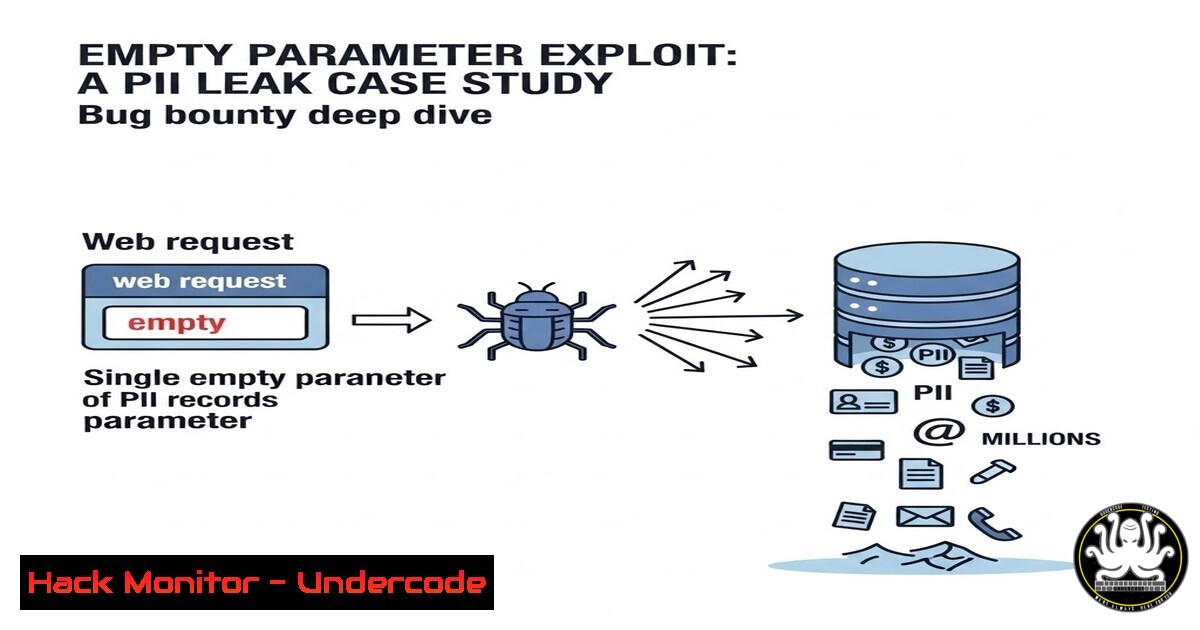
Introduction:
In the world of API security, the smallest oversight can lead to a catastrophic data breach. A recent bug bounty finding revealed that simply sending an empty parameter to a vulnerable endpoint resulted in the exposure of millions of Personally Identifiable Information (PII) records. This incident underscores a critical truth: improper server-side validation of API inputs can turn a harmless request into a goldmine for attackers. This article dissects the vulnerability, provides hands‑on techniques to discover and exploit such flaws, and outlines robust mitigation strategies to protect sensitive data.
Learning Objectives:
- Understand how missing server‑side validation of empty parameters can lead to mass PII disclosure.
- Learn manual and automated techniques to identify and exploit similar API vulnerabilities.
- Implement effective input validation, authorization checks, and security testing practices to prevent such breaches.
You Should Know
1. Understanding the Vulnerability: Empty Parameter Injection
Many APIs are designed to accept optional parameters. However, if the backend code fails to validate whether a parameter was actually supplied, an attacker can manipulate requests to bypass business logic. In the reported case, sending an empty parameter (e.g., `?user_id=` or a JSON body with "user_id": null) caused the server to return a dataset of all users instead of a single record. This happens because the code might use a default value (like an empty string) that is then interpreted as “fetch all” due to a poorly constructed database query or an insecure fallback.
Why it works:
Developers often assume that parameters will always contain valid data. They might check for existence but forget to verify that the value is not empty, leading to unintended logic flows.
2. Reconnaissance: Identifying API Endpoints
Before testing, you need to map the target’s API surface. Use browser developer tools (Network tab) while interacting with the application to capture API calls. Alternatively, use tools like Burp Suite or Postman to enumerate endpoints.
Step‑by‑step guide:
- Open Burp Suite and configure your browser to proxy traffic through it.
- Navigate through the application, noting any API calls that fetch user data, profile information, or lists.
- Use Burp’s Target > Site map to review all observed endpoints.
- For hidden endpoints, you can perform directory/file fuzzing with tools like ffuf or gobuster against common API paths (e.g.,
/api/v1/users,/internal/api/profile).
Linux command example (using ffuf):
ffuf -u https://target.com/api/FUZZ -w /usr/share/wordlists/api_endpoints.txt -fc 404
Windows alternative (using curl and a wordlist):
Get-Content .\api_wordlist.txt | ForEach-Object { curl -s -o /dev/null -w "%{http_code} $<em>\n" https://target.com/api/$</em> }
- Testing for Parameter‑Based Vulnerabilities: Manual Testing with Curl
Once you have identified an endpoint that accepts parameters (e.g.,/api/user/profile?user_id=123), you can manually test how it handles unexpected inputs.
Step‑by‑step guide:
- Start with a valid request to understand the normal response.
curl -X GET "https://target.com/api/user/profile?user_id=123"
2. Remove the parameter entirely:
curl -X GET "https://target.com/api/user/profile"
3. Send an empty parameter value:
curl -X GET "https://target.com/api/user/profile?user_id="
4. For POST requests, test with an empty JSON field:
curl -X POST "https://target.com/api/user/profile" -H "Content-Type: application/json" -d '{"user_id": ""}'
5. Observe the responses. If any of these return a large dataset instead of an error or empty result, you have found a vulnerability.
What to look for:
- Unexpected data dumps (lists of users, PII fields).
- Error messages that reveal internal logic.
- Changes in response size or status code.
6. Advanced Exploitation: Using Burp Suite Intruder
For comprehensive testing, automate parameter tampering with Burp Intruder. This allows you to fuzz parameters with empty strings, null bytes, special characters, and more.
Step‑by‑step guide:
- Capture a request containing the parameter you want to test (right‑click in Burp Proxy > Send to Intruder).
- Go to the Positions tab, clear all payload positions, then add a position marker around the parameter value (e.g.,
user_id=§123§). - In the Payloads tab, add payloads such as:
– Empty string
– `null`
– `0`
– `-1`
– `’` (SQL injection probe)
4. Start the attack and sort the results by Length or Status to identify anomalous responses.
5. Investigate any responses that are significantly larger than others—they may indicate mass data disclosure.
7. Real‑World Impact: PII Exposure Scenarios
The exposed data in such a breach typically includes:
– Full names, email addresses, phone numbers
– Physical addresses, dates of birth
– Government IDs, financial information
– Login credentials (if the API returns hashed passwords or tokens)
Attackers can use this data for identity theft, phishing campaigns, or credential stuffing attacks on other platforms. Even if the data is not sold on the dark web, the reputational damage and regulatory fines (GDPR, CCPA) can be devastating.
8. Mitigation Strategies: Input Validation and Authorization
To prevent empty‑parameter vulnerabilities, adopt a defense‑in‑depth approach:
Server‑side validation (example in Python/Flask):
@app.route('/api/user/profile')
def user_profile():
user_id = request.args.get('user_id')
if not user_id:  Explicitly check for None or empty string
return jsonify({"error": "Missing user_id"}), 400
 Ensure the user is authorized to view this profile
if not current_user.is_admin and current_user.id != int(user_id):
return jsonify({"error": "Forbidden"}), 403
 Proceed with fetching the single user
user = db.get_user(user_id)
return jsonify(user)
Key practices:
- Always validate that required parameters are present and non‑empty.
- Use strong authorization checks: verify that the authenticated user has permission to access the requested data.
- Apply the principle of least privilege in database queries—never return all records unless explicitly intended and authorized.
- Implement API gateways or Web Application Firewalls (WAF) to detect and block anomalous requests (e.g., many requests with empty parameters).
9. Defensive Coding: Secure API Development Practices
Beyond input validation, secure coding patterns can eliminate entire classes of bugs:
- Use Object‑Relational Mapping (ORM) safely: Avoid raw SQL concatenation. In Django, for example:
Vulnerable: User.objects.raw(f"SELECT FROM users WHERE id = {user_id}") Safe: User.objects.filter(id=user_id).first() Returns None if not found - Enforce strict typing: In strongly typed languages, define parameters as non‑nullable types (e.g., `int` in C or Java) to automatically reject empty strings.
- Log and monitor: Keep detailed logs of parameter validation failures and alert on unusual patterns (e.g., a sudden spike in requests with missing parameters).
What Undercode Say
Key Takeaway 1: Never trust client‑side input—even the absence of a value can be an attack vector. Every parameter must be explicitly validated for presence, type, and range.
Key Takeaway 2: Authorization must be enforced at every endpoint, regardless of how the request is formed. A missing parameter should never grant broader access.
This finding highlights a fundamental flaw in modern API development: the assumption that parameters will always be supplied with valid data. The reality is that attackers will probe every possible variation. Organizations must integrate security testing into their CI/CD pipelines, using both automated scanners and manual penetration tests. Bug bounty programs are invaluable because they leverage the creativity of the global security community to uncover these logic flaws. As APIs continue to proliferate, we can expect a surge in similar vulnerabilities unless developers adopt a zero‑trust mindset and rigorously validate every request.
Prediction:
The attack surface of APIs will expand dramatically with the adoption of microservices and serverless architectures. Automated tools will evolve to detect empty‑parameter and other logical flaws, but human ingenuity will remain essential. We will see increased adoption of API Security Posture Management (ASPM) solutions that continuously monitor API behavior and detect anomalies in real time. Regulatory bodies may also introduce stricter guidelines for API security, forcing organizations to prioritize secure design from the outset.
▶️ Related Video (78% Match):
🎯Let’s Practice For Free:
IT/Security Reporter URL:
Reported By: Https: – Hackers Feeds
Extra Hub: Undercode MoN
Basic Verification: Pass ✅


