Listen to this Post
Introduction:
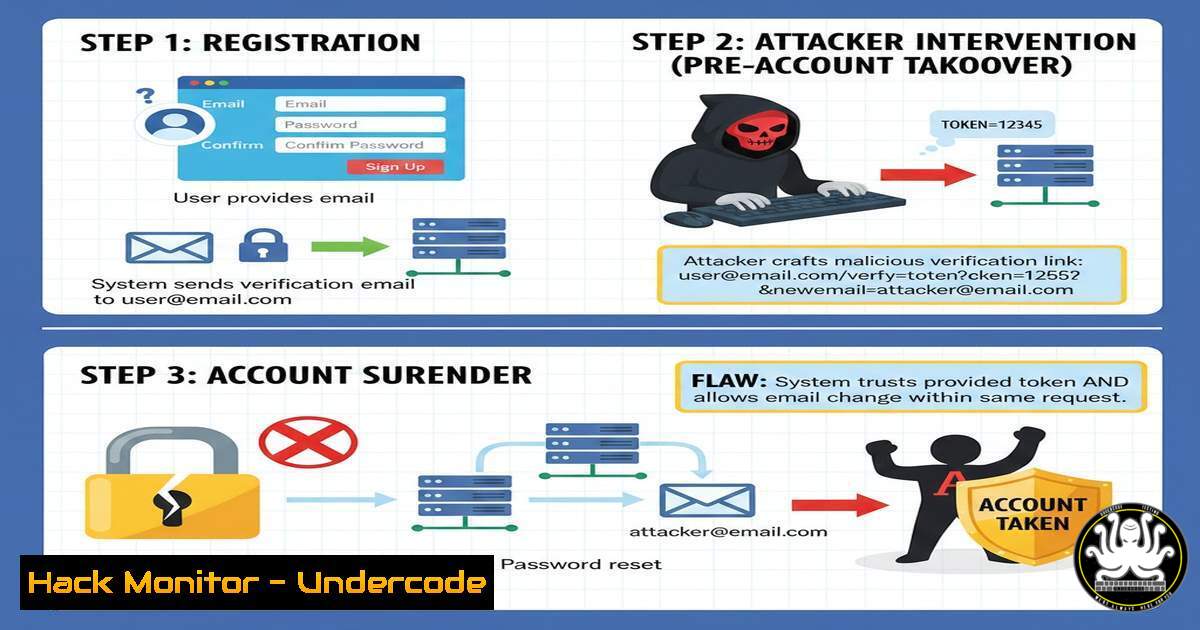
In the constant arms race of cybersecurity, authentication mechanisms stand as the primary gatekeepers of user accounts. A recent discovery by researcher Mohammed Emarah exposes how a critical flaw in an email change verification process can be weaponized into a full Pre-Account Takeover (Pre-ATO), completely locking the legitimate owner out. This vulnerability bypasses One-Time Passwords (OTP), hijacks verification channels, and demonstrates that even systems with multi-factor authentication can crumble if authorization logic is flawed.
Learning Objectives:
- Understand the technical mechanism behind weak email change authorization vulnerabilities and how they differ from simple email spoofing.
- Learn a step-by-step methodology for testing and exploiting these flaws, including the critical phase of intercepting and rerouting all future OTPs.
- Identify secure coding practices and architectural controls to prevent such vulnerabilities in web and API-based applications.
You Should Know:
1. Deconstructing the Email Change Vulnerability
A Pre-Account Takeover vulnerability occurs when an attacker can irreversibly associate a victim’s account with attacker-controlled credentials before the victim loses access, setting a trap. In this case, the flaw resided in the application’s “Change Email” function. The process likely involved the victim requesting an email change, with the system sending an OTP to the new email address for verification. The logical flaw was that the application failed to re-validate the user’s identity (via password or session) before initiating this change and subsequent OTP dispatch. This allowed an attacker, who might have temporary access to a victim’s session (via XSS, CSRF, or a shared computer), to start the process of changing the account’s email to one they own. The system would then send the verification OTP directly to the attacker, completing the takeover.
- The Exploit Chain: From OTP Bypass to Full Hijacking
The exploitation was a two-phase attack. Phase One: The Fraudulent Verification. The attacker initiates an email change to their own address. The key is what happens next: instead of the OTP being sent to the original (victim’s) email for approval, it is sent to the new (attacker’s) email. The attacker verifies this OTP, and the system incorrectly marks the original victim’s account as having a “verified” new email, even though the legitimate owner was never consulted. Phase Two: OTP Channel Hijacking. Once the attacker’s email is associated and verified, the application’s logic fatally fails: all future OTPs for any action—password reset, login 2FA, transaction approval—are sent to the attacker’s newly linked email address. The victim is left with a seemingly functional account that they can no longer control or recover.
3. Step-by-Step Testing Methodology for Bug Hunters
To test for this vulnerability ethically (on authorized systems only), follow this methodology:
Step 1: Log into a test account and navigate to the account settings or profile page.
Step 2: Locate the “Change Email” or “Update Contact Info” function.
Step 3: Using a proxy tool like Burp Suite or OWASP ZAP, intercept the request generated when submitting a new email address.
Step 4: Analyze the request. Are there parameters validating the user’s current password or active session? Is the `userId` or `accountId` controlled by the user? The absence of robust authorization tokens is a red flag.
Step 5: Attempt to submit the request while modifying the `userId` parameter to that of another test account (Horizontal Privilege Escalation test). If the application accepts the request and sends a verification email/OTP to your new address for the other user’s account, the vulnerability is present.
4. Essential Tools for Interception and Analysis
Manual testing requires the right tools to intercept and manipulate traffic.
Burp Suite Professional/Community: The industry standard. Configure your browser to use Burp as a proxy, ensure intercept is “on,” and capture all HTTP/S requests.
Browser Developer Tools (F12): Perfect for quick analysis. The Network tab logs all requests; inspect the “Payload” or “Request” section of any POST request to the `/api/change-email` or similar endpoint.
Command-Line with cURL: For automating tests or working with APIs. You can craft malicious requests directly.
 Example curl command to test the endpoint (replace tokens and IDs)
curl -X POST 'https://target.com/api/v1/email/change' \
-H 'Authorization: Bearer <VICTIM_SESSION_TOKEN>' \
-H 'Content-Type: application/json' \
-d '{"newEmail":"[email protected]"}'
Custom Python Scripts: To automate the process of testing multiple accounts or endpoints, using libraries like requests.
5. Secure Coding Practices to Prevent This Flaw
Mitigation requires a defense-in-depth approach at the code and architecture level.
Re-authentication Mandate: Always require the user’s current password or a separate OTP to the original, registered email/phone before the email change process can even be initiated. This is non-negotiable.
Immutable Audit Trail: Log all change requests with original and new values, IP address, user-agent, and timestamp. This aids in post-incident analysis.
Stateful Session Management: Tie critical actions to a server-side session object that validates the user’s identity independently of client-side parameters. Do not trust `userId` from POST bodies.
Post-Change Verification Grace Period: Implement a delay (e.g., 24-72 hours) before the new email becomes the primary contact for sensitive OTPs. Send urgent alerts to both old and new emails during this period.
6. API Security and Cloud-Native Considerations
Modern apps built on microservices and serverless APIs (AWS Lambda, Azure Functions) are especially vulnerable if authorization is handled inconsistently across services.
Use a Centralized Authorization Service: Implement a dedicated service (like OAuth 2.0/OIDC) that all microservices query to validate if a session token has permission for a specific action (e.g., `change:email` on resource:user/{id}).
API Gateway Policies: In AWS API Gateway or Azure API Management, enforce request validation schemas and inject verified user claims (from a JWT token) into the request context, removing the need for the backend to parse user IDs from the body.
Example Cloud Hardening: Ensure Lambda functions or containers assume IAM roles with least privilege and validate authorization tokens against Amazon Cognito or Azure AD before executing business logic.
7. Beyond the Hack: The Expanding Attack Surface
This vulnerability is a symptom of a larger problem: trust in user-controlled workflows. As applications integrate more third-party services (e.g., “Sign in with Google,” CRM integrations), the number of touchpoints where email or identity can be updated increases. Attackers will probe every sync mechanism and webhook callback for similar logic flaws. The future of such exploits lies in chaining them with other vulnerabilities, like Server-Side Request Forgery (SSRF) to interact with internal APIs or exploiting race conditions during the verification process to associate multiple attacker emails.
What Undercode Say:
- Authorization, Not Authentication, is the New Battleground. This exploit underscores that a system can have perfect authentication (strong 2FA) yet be completely compromised by broken authorization logic. Security teams must shift significant focus to mapping and testing user flows and state changes post-login.
- The “Verification” Illusion. An application can be littered with “verified” badges (email, phone) that provide a false sense of security. The critical question is: Verified by whom, and at what step in the workflow? Security architects must design systems where verification is a multi-party consent process, not a unilateral technical step.
Prediction:
In the next 12-24 months, as traditional injection and cross-site scripting vulnerabilities become harder to find due to mature frameworks, logic flaws—particularly in account lifecycle management (registration, email/phone change, deletion, and data export)—will become the primary vector for critical account takeover attacks. Automated scanners will evolve to better test these business logic pathways, and we will see a rise in Pre-ATO bugs being sold in underground markets for targeted harassment and corporate espionage, not just financial theft. The regulatory landscape (like GDPR and CCPA) will likely begin to cite such flaws as explicit failures in “security of processing,” leading to significant fines.
🎯Let’s Practice For Free:
IT/Security Reporter URL:
Reported By: Mohammed Emarah11 – Hackers Feeds
Extra Hub: Undercode MoN
Basic Verification: Pass ✅


