Listen to this Post
Introduction:
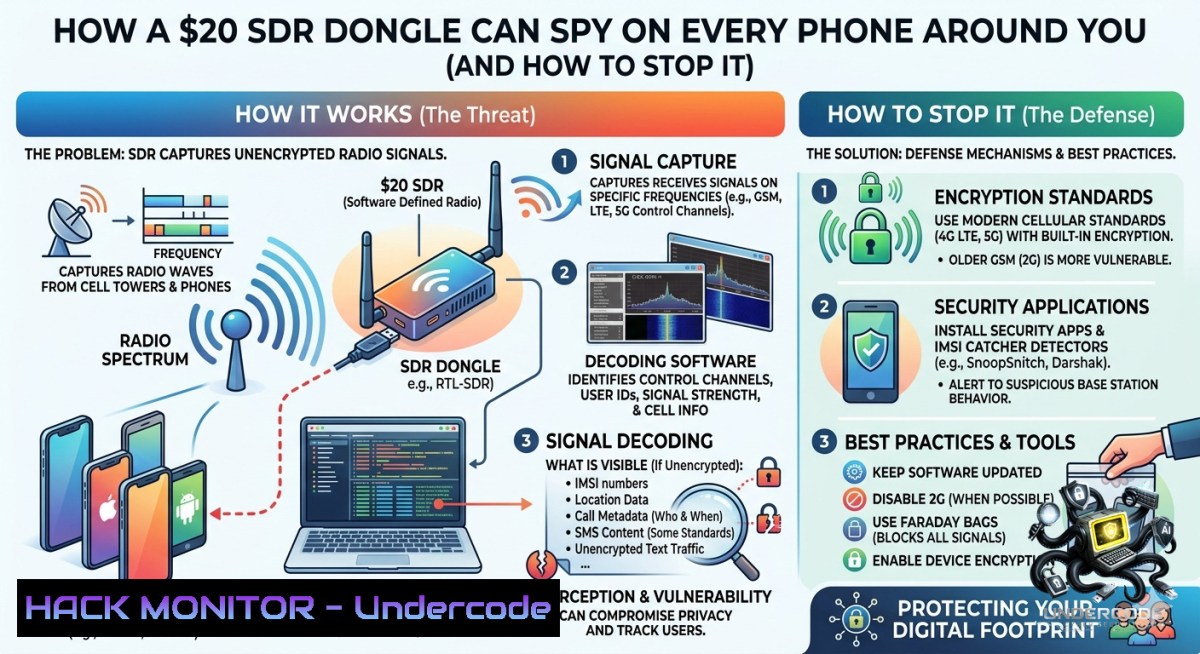
Mobile devices constantly broadcast their unique International Mobile Subscriber Identity (IMSI) to connect to cellular towers—an authentication process that malicious actors can trivially intercept with readily available software-defined radio hardware and open-source tools. The IMSI-catcher project on GitHub transforms any compatible SDR dongle into a passive surveillance device capable of mapping nearby devices, exposing IMSI numbers alongside country, brand, and operator information for every phone within signal range. What was once exclusive to intelligence agencies is now a $20 DIY project that underscores a fundamental vulnerability in legacy GSM protocols still present in modern networks through backward compatibility.
Learning Objectives:
– Analyze how IMSI-catchers exploit GSM signaling weaknesses to capture subscriber identifiers without network authorization
– Deploy and configure the IMSI-catcher tool on Kali Linux with RTL-SDR hardware for security auditing
– Implement client-side countermeasures and detection techniques using open-source Android applications
You Should Know:
1. Deploying a Passive GSM Surveillance Node
The IMSI-catcher operates purely passively—it never transmits, making it undetectable and non-disruptive to network operations. It captures unencrypted signaling messages that mobile devices broadcast when authenticating with cell towers, extracting IMSI numbers from the raw radio traffic.
Step‑by‑step guide to building your own IMSI-catcher:
Hardware requirements: any Linux-compatible PC (Debian, Ubuntu 20.04+, Kali 2025+) plus an RTL2832U-based SDR dongle ($15–20) or higher-end options like HackRF or BladeRF.
 Complete setup for Kali Linux
sudo apt update && sudo apt upgrade -y
sudo apt install -y python3-1umpy python3-scipy python3-scapy gr-gsm git
sudo apt install -y rtl-sdr kalibrate-rtl gnuradio

 Clone and build the IMSI-catcher
git clone https://github.com/Oros42/IMSI-catcher.git
cd IMSI-catcher

 Install Python dependencies
pip3 install importlib pyrtlsdr

 Verify SDR detection
rtl_test -t
Operational procedure: First, scan for active GSM downlink frequencies in your area:
 Scan for GSM base stations
sudo kal -s GSM900 -v  or GSM1800, GSM850 depending on region
Once a live frequency is identified (typical output: `chan: 123 (942.4 MHz) power: 33.42 dB`), launch two terminals:
– Terminal 1: `sudo python3 simple_IMSI-catcher.py -s` (sniffs on network interface)
– Terminal 2: `sudo grgsm_livemon -f
As devices in range authenticate with adjacent towers, the script logs captured IMSIs with country codes, mobile network codes, and timestamps. The tool supports export to SQLite (`-w database.db`), TXT (`-t output.txt`), or MySQL databases for persistent intelligence gathering.
Passive operation means no legal exposure for network interference—but logging live subscriber data without consent carries serious privacy implications under regulations like GDPR and CFAA.
2. GSM’s Broken Authentication Model
The fundamental design flaw enabling IMSI-catchers is that GSM networks require phones to identify themselves before authenticating the network. Your device broadcasts its IMSI in cleartext during initial attachment, and an attacker’s passive receiver simply listens. Modern 4G/LTE introduced network authentication through the GUTI (Globally Unique Temporary Identifier) scheme, dramatically raising the bar—but mobile networks universally retain 2G GSM compatibility, and attackers simply jam 4G/5G signals to force phones into vulnerable 2G fallback mode.
Understanding the vulnerability with Scapy:
from scapy.all import
from scapy.contrib.gsm import

 Scapy can construct arbitrary GSM Layer 3 messages
gsm_identity_request = GSMIdentityRequest(
identity_type=1  Request IMSI from target
)

 In a MITM scenario, an active IMSI-catcher would send this to provoke IMSI disclosure
 Passive versions simply wait for naturally broadcast Identity Responses
The A5/1 encryption cipher used in 2G GSM was deliberately weakened during the 1990s and can now be cracked in seconds using rainbow tables and time-memory trade-off attacks. Researchers in 2024 demonstrated practical TMTO-based attacks against both A5/3 (GSM) and GEA-3 (GPRS) cipher suites, confirming that even “improved” 2G encryption remains fundamentally broken.
Windows alternative using SDR console:
While the primary toolset is Linux-1ative, Windows users can employ SDR Console v3 with the RTL-SDR plugin to capture GSM spectrum, then pipe raw IQ samples to a WSL2 Kali instance for processing.
3. Client-Side Detection and Hardening
Effective mitigation happens at both network and device levels. On the infrastructure side, 5G networks implement Subscription Permanent Identifier (SUPI) encryption and always-authenticated network validation, making passive IMSI collection effectively impossible on pure 5G standalone deployments. On the client side, several practical countermeasures exist:
Detection tools for Android devices:
– AIMSICD (Android IMSI-Catcher Detector): An open-source app that analyzes cell tower characteristics to identify anomalies indicative of fake base stations, including suspicious signal strength variations, frequency handoff irregularities, and silent SMS tracking attempts
– SentryRadio: An Xposed/Magisk forensic module that logs all cellular network interactions, mapping anomalies like unsolicited network downgrades (4G→2G) and sending Silent SMS—classic IMSI-catcher behaviors
– Flock-You-Android: Surveillance detection suite with 75+ device signatures enabling cellular network monitoring
Manual hardening checklist for mobile devices:
 Android: Force LTE/5G only, disable 2G
Settings → Network & Internet → Mobile Network → Preferred Network Type → LTE Only / 5G Only
Settings → Security → Disable "Allow 2G service" (Android 12+)

 iOS (iOS 16+):
Settings → Cellular → Cellular Data Options → Voice & Data → Select "5G Auto"
Settings → Privacy & Security → Lockdown Mode (enables advanced network protections)
The Canadian Centre for Cyber Security’s ITSAP.00.106 advisory confirms that disabling 2G connectivity remains the single most effective user-configurable defense against IMSI-catcher attacks. Android 16 introduced native stingray protection that automatically detects and rejects connections from suspicious base stations exhibiting IMSI-catcher behavioral patterns.
4. Defensive Network Monitoring with Rayhunter
For security researchers and organizations requiring active IMSI-catcher detection, the Rayhunter project (developed by the Electronic Frontier Foundation) transforms inexpensive mobile hotspots into dedicated cell-site simulator detectors. Rayhunter continuously monitors beacon parameters, signal characteristics, and handover patterns, alerting when anomalies consistent with Stingray operation are detected.
Deployment workflow:
 Flash a compatible Verizon Orbic Speed RC400L with Rayhunter firmware
 After installation, access the web interface at http://10.0.0.1:8080
 Enable logging to capture suspect tower IDs (TAC, Cell ID, signal delta)

 For macOS/Linux detection automation with raygatherer CLI:
gem install raygatherer
raygatherer scan --interface en0 --output cellular_forensics.csv
The Tower-Hunter project offers similar functionality for Linux mobile devices—continuous tower logging with GPS correlation and anomaly scoring.
What Undercode Say:
– Any sufficiently motivated actor—stalker, competitor, or foreign intelligence officer—can identify and geolocate any mobile device within range for under $100 in hardware using open-source tools available since 2015.
– Defense requires both behavioral hardening (disable 2G everywhere possible) and active counter-surveillance (run AIMSICD or Rayhunter on a secondary device), not passive trust in “secure network” branding.
The mismatch between public perception of cellular privacy and technical reality is staggering. Users believe their calls are “private” and their location is “protected by the carrier,” when in fact GSM signaling remains essentially postcard-clear to anyone with a $20 dongle and basic Python skills. Organizations deploying mobile workforce devices should assume IMSI exposure is universal unless 2G is hardware-disabled and devices operate exclusively on 5G SA networks. Red teams should integrate passive IMSI harvesting into physical penetration exercises—it provides instant device-to-person correlation with zero active probing.
Prediction:
– -1 By 2027, affordable, turnkey IMSI-catchers will commoditize mobile surveillance for non-state actors, triggering widespread adoption of encryption-overlay apps and forcing regulators to finally mandate 2G sunset in developed nations.
– +1 5G standalone architecture’s SUPI encryption and network authentication make pure 5G networks immune to passive IMSI harvesting, but backward compatibility with 4G/3G will remain the vulnerability surface for another decade.
– -1 Law enforcement will increasingly resist 2G phase-outs, citing legitimate investigative needs for Stingray devices, creating a policy battle between security and surveillance that mobile privacy tools cannot resolve alone.
– +1 Open-source IMSI-catcher detection apps (AIMSICD, SentryRadio) will integrate with crowdsourced cell tower databases, building real-time maps of suspected rogue base stations and enabling community-driven alerting.
– -1 The proliferation of IMSI-catcher capabilities—now documented, scripted, and taught in online courses—means mass passive surveillance is no longer a nation-state capability but a script-kiddie reality that changes the calculus of mobile threat modeling permanently.
▶️ Related Video (74% Match):
🎯Let’s Practice For Free:
🎓 Live Courses & Certifications:
[Join Undercode Academy for Verified Certifications](https://undercode.co.uk/certifications/)
🚀 Request a Custom Project:
Secure, high-velocity infrastructure and disruptive technological engineering. Contact our engineering team for high-tier development and proprietary systems:
[[email protected]](mailto:[email protected])
💎 Smart Architecture | 🛡️ Secure by Design | ⭐ Trusted by Thousands
IT/Security Reporter URL:
Reported By: [Mariosantella Osint](https://www.linkedin.com/posts/mariosantella_osint-sigint-share-7470006964597608448-88JE/) – Hackers Feeds
Extra Hub: Undercode MoN
Basic Verification: Pass ✅
🔐JOIN OUR CYBER WORLD [ CVE News • HackMonitor • UndercodeNews ]
[💬 Whatsapp](https://undercode.help/whatsapp) | [💬 Telegram](https://t.me/UndercodeCommunity)
📢 Follow UndercodeTesting & Stay Tuned:
[𝕏 formerly Twitter 🐦](https://x.com/undercodeupdate) | [@ Threads](https://www.threads.net/@undercodetesting) | [🔗 Linkedin](https://www.linkedin.com/company/undercodetesting/) | [🦋BlueSky](https://bsky.app/profile/undercode.bsky.social)


