Listen to this Post
Introduction:
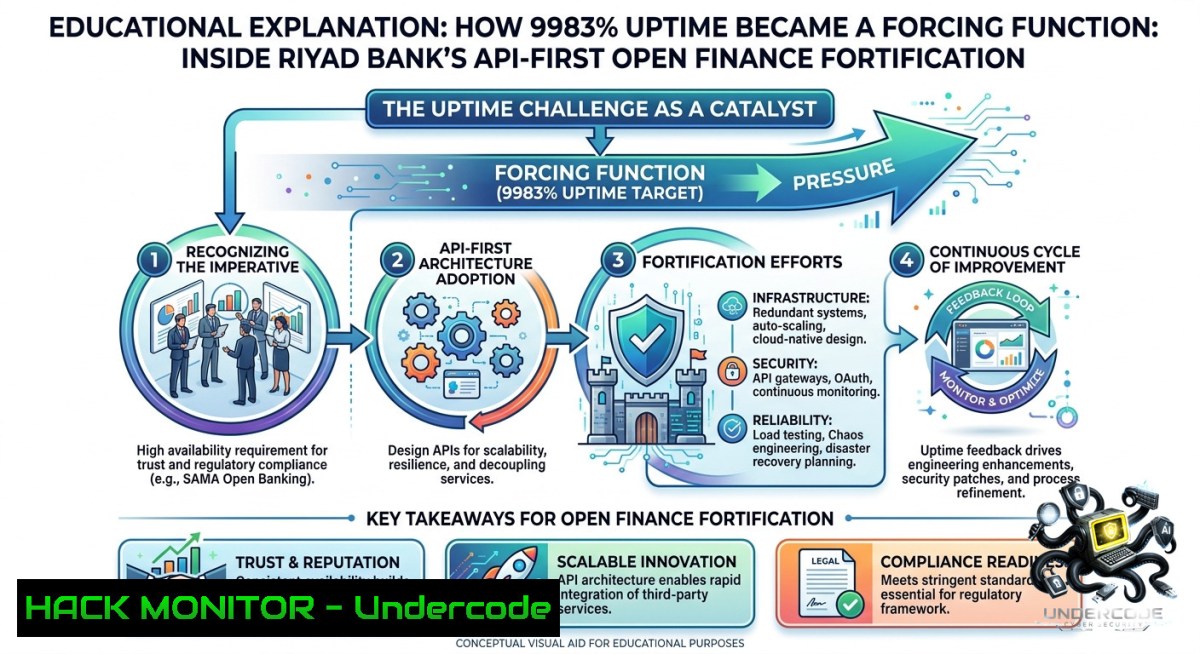
In the race to deliver Open Banking and Open Finance, most financial institutions chase feature velocity while letting infrastructure resilience drift into technical debt. Eng. Nehad Omar Rajab, SVP Head of Product Performance at Riyad Bank, inverted this model by achieving 99.83% service availability—a first in the bank’s history—through disciplined API architecture optimization, proactive monitoring, and layered cybersecurity controls. This article deconstructs the operational and security engineering behind that metric, offering hands-on guidance for hardening API marketplaces, mitigating DDoS threats, and implementing network access controls that enable speed through resilience.
Learning Objectives:
- Implement zero-trust API gateway policies, including rate limiting, JWT validation, and OAuth2 flows for Open Finance endpoints.
- Deploy proactive observability stacks (Prometheus/Grafana + synthetic monitoring) to detect infrastructure drift before it impacts SLAs.
- Mitigate volumetric DDoS and web application layer attacks using F5 WAF equivalents, iptables, and Windows Advanced Firewall configurations.
You Should Know:
1. Hardening API Marketplaces: Zero-Trust Gateway Controls
Start with an extended perspective: Riyad Bank’s API Marketplace required end-to-end architecture optimization. A critical control layer is the API gateway, which enforces authentication, authorization, and traffic shaping. Below is a step-by-step guide to replicating essential hardening measures using open-source tools (Kong/KrakenD) and native commands.
Step-by-Step Guide:
- Define rate limiting policies to prevent brute-force and DDoS exhaustion. For a Linux-based gateway (e.g., Kong):
Create a rate-limiting plugin (5 requests per second per consumer)
curl -X POST http://localhost:8001/services/example-service/plugins \
--data "name=rate-limiting" \
--data "config.second=5" \
--data "config.hour=10000"
- Validate JWT tokens for every API call. Use `jq` and `jwt-cli` to decode and inspect tokens:
Decode JWT without verification (for debugging)
echo "eyJhbGciOiJIUzI1NiIsInR5cCI6IkpXVCJ9.eyJzdWIiOiIxMjM0NTY3ODkwIiwicm9sZSI6InVzZXIifQ.signature" | jwt decode -
Verify signature using HMAC secret
jwt verify --secret "your-256-bit-secret" eyJhbGciOiJIUzI1NiIsInR5cCI6IkpXVCJ9...
- Implement OAuth2 client credentials flow (machine-to-machine). On Windows, use PowerShell to request tokens:
$body = @{
client_id = "api_client"
client_secret = "supersecret"
grant_type = "client_credentials"
scope = "openfinance:read"
}
Invoke-RestMethod -Uri "https://api.riyadbank.com/oauth/token" -Method Post -Body $body
What this achieves: Prevents token replay, limits abuse, and ensures only authorized fintech apps consume your API marketplace.
2. Achieving 99.83% Availability: Proactive Observability Stack
Riyad Bank’s historical uptime milestone came from replacing reactive break-fix with predictive monitoring. This guide sets up a lightweight Prometheus/Grafana stack with synthetic blackbox probes.
Step-by-Step Guide:
- Install Prometheus node exporter (Linux) to capture system metrics:
wget https://github.com/prometheus/node_exporter/releases/download/v1.7.0/node_exporter-1.7.0.linux-amd64.tar.gz
tar xvf node_exporter-.tar.gz
sudo cp node_exporter /usr/local/bin/
sudo useradd --1o-create-home --shell /bin/false prometheus
sudo /usr/local/bin/node_exporter &
- Configure blackbox exporter for HTTP/S probes of critical API endpoints:
modules:
http_2xx:
prober: http
timeout: 5s
http:
valid_http_versions: ["HTTP/1.1", "HTTP/2"]
method: GET
headers:
Accept: application/json
- Set up synthetic monitoring using a cron job that logs status code and response time:
!/bin/bash Linux script to monitor API health and log to syslog RESPONSE=$(curl -o /dev/null -s -w "%{http_code} %{time_total}" https://api.riyadbank.com/health) logger "API health check: $RESPONSE" - Windows Performance Monitor counters for service availability:
Create a data collector set to track Web Service uptime
New-DataCollectorSet -1ame "API_Uptime" -File "C:\PerfLogs\API_Uptime.blg" -Counter "\Web Service(_Total)\Current Connections", "\Process(APIHost)\% Processor Time"
Proactive alerting (e.g., when 5xx errors exceed 0.1% over 5 minutes) enables the “forcing function” that Toby J Daniel highlighted: tight operations make speed possible.
3. Defeating DDoS & WAF Evasion: Layered Mitigation
Nehad introduced F5 WAF and DDoS protections. For engineering teams without commercial appliances, here is a layered, open-source equivalent using iptables, fail2ban, and mod_security.
Step-by-Step Guide:
- Rate-limit incoming SYN packets (Linux) to mitigate SYN flood DDoS:
sudo iptables -A INPUT -p tcp --syn -m limit --limit 100/s --limit-burst 200 -j ACCEPT
sudo iptables -A INPUT -p tcp --syn -j DROP
- Block known DDoS user agents using fail2ban. Create
/etc/fail2ban/filter.d/api-abuse.conf:[bash] failregex = ^<HOST> . "(HEAD|GET).HTTP/." (404|429|500) .$ ignoreregex =
Then apply to your web server log (e.g., Nginx):
sudo fail2ban-client start api-abuse
- Configure WAF rules for SQLi and XSS (using ModSecurity on Nginx):
sudo apt install libmodsecurity3 libmodsecurity3-dev nginx-modsecurity
sudo cp /etc/modsecurity/modsecurity.conf-recommended /etc/modsecurity/modsecurity.conf
sudo sed -i 's/SecRuleEngine DetectionOnly/SecRuleEngine On/' /etc/modsecurity/modsecurity.conf
sudo systemctl restart nginx
- Windows Advanced Firewall blocking of malformed packets:
New-1etFirewallRule -DisplayName "Block DDoS SYN" -Direction Inbound -Protocol TCP -Action Block -RemoteAddress 0.0.0.0/0 -Description "Syn attack mitigation"
These controls directly address the attack surfaces exploited in recent Open Banking breaches (e.g., credential stuffing via API endpoints).
- Network Access Control (NAC) for Zero Trust Edge
Riyad Bank modernized its IPVPN and WAN networks while introducing NAC (Network Access Control) to enforce posture checks. Below is a practical NAC deployment guide using FreeRADIUS (Linux) and Microsoft NPS (Windows).
Step-by-Step Guide (Linux – FreeRADIUS with 802.1X):
- Install FreeRADIUS:
sudo apt install freeradius freeradius-utils
- Configure clients (network switches) in
/etc/freeradius/3.0/clients.conf:client switch01 { ipaddr = 192.168.1.10 secret = radius_shared_secret shortname = access_switch } - Add authorized users in
/etc/freeradius/3.0/users:"finance-team" Cleartext-Password := "securepass"
- Test authentication:
radtest finance-team securepass localhost 0 testing123
- Windows NPS for Active Directory integration (RADIUS proxy):
Install-WindowsFeature NPAS -IncludeManagementTools
Then open NPS console, register server in AD, configure connection request policies
With NAC, only compliant devices (patched, with antivirus) gain network access—critical for preventing lateral movement after an API compromise.
5. Open Finance API Security Testing (Penetration Testing)
Attackers target Open Finance APIs for account aggregation and payment initiation flaws. Use these command-line tools to mimic real-world tests.
Step-by-Step Guide:
- Discover hidden API endpoints using `ffuf` (Linux):
ffuf -u https://api.riyadbank.com/FUZZ -w /usr/share/wordlists/dirb/common.txt -ic -c -t 50
- Test for mass assignment vulnerabilities (parameter pollution):
curl -X PATCH https://api.riyadbank.com/users/12345 -d '{"role":"admin"}' -H "Authorization: Bearer $TOKEN" - Fuzz JWT for algorithm confusion (set algorithm to
none):Python snippet to create a "none" algorithm token import jwt token = jwt.encode({"user":"attacker", "admin":True}, key="", algorithm="none") print(token) - Windows PowerShell for basic fuzzing of rate limit bypass:
1..200 | ForEach-Object { Invoke-RestMethod -Uri "https://api.riyadbank.com/balance" -Headers @{Authorization="Bearer $env:TOKEN"} -ErrorAction SilentlyContinue } - Use OWASP ZAP in headless mode for automated scanning:
zap-cli quick-scan -spider -scanner https://api.riyadbank.com/v1/openfinance
These tests uncover broken object-level authorization (BOLA), excessive data exposure, and improper assets management—top OWASP API risks.
6. Infrastructure Modernization Commands for Legacy-to-Cloud Migration
Nehad led 57+ transformation projects, including data centre modernization. For teams refactoring legacy systems, these commands accelerate hybrid cloud preparation.
Step-by-Step Guide:
- Assess network latency between on-prem and cloud (Linux):
mtr -r -c 100 aws.amazon.com
- Migrate on-prem VMs to cloud using Azure Migrate (PowerShell):
Discover on-prem servers
Import-Module Az.Migrate
$project = Get-AzMigrateProject -1ame "RiyadBankMigration" -ResourceGroupName "InfraTeam"
Start-AzMigrateServerReplication -Project $project -MachineName "legacy-app01"
- Set up site-to-site VPN for hybrid connectivity (using WireGuard on Linux):
On cloud instance
wg genkey | tee privatekey | wg pubkey > publickey
ip link add dev wg0 type wireguard
ip address add 10.0.0.1/24 dev wg0
Documentation and automated runbooks (using Ansible) ensure the 99.83% uptime translates across environments.
What Undercode Say:
- Key Takeaway 1: Operational resilience is not a bottleneck but an accelerator for digital innovation. Nehad’s 99.83% uptime proved that tight controls on API and network layers enable faster feature rollouts, not delays.
- Key Takeaway 2: API marketplaces demand security by design, not as an afterthought. Embedding rate limiting, JWT validation, and NAC from day one prevents the “drift” most banks tolerate.
-
Analysis: Undercode would observe that Nehad’s metrics-driven engineering culture (KPI frameworks, proactive monitoring) creates a positive feedback loop: higher availability reduces incident firefighting, freeing teams to build Open Finance products. The introduction of F5 WAF and DDoS protections shows a defense-in-depth maturity lacking in many fintech API-first firms. For CISOs, the lesson is to align uptime SLAs directly with security controls—every packet drop or rate limit event is a business metric, not just a security log. As Open Banking expands to Open Finance (investments, insurance), this resilience-first posture will become a competitive moat against both cyber threats and operational failures. Nehad’s transition to CDO/CEO/COO roles signals that technology governance is now a board-level mandate.
Prediction:
+1 More banks will adopt “resilience as a forcing function” by integrating SRE practices with cybersecurity teams, leading to standardized 99.99% uptime for critical APIs within three years.
-1 Attackers will shift focus to third-party Open Finance aggregators and supply chain libraries (e.g., compromised npm packages in API gateways), bypassing even well-hardened direct bank APIs.
+1 AI-driven predictive anomaly detection (e.g., analyzing latency jitter as a precursor to DDoS) will become standard for maintaining high availability, reducing false positives by 60%.
▶️ Related Video (80% Match):
🎯Let’s Practice For Free:
🎓 Live Courses & Certifications:
Join Undercode Academy for Verified Certifications
🚀 Request a Custom Project:
Secure, high-velocity infrastructure and disruptive technological engineering. Contact our engineering team for high-tier development and proprietary systems:
[email protected]
💎 Smart Architecture | 🛡️ Secure by Design | ⭐ Trusted by Thousands
IT/Security Reporter URL:
Reported By: Digitaltransformation Openfinance – Hackers Feeds
Extra Hub: Undercode MoN
Basic Verification: Pass ✅


