
Listen to this Post
Introduction:
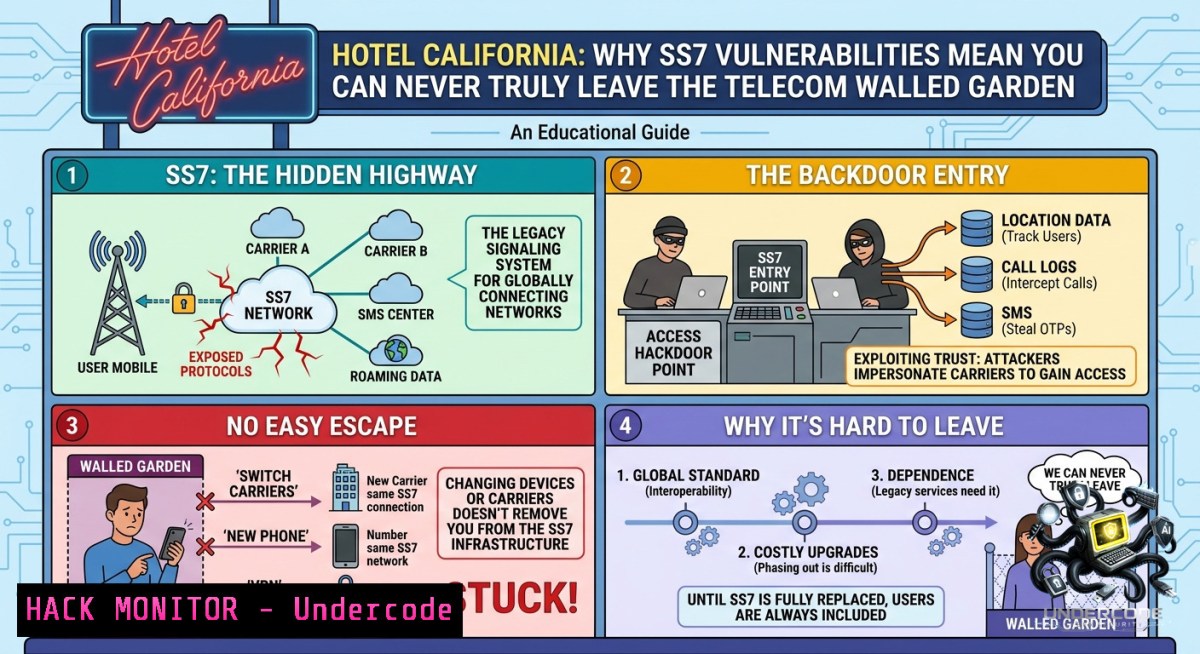
The Signaling System 7 (SS7) protocol suite, originally designed in the 1970s for landline call setup, now underpins global mobile communications—but its lack of authentication and encryption creates a sprawling attack surface. As Ryan Williams’ “Hotel California” analogy suggests, once an attacker gains access to SS7 (or its IP‑based sibling SIGTRAN), they can track, intercept, and manipulate subscriber data at will, making it nearly impossible for victims to “check out” of the surveillance nightmare. This article dissects SS7’s core protocols (MAP, TCAP, SCCP), demonstrates real‑world exploitation vectors, and provides actionable detection and hardening steps for telecom engineers, security architects, and red teamers.
Learning Objectives:
- Understand the architectural weaknesses of SS7/SIGTRAN and how attackers abuse MAP (Mobile Application Part) and BER (Basic Encoding Rules) to perform location tracking, SMS interception, and call redirection.
- Learn to use open‑source tools (e.g., Osmocom, ss7map, Wireshark with ASN.1 dissectors) to capture and analyze SS7 traffic on both TDM and IP links.
- Implement mitigation strategies, including firewall filtering for SIGTRAN, M3UA access controls, and anomaly detection rules using Linux/Windows command lines and SIEM correlation.
You Should Know:
- SIGTRAN and MAP: The Attack Surface You Can’t Ignore
SIGTRAN (Signaling Transport) carries SS7 messages over IP using SCTP (Stream Control Transmission Protocol). MAP (Mobile Application Part) handles location updates, subscriber info retrieval (SendRoutingInfo), and SMS forwarding. An attacker with a single SS7 roaming link—often leased from a compromised carrier or a cheap “SS7 aggregator”—can issue `provideSubscriberInfo` or `sendRoutingInfoForSM` messages to locate a phone, intercept 2FA SMS codes, and forward calls.
Step‑by‑step guide – Capturing SIGTRAN/MAP traffic on Linux:
1. Install necessary tools (Ubuntu/Debian):
sudo apt update && sudo apt install wireshark tshark sctplib libsctp-dev tcpdump python3-pip
pip3 install scapy ss7map
- Capture SCTP traffic on interface `eth0` (replace with your signalling interface):
sudo tcpdump -i eth0 -s 0 -w ss7_capture.pcap 'sctp port 2905 or sctp port 3868'
Port 2905 = M3UA (SIGTRAN adaptation for MTP3); port 3868 = M2PA/SCTP.
-
Dissect MAP messages using Wireshark’s ASN.1 BER dissector:
tshark -r ss7_capture.pcap -Y "map" -T fields -e map.mt.mobileStationISDN -e map.sendRoutingInfoForSM.sm-RP-DA
This extracts target MSISDNs and destination addresses from SMS routing requests.
-
Simulate a MAP location request (requires legitimate access to an SS7 gateway – for testing only):
Using ss7map library (example – assumes you have authentication tokens)
from ss7map import Client, MAP
client = Client(gt="1234567890", sccp_addr="1.2.3.4")
resp = client.send(MAP.provide_subscriber_info(msisdn="+447700900123"))
print(resp.location)  Returns LAI, cell ID, and timestamp
Windows alternative: Use Wireshark portable with SCTP plugin, or run the above commands via WSL2 (Windows Subsystem for Linux).
- Exploiting BER (Basic Encoding Rules) to Craft Malformed MAP PDUs
MAP messages are encoded using ASN.1 with BER (Basic Encoding Rules). Attackers can inject malformed but still‑valid BER sequences to trigger buffer overflows or state confusion in legacy STPs (Signaling Transfer Points). For example, manipulating the `imsi` parameter length field can cause a HLR to skip authentication checks.
Step‑by‑step guide – Crafting a malformed MAP PDU with Python’s asn1tools:
1. Install asn1tools:
pip3 install asn1tools
- Download the MAP ASN.1 specification (from 3GPP TS 29.002) and compile:
import asn1tools Assuming you have map.asn file map_codec = asn1tools.compile_ber('map.asn') -
Create a `sendRoutingInfoForSM` PDU with an oversized parameter:
pdu = { 'invokeId': 1, 'opcode': 'sendRoutingInfoForSM', 'parameters': { 'msisdn': '447700900123', 'sm-RP-DA': 'X' 512 Exceeds typical 20‑byte length } } encoded = map_codec.encode('MAP_PDU', pdu) Send via SCTP socket (requires raw socket privileges) -
Monitor the STP’s response – legitimate stacks drop the PDU, vulnerable ones may crash. Use `tcpdump -i eth0 ‘sctp and port 2905’ -vv` to see re‑transmissions or unexpected SCCP error messages.
-
Detection: Using Linux `ss` and `nftables` to Filter Malicious SIGTRAN Peers
Many SS7 attacks originate from unexpected IP addresses using dynamic SCTP associations. You can whitelist known peer STPs and drop everything else.
Step‑by‑step guide – SIGTRAN firewalling on Linux:
1. List active SCTP associations:
ss -s -l -1 --sctp
Look for `ESTAB` states on ports 2905, 3868, and 14001 (M3UA default).
- Create nftables rules to allow only specific peer IPs (e.g., your carrier’s STP at
10.1.1.100):sudo nft add table inet ss7_filter sudo nft add chain inet ss7_filter input { type filter hook input priority 0\; policy drop\; } sudo nft add rule inet ss7_filter input sctp sport 2905 ip saddr 10.1.1.100 accept sudo nft add rule inet ss7_filter input sctp dport 2905 ip saddr 10.1.1.100 accept sudo nft add rule inet ss7_filter input sctp sport 3868 ip saddr 10.1.1.100 accept sudo nft add rule inet ss7_filter input log prefix "DROP_SS7: " counter drop
3. Persist rules (Debian/Ubuntu):
sudo apt install nftables
sudo systemctl enable nftables
sudo nft list ruleset | sudo tee /etc/nftables.conf
Windows equivalent (PowerShell with advanced firewall) – not native for SCTP, but you can block ports using New-1etFirewallRule -DisplayName "Block_SCTP_2905" -Direction Inbound -Protocol SCTP -LocalPort 2905 -Action Block.
- Cloud Hardening for 5G Core (Transition from SS7 to HTTP/2)
While 5G uses HTTP/2 on the Service‑Based Architecture (SBA), interconnect gateways (N26, N32) often still fallback to SS7/SIGTRAN for legacy roaming. In cloud deployments (AWS, Azure), misconfigured security groups can expose SCTP ports to the internet.
Step‑by‑step guide – Hardening cloud instances handling SS7 interworking:
- Identify exposed SIGTRAN ports using `nmap` (from a separate host):
nmap -p 2905,3868,14001 --script sctp-ports -sS your_vm_public_ip
-
For AWS EC2 – add an inbound security group rule that drops SCTP traffic from `0.0.0.0/0` but allows only the specific SCTP ports from your carrier’s private IP range (e.g.,
172.31.0.0/16). Use VPC network ACLs for stateless SCTP filtering. -
Azure NSG – SCTP is not supported natively; use an Azure Firewall with application rules to inspect HTTP/2, but for legacy SCTP, deploy a virtual NVA (Network Virtual Appliance) running Linux with iptables/nftables.
-
Enable VPC Flow Logs (AWS) or NSG Flow Logs (Azure) and set alerts for SCTP traffic sourcing from unexpected geolocations using Athena queries:
SELECT day, srcaddr, destaddr, action FROM flow_logs WHERE protocol = '132' AND destport IN (2905,3868)
-
Real‑time Anomaly Detection with Zeek (formerly Bro) and MAP Fingerprinting
Zeek can parse SCTP and dissect MAP if you enable the `sctp` and `ss7` analyzers. This allows you to detect high‑frequency `sendRoutingInfoForSM` requests (SMS interception) or `provideSubscriberInfo` (location tracking).
Step‑by‑step guide – Deploying Zeek for SS7 monitoring:
1. Install Zeek (Ubuntu):
sudo apt install zeek
export PATH=$PATH:/opt/zeek/bin
- Enable SS7 scripts – edit `/opt/zeek/share/zeek/site/local.zeek` and add:
@load protocols/sctp
@load protocols/ss7
redef SS7::reassembly_depth = 1500;
-
Create a custom MAP detector (save as
map_detect.zeek):event map_send_routing_info_for_sm(c: connection, invoke_id: count, msisdn: string, sm_rp_da: string) { if (msisdn ! in known_subscribers) { print fmt("ALERT: Suspicious SM routing request for %s from %s", msisdn, c$id$orig_h); } }
4. Run Zeek on the signaling interface:
sudo zeek -i eth0 -C map_detect.zeek /opt/zeek/share/zeek/site/local.zeek
Results go to `alert.log` – feed this into a SIEM (Splunk, ELK) with a dashboard for “SS7 anomaly score”.
6. Mitigating “Hotel California” Persistence – Subscriber‑side Defenses
Even if you can’t patch the carrier’s SS7, you can reduce your exposure: use VoLTE (which often bypasses SS7 for call setup), enable second‑factor authentication via authenticator apps (not SMS), and monitor for unexpected SIM changes.
Step‑by‑step guide – Personal monitoring (Android with root):
- Install “SnoopSnitch” (requires root and a Qualcomm device) – logs SS7 signaling received by your phone.
- Check for silent SMS (class 0) that bypass notification – use terminal:
adb shell logcat -b radio | grep -i "silent sms"
- Set up IMSI catcher detection – `CellGuard` (iOS) or `AIMSICD` (Android, unmaintained but fork available) logs location update responses to detect false base stations.
Carrier‑side (for telecom admins): Implement Diameter Edge Agent (DEA) filters for 4G/5G and enforce GTP/SCTP whitelisting. Regularly audit SS7 roaming agreements – many breaches originate from “buddy” carriers with lax security.
What Undercode Say:
- Key Takeaway 1: SS7 and SIGTRAN are legacy protocols with no built‑in peer authentication; once an attacker obtains a single signaling link (often through compromised carriers or cheap roaming hubs), they can silently locate, intercept calls/SMS, and even inject fraudulent USSD commands – truly a “Hotel California” scenario.
- Key Takeaway 2: Mitigation is possible but requires a layered approach: network‑level filters (nftables for SCTP, cloud security groups), active monitoring (Zeek + custom MAP anomaly detection), and subscriber‑side education (avoid SMS 2FA, use encrypted messengers). However, full “exit” from SS7 exposure is impossible as long as legacy roaming exists.
Analysis (approx. 10 lines): Ryan Williams’ reference to the Eagles’ “Hotel California” perfectly captures the trapping nature of SS7 – you can “check out” (stop actively using the vulnerable protocol) but you can “never leave” because every back‑end mobility update, lawful intercept gateway, or international roaming partner still relies on MAP and TCAP. The mention of “BER” (Basic Encoding Rules) highlights how deep the vulnerability goes: even the encoding format offers no confidentiality. “SIGTRAN” is the IP‑based enabler that makes SS7 attacks scalable from any cloud VM. The acceptance of his talk at BSides Brisbane underlines that this is still a live battlefield – new exploits emerge (e.g., using fake location updates to bypass anti‑fraud systems). For defenders, the only practical strategy is to assume SS7 is compromised and build zero‑trust overlays (end‑to‑end encryption for calls/SMS via Signal or WhatsApp). Regulatory pressure (e.g., GSMA’s SS7 Security Guidelines) has helped, but many tier‑2/3 carriers still expose raw MAP interfaces. The “walled garden” analogy also applies to 5G’s SBA – new protocols introduce new risks, but the legacy garden walls are crumbling, not disappearing.
Expected Output:
Introduction: [Already provided above – a 3‑sentence cybersecurity angle on SS7’s architectural flaws and the “Hotel California” trap.]
What Undercode Say: [Listed above as Key Takeaway 1, Key Takeaway 2, plus the analysis section.]
Expected Output (Prediction):
- -1 Over the next 3–5 years, as 5G standalone (5G SA) cores replace legacy SS7 interconnects, attackers will pivot to exploiting flawed interworking gateways (N26, N32) that still translate Diameter/HTTP/2 to MAP/SIGTRAN, preserving the same surveillance capabilities.
- -1 Telecom carriers that delay SS7 filtering will face regulatory fines and class‑action lawsuits from high‑profile SMS interception incidents, especially as 2FA remains widely used in banking.
- +1 Open‑source detection tools (like the Zeek script shown above) will mature into plug‑and‑play SIEM apps, enabling even small MVNOs to detect location tracking attempts in real time and automatically block rogue SCTP associations.
- +1 The community’s “know your enemy” mindset – as demonstrated by Williams’ talk – will drive more public BSides workshops on SIGTRAN forensics, forcing vendors to add built‑in MAP anomaly detection in future STP/DPC hardware.
▶️ Related Video (78% Match):
🎯Let’s Practice For Free:
🎓 Live Courses & Certifications:
Join Undercode Academy for Verified Certifications
🚀 Request a Custom Project:
Secure, high-velocity infrastructure and disruptive technological engineering. Contact our engineering team for high-tier development and proprietary systems:
[email protected]
💎 Smart Architecture | 🛡️ Secure by Design | ⭐ Trusted by Thousands
IT/Security Reporter URL:
Reported By: Ryan Williams – Hackers Feeds
Extra Hub: Undercode MoN
Basic Verification: Pass ✅


