Listen to this Post
Introduction:
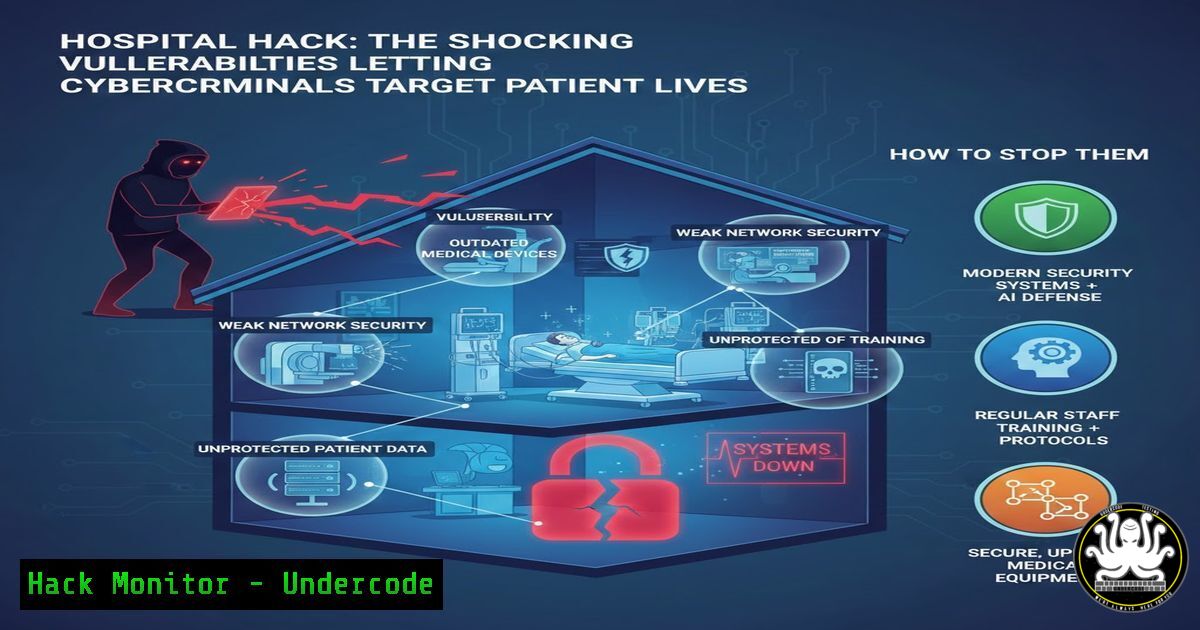
In an era where healthcare is increasingly digital, hospitals have become prime targets for cybercriminals, turning network vulnerabilities into potential life-or-death situations. This article delves into the specialized field of hospital network penetration testing, a critical practice for safeguarding not just data, but human lives, by proactively identifying and mitigating risks in complex healthcare IT ecosystems. We will explore the technical methodologies used to secure everything from legacy medical devices to critical patient data systems.
Learning Objectives:
- Understand the unique attack surfaces and high-value targets within a hospital’s network infrastructure.
- Learn practical, actionable steps and commands to assess and harden key hospital systems like PACS, Active Directory, and networked medical equipment.
- Develop a roadmap for implementing a continuous security posture that aligns with real-world threat scenarios faced by healthcare IT and SOC teams.
You Should Know:
- Mapping and Assessing the Hospital Network Attack Surface
The first step in securing any network is understanding its scope. Hospital networks are uniquely complex, blending standard IT infrastructure with specialized medical devices (IoT), often on segmented VLANs. A penetration tester must map all assets, from nurse station workstations to MRI machines.
Step‑by‑step guide:
- Network Discovery: Use a tool like `nmap` to perform a non-intrusive sweep of the network ranges. The goal is to catalog all IPs without triggering alarms on sensitive medical equipment.
Command: `sudo nmap -sn 192.168.1.0/24` (Replace with the hospital’s IP range). This lists all live hosts. - Service and OS Fingerprinting: Once hosts are identified, perform a more detailed scan to identify operating systems and running services, which can reveal outdated and vulnerable software.
Command: `sudo nmap -O -sV 192.168.1.100` (Target a specific host). Pay special attention to ports associated with medical systems (e.g., DICOM services on port 104 for PACS). - Medical Device Identification: Correlate `nmap` results with known medical device MAC address prefixes (OUI) and open ports to create an inventory of networked medical equipment. Manual verification with clinical staff is essential to avoid disrupting critical care devices.
-
Exploiting and Hardening Active Directory in a Healthcare Environment
Active Directory (AD) is the central nervous system for user authentication in most hospitals. A compromised AD account can lead to lateral movement towards domain admin rights and access to every system joined to the domain, including those storing patient health information (PHI).
Step‑by‑step guide (Attack & Defense):
- Reconnaissance: From a compromised workstation, enumerate domain users, groups, and trust relationships to map the attack path.
Command (PowerShell on Windows): `Get-ADUser -Filter -Properties | select Name, SamAccountName, LastLogonDate`
Tool: Use `BloodHound` to automatically ingest this data and visualize attack paths to privileged accounts. - Privilege Escalation: Test for common misconfigurations like unconstrained Kerberos delegation or vulnerable GPOs that can be exploited.
Mitigation: Implement strict Least Privilege Access, regularly audit privileged group memberships, and disable legacy protocols like NTLM where possible. -
Hardening: Enforce strong password policies via GPO, enable Multi-Factor Authentication (MFA) for all administrative and clinical access to PHI, and ensure all domain controllers are patched.
-
Testing the Security of Critical Systems: HIS, PACS, and LIS
Hospital Information Systems (HIS), Picture Archiving and Communication Systems (PACS), and Laboratory Information Systems (LIS) are mission-critical. They often run on legacy software, have complex dependencies, and contain the most sensitive patient data.
Step‑by‑step guide:
- Web Interface Testing: Most modern systems have web front-ends. Use automated scanners like `Burp Suite` or `OWASP ZAP` to test for common web vulnerabilities (SQL injection, Cross-Site Scripting) in login portals and data access points.
- API Security Assessment: These systems heavily rely on APIs for data exchange. Fuzz API endpoints using tools like `ffuf` to uncover hidden endpoints or injection flaws.
Command Example: `ffuf -w /path/to/wordlist -u https://hospital-server/api/FUZZ -H “Authorization: Bearer“`
3. Database Security: If direct access is found, check for default or weak credentials on backend databases (e.g., SQL Server, Oracle). Use native database commands to audit user permissions and sensitive data exposure.
Mitigation: Ensure all interfaces are behind strong authentication, encrypt data in transit and at rest, and segment these systems onto dedicated, tightly controlled network zones.
4. Assessing and Securing Networked Medical Devices (IoT)
From infusion pumps to ventilators, many medical devices are built for reliability, not security. They are often unpatched, run embedded operating systems, and use default passwords, making them easy entry points.
Step‑by‑step guide:
- Passive Identification: Use network traffic analysis tools like `Wireshark` to monitor traffic from device IPs. Look for clear-text communication protocols or beaconing to unknown external IPs.
- Active Assessment (With Caution): Only test on devices explicitly approved and in a non-clinical environment. Check for web interfaces or telnet ports (23) using default credential lists.
Command: Use `hydra` cautiously for brute-force testing: `hydra -L userlist.txt -P passlist.txt telnet://192.168.2.50`
3. Hardening Strategy: Work with vendors to establish a secure patch management process. Network segmentation is non-negotiable; place all medical IoT devices on an isolated VLAN with strict firewall rules that only allow essential communication to specific hosts.
5. Evaluating Network Segmentation and VLAN Security
Proper segmentation is supposed to contain an attacker. Penetration testing must validate that VLANs and firewall rules between zones (e.g., Clinical VLAN, Guest WiFi, Administrative VLAN) are correctly configured and cannot be bypassed.
Step‑by‑step guide:
- VLAN Hopping Test: Attempt to bypass segmentation by crafting and sending double-tagged 802.1Q frames to a trunk port, a technique known as VLAN hopping.
Tool: Use `yersinia` to launch layer 2 attacks and test switch configuration. - Firewall Rule Validation: From a compromised host in one segment (e.g., Guest WiFi), use `nmap` to probe hosts in the clinical segment, testing if firewall rules are as restrictive as intended.
Command: `nmap -p 445,3389,22 10.0.10.0/24` (Scans for common management ports from an unauthorized zone). - Mitigation: Ensure switch ports are configured with “switchport mode access” for end-user ports and disable Dynamic Trunking Protocol (DTP). Regularly audit firewall rule sets to remove overly permissive “any-any” rules.
6. Testing SOC and Incident Response Readiness
The final line of defense is the people and processes. A penetration test must include actions designed to gauge the Security Operations Center’s ability to detect, analyze, and respond to a live intrusion.
Step‑by‑step guide:
- Simulated Attack Chain: Execute a multi-stage attack, such as delivering a benign payload via phishing, establishing a command & control (C2) beacon, and attempting to exfiltrate a dummy file labeled as “Patient_Records.zip.”
- Monitoring for Detection: Use open-source C2 frameworks like `Cobalt Strike` or `Sliver` in a controlled manner to generate beacon traffic and see if SOC tools (SIEM) trigger alerts on unusual outbound connections or data transfers.
- Measure Response: Time how long it takes for the SOC to escalate the alert, engage the incident response team, and contain the simulated threat. The goal is to identify gaps in playbooks and communication.
What Undercode Say:
- Key Takeaway 1: Hospital cybersecurity is intrinsically patient safety. A technical vulnerability in a PACS server or an infusion pump is not just an IT issue; it is a direct threat to clinical care delivery and patient outcomes. The mindset must shift from protecting data to protecting lives.
- Key Takeaway 2: The convergence of legacy medical technology with modern IT networks creates a uniquely vulnerable attack surface. Traditional, periodic penetration testing is insufficient. Healthcare requires continuous security monitoring, specialized threat intelligence on medical device vulnerabilities, and deeply integrated collaboration between cybersecurity teams and clinical/biomedical engineering staff.
The analysis from the promoted content by Black Box Academy highlights a critical market need: moving beyond theoretical security frameworks to hands-on, scenario-based testing that mirrors the tactics of real attackers. Their focus on delivering actionable technical reports and knowledge transfer sessions underscores that the value of a penetration test lies not in the list of findings alone, but in empowering internal IT teams to understand and fix the root causes. However, the persistent challenge for the industry will be balancing the imperative to secure systems with the operational and regulatory complexities of healthcare, where system availability often trumps security updates.
Prediction:
The future of healthcare cybersecurity will be dominated by two converging trends: the increasing weaponization of AI by attackers to craft hyper-targeted phishing campaigns and discover zero-day vulnerabilities in hospital software, and the regulatory response forcing stricter mandates. We predict that within the next 3-5 years, hospital accreditation bodies worldwide will make advanced, continuous penetration testing and proven incident response capabilities a mandatory condition for operation, similar to hygiene standards today. This will drive massive investment in healthcare-specific SOC services and AI-driven defense platforms, but will also exacerbate the talent shortage, making the practical training courses offered by academies in this field more valuable than ever.
▶️ Related Video (76% Match):
🎯Let’s Practice For Free:
IT/Security Reporter URL:
Reported By: Hosseinmalekzadeh Cybersecurity – Hackers Feeds
Extra Hub: Undercode MoN
Basic Verification: Pass ✅


