Listen to this Post
Introduction:
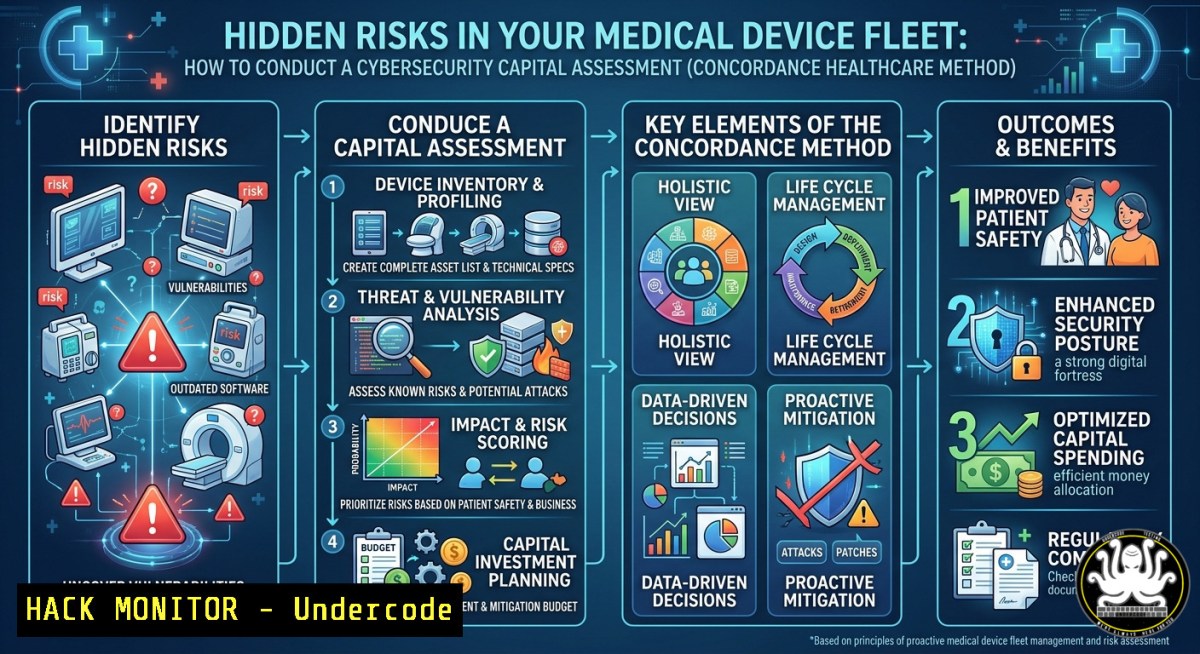
Healthcare organizations increasingly rely on connected medical devices—from infusion pumps to MRI scanners—yet most capital equipment assessments overlook cybersecurity posture. Concordance Healthcare Solutions’ framework for evaluating utilization, condition, and total cost of ownership can be extended to include threat surfaces, firmware vulnerabilities, and network segmentation gaps. This article transforms their asset-centric methodology into a hands-on cybersecurity and AI-driven assessment guide, helping IT and clinical engineering teams identify exploitable medical IoT devices before attackers do.
Learning Objectives:
- Perform a hybrid cybersecurity and operational assessment of healthcare capital equipment using open-source tools.
- Apply AI-based anomaly detection to device behavior logs and identify unauthorized configuration changes.
- Implement Linux/Windows commands to enumerate medical devices, check for unpatched services, and harden network access controls.
You Should Know:
- Enumerating Connected Medical Devices Using Nmap and Custom Scripts
Start by replicating Concordance’s “asset inventory” step, but with a security lens. The following commands discover devices on the clinical network, fingerprint their operating systems, and detect exposed services—common in legacy infusion pumps and patient monitors.
Step‑by‑step guide:
- Linux (or WSL on Windows): Install Nmap and its medical device scripts.
sudo apt update && sudo apt install nmap nmap-scripts -y
- Scan a clinical subnet (e.g., 10.10.50.0/24) for DICOM and HL7 services:
sudo nmap -sS -sV -p 104,11112,2575,4242,5678,8000-9000 10.10.50.0/24 -oA medical_scan
- Use the `medica` script category to detect specific devices:
sudo nmap --script "medical-" -p 104,8080 10.10.50.15
- Windows alternative (PowerShell as Admin): Use `Test-NetConnection` for individual ports, or install Nmap via the official installer.
- Expected output: List of IPs, open ports, service banners (e.g., “Philips IntelliVue MP5 – DICOM C‑STORE SCP”).
What this does: Identifies unpatched devices listening on standard medical protocols, revealing potential remote code execution vectors (e.g., CVE-2021-39213 on certain patient monitors). Use the output to prioritize replacement or micro‑segmentation.
- Automated Vulnerability Assessment with OpenVAS and AI‑Enhanced Risk Scoring
After inventory, Concordance evaluates “condition and risk.” In cybersecurity, this means checking each device against known vulnerabilities and using machine learning to predict compromise likelihood.
Step‑by‑step guide:
- Install Greenbone Vulnerability Management (OpenVAS) on Ubuntu 22.04:
sudo apt update && sudo apt install gvm -y
sudo gvm-setup
sudo gvm-check-setup
- Run a targeted scan using the “Medical Device Security” config (create via Greenbone’s web UI or CLI):
greenbone-nvt-sync
gvm-cli --gmp-username admin --gmp-password pass socket --socketpath /var/run/gvmd.sock --xml "<create_task>..."
- AI enhancement: Use a local LLM (Ollama + Mistral) to score findings:
curl -X POST http://localhost:11434/api/generate -d '{ "model": "mistral", "prompt": "Rank these CVEs for a hospital infusion pump (CVE-2022-26765, CVE-2021-3220) by exploitability:", "stream": false }' - Windows option: Install OpenVAS via WSL2, or use Nessus Essentials (free for 16 IPs) with custom medical device templates.
What this does: Automates the discovery of missing patches, default credentials, and insecure protocols (Telnet, SNMPv1). The AI scoring helps overwhelmed teams triage findings by simulating attacker cost‑benefit analysis.
3. Hardening Windows‑Based Modalities and Imaging Stations
Many capital assets (CT workstations, PACS viewers) run Windows 10 IoT or Windows Server. Concordance’s “standardization opportunities” translate to security baseline enforcement.
Step‑by‑step guide (Windows PowerShell as Administrator):
- Enforce Local Group Policy for device control:
Disable USB storage (prevents malware injection from portable drives)
Set-ItemProperty -Path "HKLM:\SYSTEM\CurrentControlSet\Services\USBSTOR" -Name "Start" -Value 4 -Type DWord
- Block SMBv1 (often enabled on old imaging equipment):
Disable-WindowsOptionalFeature -Online -FeatureName SMB1Protocol -Remove
- Apply Microsoft’s Security Compliance Toolkit for medical devices:
Install-Module -Name PSDesiredStateConfiguration -Force
Download and apply HC3-derived baselines from https://msrc.microsoft.com/tools
- Linux side (for embedded devices like ventilator controllers): Disable unused services:
systemctl list-units --type=service --state=running | grep -E "telnet|ftp|rpc"
sudo systemctl disable --now telnet.socket
What this does: Reduces attack surface on clinical endpoints. Regular hardening closes paths used by ransomware (e.g., Ryuk’s lateral movement through SMB). Include these steps in your equipment “repair frequency” review.
4. API Security Assessment for Cloud‑Connected Capital Equipment
Modern ventilators, infusion pumps, and patient monitors often expose REST APIs for telemetry. Concordance’s “total cost of ownership” must include API breach impact. Use OWASP ZAP and custom fuzzing.
Step‑by‑step guide:
- Intercept traffic between a medical device and its cloud portal (requires network tap or ARP spoofing on isolated test segment).
- Use ZAP in headless mode:
docker run -v $(pwd):/zap/wrk:rw -t ghcr.io/zaproxy/zaproxy:stable zap-api-scan.py -t https://device-api.healthcareprovider.com/swagger.json -f openapi -r api_report.html
- Fuzz for IDOR vulnerabilities (e.g., patient data exposure):
ffuf -u https://api.clinicaldevice.com/v1/patient/FUZZ -w /usr/share/wordlists/dirb/common.txt -fc 401,403,404
- Windows: Run ZAP desktop, import device API specs, and execute “Automated Scan” with scripted authentication.
What this does: Reveals whether a competitor (or attacker) could access other patients’ data or modify device settings (e.g., alarm thresholds). Mitigate by enforcing OAuth2 with short-lived tokens and input validation.
5. AI‑Driven Anomaly Detection on Device Logs
Concordance’s “performance and cost” analysis becomes proactive when you apply unsupervised learning to syslog and SNMP traps. Use an ELK stack + custom Python isolation forest.
Step‑by‑step guide:
- Forward syslog from medical devices to a Linux collector:
On collector (Ubuntu)
sudo apt install rsyslog
echo '. @192.168.1.100:514' | sudo tee -a /etc/rsyslog.conf
sudo systemctl restart rsyslog
- Ingest into Elasticsearch with Filebeat, then use the Elastic Machine Learning “unusual log rate” job.
- Alternative – Python script for lightweight detection:
from sklearn.ensemble import IsolationForest import pandas as pd Load feature matrix: connection count, error rate, firmware version changes df = pd.read_csv('device_telemetry.csv') model = IsolationForest(contamination=0.05) model.fit(df) df['anomaly'] = model.predict(df) - Train on one month of baseline (normal clinical operations). Flag devices where anomaly = -1 for manual review.
What this does: Detects zero‑day compromise (e.g., lateral movement from a compromised nurse station to a networked defibrillator). Integrate into your quarterly capital review as “AI opportunity score.”
- Training Courses for Clinical Engineering and IT Teams
To sustain Concordance’s “actionable roadmap,” invest in role‑specific training. Recommended courses (free/paid) with labs:
- ICS/Healthcare Security Essentials: SANS ICS410 (paid) or CISA’s free “Medical Device Cybersecurity Training” (search “CISA MDCS”).
- AI for Asset Management: Coursera “AI for Healthcare” (Andrew Ng) – apply ML models to predict equipment failure and exploit likelihood.
- Hands‑on labs for commands above: TryHackMe “Medical Device Security” room (simulated hospital network); HTB “Hospital” machine.
- Certificate of completion: After finishing this guide, practice by scanning your own lab environment (e.g., using a Raspberry Pi emulating a patient monitor with custom open ports).
What Undercode Say:
- Key Takeaway 1: A capital equipment assessment must include a cybersecurity layer—unpatched medical devices are the fastest growing attack vector in healthcare ransomware.
- Key Takeaway 2: AI is not a replacement for basic inventory and scanning; it amplifies triage and anomaly detection, but only after you’ve implemented repeatable Nmap and OpenVAS workflows.
Analysis: Concordance Healthcare Solutions focuses on operational efficiency and cost. By adding the six sections above, any healthcare organization can merge that framework with NIST’s cybersecurity practice guide for medical devices (NIST SP 1800-30). The commands and AI scripts translate “utilization” into “threat exposure” and “total cost of ownership” into “breach risk amortization.” Most hospitals lack a single source of truth for both engineering and security data—this article bridges that gap. Expect that within 12 months, AI-powered asset assessments will be mandatory for insurance premium reductions.
Expected Output:
Introduction: [Already provided above]
What Undercode Say: – Key Takeaway 1 – Key Takeaway 2 + analysis lines.
Prediction:
By 2027, AI-driven continuous monitoring of medical device behavior will replace periodic manual assessments. Attackers will shift to targeting API vulnerabilities in cloud-connected capital equipment (e.g., CT scanners that auto‑upload to teleradiology). Organizations that today integrate Nmap‑based inventory, OpenVAS scanning, and anomaly detection into their capital planning will achieve 70% faster ransomware containment and lower cyber insurance premiums. Conversely, those who continue to assess only physical condition will face regulatory fines from the FDA’s new pre‑market cybersecurity guidance (Section 524B of the FD&C Act).
▶️ Related Video (74% Match):
🎯Let’s Practice For Free:
IT/Security Reporter URL:
Reported By: 05 27 – Hackers Feeds
Extra Hub: Undercode MoN
Basic Verification: Pass ✅
🎓 Live Courses & Certifications:
Join Undercode Academy for Verified Certifications
🚀 Request a Custom Project:
Secure, high-velocity infrastructure and disruptive technological engineering. Contact our engineering team for high-tier development and proprietary systems:
[email protected]


