Listen to this Post
Introduction:
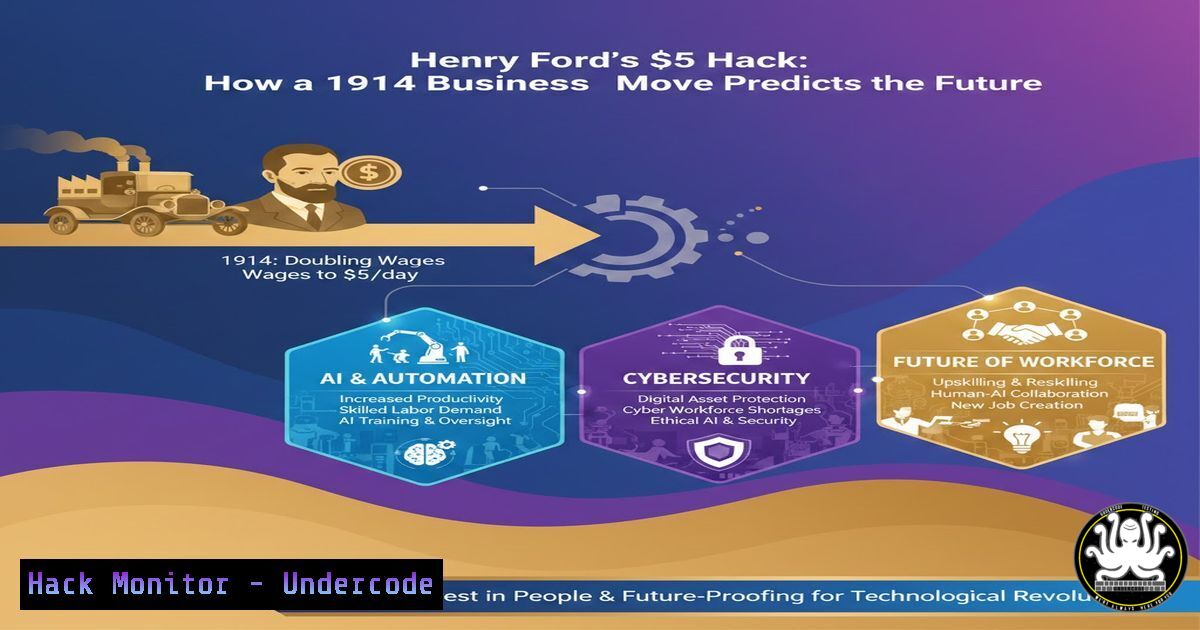
In 1914, Henry Ford didn’t double wages out of charity; he executed a strategic business hack to counter crippling turnover and training costs, thereby stabilizing his workforce and creating a new consumer class. Today, as AI and automation drive unprecedented productivity gains, this historical lesson is a critical blueprint for IT and cybersecurity leaders. The companies that master the integration of technology with strategic workforce investment—particularly in reskilling and retention—will build resilient, secure, and innovative organizations.
Learning Objectives:
- Understand the direct parallel between Ford’s wage strategy and modern investment in employee reskilling and retention amidst AI transformation.
- Identify the cybersecurity and IT governance risks introduced by high workforce churn and rapid AI adoption.
- Implement technical and strategic measures to secure your AI tools, protect institutional knowledge, and build a future-ready team.
You Should Know:
- The High Cost of Talent Churn in Tech
The original post highlights Ford’s realization that constant retraining and turnover were more expensive than paying a premium to retain workers. In a modern IT context, churn is a direct security vulnerability. The departure of a system administrator, DevOps engineer, or security analyst often leads to orphaned accounts, undocumented configurations, and latent access privileges—creating a vast attack surface.
Step‑by‑step guide explaining what this does and how to use it.
Step 1: Audit for “Orphaned Assets” and Knowledge Silos.
On a Linux system, use commands to find files and processes owned by departed users and check for recent activity.
 Find files not accessed in last 90 days owned by a specific user (e.g., 'jdoe')
find / -user jdoe -atime +90 -type f 2>/dev/null | head -20
 Check for active cron jobs or systemd timers belonging to old accounts
crontab -u jdoe -l 2>/dev/null || echo "No crontab or user removed"
systemctl list-timers --all | grep -i jdoe
Step 2: Implement Mandatory Knowledge Capture. Enforce documentation as part of the offboarding checklist. Use a centralized wiki (like Confluence) with structured templates. All admin-level changes must be logged via a tool like `sudo` with session recording or a PAM (Privileged Access Management) solution.
Step 3: Automate Access Revocation. Integrate HR systems with IAM (Identity and Access Management) platforms like Okta or Microsoft Entra ID to automatically trigger deprovisioning workflows upon employment status change.
- AI as a Productivity Multiplier and a Security Threat Vector
Ford’s assembly line increased output but introduced new human challenges. Similarly, AI coding assistants (GitHub Copilot, Amazon CodeWhisperer) and operational bots boost developer velocity but can inadvertently expose secrets, suggest vulnerable code, or be manipulated through prompt injection attacks.
Step‑by‑step guide explaining what this does and how to use it.
Step 1: Secure Your AI Tooling Pipeline.
- Pre-commit Hooks for Secret Detection: Use `truffleHog` or `gitleaks` in your CI/CD pipeline to scan for API keys or tokens that an AI might have embedded in code.
Install and run gitleaks in a repo
docker run -v $(pwd):/src zricethezav/gitleaks:latest detect --source="/src" --verbose
- Code Security Training for AI Output: Treat AI-generated code as untrusted third-party code. Mandate security reviews.
Step 2: Harden AI API Endpoints. If using internal LLMs (e.g., via OpenAI API, Azure OpenAI), ensure strict authentication, quota limits, and audit logging. Example for monitoring:Use network monitoring to track traffic to your AI service IP/port sudo tcpdump -i any port 443 and host api.openai.com -w ai_traffic.pcap
Step 3: Implement “AI Governance” Policies. Define approved use cases, prohibit the input of PII or IP into public AI models, and mandate data anonymization techniques.
- Building the “Modern $5 Day”: Strategic Reskilling Programs
Ford’s investment gave workers a stake in the system. Today, this translates to funded, structured upskilling in cloud security, AI ethics, and threat analysis. This reduces the temptation for disgruntled employees to become insider threats and builds internal defense capabilities.
Step‑by‑step guide explaining what this does and how to use it.
Step 1: Skills Gap Analysis & Personalized Learning Paths.
– Use tools like `nmap` or vulnerability scanner reports to show teams the real threats, connecting training to daily work.
 Generate a simple network scan report to discuss in a training session
nmap -sV -O --top-ports 20 192.168.1.0/24 -oN network_scan.txt
Step 2: Leverage Free and Premium Training Resources.
. Cybersecurity: SANS Free Resources, TryHackMe, Hack The Box.
. Cloud & AI: Microsoft Learn, AWS Skill Builder, Google Cloud Skills Boost.
. Formal Courses (Examples): Coursera’s “AI For Everyone” (deeplearning.ai), “Cybersecurity for Everyone” (University of Maryland).
Step 3: Create Internal “Cyber Ranges.” Set up isolated lab environments using Docker or Vagrant where employees can safely practice incident response on compromised VM images.
- The Insider Threat: When Automation and Monitoring Backfire
A LinkedIn commenter warned against “intrusive AI monitoring systems.” Excessive surveillance can foster resentment—a modern insider threat risk. The goal is security-aware coaching, not micromanagement.
Step‑by‑step guide explaining what this does and how to use it.
Step 1: Deploy Ethical Activity Monitoring. Focus on asset and data flow, not keystrokes. Use Data Loss Prevention (DLP) tools and Cloud Access Security Brokers (CASBs) like Microsoft Purview or Netskope to monitor for anomalous data exfiltration, not productivity.
Step 2: Configure Windows Event Logging for Critical Security Events. Monitor for potential insider activity without being overly broad.
 PowerShell to enable detailed process creation logging (Windows)
Auditpol /set /subcategory:"Process Creation" /success:enable /failure:enable
Step 3: Foster a “See Something, Say Something” Culture. Pair monitoring with anonymous reporting channels and regular training that frames security as a shared responsibility for job protection.
- Fortifying the New “Assembly Line”: Securing CI/CD and Automation Pipelines
The modern assembly line is the CI/CD pipeline. Just as Ford’s line needed stability, your DevOps pipeline needs security to prevent sabotage (insider or external) and ensure the integrity of software deliveries.
Step‑by‑step guide explaining what this does and how to use it.
Step 1: Implement Mandatory Code Signing and Verification.
 Example of verifying a Git commit signature
git verify-commit HEAD
 Use cosign for container signing
cosign sign --key cosign.key myregistry/myimage:latest
Step 2: Harden Your Git Server. Enforce branch protection rules, require pull request reviews, and integrate SAST (Static Application Security Testing) tools like SonarQube or Checkmarx into merge checks.
Step 3: Isolate and Monitor Build Environments. Run Jenkins/Agents or GitHub Actions runners in isolated containers or VMs. Use tools like Falco or Tracee for runtime security monitoring during builds.
What Undercode Say:
- Key Takeaway 1: Technological transformation without parallel investment in human capital is a strategic security risk. High churn erodes institutional knowledge and creates exploitable IT gaps, while unaddressed employee discontent fuels insider threats.
- Key Takeaway 2: The integration of AI and automation must be governed by stringent security protocols from the start. AI tools are powerful new attack vectors that require specific hardening, just as you would harden a network server.
-
Analysis: The Ford analogy cuts to the core of modern tech leadership. The hack isn’t about the AI itself; it’s about the socio-technical system around it. Cybersecurity is no longer just about firewalls and patches; it’s about human systems. A poorly integrated, poorly understood AI tool deployed by an underpaid, under-skilled, and disengaged workforce is the ultimate vulnerability. The winning strategy is twofold: first, to secure the technology itself with rigorous DevSecOps and AI governance; second, to secure the organization by making strategic investments in people that reduce churn, build loyalty, and transform your workforce from a potential risk into your most robust line of defense. This is how you build an organization that is not only productive but also resilient.
Prediction:
The next five years will see a clear bifurcation in the corporate landscape. Organizations that treat AI/automation purely as a cost-cutting and headcount-reduction tool will experience increased systemic fragility—more frequent outages, more successful phishing and insider attacks, and an inability to adapt to new threats. Conversely, organizations that adopt the “Modern $5 Day” principle—viewing AI as a catalyst for workforce elevation—will develop a sustainable competitive advantage. They will foster a loyal, skilled internal community capable of ethically operating and securing complex systems. This will give rise to a new corporate defense paradigm: the Resilient Human-Technical Firewall, where culture and technology are interlocked, making the organization profoundly harder to disrupt or breach.
▶️ Related Video (72% Match):
🎯Let’s Practice For Free:
IT/Security Reporter URL:
Reported By: Evankirstel In – Hackers Feeds
Extra Hub: Undercode MoN
Basic Verification: Pass ✅


