
Listen to this Post
Introduction:
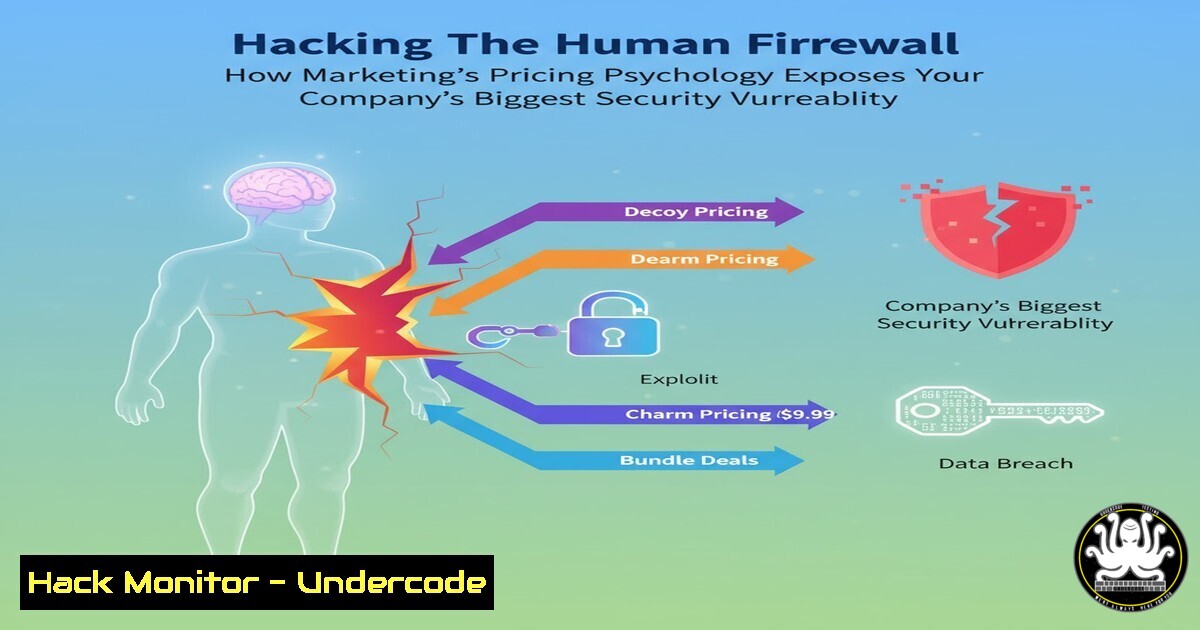
A recent LinkedIn post by marketing expert Phill Agnew highlighted a powerful behavioral science principle: framing a $18.99 cost as $1.58 per unit makes the price seem 108% more reasonable, dramatically increasing consumer acceptance. While this is a tactic used to drive sales, it perfectly mirrors the psychological manipulation employed by modern cybercriminals. In the context of cybersecurity, this “per-unit framing” is analogous to how attackers deconstruct a massive data breach or ransomware attack into seemingly insignificant, harmless actions—a single click, a downloaded file, a password reset—to bypass an organization’s most critical defense: the human firewall. This article explores how these psychological triggers are weaponized in social engineering attacks and provides a technical playbook for defense.
Learning Objectives:
- Analyze the psychological principles of pricing psychology (unit cost framing) and map them directly to social engineering attack vectors (phishing, pretexting).
- Execute practical command-line techniques to dissect malicious URLs and email headers, identifying the “hidden costs” of a single click.
- Implement technical controls (Group Policy, ModSecurity rules) to harden systems against the delivery mechanisms of these psychological exploits.
You Should Know:
- The “Unit Cost” of a Breach: Deconstructing the Phishing Lure
Just as the Huel ad on the right (B) breaks down a bulk price into a palatable per-meal cost ($3.76), a sophisticated phishing email breaks down a complex, frightening scenario (e.g., “Your account will be terminated”) into a simple, low-friction action (e.g., “Click here to verify your password”). The attacker frames the “cost” to the user not as potential data loss or network compromise, but as a 30-second inconvenience.
Step‑by‑step guide to analyzing a suspicious email’s “per-unit” ask:
1. Isolate the Email: Save the email as an `.eml` file. This contains all headers and原始 data.
2. Analyze Headers (Linux/macOS): Use the `grep` command to find the originating IP and route.
grep -i "received:" email_header.txt
Trace the path. If the “Received: from” lines show IPs from known malicious ranges or anonymous relays, the “deal” is bad.
3. Analyze Headers (Windows PowerShell): Use PowerShell to extract the same information.
Get-Content .\email_header.txt | Select-String -Pattern "Received"
4. Extract and Analyze Links: Use a Python script or `grep` to pull all URLs.
grep -Eo "(http|https)://[a-zA-Z0-9./?=_-]" email_body.txt > extracted_urls.txt
5. Deconstruct the URL “Price”: The “per-unit” price in a phishing link is the domain name itself. Use `whois` to see when it was registered (new domains are high-risk).
whois suspicious-domain.xyz | grep -E "Creation Date|Registrar"
If the domain was created within the last 30 days, the risk is exponentially higher. The attacker is offering a “new product” (the domain) at a seemingly low “unit cost” (your credentials).
- Hardening the “Shopping Cart”: Securing Web Applications Against Malicious Framing
In marketing, ad B frames the product as affordable. In cybersecurity, attackers “frame” malicious input to your web applications (SQL Injection, XSS) as harmless data. They break down a complex attack into small, “affordable” payloads that bypass filters.
Step‑by‑step guide to implementing a Web Application Firewall (WAF) rule to block common SQLi framing:
1. Identify the Attack Vector: Attackers often use `’ OR 1=1 –` to “frame” a login bypass as a simple comment.
2. Craft a ModSecurity Rule: Create a custom rule to inspect POST/GET parameters for SQL patterns.
 Block requests containing typical SQL injection patterns
SecRule ARGS "@rx ((\%27)|(\'))\s((\%6F)|o|(\%4F))((\%72)|r|(\%52))" \
"id:1001,\
phase:2,\
deny,\
status:403,\
msg:'SQL Injection Pattern Detected - OR clause',\
logdata:'%{MATCHED_VAR_NAME}=%{MATCHED_VAR_VALUE}'"
3. Test the Rule: Attempt a login with `’ OR 1=1 –` in the username field. The server should return a 403 Forbidden, proving the “sale” of the fraudulent login attempt has been blocked.
- API Security: The Fine Print No One Reads
Just as consumers only see the $3.76/meal and ignore the subscription terms, developers often see the utility of an API and ignore the “fine print” of its security. An API endpoint might be “framed” as a simple data retrieval tool (/api/user/123), but without proper Object-Level Authorization, the “unit cost” of that call could be access to every user’s data (IDOR).
Step‑by‑step guide to testing for Insecure Direct Object References (IDOR):
1. Authenticate and Intercept: Log in as a standard user (User A) and intercept a request using Burp Suite or OWASP ZAP. Find an API call like GET /api/orders/5678.
2. Change the “Unit”: Send this request to the Repeater tool. Change the order ID from `5678` to a known ID belonging to another user (User B), e.g., 5679.
3. Analyze the Response:
 Using cURL to test IDOR from the command line
curl -X GET https://target-site.com/api/orders/5679 \
-H "Authorization: Bearer [bash]" \
-H "Content-Type: application/json" \
-v
4. Assess the Damage: If the API returns User B’s order details without complaint, the “per-unit” price of the API call has been exploited to gain unauthorized data. The fix is to implement robust authorization checks on the backend, ensuring the user token matches the resource owner.
4. Cloud Hardening: The “Volume Discount” Trap
Marketers love volume discounts, but in the cloud, misconfigured, overly permissive IAM roles are the “volume discount” for attackers. A single role that grants “s3:” on all buckets might seem like a convenience for developers, but to an attacker, it’s a bulk discount on data exfiltration.
Step‑by‑step guide to auditing IAM policies for over-privilege (AWS CLI):
1. List Policies: Identify policies that are attached to critical roles.
aws iam list-policies --scope Local --only-attached
2. Get a Specific Policy Version: Retrieve the details of a policy document to see the actual permissions.
 Get the default version of a policy
aws iam get-policy-version --policy-arn arn:aws:iam::123456789012:policy/MyPolicy --version-id v1
3. Analyze for “Wildcard” Discounts: Look for `”Effect”: “Allow”` with `”Action”: “”` or "Resource": "". This is the equivalent of a “bulk purchase” option for a hacker. The principle of least privilege (buying only what you need) is the most secure approach, even if it seems more expensive in management time.
What Undercode Say:
- Key Takeaway 1: The psychology that makes a consumer buy a product is the same psychology that makes an employee click a malicious link. By understanding how attackers “frame” the action, defenders can better craft security awareness training that highlights the real, catastrophic “total price” of a momentary lapse.
- Key Takeaway 2: Technical defenses must mirror the granularity of the attack. Just as breaking down a price requires looking at the unit cost, breaking down a cyber attack requires looking at the “unit actions”—the individual API calls, the single packet, the specific log entry. This is where proactive threat hunting and robust logging (e.g., SIEM queries focusing on anomalous “per-user” behavior) become invaluable.
- Analysis: The LinkedIn post serves as a perfect, non-technical analogy for the cyber threat landscape. We are constantly bombarded with “deals” that seem too good to be true, or requests that seem too small to matter. In 2025, the line between social engineering and technical exploitation is blurred. The “deal” is the phishing email promising a free package update. The “unit price” is the single command an attacker runs after gaining a foothold. The only way to combat this is to foster a culture of skepticism and to implement technical controls that audit every transaction, no matter how small, for its true cost.
Prediction:
As AI-generated content becomes indistinguishable from human-created marketing, we will see a surge in “hyper-personalized” social engineering attacks. Attackers will use AI to craft lures that are not just generic “unit price” breakdowns, but personalized offers that reference a target’s recent purchases, projects, or even Slack conversations. The future of defense lies not just in perimeter security, but in AI-driven behavioral analysis that can detect when an interaction—no matter how well-framed—deviates from an established human and technical baseline.
▶️ Related Video (80% Match):
🎯Let’s Practice For Free:
IT/Security Reporter URL:
Reported By: Phill Agnew – Hackers Feeds
Extra Hub: Undercode MoN
Basic Verification: Pass ✅


