
Listen to this Post
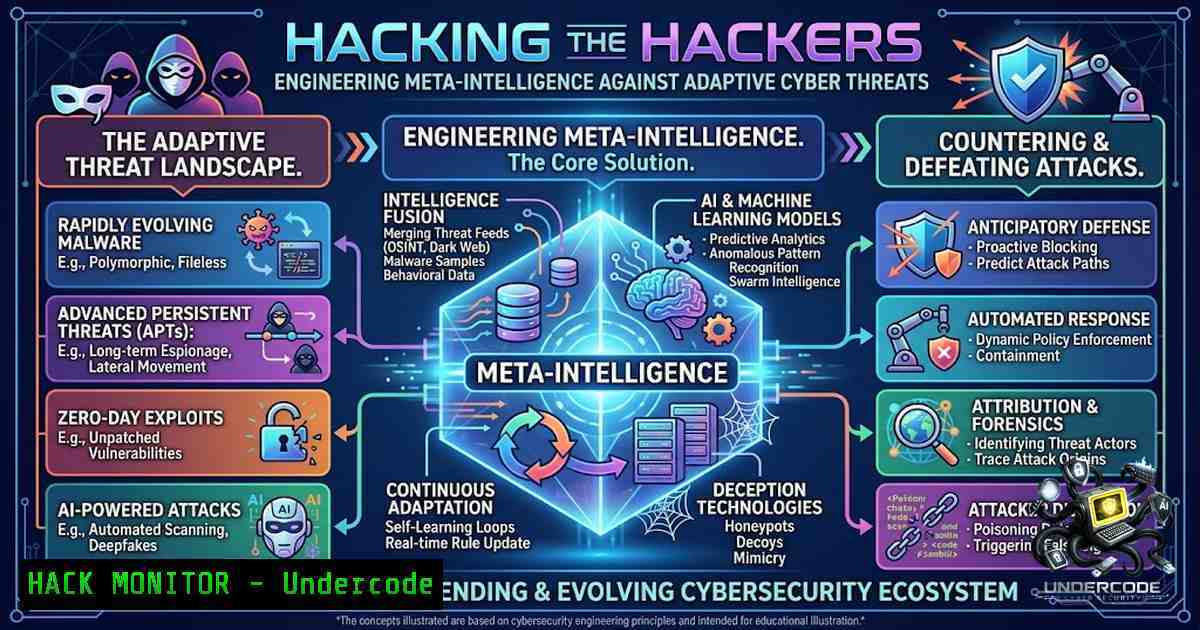
Introduction:
The traditional cybersecurity paradigm, focused on perimeter defense and signature-based detection, is increasingly inadequate against modern adversaries who operate as complex, adaptive systems. These threat actors learn from their environment, collaborate across underground networks, and mutate their tactics in response to defensive measures. The next frontier in cyber defense lies in moving beyond simple detection to understanding the adversarial ecosystem itself, employing meta-intelligence to anticipate, disrupt, and adapt faster than the threats can evolve.
Learning Objectives & Secrets:
- Objective 1: Understand the adversary as a System-of-Systems. This means mapping the interconnected nature of threat groups, their infrastructure, and their knowledge-sharing mechanisms.
- Objective 2 Secret Tips: Leverage “Adaptive Defense Loops.” Don’t just react to incidents. Implement a continuous cycle of Sense → Understand → Verify → Predict → Decide → Adapt → Learn → Evolve to stay ahead of attacker TTPs (Tactics, Techniques, and Procedures).
- Objective 3 Secret Tips: Focus on Behavioral Anomalies Over Indicators of Compromise (IoCs). IoCs are fleeting; behavioral analysis of system and network activity provides a more durable and predictive defense posture.
You Should Know:
1. From Static Defenses to Systemic Understanding
The core of the “Hacking the Hackers” philosophy is a paradigm shift from a reactive, checklist-based security model to a proactive, intelligence-driven one. It acknowledges that attackers are not monolithic but are part of a larger, adaptive ecosystem. They learn from each other, share tools and exploits in forums, and shift their focus based on what is profitable or vulnerable. For a defender, this means that collecting logs and blocking known bad IP addresses is no longer sufficient. You must analyze the enemy’s operational tempo, their preferred methods for initial access, and their post-exploitation behaviors.
Step‑by‑Step Guide to Building a System-of-Systems View:
- Data Aggregation: Centralize logs from all sources (endpoints, network, cloud, identity providers).
- Threat Intelligence Integration: Subscribe to and operationalize threat feeds (e.g., MISP, AlienVault OTX) to understand the broader threat landscape.
- Correlation & Analysis: Use a SIEM or XDR platform to correlate internal anomalies with external threat intelligence to identify emerging patterns.
- Adversary Emulation: Use frameworks like MITRE ATT&CK to map adversary behaviors and test your defenses against them proactively.
- Feedback Loop: Refine your detection rules and response playbooks based on the findings from each step.
2. The M∞ Meta-Intelligence Framework in Practice
The M∞ framework—Meta-Intelligence—is the practical application of this philosophy. It’s about building a “brain” for your security operations center (SOC). This involves creating a closed-loop system that uses AI and machine learning not just to detect, but to predict potential future attack vectors. For example, if your system observes a new exploit being discussed on dark web forums, it can automatically simulate that attack against your own infrastructure to identify gaps.
Step‑by‑Step Guide to Implementing a Predictive Intelligence Loop:
- Establish Baseline: Define “normal” behavior for users, applications, and network traffic.
- Continuous Monitoring: Deploy sensors to capture deep telemetry data across all environments.
- AI-Powered Analysis: Use machine learning models to detect deviations from the baseline that may indicate a sophisticated, low-and-slow attack.
- Automated Response: Implement playbooks that can contain a threat automatically (e.g., isolating an endpoint, blocking a domain) while the SOC investigates.
- Post-Incident Review: Conduct a “lessons learned” session to feed new insights back into the baseline and detection models.
Linux Command for Anomaly Detection:
To gain system-level insights, you can use auditd. For example, to monitor for unusual file access patterns, configure rules:
sudo auditctl -w /etc/passwd -p wa -k identity_changes
sudo auditctl -w /etc/shadow -p wa -k identity_changes
This command sets up auditing on critical system files, alerting you to unauthorized write attempts, which is a key indicator of potential privilege escalation attempts.
3. Building an Adaptive Defense System
Adaptability is the cornerstone of resilience. A defensive system that fails to adapt is a static target. This means your security architecture must be designed to evolve. You need to be capable of learning from near-misses and full-blown incidents to continuously harden your environment. This includes updating your firewall rules, access control lists, and endpoint protection policies in near real-time based on the intelligence gathered.
Step‑by‑Step Guide to Cloud Infrastructure Hardening (Azure Example):
- Enable Just-In-Time (JIT) VM Access: This prevents persistent access by only opening ports when needed.
- Implement Adaptive Network Hardening: Use Azure Security Center to analyze traffic patterns and automatically create NSG (Network Security Group) rules to restrict traffic.
- Deploy Adaptive Application Controls: Define application whitelists based on known good applications to prevent the execution of malicious binaries.
- Continuous Compliance Assessment: Automatically check your environment against benchmarks like CIS or NIST.
- Use Azure Policy: Enforce organization-wide security settings and automatically remediate non-compliant resources.
Windows PowerShell Command for Audit Logging:
To enable advanced audit logging on a Windows server, which is crucial for understanding attacks, use:
auditpol /set /subcategory:"Detailed File Share" /success:enable /failure:enable
auditpol /set /subcategory:"Process Creation" /success:enable /failure:enable
This ensures you are capturing crucial events like file access and process creation, which are essential for tracking attacker lateral movement.
4. Disrupting the Attacker’s Kill Chain
By understanding the adversary’s system, you can disrupt their operations at every stage of the cyber kill chain. Instead of only focusing on the final stage (the “objective”), a meta-intelligence approach allows you to jam their reconnaissance, deny them weaponization, interrupt their delivery, and block their command and control (C2) channels. For example, by analyzing C2 communication patterns, you can proactively block them or use deception technologies to waste the attacker’s time and resources.
Step‑by‑Step Guide to Implementing Deception Technology:
- Identify High-Value Assets: Determine which servers, data repositories, and applications are your crown jewels.
- Deploy Decoys: Place realistic decoy systems (honeypots) and credentials across your network.
- Monitor Decoys: Any interaction with a decoy is by definition malicious, allowing for immediate detection and high-fidelity alerts.
- Analyze Attacker Activity: Study the adversary’s actions in the decoy environment to learn their motives, tools, and strategies.
- Feed Intelligence Back: Use what you learn to strengthen the defenses on your actual systems.
5. The Ethical and Legal Considerations
The term “Hacking the Hackers” must be understood within a strict legal and ethical framework. It refers to understanding, not reciprocating, offensive actions. Active counter-hacking or “hacking back” is illegal in many jurisdictions and can escalate conflicts. The focus here is on offensive security—penetration testing, red teaming, and vulnerability research—to fix vulnerabilities before they can be exploited. The goal is to use the intelligence gathered to build a stronger, more resilient defense, not to breach the attacker’s systems.
What Undercode Say:
- Key Takeaway 1: The traditional “castle and moat” approach is obsolete. The modern defender must act as a systems thinker, mapping and understanding the complex adversary ecosystem to anticipate their next move.
- Key Takeaway 2: The true advantage lies in speed and adaptation. The defender who can sense changes in the threat landscape and adapt their defenses faster than the adversary can change their tactics will ultimately prevail.
Analysis: The post’s core argument is a profound and necessary evolution in cybersecurity thinking. It shifts the focus from specific tools and technologies to a holistic, intelligence-driven strategy. By treating the adversary as a complex adaptive system, security professionals can move from a purely reactive posture to a proactive and predictive one, making it significantly harder for attackers to achieve their objectives. The M∞ concept offers a compelling vision for the future of cyber defense, where resilience is built through continuous learning and adaptation, not static defenses. This approach demands a cultural shift within organizations, requiring more collaboration between security teams, threat intelligence analysts, and business leadership to effectively implement and sustain this systemic mindset.
Prediction:
- -1: Without adopting this systemic view, organizations will continue to be caught off-guard by evolving threats, suffering from breaches that are more complex and disruptive than traditional defenses can handle, leading to significant financial and reputational damage.
- -1: The increasing sophistication of AI-powered attacks will outpace human-only defense teams, creating a critical skills gap and making it impossible to manually keep up with the speed of malicious adaptation.
- +1: Organizations that successfully implement meta-intelligence frameworks will achieve a significant competitive advantage, demonstrating superior resilience and the ability to rapidly respond to new threats, thereby building greater trust with customers and partners.
- +1: The evolution toward understanding and anticipating adversarial systems will lead to the development of more robust and secure software and systems, as security will be “baked in” from the design phase rather than “bolted on” after deployment.
- +1: In the long term, a global ecosystem of shared threat intelligence and adaptive defense mechanisms could create a “rising tide” effect, raising the baseline security posture for all participants and making cyber attacks more costly and less effective for adversaries.
▶️ Related Video (90% Match):
🎯Let’s Practice For Free:
🎓 Live Courses & Certifications:
Join Undercode Academy for Verified Certifications
🚀 Request a Custom Project:
Secure, high-velocity infrastructure and disruptive technological engineering. Contact our engineering team for high-tier development and proprietary systems:
[email protected]
💎 Smart Architecture | 🛡️ Secure by Design | ⭐ Trusted by Thousands
IT/Security Reporter URL:
Reported By: https://lnkd.in/p/e4DK54HG – Hackers Feeds
Extra Hub: Undercode MoN
Basic Verification: Pass ✅


