Listen to this Post
Introduction:
A fascinating video of a singer performing inside an MRI machine has captured the internet’s imagination, but for cybersecurity professionals, it sounds a different alarm. This demonstration of capturing vocal tract movements in real-time, pioneered by artists like Anna-Maria Hefele, reveals a startling convergence of biomedical imaging and data synthesis. This article will deconstruct the underlying technology and explore its potential for malicious repurposing, transforming a medical diagnostic tool into a vector for advanced biometric theft and audio deepfake creation.
Learning Objectives:
- Understand the technical process of how real-time MRI (rt-MRI) can capture unique physiological data for voice synthesis.
- Learn to identify the security vulnerabilities in networked medical imaging systems and their adjacent data pipelines.
- Implement practical hardening measures for environments where sensitive biometric or medical data is processed.
You Should Know:
- The Anatomy of a Voice Synthesis Hack: From MRI to Audio File
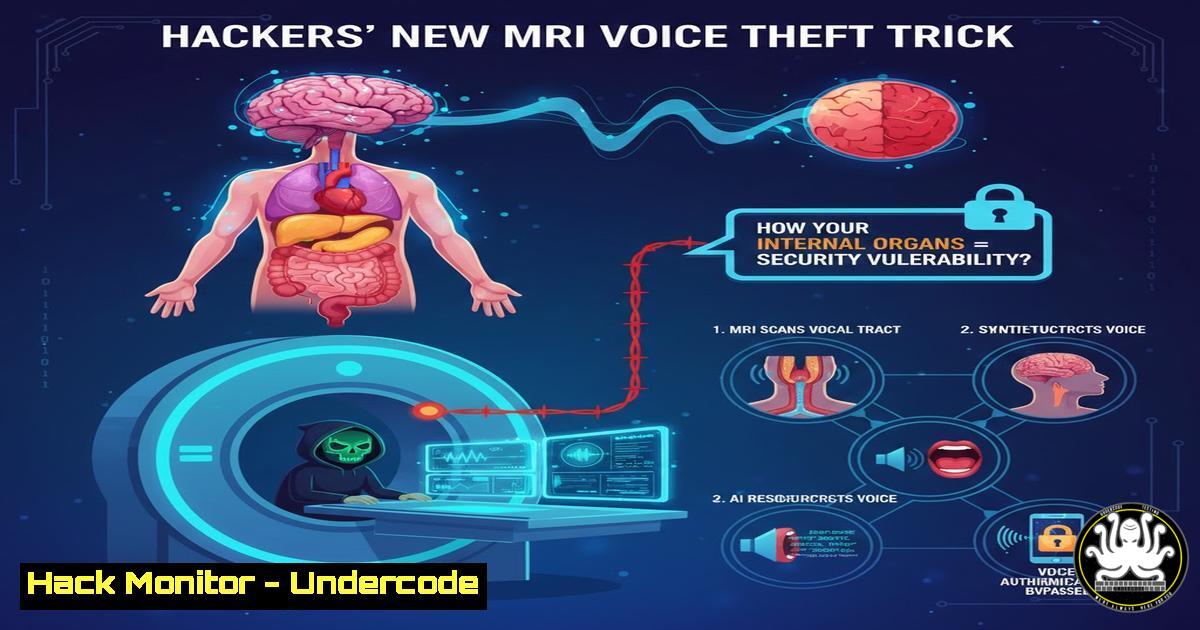
The core of this threat lies in the repurposing of real-time Magnetic Resonance Imaging (rt-MRI). Unlike standard MRI that takes static pictures, rt-MRI captures rapid sequential images, often at 10-30 frames per second. When focused on the vocal tract—the throat, tongue, and larynx—it creates a dynamic map of the precise shapes that produce specific sounds. This dataset of articulator movements is a biometric blueprint far more unique than a voiceprint; it’s the physical source of the voice itself. Attackers targeting this data aim to intercept these video feeds or stored files to train AI voice synthesis models that can mimic a victim with terrifying accuracy, bypassing traditional voice authentication.
Step‑by‑step guide explaining what this does and how to use it.
A proof-of-concept attack chain might involve:
- Reconnaissance: An attacker profiles a high-value target (e.g., a CEO, journalist) to identify if they have had recent medical procedures. Phishing or open-source intelligence (OSINT) might reveal this.
- Initial Access: The attacker exploits vulnerabilities in the hospital’s PACS (Picture Archiving and Communication System) or the MRI machine’s own software. Many medical devices run on legacy, unpatched operating systems.
Example Exploit Check (Linux-based PACS server):
 Use nmap to scan for outdated DICOM (medical image standard) services
nmap -p 104,11112 --script dicom-ping <target-hospital-ip-range>
 Search for known vulnerabilities in the detected service version
searchsploit "Orthanc DICOM"  Example open-source PACS software
3. Data Exfiltration: Once inside the network, the attacker locates and extracts rt-MRI DICOM files. These are often stored in clear text or with weak encryption.
Example Data Identification Command:
 Find large series of image files on a compromised system
find /mnt/pacs_storage -name ".dcm" -type f -size +10M | head -20
4. Model Training: The stolen image sequences are processed using AI toolkits like `TensorFlow` or `PyTorch` to train a neural network that maps vocal tract shapes to audio output.
5. Synthesis & Weaponization: The trained model generates audio of the target saying anything the attacker inputs, which can then be used in vishing (voice phishing) attacks, fraud, or disinformation campaigns.
- Fortifying the DICOM Data Pipeline: Securing Medical Imaging at Rest and in Transit
The Digital Imaging and Communications in Medicine (DICOM) standard is the backbone of medical imaging but was designed for functionality, not robust security. Its default configurations often lack encryption and proper access controls. The primary attack surfaces are the network ports used for DICOM communication (e.g., TCP 104, 11112) and the storage servers (PACS). Data is vulnerable during transmission from the MRI to the PACS and while at rest in archives.
Step‑by‑step guide explaining what this does and how to use it.
To secure this pipeline, a defense-in-depth approach is required:
1. Network Segmentation: Isolate all medical imaging devices and PACS servers on a dedicated VLAN, separate from the general hospital network. Implement strict firewall rules.
Example Windows Firewall Rule (on PACS server):
 Allow DICOM traffic ONLY from the MRI scanner's specific IP
New-NetFirewallRule -DisplayName "Allow DICOM from MRI-01" -Direction Inbound -Protocol TCP -LocalPort 104,11112 -RemoteAddress 192.168.10.50 -Action Allow
2. Encrypt DICOM Traffic: Enforce TLS encryption for all DICOM communications (DICOM TLS). This prevents eavesdropping on the image data stream.
Configuration typically involves: Generating and deploying X.509 certificates on the MRI and PACS systems and modifying the DICOM Application Entity (AE) configuration to require TLS.
3. Secure Storage Encryption: Ensure all DICOM files at rest are encrypted. Use full-disk encryption on PACS servers and database-level encryption for patient metadata.
Linux Example using LUKS for the PACS storage volume:
 Check if the volume is encrypted
sudo cryptsetup isLuks /dev/sdb1
 If not, it can be encrypted (WARNING: will destroy data)
sudo cryptsetup luksFormat /dev/sdb1
4. Harden the DICOM Service: Change default AE Titles and ports. Disable any unused DICOM services (e.g., storage commitment, modality worklist). Implement rigorous audit logging for all image access queries.
- AI Model Inversion: When Synthetic Voices Leak Your Biological Data
A secondary, advanced threat is model inversion attacks. If an attacker cannot steal the original MRI data but gains access to a voice synthesis model trained on that data, they may attempt to reverse-engineer the model to infer sensitive physiological attributes of the victim. This could reveal private medical conditions, such as the presence of tumors, growths, or post-surgical changes in the vocal tract, turning an audio tool into a medical privacy breach.
Step‑by‑step guide explaining what this does and how to use it.
Mitigating this risk involves securing the AI pipeline:
- Implement Differential Privacy: During the model training phase, add carefully calibrated statistical noise to the training data. This ensures the model learns general patterns without memorizing unique, individual biometric details. Libraries like `TensorFlow Privacy` can be integrated.
Python Code Snippet Concept:
import tensorflow_privacy
 Use a DP optimizer instead of a standard one
optimizer = tensorflow_privacy.DPKerasSGDOptimizer(
l2_norm_clip=1.0,
noise_multiplier=0.5,
num_microbatches=1,
learning_rate=0.01)
model.compile(optimizer=optimizer, ...)
2. Use Federated Learning: Train the voice synthesis model in a decentralized manner. The MRI data never leaves the hospital’s secure server; only encrypted model updates are shared. This drastically reduces the central point of failure for data theft.
3. Employ Model Obfuscation: Techniques like model watermarking or fingerprinting don’t prevent inversion but help trace the source of a leak if a model is stolen and misused.
4. Behavioral Biometrics as a Countermeasure
Since the physical source of a voice can potentially be cloned, security systems must evolve to detect synthetic audio. This is where behavioral biometrics comes in. It analyzes how a person speaks—their unique rhythm, pitch fluctuations, emphasis patterns, and even breathing pauses—which are much harder to perfectly replicate from an MRI-derived model alone.
Step‑by‑step guide explaining what this does and how to use it.
To integrate this defense:
- Deploy Specialized Detection APIs: Services like Azure AI Speech’s `Deepfake Detection` or open-source tools like `Resemble Detect` can analyze audio files for artifacts of AI generation.
- Implement Continuous Authentication: For high-security voice access systems, move beyond a one-time passphrase. The system should continuously monitor the user’s speech during a session for deviations from their learned behavioral profile.
Conceptual Logic Flow:
 Pseudo-code for continuous voice verification
user_audio_stream = get_live_audio()
baseline_profile = load_user_voice_profile()

while session_active:
live_features = extract_behavioral_features(user_audio_stream)
anomaly_score = compare(live_features, baseline_profile)

if anomaly_score > threshold:
flag_potential_deepfake()
request_2fa_or_terminate_session()
What Undercode Say:
The Vulnerability is the Interface: The most critical lesson is that any system which digitizes a human biological process—be it a heartbeat, a fingerprint, or the movement of vocal organs—creates a new, hackable data type. Security must be designed into these interfaces from the first prototype, not bolted on years later.
Convergence Creates New Attack Vectors: The intersection of medical technology, AI research, and audio engineering has birthed a novel threat. Future risks will emerge from other convergences, like genomics and AI or neuroimaging and brain-computer interfaces. Proactive threat modeling in these nascent fields is non-negotiable.
The MRI voice synthesis case is not about a specific software bug; it’s a paradigm warning. It demonstrates that as our ability to measure the human body advances, so does the fidelity of the digital ghosts we can create. The data generated for healing and understanding can, with a shift in intent, become the raw material for unprecedented deception. Defending against this requires a collaborative effort between cybersecurity experts, biomedical engineers, ethicists, and regulators to establish security standards that keep pace with diagnostic innovation.
Prediction:
This incident foreshadows a future where “biometric theft” evolves beyond copying surface traits to the theft of underlying physiological models. We will likely see the first high-profile vishing attack using a medically-sourced voice clone within the next 2-3 years, potentially targeting financial or political sectors. This will catalyze stricter regulations for medical data (beyond HIPAA) and spur the rapid adoption of “liveness detection” for voice biometrics, moving the industry towards multi-modal authentication that combines voice with other context-aware signals. The arms race between biometric synthesis and detection will become a central battleground in AI security.
▶️ Related Video (78% Match):
🎯Let’s Practice For Free:
IT/Security Reporter URL:
Reported By: Christine Raibaldi – Hackers Feeds
Extra Hub: Undercode MoN
Basic Verification: Pass ✅


