Listen to this Post
Introduction:
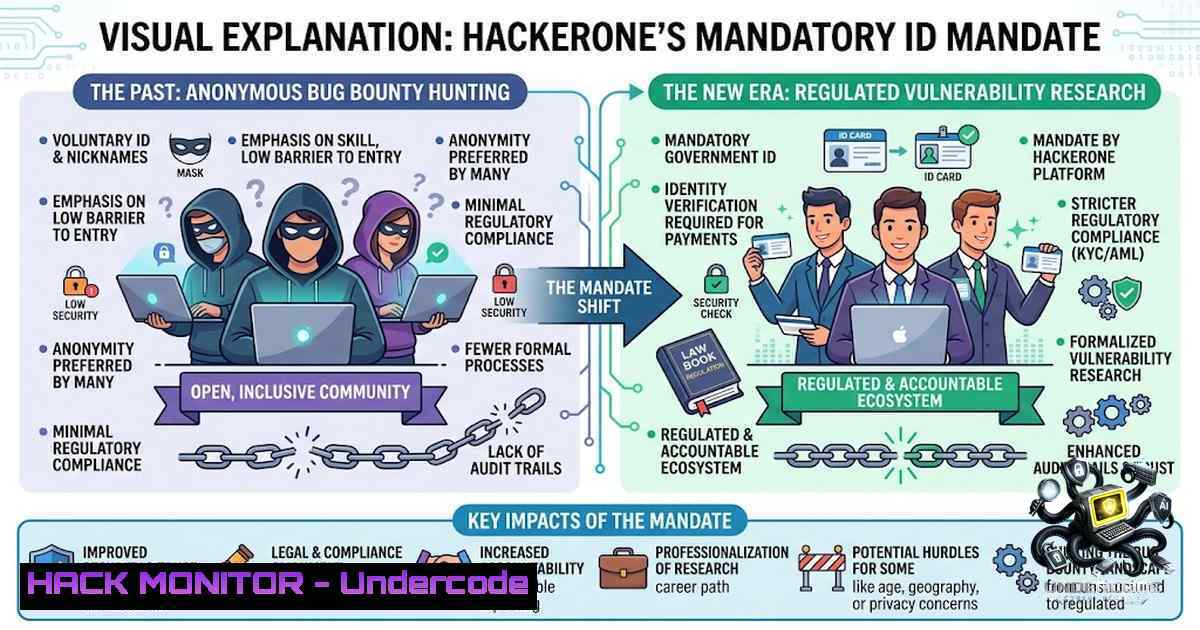
The bug bounty ecosystem, long celebrated as the frontier of crowdsourced security, is undergoing its most seismic shift since its inception. On August 14, 2026, HackerOne will implement a mandate requiring every security researcher to verify a government-issued ID before submitting vulnerabilities to any paid bug bounty program on its platform. This policy, driven by “regulatory requirements,” effectively terminates anonymous hacking on the world’s largest bug bounty platform, fundamentally altering the relationship between security researchers, platforms, and the regulatory state. For an industry built on pseudonymity and the merit of code over identity, this represents a critical inflection point where compliance architecture meets cybersecurity’s wild west.
Learning Objectives:
- Understand the technical implementation, eligibility criteria, and procedural requirements of HackerOne’s new ID verification system via Veriff.
- Analyze the security, privacy, and compliance implications of mandatory KYC (Know Your Customer) for vulnerability research.
- Identify practical workarounds, mitigation strategies, and alternative pathways for researchers affected by the new policy.
1. The Verification Gauntlet: Technical Requirements and Restrictions
HackerOne’s new policy is not merely a checkbox; it is a technically enforced identity barrier managed by Veriff, a third-party identity verification vendor. To become ID verified, a hacker must have submitted at least one valid report. The process requires users to sign the HackerOne Rules of Engagement before initiating verification via their profile page.
However, the technical restrictions are particularly draconian: the verification session will be rejected if the user is connected via a VPN, using an SDK emulator, operating a jailbroken device, or employing any traffic anonymizer. This forces researchers to expose their true IP addresses and device fingerprints during the verification flow, creating a direct linkage between their online research identity and their physical location and hardware. The verification itself requires a physical copy of a government-issued ID; digital copies are not supported. The process involves taking a photograph of the ID and a selfie, which Veriff’s technology checks for genuineness and facial matching.
Once completed, the verification is only valid for 12 months, with renewal required annually. Users are notified one month before expiration and lose verification privileges if they fail to renew within that window. This creates a recurring compliance burden and a potential single point of failure for researchers who might lose access to programs due to administrative lapses.
Step-by-Step Guide to HackerOne ID Verification:
Step 1: Eligibility Check – Ensure you have submitted at least one valid report on the HackerOne platform. Without this, the ID Verification option will not be available.
Step 2: Navigate to Profile – Go to your HackerOne User profile page and click on the “ID Verification” header.
Step 3: Sign Rules of Engagement – Click the “Sign the Rules of Engagement” button. Review the hyperlinked documents, tick the box to confirm agreement, and press Save.
Step 4: Prepare Your Environment – Before clicking “Start Verification,” you must:
– Disable any VPN or proxy service.
– Ensure you are not using an SDK emulator.
– Verify your device is not jailbroken or rooted.
– Disable any traffic anonymizers.
Step 5: Verification Session – Click “Start Verification” to hand the process over to Veriff. Photograph a valid, undamaged government ID (passport, national ID card, residence permit, or driver’s license) and take a live selfie.
Step 6: Await Confirmation – HackerOne typically emails a confirmation of verification status within three business days; pending reviews can take up to 48 hours before you need to consider contacting support.
- The Privacy Paradox: What Happens to Your Data?
The mandate raises profound privacy questions. HackerOne’s own history with data security does little to inspire confidence. In March 2026, almost 300 HackerOne employees were caught up in a data breach after a third-party benefits provider delayed breach notification by weeks. While HackerOne claimed there was no evidence of misuse, the company proceeded on the assumption that the data could still be abused.
Furthermore, HackerOne has faced public backlash from researchers who questioned whether bug bounty submissions and customer data were being used to train its new agentic pentesting offering (Agentic PTaaS) and its AI system (Hai). Although HackerOne responded that it does not train generative AI models on researcher submissions or customer confidential data, the suspicion alone highlights the trust deficit that now exists between the platform and its researcher community.
The verification process itself is a data goldmine. By requiring researchers to disable VPNs and anonymizers, HackerOne and Veriff gain access to:
– True IP addresses and geolocation data.
– Device fingerprints (hardware identifiers, browser configurations).
– Biometric data (facial recognition scans).
– Government ID details (name, date of birth, ID number, address).
This data is stored and linked to every vulnerability report a researcher submits, creating a permanent, auditable trail that connects real-world identity to security research activities. For researchers operating in jurisdictions with repressive regimes or for those who fear retaliation from powerful entities they have exposed vulnerabilities in, this is an existential threat.
3. The Researcher’s Dilemma: Compliance vs. Principle
The mandate creates a clear bifurcation: paid bug bounty programs now require ID verification, while Vulnerability Disclosure Programs (VDPs) remain open to unverified researchers since no monetary reward is involved. This distinction is critical. Researchers who refuse to verify their identity can still participate in VDPs, but they forfeit any financial compensation for their findings.
For many researchers, especially those in countries with weaker economies, bug bounty income is a significant livelihood. The mandate effectively forces them to choose between their privacy and their paycheck. As one Hacker News commenter put it: “Yikes”.
Moreover, the policy applies to every account, new and existing, across all bug bounty programs, whether managed or unmanaged. There is no grandfather clause; even veteran researchers with years of contributions must comply.
Linux/Windows Commands for Privacy-Conscious Researchers:
For researchers concerned about the data leakage during verification, consider these commands to audit your digital footprint:
On Linux:
 Check your current IP and geolocation
curl ifconfig.me
curl ipinfo.io

Check for active VPN/Proxy connections
ip addr show
netstat -tulpn | grep -E "openvpn|wireguard|proxy"

Check if your device is rooted (Android emulator detection)
adb shell su -c "id"
On Windows:
 Check your public IP
(Invoke-WebRequest ifconfig.me).Content.Trim()

Check for active VPN connections
Get-1etAdapter | Where-Object {$_.Status -eq "Up"}
Get-VpnConnection

Check for proxy settings
netsh winhttp show proxy
For Browser Fingerprinting Protection:
- Use Firefox with ResistFingerprinting enabled (
about:config→ `privacy.resistFingerprinting` =true). - Use Brave Browser with Shields Up and fingerprinting blocking.
- Consider using a dedicated verification device that you wipe clean after the process.
4. The Regulatory Rationale: Compliance or Control?
HackerOne claims the mandate is necessary to meet regulatory requirements. While the specific regulations are not named, several plausible drivers exist:
- Anti-Money Laundering (AML) and Counter-Terrorism Financing (CTF): Bounty payments are financial transactions. Regulators increasingly require platforms to know who they are paying.
- Tax Compliance: HackerOne has already updated ID verification eligibility for tax form purposes, requiring at least one valid report submission or receipt of an award before tax form completion.
- Sanctions Screening: Governments require platforms to ensure they are not paying individuals or entities on sanctions lists.
- Liability Shifting: By verifying identities, HackerOne can shift liability to researchers if they engage in illegal activities while testing.
However, the opacity of the “regulatory requirements” justification has bred skepticism. If the mandate were purely about compliance, why the draconian technical restrictions (no VPN, no emulators, no jailbroken devices)? These restrictions go beyond KYC and into device and network forensics, suggesting a broader surveillance agenda.
5. Alternative Pathways: Where Can Anonymous Researchers Go?
For researchers unwilling to comply, several alternatives exist:
- Vulnerability Disclosure Programs (VDPs): As noted, VDPs remain open to unverified researchers. While they offer no monetary rewards, they provide a pathway to responsible disclosure and reputation building.
-
Self-Hosted Bug Bounty Platforms: Platforms like Bugcrowd and YesWeHack may or may not follow HackerOne’s lead. Researchers should monitor their policies closely.
-
Direct Reporting: Many organizations accept vulnerability reports directly via security@ email addresses or web forms, bypassing third-party platforms entirely.
-
Decentralized/Blockchain-Based Platforms: Emerging platforms like Immunefi (focused on DeFi) and Hats Finance offer bug bounty programs with varying KYC requirements. Some may offer more privacy-preserving options.
-
Open Source Security Auditing: Contributing to open source projects through platforms like GitHub Security Advisories allows researchers to disclose vulnerabilities without ID verification, often with no financial reward but with public recognition.
Configuration Example: Setting Up a Secure, Anonymous Reporting Workflow:
For researchers who want to maintain privacy while reporting vulnerabilities directly:
- Use Tails OS – A privacy-focused operating system that routes all traffic through Tor.
- Use ProtonMail or Tutanota – Encrypted email services that do not require phone verification.
- Use a Burner Device – A dedicated laptop or smartphone used only for security research.
- Use Monero (XMR) – If accepting payments, use privacy-focused cryptocurrencies.
- Use a PO Box – For any physical mail required by programs.
6. The Clear Program: Verification on Steroids
HackerOne separates standard ID Verification from its more rigorous H1 Clear program, which layers on a stringent criminal background check via Checkr and is reserved for a smaller subset of vetted hackers. While basic ID Verification is mandatory for all paid submissions, Clear requires an additional, more invasive background check.
Hackers who hold Clear status still need to prioritize their annual ID Verification renewal, since lapsing on this requirement puts their Clear privileges at risk too. The Clear program is typically required for pentesting engagements and access to sensitive internal assets.
API Security Consideration:
For researchers testing APIs, the verification mandate has implications for API key management. HackerOne’s API may now require verified identity for certain endpoints. Researchers should review the API documentation for any new authentication requirements.
 Example: Testing HackerOne API with verified token
curl -X GET "https://api.hackerone.com/v1/reports" \
-H "Authorization: Bearer YOUR_VERIFIED_TOKEN" \
-H "Accept: application/json"
- The Future of Bug Bounty: Regulated Vulnerability Research
HackerOne’s mandate signals a broader trend: the institutionalization and regulation of vulnerability research. What was once a Wild West of pseudonymous hackers competing for bounties is becoming a regulated industry with KYC, background checks, and compliance requirements.
This shift has both positive and negative implications:
- Positive: Reduced fraud, improved tax compliance, better accountability for malicious actors.
- Negative: Suppression of whistleblowers, chilling effect on research in repressive regimes, loss of the meritocratic ethos that made bug bounty programs revolutionary.
The mandate also raises questions about equity. Researchers from countries with weak ID infrastructure, or those who cannot afford to maintain a clean, non-jailbroken device, may be effectively excluded from the ecosystem.
Cloud Hardening Tip:
For organizations running bug bounty programs, consider implementing Zero Trust Architecture for your testing environments:
 Example: Terraform configuration for an isolated testing environment
resource "aws_vpc" "bug_bounty_vpc" {
cidr_block = "10.0.0.0/16"
enable_dns_hostnames = true
}

resource "aws_security_group" "bounty_sg" {
name = "bounty-sg"
ingress {
from_port = 443
to_port = 443
protocol = "tcp"
cidr_blocks = ["0.0.0.0/0"]
}
 Restrict access to verified researchers only
}
What Undercode Say:
- The Privacy vs. Paycheck Dilemma is Real: Researchers now face an impossible choice: protect their anonymity or earn a living. This will drive talent away from HackerOne and toward alternative platforms or direct reporting.
- Regulatory Capture of Cybersecurity: The mandate is a harbinger of things to come. As governments increasingly regulate the cybersecurity industry, platforms will be forced to implement KYC and surveillance measures, fundamentally changing the nature of ethical hacking.
Analysis: The HackerOne mandate is not an isolated event; it is part of a broader trend toward the financialization and regulation of cybersecurity. Bug bounty programs have always existed in a gray area between legitimate security research and potential legal liability. By requiring ID verification, HackerOne is attempting to formalize the industry, reduce fraud, and protect itself from regulatory scrutiny. However, this comes at the cost of the anonymity that has been a cornerstone of the hacker ethic. The mandate will likely accelerate the development of decentralized, privacy-preserving bug bounty platforms and force researchers to adapt their workflows. For organizations, this means a more vetted, but potentially smaller, pool of researchers. For researchers, it means learning to navigate a new landscape where identity is currency and privacy is a luxury.
Expected Output:
Introduction:
The bug bounty ecosystem, long celebrated as the frontier of crowdsourced security, is undergoing its most seismic shift since its inception. On August 14, 2026, HackerOne will implement a mandate requiring every security researcher to verify a government-issued ID before submitting vulnerabilities to any paid bug bounty program on its platform. This policy, driven by “regulatory requirements,” effectively terminates anonymous hacking on the world’s largest bug bounty platform, fundamentally altering the relationship between security researchers, platforms, and the regulatory state.
What Undercode Say:
- The Privacy vs. Paycheck Dilemma is Real: Researchers now face an impossible choice: protect their anonymity or earn a living. This will drive talent away from HackerOne and toward alternative platforms or direct reporting.
- Regulatory Capture of Cybersecurity: The mandate is a harbinger of things to come. As governments increasingly regulate the cybersecurity industry, platforms will be forced to implement KYC and surveillance measures, fundamentally changing the nature of ethical hacking.
Prediction:
- -1 Loss of Talent: Anonymous researchers, particularly those from repressive regimes or those who fear retaliation, will abandon HackerOne, reducing the platform’s talent pool and the quality of vulnerability discoveries.
- -1 Rise of Decentralized Platforms: Decentralized, blockchain-based bug bounty platforms with privacy-preserving features will gain traction, fragmenting the market.
- -1 Chilling Effect on Research: The mandate will discourage researchers from reporting vulnerabilities that could expose powerful entities, leading to more unpatched zero-days in the wild.
- +1 Increased Accountability: Verified identities will reduce fraud, ensure tax compliance, and hold malicious actors accountable, professionalizing the industry.
- +1 Better Corporate Relationships: Organizations will have greater confidence in the legitimacy of researchers, potentially leading to higher bounties and more collaborative relationships.
▶️ Related Video (72% Match):
🎯Let’s Practice For Free:
🎓 Live Courses & Certifications:
Join Undercode Academy for Verified Certifications
🚀 Request a Custom Project:
Secure, high-velocity infrastructure and disruptive technological engineering. Contact our engineering team for high-tier development and proprietary systems:
[email protected]
💎 Smart Architecture | 🛡️ Secure by Design | ⭐ Trusted by Thousands
IT/Security Reporter URL:
Reported By: Pethu Hackerone – Hackers Feeds
Extra Hub: Undercode MoN
Basic Verification: Pass ✅


