Listen to this Post
Introduction:
Most executives perceive AI security as a model-level threat—prompt injections or data leaks. However, the real enterprise-grade vulnerabilities are systemic, embedded within the very stack that makes AI operational. A failure to harden layers like orchestration and integration doesn’t just break functionality; it creates predictable attack surfaces that adversaries can exploit to escalate privileges, exfiltrate data, or manipulate business logic at scale. This article deconstructs the LLM stack from an adversarial perspective, providing a technical blueprint for where and how to fortify it.
Learning Objectives:
- Identify the most exploitable vulnerability in each layer of a production LLM stack.
- Implement critical security hardening for orchestration frameworks and API integrations.
- Apply proactive monitoring and testing commands to detect weaknesses before adversaries do.
You Should Know:
- The Foundation is Flawed: Securing Data and Preprocessing (Layers 1 & 2)
The principle “garbage in, garbage out” has a sinister counterpart: “poison in, weaponized out.” An insecure data pipeline is the first step toward a compromised model.
Step-by-step Guide:
The Threat: Attackers can poison training data or bias preprocessing logic to create hidden triggers, causing the model to behave maliciously when specific inputs are detected. Unsecured data lakes are also prime targets for bulk exfiltration.
The Hardening:
- Implement Data Lineage & Integrity Checks: Use tools like `Apache Atlas` or `Great Expectations` to track data provenance. Compute and verify checksums at each pipeline stage.
Generate and store SHA-256 checksum for a critical dataset
sha256sum training_data.json > training_data.sha256
Verify integrity before processing
sha256sum -c training_data.sha256
- Sanitize with Precision: Move beyond basic cleaning. Use differential privacy in preprocessing or tools like `Microsoft Presidio` to actively find and anonymize PII before training.
- Harden Storage: Encrypt data at rest and in transit. For cloud buckets (e.g., AWS S3), enforce strict bucket policies and disable public access.
Example AWS CLI command to block all public access on an S3 bucket
aws s3api put-public-access-block \
--bucket your-data-bucket \
--public-access-block-configuration "BlockPublicAcls=true,IgnorePublicAcls=true,BlockPublicPolicy=true,RestrictPublicBuckets=true"
-
The Training Compromise: When Your Model Becomes a Trojan Horse (Layer 3)
Focusing solely on “GPT vs. Claude” ignores how the training environment itself can be subverted.
Step-by-step Guide:
The Threat: Compromised training pipelines can lead to model stealing (theft of intellectual property) or the insertion of backdoors. Insecure dependencies in training scripts are a common entry point.
The Hardening:
- Isolate the Training Environment: Treat the training cluster as a high-security zone. Use isolated VPCs, strict network security groups, and require VPN/jumpbox access.
- Secure the CI/CD Pipeline: Harden the GitHub Actions, GitLab CI, or Jenkins pipeline that launches training jobs. Use secrets management for API keys and scan code for vulnerabilities.
Example GitLab CI job snippet for security scanning
train_model:
stage: train
image: tensorflow/tensorflow:latest
before_script:</li>
</ol>

- apt-get update && apt-get install -y git
- echo "$MODEL_SECRET_KEY" | docker login -u $CI_REGISTRY_USER --password-stdin $CI_REGISTRY
script:
- python train.py
dependencies:
- security_scan  Ensure a prior job scans for vulnerabilities
3. Audit Dependencies: Continuously scan for vulnerabilities in Python packages (
torch,transformers, etc.).Use safety or trivy to scan Python dependencies for known vulnerabilities pip list | safety check --stdin Or for containerized training trivy image your-training-image:latest
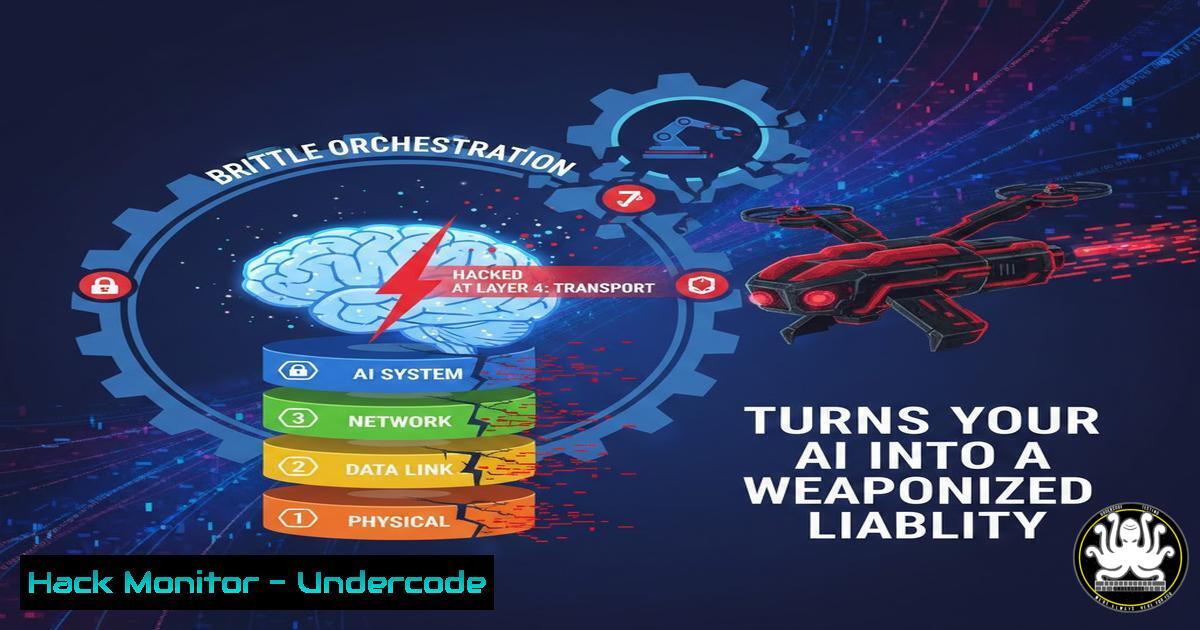
- The Adversarial Playground: Exploiting Brittle Orchestration (Layer 4)
This is the core nervous system of your AI application—and its most brittle component. As the LinkedIn comments noted, weak orchestration leads to “brittle agents and hidden risk.”
Step-by-step Guide:
The Threat: Orchestration layers (e.g., LangChain, LlamaIndex, custom agents) manage context, tool calls, and memory. Attackers can exploit poorly implemented tool permissions to execute shell commands, manipulate memory to induce amnesia or bias, or bypass guardrails through iterative probing.
The Hardening:
- Principle of Least Privilege for Tools: Never grant an AI agent unrestricted access to a shell or database. Use strict, sandboxed interfaces.
UNSAFE: Direct shell access
agent.tools = [ShellTool()]
SAFE: Restricted, validated interface
import subprocess
ALLOWED_COMMANDS = ['ls -la /safe/dir', 'cat /app/log.txt']
def safe_command_executor(user_input):
if user_input not in ALLOWED_COMMANDS:
return "Command not permitted."
try:
result = subprocess.run(user_input.split(), capture_output=True, text=True, timeout=5)
return result.stdout
except subprocess.TimeoutExpired:
return "Command timed out."
Expose only the safe_executor function as a tool to the agent
- Harden Memory & Guardrails: Encrypt sensitive conversation history. Implement layered guardrails—syntax checks, semantic filters, and a final output scanner—instead of a single, easily-jailbroken prompt.
- Stress Test with Adversarial Simulations: Regularly test your orchestration with tools like `Garak` (LLM vulnerability scanner) or custom red-team prompts designed to break tool constraints.
-
The Costly Breach: Weaponizing Inference and Integration (Layers 5 & 6)
Inference APIs and integrations are the gates between your AI and the world. They are under constant, automated attack.
Step-by-step Guide:
The Threat: Unprotected inference endpoints are susceptible to Denial-of-Wallet attacks (malicious queries that spike costs), model stealing via repeated queries, and data leakage through responses. Weak API authentication (Layer 6) can turn an AI feature into a pivot point into your core systems.
Hardening:
- Fortify the Inference Endpoint: Implement strict rate limiting, query costing, and anomaly detection. For cloud-based LLMs, use API gateway features.
Example using NGINX for basic rate limiting on an inference endpoint In nginx.conf location block location /v1/completions { limit_req zone=llm burst=5 nodelay; proxy_pass http://inference_service; Set timeouts to prevent resource exhaustion proxy_read_timeout 30s; proxy_connect_timeout 5s; } - Implement Zero-Trust Integration: Never trust requests from the AI layer implicitly. Use robust service-to-service authentication (e.g., mutual TLS, API keys with short lifetimes) for all internal APIs. Every service must verify the identity and permissions of the caller, even if it’s your own AI agent.
- Audit and Log Everything: Log all inference inputs/outputs (with PII redacted) and API calls for security audits. Use these logs to establish a baseline and detect anomalous patterns.
-
The Deceptive Surface: When the Application Layer Lies (Layer 7)
The user-facing application (copilot, chatbot) is the final facade. It can be designed to appear secure while the underlying stack is compromised.
Step-by-step Guide:
The Threat: Input validation that exists only on the client-side can be bypassed. Over-reliance on the LLM for security decisions (e.g., “Is this query allowed?”) creates a circular vulnerability.
The Hardening:
- Validate on the Server, Always: Replicate all input validation and sanitization in your backend services. Treat the client as untrusted.
- Design Secure UX: Avoid having the AI directly output security-critical information (like passwords, internal IPs) without human approval or secondary verification channels.
- Conduct Penetration Testing: Regularly engage red teams to test the entire stack, from prompt injection through the UI to data exfiltration via compromised tools. Use frameworks like the `OWASP Top 10 for LLMs` as a guide.
What Undercode Say:
- The Weakest Link Dictates Security: An organization’s AI security posture is not defined by its strongest layer, but by its most poorly configured one. Adversaries will systematically probe Layers 4 (Orchestration) and 6 (Integration) first, as these often have the highest payoff for the least effort.
- Security is a System Property: You cannot bolt on security after building the stack. Each architectural decision—from how an agent calls a tool to how APIs authenticate—must be made with an adversarial mindset from the start. The comments highlighting that “AI ROI is a systems problem” apply doubly to security.
Prediction:
In the next 18-24 months, we will witness a surge in sophisticated, multi-layer AI stack attacks. These will not be simple prompt hacks, but automated campaigns that systematically exploit weak data governance to poison models, target orchestration vulnerabilities to take autonomous control of agents, and abuse insecure integrations for lateral movement into corporate networks. The teams that survive will be those who shift from viewing AI as a magical model to treating it as a complex, distributed system requiring traditional IT hardening, continuous adversarial testing, and defense-in-depth principles. The era of AI as a security afterthought is ending; it is becoming the primary attack surface.
▶️ Related Video (80% Match):
🎯Let’s Practice For Free:
IT/Security Reporter URL:
Reported By: Gabriel Millien – Hackers Feeds
Extra Hub: Undercode MoN
Basic Verification: Pass ✅🔐JOIN OUR CYBER WORLD [ CVE News • HackMonitor • UndercodeNews ]
📢 Follow UndercodeTesting & Stay Tuned:
- The Adversarial Playground: Exploiting Brittle Orchestration (Layer 4)


