Listen to this Post
Introduction:
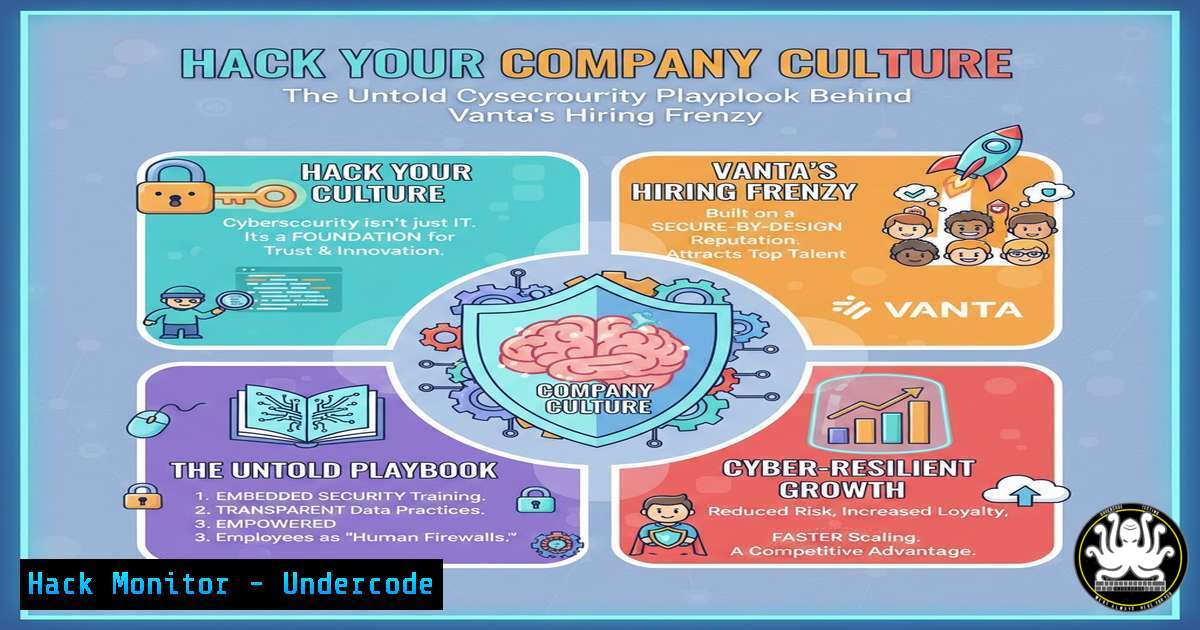
While a viral LinkedIn post celebrating team culture and hiring may seem purely corporate, for cybersecurity professionals, it signals a critical strategic shift. Companies like Vanta, which specializes in automated security compliance, are aggressively scaling by embedding security operations (SecOps) and governance directly into their core business functions like Revenue Operations (RevOps). This convergence is not about posting job ads; it’s about engineering a human firewall where every hire strengthens the organization’s security posture from within. The race is on to build teams that don’t just use security tools but live the security mindset, turning cultural buy-in into the ultimate vulnerability mitigation strategy.
Learning Objectives:
- Decode how modern tech companies integrate security principles directly into business and operational roles to create a proactive defense culture.
- Implement technical audits and controls that mirror the compliance automation Vanta sells, ensuring your internal practices match vendor promises.
- Leverage AI and automation tools to scale security training and monitoring in a rapidly growing organization, preventing cultural dilution.
You Should Know:
- The “GTMOps” Fusion: Where Security Meets Business Velocity
The post mentions “GTMOps,” a blend of Go-To-Market and Operations. In a security-centric company, this means embedding compliance checks into every sales, marketing, and customer onboarding workflow. The technical goal is to ensure that growth does not outpace security.
Step‑by‑step guide:
Concept: Automate the enforcement of security policies within business tools like CRM (e.g., Salesforce) and marketing platforms.
Action: Use APIs to connect your compliance tooling to business systems. For example, a script can check if a new sales prospect is from a sanctioned entity or if customer data being logged meets privacy standards.
Example Script (Python – Pseudocode):
import requests
 API call to internal compliance engine before creating a CRM lead
def vet_prospect(company_domain):
compliance_api_url = "https://compliance.internal/check"
payload = {"entity": company_domain, "check_type": "sanctions"}
response = requests.post(compliance_api_url, json=payload)
return response.json().get('approved', False)

if vet_prospect(new_lead_domain):
create_lead_in_crm()
else:
alert_security_team()
Tooling: Use Vanta, Drata, or open-source tools like OPA (Open Policy Agent) to define and enforce policies as code.
- Hardening Your “Absolute Killers”: Onboarding with Security from Day One
Scaling the team with “absolute killers” introduces risk if their access and training aren’t meticulously controlled. A structured, automated onboarding process is non-negotiable.
Step‑by‑step guide:
Concept: Implement Just-In-Time (JIT) and Role-Based Access Control (RBAC) using your identity provider (e.g., Okta, Azure AD).
Action:
- Pre-Onboarding: Use HRIS integrations to auto-provision accounts in a disabled state.
- Day One: Run a script that grants base access to essential tools (email, Slack) upon identity verification.
- Privileged Access: For engineers, require a ticket and manager approval for access to production systems. Use a PAM (Privileged Access Management) tool or configure `sudo` rights carefully.
Linux Command Example: Restrict `sudo` access to a specific user group for a critical command.In /etc/sudoers.d/developers %dev-team ALL=(ALL) /usr/bin/systemctl restart nginx Denies all other sudo commands to this group
Windows Command Example: Use PowerShell to add a user to a specific security group.
Add-ADGroupMember -Identity "Security-Cloud-ReadOnly" -Members "john.doe"
-
The AI Llama in the Room: Securing Generative AI Tools
The joking reference to an “AI two-headed llama” highlights the pervasive use of generative AI (like Llama). Unmanaged AI tool usage is a massive data exfiltration vector.
Step‑by‑step guide:
Concept: Apply data loss prevention (DLP) principles to AI chat interfaces and APIs.
Action:
- Network Control: Use firewall rules or a secure web gateway to block unauthorized AI tools. Allow only approved vendors.
- Browser Extension Control: Deploy management policies to disable unapproved AI browser extensions.
- API Security: If using internal AI models, secure the API endpoints with strict authentication, rate limiting, and input sanitization.
Example Mitigation: Configure a cloud security group (AWS example) to restrict outbound traffic to only approved AI service IPs.AWS CLI snippet to update a security group aws ec2 authorize-security-group-egress \ --group-id sg-12345678 \ --ip-permissions 'IpProtocol=tcp,FromPort=443,ToPort=443,IpRanges=[{CidrIp=192.0.2.0/24}]'
4. “Prove Trust” Internally: Continuous Vulnerability Management
Vanta’s mission is to help businesses “earn and prove trust.” This must be mirrored internally with continuous vulnerability assessment.
Step‑by‑step guide:
Concept: Shift from periodic scans to continuous, automated vulnerability discovery and patching.
Action:
- Agent Deployment: Install lightweight vulnerability agents on all servers and workstations.
- Container Scanning: Integrate static application security testing (SAST) and software composition analysis (SCA) tools like Snyk or Trivy directly into the CI/CD pipeline.
- Automated Patching: For infrastructure as code (IaC), use `terraform apply` with updated AMIs/versions. For workstations, enforce patch deadlines via MDM (Mobile Device Management) or Group Policy.
Example Command: Run a quick container image scan with Trivy.trivy image --severity CRITICAL,HIGH your-app-image:latest
-
API Security: The Silent Backbone of Modern Ops
The seamless integration mentioned between teams implies heavy API use. APIs are prime attack targets and must be hardened.
Step‑by‑step guide:
Concept: Protect APIs beyond just using API keys. Implement OAuth 2.0, rigorous input validation, and rate limiting.
Action:
- Use an API Gateway: Enforce security policies centrally (e.g., AWS API Gateway, Apigee).
- Validate and Sanitize: For every endpoint, validate schema and sanitize inputs to prevent injection attacks.
- Monitor and Log: Log all API traffic for anomalies. Use a tool like Elastic SIEM to detect suspicious patterns.
Example Code Snippet: Basic Express.js middleware for rate limiting.const rateLimit = require('express-rate-limit'); const apiLimiter = rateLimit({ windowMs: 15 60 1000, // 15 minutes max: 100, // Limit each IP to 100 requests per window message: 'Too many requests from this IP' }); app.use('/api/', apiLimiter);
What Undercode Say:
- Culture is Configuration: The most sophisticated security tool is irrelevant without a culture configured to use it. Hiring for security-mindedness in every role, as hinted at in the post, is more critical than any single technology purchase.
- Automation is the Enabler: Scaling a security culture “across the board” is only possible by automating compliance checks, access reviews, and policy enforcement. The human team strategizes; the machines execute the consistent, tedious work.
Analysis:
The LinkedIn post is a masterclass in signaling security maturity. Vanta isn’t just selling a product; they are operationalizing their own medicine. The excitement around hiring reflects a strategic understanding that in 2024, cybersecurity is a team sport played across all departments. The technical depth lies not in the post’s text, but in the invisible architecture required to support such rapid, secure growth. It underscores that the endpoint of modern security programs is not a perfectly hardened system—an impossible goal—but a resilient, aware, and agile organization where every employee is a conscious node in the security mesh. The reference to AI tools and “GTMOps” crime partners reveals the next frontier: securing the hyper-automated, AI-augmented business environment where the attack surface is behavioral as much as it is technological.
Prediction:
The future impact of this “hack” on company culture is the emergence of the Security-First Revenue Organization. We will see the dissolution of traditional security silos, with SecOps principles becoming default in SalesOps, RevOps, and MarketingOps. AI will be used not just for threat detection, but to model behavioral risks within teams and optimize security training in real-time. Companies that fail to engineer this cultural and technical fusion will be outcompeted, not just on security audits, but on talent acquisition, customer trust, and ultimately, revenue growth. The line between a “great place to work” and a “secure place to work” will vanish entirely.
▶️ Related Video (84% Match):
🎯Let’s Practice For Free:
IT/Security Reporter URL:
Reported By: Joshmacintyre If – Hackers Feeds
Extra Hub: Undercode MoN
Basic Verification: Pass ✅


