
Listen to this Post
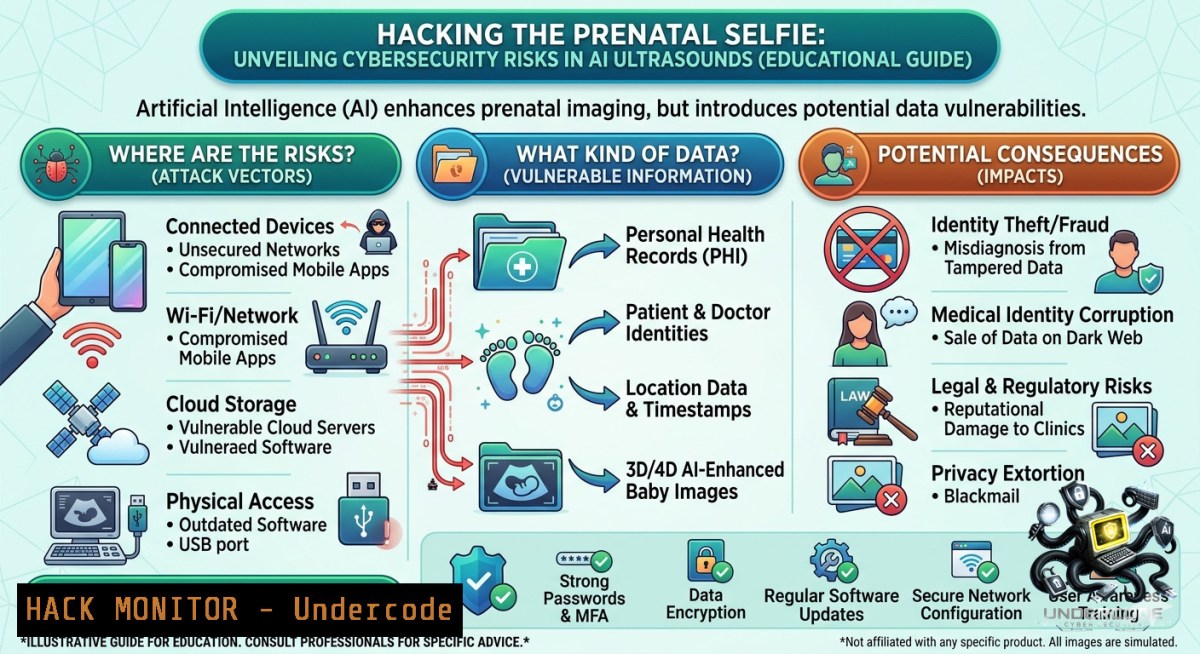
Introduction:
The convergence of consumer-grade medical devices, wireless communication, and cloud-based AI introduces unprecedented risks. While the Terna Wireless Handheld Ultrasound Scanner promises emotional bonding for parents, its reliance on Wi-Fi/Bluetooth transmission and AI-assisted measurement APIs creates a sprawling attack surface that threat actors can exploit to intercept sensitive fetal imaging, manipulate diagnostic data, or pivot into home networks.
Learning Objectives:
- Identify and exploit insecure wireless protocols (Bluetooth LE, Wi-Fi Direct) commonly used in portable medical IoT devices.
- Analyze cloud-based AI inference endpoints for injection flaws, broken authentication, and data leakage.
- Implement network segmentation, traffic filtering, and firmware validation to mitigate consumer-grade device risks.
You Should Know:
- Wireless Protocol Reverse Engineering for IoT Ultrasound Devices
Many handheld medical devices use unauthenticated Bluetooth Low Energy (BLE) or open Wi-Fi Direct channels to stream B‑mode images. Without proper encryption, an attacker within range can capture live fetal ultrasound feeds.
Step‑by‑step guide to assess BLE exposure (Linux):
- Install Bluetooth tools: `sudo apt install bluez bluez-utils bluetooth rfkill`
– Scan for visible devices: `sudo hcitool scan` or `sudo bluetoothctl scan on`
– Enumerate BLE services and characteristics:
`sudo gatttool -b –primary`
`sudo gatttool -b –characteristics`
- Attempt read/write to unprotected handles:
`sudo gatttool -b –char-read -a 0x0012`
For Windows: Use `btlejack` via WSL or tools like Wireshark with a compatible Bluetooth dongle to capture BLE packets.
What this does: Identifies if the device broadcasts imaging data without encryption or access control, allowing man‑in‑the‑middle interception.
- Cloud AI API Abuse and Basic Measurement Manipulation
The post mentions “Cloud based AI can assist in basic measurements.” These API endpoints are often misconfigured, exposing patient metadata or accepting malformed inputs that alter measurements.
Step‑by‑step API security testing:
- Capture API traffic using Burp Suite or mitmproxy after pairing the device.
- Look for endpoints like
/api/v1/measure,/inference/biparietal,/upload/image. - Test for IDOR (Insecure Direct Object Reference): change sequential `patient_id` or `scan_id` parameters.
- Inject unexpected values: `{“measurement”: “12cm”} → {“measurement”: “12cm; DROP TABLE”}` to test for NoSQL/SQL injection in cloud logs.
- Use curl to replay requests:
`curl -X POST https://cloud-ultrasound.api/measure -H “Content-Type: application/json” -d ‘{“frame”:”base64…”,”type”:”bpd”}’` - Attempt to bypass rate limits by rotating dummy tokens.
Mitigation: Enforce OAuth 2.0 with short-lived tokens, input validation, and signed API payloads.
3. Hardening Home Networks Against Medical IoT Eavesdropping
Default home Wi-Fi and IoT configurations rarely isolate medical devices, meaning a compromised ultrasound scanner can become a foothold for lateral movement.
Step‑by‑step network segmentation (Linux/Windows):
- Create a dedicated VLAN for IoT medical devices (requires managed switch + router). Example on OpenWrt:
`uci add network vlan`
`uci set network.@vlan[-1].device=”eth0″`
`uci set network.@vlan[-1].vlan=”20″`
`uci commit network; service network restart`
- Set firewall rules to block IoT→LAN and IoT→WAN except to cloud API whitelist:
`iptables -A FORWARD -i iot0 -o br-lan -j DROP`
`iptables -A FORWARD -i iot0 -o wan -j ACCEPT -m iprange –dst-range 52.0.0.0/8` (example AWS range for that cloud AI) - On Windows, use PowerShell to set restricted network profile and outbound rules:
`New-1etFirewallRule -DisplayName “Block IoT ultrasound outbound” -Direction Outbound -RemoteAddress 192.168.20.0/24 -Action Block`Verification: Run `nmap -sn 192.168.20.0/24` from main LAN to confirm no response from IoT subnet.
4. Firmware Extraction and Unsigned Update Exploitation
If the device performs firmware updates over unencrypted channels or lacks digital signatures, an attacker can replace the ultrasound software with rogue code that exfiltrates images.
Step‑by‑step firmware analysis:
- Capture OTA update URL via device logs or proxy. Download the `.bin` or `.hex` file.
- Check for signature: `openssl dgst -sha256 -verify public_key.pem -signature firmware.sig firmware.bin`
– If unsigned, modify firmware using tools like `binwalk` to extract filesystem:
`binwalk -e firmware.bin`
`cd _firmware.bin.extracted/; ls`
- Inject reverse shell payload into init script.
- Repack and emulate with QEMU: `qemu-system-arm -M versatilepb -kernel modified.bin -1ographic`
For Windows: Use WSL to run binwalk, or commercial tools like UEFITool.
5. Incident Response for Suspected Ultrasound Data Leakage
When a mother notices unusual network activity or receives unsolicited fetal images, immediate containment is required.
Step‑by‑step response:
- Disconnect the device: physically remove battery or disable wireless via smartphone app.
- Collect logs from router/AP:
`cat /var/log/syslog | grep “MAC:XX:XX:XX:XX”` (Linux)
`Get-1etTCPConnection -LocalPort 53 | Where-Object {$_.OwningProcess -1e “svchost”}` (Windows)
– Check cloud API access logs (if vendor provides user portal) for anomalous IPs or geographic regions.
– Reset device to factory and change home Wi-Fi credentials.
– Report to CERT/CC and vendor; request firmware update with signed encryption.
Why it matters: Delayed response can allow harvested fetal imaging to appear on darknet medical data markets, leading to blackmail or identity theft.
What Undercode Say:
- The Terna device’s biggest cybersecurity gap is the lack of mandatory encryption for wireless image streams – expectant parents trade safety for convenience.
- Cloud AI measurement APIs are prime targets for adversarial machine learning; a simple pixel perturbation could misreport gestational age by weeks, risking clinical decisions.
- Despite ALARA safety claims, frequent home use combined with insecure software updates could silently introduce hardware over‑heating or RF emission exploits.
Analysis: This portable ultrasound trend forces us to confront a new class of medical IoT threats that blend physical safety with cyber vulnerabilities. Most healthcare regulations (HIPAA, GDPR) focus on clinic‑owned devices, leaving consumer‑operated scanners in a regulatory void. Attackers will likely shift from traditional ransomware to manipulating AI‑based measurements for insurance fraud or revenge scenarios. Home network security, currently an afterthought for expecting parents, must become as routine as antenatal vitamins. The industry needs a “medical IoT kill switch” standard – a hardware‑enforced mode that disables wireless when not transmitting to a verified clinic gateway.
Prediction:
-1 Unregulated consumer ultrasound adoption will lead to at least three documented cases of image interception exploits by 2027, sparking lawsuits against manufacturers lacking transport encryption.
+1 Expect open‑source projects like “UltraSec” to emerge, offering free firmware patches and VLAN configuration scripts for medical IoT devices.
-1 Cloud AI measurement endpoints will suffer a high‑profile data scrape within 18 months, exposing millions of de‑identified fetal scans re‑identifiable via metadata.
+1 The FDA and EU MDR will update guidance by 2026 Q4 to mandate FIPS 140‑3 validated wireless stacks for any home‑use diagnostic imaging device, raising baseline security.
▶️ Related Video (80% Match):
🎯Let’s Practice For Free:
🎓 Live Courses & Certifications:
Join Undercode Academy for Verified Certifications
🚀 Request a Custom Project:
Secure, high-velocity infrastructure and disruptive technological engineering. Contact our engineering team for high-tier development and proprietary systems:
[email protected]
💎 Smart Architecture | 🛡️ Secure by Design | ⭐ Trusted by Thousands
IT/Security Reporter URL:
Reported By: Furkan Bolakar – Hackers Feeds
Extra Hub: Undercode MoN
Basic Verification: Pass ✅


