Listen to this Post
Introduction:
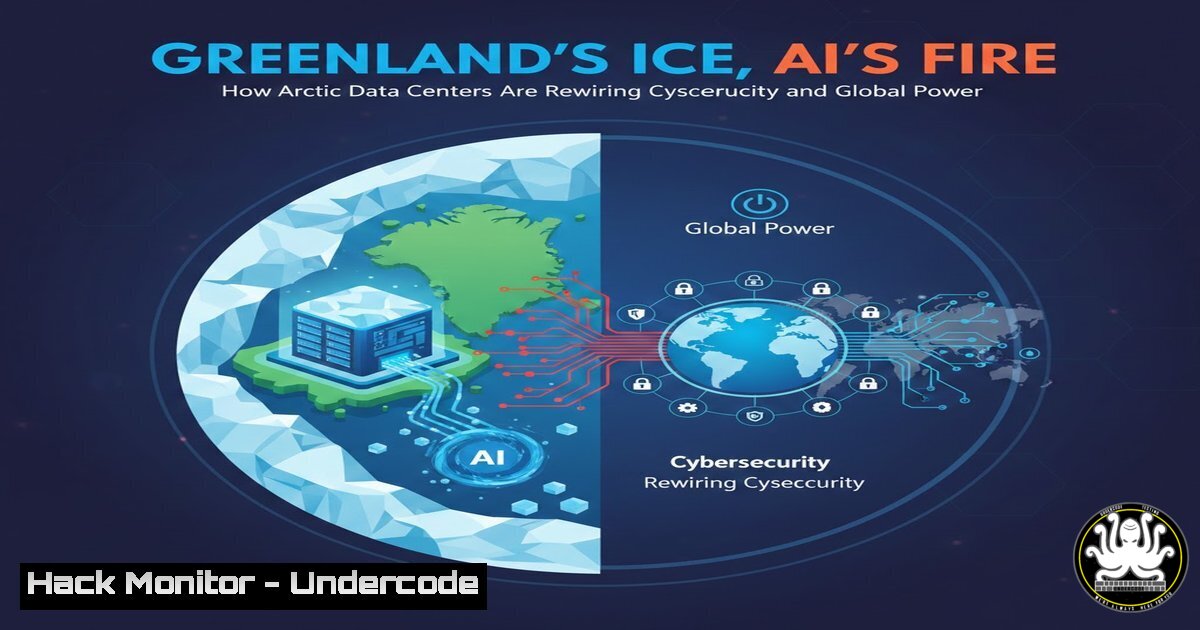
The geopolitical discourse around Greenland has abruptly pivoted from traditional sovereignty disputes to a critical infrastructure and cybersecurity frontier. As revealed in recent analysis, the region is now framed as a “radiator for humanity’s new prefrontal cortex”—a prime location for next-generation AI data centers. This shift turns a strategic landmass into a live stress test for the physical and digital security of the future’s computational backbone.
Learning Objectives:
- Understand the confluence of geopolitical strategy, AI infrastructure demands, and physical data center security.
- Learn to harden and monitor critical infrastructure in extreme environments using proven IT commands and frameworks.
- Analyze how physical location choices for AI compute create new, high-stakes attack surfaces requiring integrated defense strategies.
You Should Know:
- The Thermodynamic Imperative: Why AI is Moving to the Ice
The core technical argument posits that advanced AI, particularly AGI (Artificial General Intelligence), generates unprecedented heat. Greenland’s subarctic climate offers natural, energy-efficient cooling—a critical advantage for exascale computing. This isn’t just about geography; it’s about thermodynamics as a primary constraint in the AI arms race.
Step‑by‑step guide: Monitoring Data Center Thermal Dynamics
A secure AI facility begins with granular environmental monitoring. Below is a foundational setup using common tools.
Linux/Server Monitoring Commands:
- Install `lm-sensors` and `hddtemp` for hardware telemetry:
sudo apt update && sudo apt install lm-sensors hddtemp -y
sudo sensors-detect --auto
- Run sensor detection and view real-time output:
sensors
This displays CPU and motherboard temperature readings, crucial for preventing thermal throttling or hardware failure.
- For centralized logging, configure `Telegraf` to collect sensor data and ship it to a time-series database like
InfluxDB:/etc/telegraf/telegraf.conf snippet [[inputs.sensors]] remove_numbers = true
- Securing the “Radiator”: Physical Access and Network Hardening
A remote, critical data center is a high-value target. Security must be layered, from the perimeter to the API.
Step‑by‑step guide: Implementing Zero-Trust Network Access (ZTNA)
Assume breach. Isolate the data center network and enforce strict access controls.
– On the Firewall (Using `iptables` as an example): Create explicit drop rules and allow only from jump hosts.
 Default deny policy
sudo iptables -P INPUT DROP
sudo iptables -P FORWARD DROP
 Allow SSH only from a specific management VLAN
sudo iptables -A INPUT -p tcp --dport 22 -s 10.10.1.0/24 -j ACCEPT
– Implement Application-Level ZTNA: Use tools like `OpenZiti` or `Cloudflare Tunnel` to create private, encrypted overlays. No service is exposed to the public internet.
 Example Cloudflare Tunnel quick start
cloudflared tunnel create GREENLAND-DC
cloudflared tunnel route dns GREENLAND-DC dc-ai.yourcompany.com
cloudflared tunnel run GREENLAND-DC
3. The Sovereignty-Cloud Interface: Legal and Technical Jurisdiction
When data centers reside in geopolitically sensitive zones, data sovereignty becomes a cybersecurity control. Regulations dictate where data lives and how it’s moved.
Step‑by‑step guide: Enforcing Data Sovereignty with Cloud Policy
In AWS, use S3 Bucket Policies and `aws:RequestedRegion` condition key to lock data storage to a specific region (e.g., `eu-north-1` for Nordic regions).
{
"Version": "2012-10-17",
"Statement": [
{
"Sid": "EnforceGreenlandStorage",
"Effect": "Deny",
"Principal": "",
"Action": "s3:PutObject",
"Resource": "arn:aws:s3:::your-ai-data-bucket/",
"Condition": {"StringNotEquals": {"aws:RequestedRegion": "eu-north-1"}}
}
]
}
Regularly audit compliance with AWS Config Rules or using `Steampipe` SQL queries:
select
account_id,
region,
name,
bucket_policy_is_public
from
aws_s3_bucket
where
region != 'eu-north-1';
- AI Supply Chain Vulnerabilities: From Mine to Model
The hardware running in these data centers—GPUs, TPUs, networking chips—is itself a supply chain risk. Adversaries may target the equipment before it even reaches the Arctic.
Step‑by‑step guide: Firmware Integrity Checking with TPM
Leverage the Trusted Platform Module (TPM) to ensure boot integrity on critical servers.
– On a Linux server, check TPM presence and PCR (Platform Configuration Register) values:
sudo dmesg | grep -i tpm
sudo cat /sys/class/tpm/tpm0/device/description
– Use `tpm2_tools` to generate an integrity report:
sudo tpm2_pcrread sha256:0,1,2,3,4,5,6,7
Compare these hash values against a known-good baseline stored securely offline. Any deviation indicates potential firmware compromise.
5. Mitigating Insider Threats in Isolated Environments
Small, remote teams pose significant insider risk. Activity must be logged, audited, and behavior analyzed.
Step‑by‑step guide: Advanced Auditd Configuration on Linux Servers
Deploy a stringent `auditd` rule set to monitor privileged actions and file access.
– Create a rule to log all commands executed by privileged users (uid >= 1000):
 /etc/audit/rules.d/99-keyfiles.rules
-a exit,always -F arch=b64 -F uid>=1000 -S execve -k EXEC_LOG
-w /etc/ssh/sshd_config -p warx -k SSH_CONFIG
-w /usr/bin/ -p wa -k BIN_MODIFY
– Apply the rules and search logs:
sudo auditctl -R /etc/audit/rules.d/99-keyfiles.rules
sudo ausearch -k EXEC_LOG | tail -20
6. Resilience Against Dual-Use Coercion: Off-Grid Operations
The “coercive signalling” mentioned in the source material implies potential for cut-offs. Data centers must be capable of sustained isolated operation.
Step‑by‑step guide: Implementing Immutable Backups and Local DNS
- Create immutable, on-site backups using `BorgBackup` with append-only mode:
borg init --encryption=repokey-blake2 --append-only /backup-repo borg create /backup-repo::'{hostname}-{now}' /critical-ai-models/ - For network resilience, run a local, cached DNS resolver (
Unbound):sudo apt install unbound -y Configure /etc/unbound/unbound.conf with root hints and local zone overrides sudo systemctl enable --now unbound sudo resolvectl dns eth0 127.0.0.1
- Ethical AI Governance as a Security Layer (MEG Framework)
The comment references the “MEG – Minimum Ethics Code” (zenodo.org/communities/meg/). Ethical guidelines are a non-technical security control, preventing malicious AI use from within.
Step‑by‑step guide: Integrating Ethical Checks into CI/CD for AI
In your ML pipeline, add an ethical scoring step using a tool like `Microsoft’s Fairlearn` or a custom policy check.
 Example simplified CI step in a GitHub Action or GitLab CI
- name: Ethical Model Scan
run: |
python ethics_check.py --model-path ./new-model.bin \
--policy-file ./MEG-policy.yaml
 Fails the build if bias exceeds threshold or use-case is prohibited
What Undercode Say:
- Key Takeaway 1: The next battlefield for AI supremacy is physical. Cybersecurity strategy must now encompass geophysical advantages (like cooling) and the immense attack surface of distributed, high-value compute infrastructure in contested regions.
- Key Takeaway 2: Sovereignty is a digital construct. Controlling the land that houses the “radiator” for AGI means controlling the latency, legal jurisdiction, and integrity of the AI itself. Security protocols must be designed for both network packets and geopolitical pressure.
The analysis suggests we are moving beyond cloud security to climate security. The “Greenland File” is a blueprint: future attacks on AI may not be SQL injections, but legislation forcing backdoor access, or sabotage of the fragile power and cooling infrastructure in remote locales. Defending AI now requires command-line expertise in one hand and a deep understanding of international relations in the other. The entities that can fuse these disciplines—hardening servers against both rootkits and coercive treaties—will control the cognitive infrastructure of the 21st century.
Prediction:
Within the next 3-5 years, we will see the first publicly attributed cyber-physical attacks targeting AI data center environmental controls (cooling, power) as a proxy method to degrade or ransom a competitor’s flagship model. This will spawn a new niche in cybersecurity: “Extreme Environment Infrastructure Security,” merging OT (Operational Technology), IoT, and traditional IT defense with geopolitical risk assessment. Nation-states will treat strategic data center locations as assets of national security, leading to new forms of digital sovereignty laws and potentially, the rise of “compute sanctions” as a foreign policy tool.
▶️ Related Video (80% Match):
🎯Let’s Practice For Free:
IT/Security Reporter URL:
Reported By: Ivan Savov – Hackers Feeds
Extra Hub: Undercode MoN
Basic Verification: Pass ✅


