Listen to this Post
Introduction:
Asphalt melting on German highways at just +1.5°C of global warming isn’t just a climate headline—it’s a hardware warning. The same extreme heat that buckles roadways is pushing data centers to their thermal limits, with 79% of global compute capacity now exposed to climate hazards like floods, fires, and heatwaves that can trigger costly outages. For IT professionals, this isn’t an environmental debate; it’s an infrastructure reliability crisis where inefficient code, bloated cloud architectures, and overlooked power consumption directly translate to hardware failure risk and spiraling operational costs. This article bridges the gap between sustainable coding practices and cybersecurity resilience, offering a technical roadmap to harden your infrastructure against both climate volatility and the attackers who exploit it.
Learning Objectives:
- Master green coding techniques to reduce computational overhead and extend hardware lifespan in thermally stressed environments.
- Implement Linux and Windows power management and monitoring commands to benchmark and optimize energy consumption.
- Configure AI-driven cooling and workload scheduling to maintain data center resilience during extreme weather events.
- Apply cloud hardening and API security measures that align with sustainability goals.
- Develop incident response playbooks that account for climate-induced infrastructure failures.
You Should Know:
- Green Coding: Writing Code That Doesn’t Melt the Server
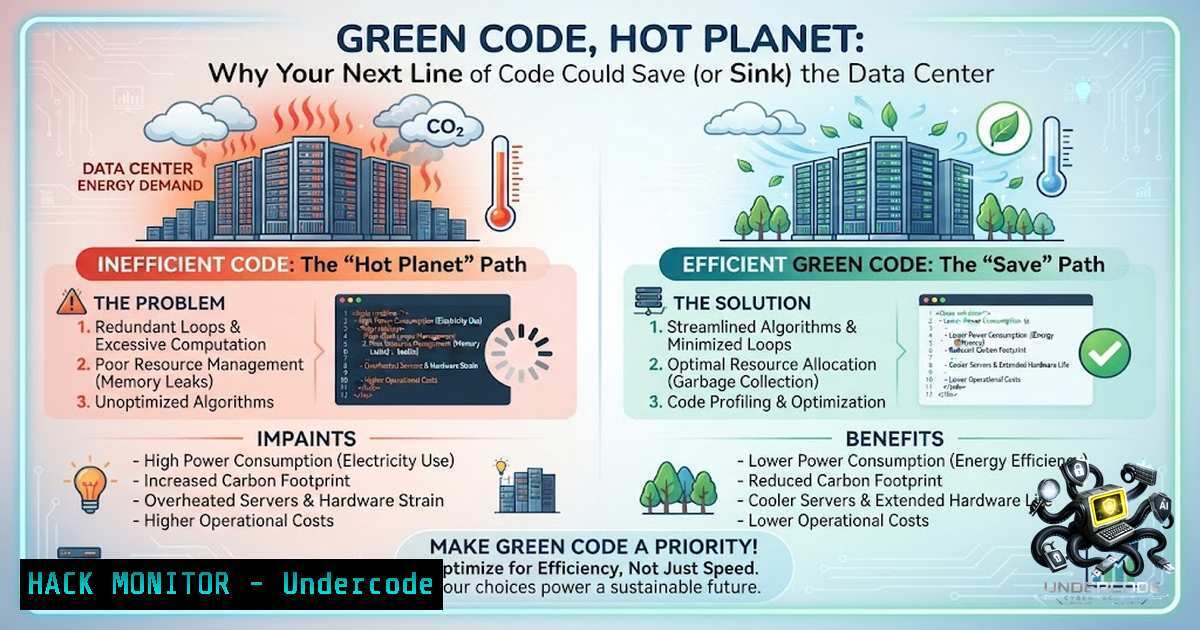
The software you write directly determines how much energy your infrastructure consumes. Green coding is the practice of designing energy-efficient software that reduces carbon emissions, lowers data center energy usage, and supports compliance with sustainability standards like ISO 14001. Inefficient algorithms, excessive API calls, and memory leaks aren’t just performance issues—they’re thermal loads that push cooling systems beyond their designed capacity.
Step‑by‑step guide to green coding implementation:
Step 1: Profile your application’s energy consumption. Use tools like Intel’s Running Average Power Limit (RAPL) to measure per-function energy usage. On Linux:
sudo apt install linux-tools-common linux-tools-$(uname -r)
sudo turbostat --show PkgWatt,CorWatt,GFXWatt,RAMWatt cmd
On Windows, use PowerCfg to analyze system energy efficiency:
powercfg /energy
powercfg /systemthermalpolicy
Step 2: Optimize algorithm complexity. Replace O(n²) operations with O(n log n) alternatives where possible. For Python, use `cProfile` to identify hotspots:
import cProfile
import pstats
cProfile.run('your_function()', 'profile_output')
p = pstats.Stats('profile_output')
p.sort_stats('cumtime').print_stats(20)
Step 3: Implement request coalescing and batching. Reduce API call frequency by aggregating operations. For REST APIs, implement bulk endpoints that process multiple records in a single round-trip, cutting network I/O and CPU wake-ups.
Step 4: Adopt carbon‑aware scheduling. Use libraries like `carbon-intensity` to schedule batch jobs during periods of low grid carbon intensity:
from carbon_intensity import get_intensity
if get_intensity('your_region') < threshold:
run_heavy_workload()
else:
defer_workload()
Step 5: Monitor and iterate. Integrate green metrics into your CI/CD pipeline using tools like Green Metrics Tool (GMT) to track energy regression before deployment.
2. Thermal Resilience: Hardening Infrastructure Against Extreme Heat
Data centers currently contribute 2–4% of global greenhouse gas emissions—comparable to the airline industry. As global temperatures rise, cooling systems must work harder, creating a vicious cycle of higher energy consumption and greater emissions. Extreme heat, drought, and other climate hazards could drive annual costs at data centers globally up by $81 billion by 2035.
Step‑by‑step guide to thermal resilience:
Step 1: Implement dynamic thermal monitoring. Deploy sensors and use IPMI to track real‑time temperature metrics:
 Linux: Query thermal zones
cat /sys/class/thermal/thermal_zone/temp

IPMI temperature readings
sudo ipmitool sensor list | grep -i temp

Windows: Use WMI to get thermal information
Get-WmiObject -1amespace "root/wmi" -Class MSAcpi_ThermalZoneTemperature | Select-Object CurrentTemperature
Step 2: Configure predictive cooling with AI. Train machine learning models on historical temperature and workload data to anticipate cooling needs. Implement a simple LSTM-based predictor:
from tensorflow.keras.models import Sequential
from tensorflow.keras.layers import LSTM, Dense

model = Sequential([
LSTM(50, activation='relu', input_shape=(n_steps, n_features)),
Dense(1)
])
model.compile(optimizer='adam', loss='mse')
 Train on historical temperature and CPU load data
Step 3: Implement workload shifting to renewable-rich periods. Flexible computing can help reduce renewable curtailment from over 9% to about 6.5%. Use Kubernetes cron jobs or AWS Lambda scheduled functions to shift non‑critical workloads to off‑peak hours:
 Kubernetes CronJob for off-peak processing
apiVersion: batch/v1
kind: CronJob
metadata:
name: offpeak-batch
spec:
schedule: "0 2   "  2 AM daily
jobTemplate:
spec:
template:
spec:
containers:
- name: batch-processor
image: your-batch-image:latest
Step 4: Establish thermal shutdown protocols. Define temperature thresholds that trigger graceful workload migration and system shutdown to prevent hardware damage:
 Linux: Set thermal shutdown threshold via /etc/thermald/thermal-conf.xml
<ThermalConfiguration>
<Platform>
<Name>Your_Platform</Name>
<ThermalZones>
<ThermalZone>
<Type>cpu-thermal</Type>
<TripPoints>
<TripPoint>
<Temperature>95000</Temperature> <!-- 95°C -->
<Type>critical</Type>
<Action>shutdown</Action>
</TripPoint>
</TripPoints>
</ThermalZone>
</ThermalZones>
</Platform>
</ThermalConfiguration>
3. Cloud Hardening for Sustainable Security
Sustainability and cybersecurity are not opposing forces—they reinforce each other. Secure update mechanisms enable device maintenance that extends hardware lifespan, reducing e‑waste and embodied carbon. Conversely, bloated security stacks consume unnecessary compute, undermining sustainability goals.
Step‑by‑step guide to sustainable cloud hardening:
Step 1: Rightsize your cloud resources. Over‑provisioned VMs waste energy and increase attack surface. Use AWS Trusted Advisor or Azure Advisor to identify underutilized instances:
 AWS CLI: List EC2 instances with low utilization
aws ec2 describe-instances --filters "Name=instance-state-1ame,Values=running" \
--query 'Reservations[].Instances[].[InstanceId,InstanceType,State.Name]' \
--output table

Azure CLI: Get VM utilization metrics
az monitor metrics list --resource /subscriptions/{sub}/resourceGroups/{rg}/providers/Microsoft.Compute/virtualMachines/{vm} \
--metric "Percentage CPU" --interval PT1H
Step 2: Implement zero‑trust architecture with minimal logging. Audit logs are essential but costly. Implement structured logging with sampling for high‑volume, low‑risk events:
 Fluentd configuration with sampling
<filter app.>
@type sample
sample_rate 0.1  Log only 10% of events
</filter>
Step 3: Automate security patching with carbon‑aware scheduling. Use Ansible or AWS Systems Manager to patch during low‑demand periods:
<ul>
<li>name: Schedule patching during off-peak hours
hosts: all
tasks:</li>
<li>name: Run updates at 3 AM
cron:
name: "security updates"
minute: "0"
hour: "3"
job: "apt update && apt upgrade -y"
Step 4: Deploy Web Application Firewall (WAF) rules that balance security and performance. Use rate‑based rules to block DDoS without over‑provisioning:
{
"Name": "RateBasedRule",
"Priority": 1,
"Statement": {
"RateBasedStatement": {
"Limit": 1000,
"AggregateKeyType": "IP"
}
},
"Action": { "Block": {} },
"VisibilityConfig": {
"SampledRequestsEnabled": true,
"CloudWatchMetricsEnabled": false
}
}
4. AI-Powered Energy Optimization and Threat Detection
AI is a double‑edged sword: it enables powerful optimizations but also consumes enormous energy. Sustainable AI practices are critical for both cost and carbon management.
Step‑by‑step guide to sustainable AI operations:
Step 1: Optimize model architecture. Use pruning, quantization, and distillation to reduce inference costs:
import torch
import torch.quantization

Quantize a PyTorch model
model.qconfig = torch.quantization.get_default_qconfig('fbgemm')
model = torch.quantization.prepare(model, inplace=True)
model = torch.quantization.convert(model, inplace=True)
Step 2: Implement energy‑aware model selection. Use a model registry that tracks energy per inference:
-- Track model efficiency in your MLOps database
CREATE TABLE model_metrics (
model_id VARCHAR(50),
inference_time_ms FLOAT,
energy_wh FLOAT,
carbon_g FLOAT,
accuracy FLOAT
);

SELECT model_id FROM model_metrics
WHERE accuracy > 0.95
ORDER BY energy_wh ASC
LIMIT 1;
Step 3: Use AI for predictive threat detection with minimal false positives. Train models on reduced feature sets to lower compute:
from sklearn.ensemble import RandomForestClassifier
from sklearn.feature_selection import SelectFromModel

Feature selection to reduce compute
selector = SelectFromModel(RandomForestClassifier(n_estimators=50))
X_selected = selector.fit_transform(X, y)
Step 4: Schedule AI training during renewable‑energy peaks. Use cloud provider carbon‑intensity APIs to trigger training jobs:
 Google Cloud Carbon Footprint API
from google.cloud import carbon_footprint
client = carbon_footprint.CarbonFootprintClient()
intensity = client.get_carbon_intensity(region='us-central1')
if intensity < 200:  gCO2/kWh
trigger_training_job()
5. Incident Response for Climate‑Induced Failures
When extreme weather takes down power or cooling, your incident response plan must account for physical infrastructure failures, not just cyber threats.
Step‑by‑step guide to climate‑resilient incident response:
Step 1: Develop a climate threat intelligence feed. Monitor weather APIs and integrate alerts into your SIEM:
import requests

def get_weather_alerts(lat, lon):
api_key = 'YOUR_API_KEY'
url = f'https://api.weather.gov/alerts?point={lat},{lon}'
response = requests.get(url)
alerts = response.json()
for alert in alerts['features']:
if alert['properties']['severity'] in ['Extreme', 'Severe']:
send_to_siem(alert)
Step 2: Define evacuation and failover procedures. Automate failover to geographically distributed regions when local temperatures exceed thresholds:
 Terraform for multi-region failover
resource "aws_instance" "primary" {
count = var.temperature_threshold_exceeded ? 0 : 1
 primary instance config
}

resource "aws_instance" "secondary" {
count = var.temperature_threshold_exceeded ? 1 : 0
 secondary instance config in cooler region
}
Step 3: Test climate resilience annually. Run tabletop exercises simulating power outages, flooding, and extreme heat. Include IT, facilities, and security teams.
Step 4: Document and learn. Post‑incident reviews should include energy consumption data and thermal metrics to refine future responses.
What Undercode Say:
- Key Takeaway 1: Climate change is not a distant problem—it’s actively degrading IT infrastructure today, with 79% of data center capacity at risk from climate hazards. Every line of inefficient code contributes to thermal stress and operational risk.
-
Key Takeaway 2: Sustainability and cybersecurity are mutually reinforcing. Secure, well‑maintained systems last longer, consume less energy, and present a smaller attack surface. Green coding isn’t just ethical—it’s a competitive advantage in a resource‑constrained world.
Analysis: The intersection of climate resilience and cybersecurity represents a paradigm shift in how we think about infrastructure protection. Traditional security models assumed stable physical environments; today, we must design for volatility. This means embedding thermal awareness into application design, using AI not just for threat detection but for energy optimization, and treating power consumption as a first‑class security metric. Organizations that fail to adapt will face not only regulatory penalties and reputational damage but also tangible operational failures as extreme weather events become more frequent. The most forward‑thinking security teams are already integrating sustainability officers into their incident response drills and using carbon‑intensity data to inform patching and deployment schedules. This is the new frontier of resilient infrastructure—where green meets secure.
Prediction:
- +1 The convergence of sustainability and cybersecurity will spawn a new certification category (e.g., “Green Security Architect”) within 3–5 years, creating high‑demand roles for professionals skilled in both domains.
-
+1 AI‑driven energy optimization tools will become standard components of cloud security platforms, reducing data center energy consumption by 20–30% while simultaneously improving threat detection accuracy through better resource allocation.
-
-1 Organizations that delay adopting green coding and thermal resilience practices will face insurance premium hikes of 40–60% by 2030, as underwriters increasingly factor climate risk into cyber insurance policies.
-
-1 The skills gap in sustainable IT will widen dramatically, with 70% of enterprises reporting difficulty finding engineers who understand both energy efficiency and security best practices by 2028.
-
+1 Open‑source green coding frameworks will emerge as the de facto standard, enabling community‑driven optimization that reduces the carbon footprint of the entire software ecosystem.
🎯Let’s Practice For Free:
🎓 Live Courses & Certifications:
Join Undercode Academy for Verified Certifications
🚀 Request a Custom Project:
Secure, high-velocity infrastructure and disruptive technological engineering. Contact our engineering team for high-tier development and proprietary systems:
[email protected]
💎 Smart Architecture | 🛡️ Secure by Design | ⭐ Trusted by Thousands
IT/Security Reporter URL:
Reported By: J%C3%BCrgen Baumann – Hackers Feeds
Extra Hub: Undercode MoN
Basic Verification: Pass ✅


