Listen to this Post
Introduction:
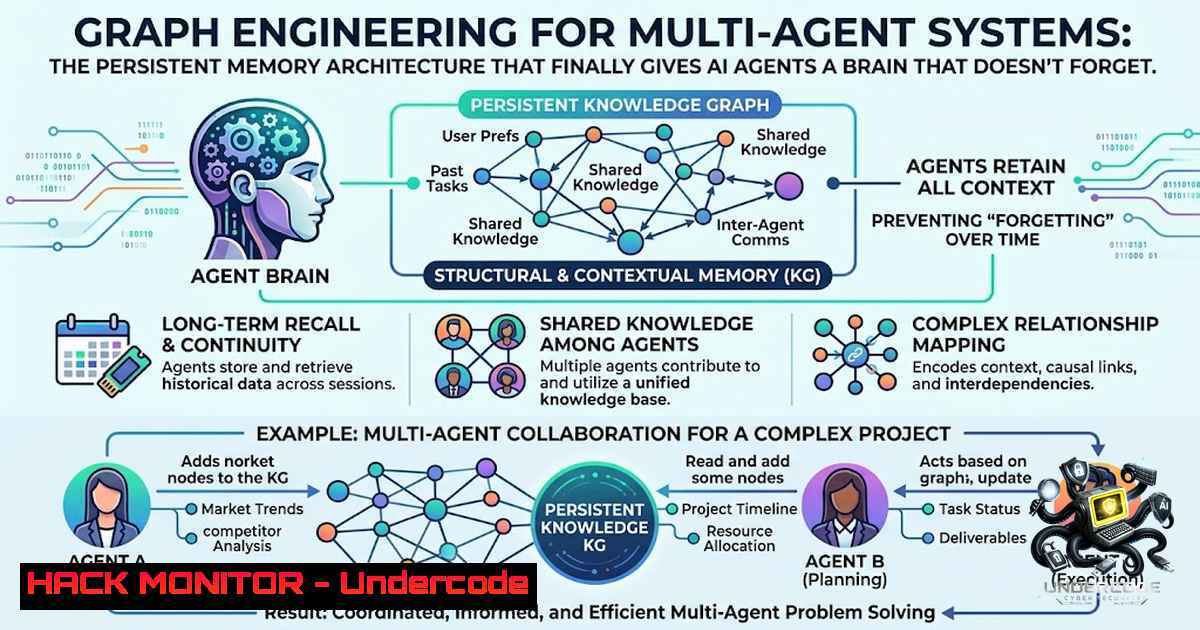
The most crippling limitation of AI agents today isn’t their reasoning capability—it’s their memory. Once the context window closes, everything the agent learned vanishes into the digital ether. A 12-page document on Graph Engineering for multi-agent systems has fundamentally reshaped how we think about agent memory, introducing a persistent, structured knowledge graph architecture that enables agents to continuously build upon accumulated intelligence rather than starting from scratch with every interaction. This framework—Extract → Resolve → Assemble → Query → Repeat—transforms ephemeral agent interactions into durable, queryable, and shareable organizational knowledge.
Learning Objectives:
- Understand the five-stage Graph Engineering framework for building persistent agent memory
- Master entity resolution techniques that go beyond string matching to resolve duplicates using contextual understanding
- Implement shared knowledge graph architectures for multi-agent collaboration with conflict resolution and provenance tracking
- Deploy production-ready graph memory systems using tools like Neo4j, Graphiti, and FalkorDB
- Apply graph-based retrieval strategies that achieve 99% token reduction and 4.2× faster queries compared to naive RAG
- The Five-Stage Framework: Extract → Resolve → Assemble → Query → Repeat
The Graph Engineering methodology follows a surprisingly simple yet powerful loop that transforms raw data into persistent, structured agent memory.
Extract: Entities and subject-predicate-object relationships are extracted from documents into a structured format. This goes beyond simple keyword extraction—the system identifies meaningful connections between concepts, people, organizations, and events. Modern implementations leverage LLMs to perform this extraction automatically, with tools like `sift-kg` supporting over 75 document formats including PDFs, DOCX, and HTML.
Resolve: This is where the magic happens. Duplicate entities are resolved even when names don’t match directly, using contextual understanding rather than simplistic string similarity. For example, “John Smith,” “Mr. Smith,” and “the CEO” might all refer to the same entity—traditional systems would treat these as separate nodes, creating confusion and fragmented knowledge. Entity resolution typically employs a multi-method scoring system combining blocking/candidate generation, pairwise similarity scoring, confidence-based match classification, and transitive closure.
Assemble: Everything is assembled into a single knowledge graph with canonical nodes, typed relationships, and traceable sources. Each piece of information retains its provenance—you can trace every answer back to its original source.
Query: Relevant subgraphs are queried so every answer is grounded in connected facts. Instead of relying on semantic similarity alone, graph traversal follows explicit relationships to find connections that vector search would miss.
Repeat: The system continuously evolves as new information flows in, with old, irrelevant memories naturally fading through decay mechanisms while important knowledge consolidates—mirroring how human memory works.
- Building a Persistent Knowledge Graph Memory Stack: A Step-by-Step Tutorial
The fastest path from zero to a working persistent memory system uses the Graphiti MCP server with FalkorDB as the underlying graph database. Here’s how to deploy it:
Step 1: Clone and Start the Stack
git clone https://github.com/getzep/graphiti
cd graphiti/mcp_server
docker-compose up
This single command launches a container stack that includes FalkorDB (graph database), FalkorDB browser UI for inspecting graphs, and the Graphiti MCP server.
Step 2: Configure Claude Desktop as MCP Client
The MCP (Model Context Protocol) standardizes how AI clients connect to external tools. With a single MCP-enabled client, you can connect to multiple MCP servers exposing typed tools, keeping integration surfaces consistent as the system evolves.
Step 3: Enable Tenant Isolation
Graphiti groups enforce multi-tenancy at the storage layer using group_id. This ensures “Project A memory” never contaminates “Project B memory”—critical for production deployments where data leakage between users, organizations, or workspaces is unacceptable.
Alternative: Neo4j-Based Multi-Agent Memory
For teams already invested in Neo4j, the `neo4j-agent-memory` package provides a streamlined approach:
from neo4j_agent_memory.integrations.strands import context_graph_tools

One shared tool set for all agents
tools = context_graph_tools(
neo4j_uri=os.environ["NEO4J_URI"],
neo4j_password=os.environ["NEO4J_PASSWORD"],
embedding_provider="bedrock",
aws_region="us-east-1",
)

Each agent gets the SAME tools—shared memory layer
kyc_agent = Agent(model=MODEL, tools=tools, system_prompt=KYC_PROMPT)
credit_agent = Agent(model=MODEL, tools=tools, system_prompt=CREDIT_PROMPT)
orchestrator = Agent(model=MODEL, tools=tools, system_prompt=ORCH_PROMPT)
This single shared tool set—search_context, get_entity_graph, add_memory, and get_user_preferences—enables every agent to read from and write to the same shared graph. No message queues, no pub/sub, no serialization formats—just shared, structured memory.
- Entity Resolution: The Critical Step Most Implementations Get Wrong
Entity resolution is where knowledge graphs succeed or fail. Without proper deduplication, the same real-world entity appears as multiple disconnected nodes, fracturing the knowledge graph into incoherent fragments.
The Problem with Naive Approaches: Traditional systems use string similarity—”John Smith” and “J. Smith” might match, but “the CEO” won’t. Contextual resolution solves this by considering relationships, roles, and document context.
Implementation with sift-kg:
 Install and initialize
pip install sift-kg
sift init  creates sift.yaml + .env.example

Extract entities and relationships from documents
sift extract ./documents/

Build the knowledge graph
sift build

Find duplicate entities using LLM-based contextual matching
sift resolve

Interactively approve or reject proposed merges
sift review

Apply your decisions
sift apply-merges

View the graph interactively in your browser
sift view
The human-in-the-loop approach ensures quality—LLMs propose merges, but you approve or reject them through an interactive terminal UI. Every entity and relation links back to the source document and passage, maintaining full provenance.
Advanced Entity Resolution with Agentic Systems:
Production-grade systems like Agentic Graph RAG employ a 3-method scoring system for high-accuracy entity matching, with zero-tolerance validation guaranteeing precision ≥ 0.85. The system automatically canonicalizes entities—users referring to “John,” “Mr. Smith,” or “the CEO” all resolve to the same canonical node.
- Multi-Agent Shared Memory: From Silos to Collective Intelligence
The real transformative power emerges when multiple agents share the same knowledge graph. Different agents can contribute knowledge, verify each other’s outputs, and preserve information across long-running workflows.
The Silo Problem: Traditional multi-agent systems give each agent its own memory, context, and silo. This works for demos but fails catastrophically when agents need to collaborate.
Real-World Scenario: Financial Services
In a financial services system, a KYC analyst agent discovers a customer has ties to a sanctioned entity. The credit assessment agent needs to know this immediately—not after a manual handoff, not through an ad-hoc message bus, but through shared, structured memory that both agents can read and write.
Three problems emerge without shared memory:
- Duplicated entity extraction: Both agents process the same customer data independently, wasting compute and creating inconsistencies
- Blind spots: The KYC agent flags suspicious activity, but the credit agent never sees the flag and approves a loan that should have been held for review
- No audit trail: Regulators ask “Why did the agent approve this credit application?” and you can’t answer because reasoning was never connected to findings
The Solution: Shared graph memory solves all three. Entities are extracted once and deduplicated. Findings from any agent are immediately visible to every other agent. Reasoning traces are connected to the entities and messages that informed them, creating a full provenance chain.
Architecture Pattern:
┌─────────────────────────────────────────────────────────┐
│ SHARED KNOWLEDGE GRAPH │
│ (Neo4j / FalkorDB / AWS Neptune with tenant isolation) │
└─────────────────────────────────────────────────────────┘
▲ ▲ ▲ ▲
│ │ │ │
┌────┴────┐ ┌────┴────┐ ┌────┴────┐ ┌────┴────┐
│ Agent A │ │ Agent B │ │ Agent C │ │ Agent D │
│(KYC) │ │(Credit) │ │(Risk) │ │(Orch.) │
└─────────┘ └─────────┘ └─────────┘ └─────────┘
Each agent receives the same tool instances, reading from and writing to the same shared graph with a compatible data model. The graph serves as short-term, long-term, and reasoning memory simultaneously.
5. Production Deployment: GraphMem for Enterprise Scale
Naive RAG approaches collapse at production scale. After thousands of interactions, context windows overflow. Entity conflicts proliferate. Query latency becomes unbearable.
GraphMem—a state-of-the-art, self-evolving graph-based memory system—achieves 99% token reduction, 4.2× faster queries, and bounded memory growth compared to naive RAG.
Scale Comparison:
| Scale Factor | Naive RAG | GraphMem |
||||
| 1K conversations | Context window overflow | Bounded memory |
| 10K entities | O(n) search, slow | O(1) graph lookup |
| 100K+ memories | Unusable latency | Sub-second queries |
| 1 year of history | 3,650+ raw entries | ~100 consolidated |
| Entity conflicts | Duplicates everywhere | Auto-canonicalized |
Key Production Features:
- Self-Evolving Memory: Multi-factor scoring (recency, frequency, centrality) determines what to keep and what to let decay
- Temporal Tracking: Facts change—”CEO is John” becomes “CEO is Jane” six months later. GraphMem tracks temporal changes and returns current truth
- Community Detection: Auto-clustering identifies related entities and concepts
- Cost Efficiency: Instead of sending entire history to LLM every query, retrieve only the relevant subgraph
Quick Deployment with Docker:
 Clone and start Agentic Graph RAG
git clone <repo-url>
cd agentic-graph-rag
docker-compose up -d

Access the system
 Frontend: http://localhost:3000
 API Docs: http://localhost:8000/docs
 Monitoring: http://localhost:3001
This launches a complete stack including multi-agent retrieval, Neo4j graph database, PostgreSQL metadata store, Pinecone vector search, Redis caching, and Prometheus + Grafana monitoring.
6. Querying the Knowledge Graph: Cypher and Beyond
Once your knowledge graph is built, querying it effectively requires understanding graph traversal. Neo4j’s Cypher query language is the industry standard:
Finding connected entities:
MATCH (person:Person {name: "John"})-[r:WORKS_FOR]->(company:Company)
RETURN person, r, company
Multi-hop reasoning:
MATCH path = (user:User)-[:DISCUSSED]->(contract:Contract)
-[:MENTIONS]->(lawyer:Lawyer)
WHERE contract.date > date('2025-01-01')
RETURN path
Temporal queries:
MATCH (ceo:Person)-[:IS_CEO_OF]->(company:Company)
WHERE ceo.effective_date <= date() AND ceo.end_date IS NULL
RETURN ceo.name AS current_ceo, company.name
For natural language interfaces, systems like Agentic Graph RAG automatically convert natural language queries to Cypher or Gremlin, with iterative refinement until precision thresholds are met.
What Undercode Say:
- Key Takeaway 1: The “Extract → Resolve → Assemble → Query → Repeat” framework represents a paradigm shift from ephemeral agent memory to persistent, structured organizational knowledge. The real breakthrough isn’t just storing data—it’s resolving duplicates using context rather than string matching, which prevents the fragmentation that destroys knowledge graph utility.
-
Key Takeaway 2: Multi-agent shared memory transforms isolated AI workers into a collaborative intelligence network. When agents share a single graph with conflict resolution, versioning, and provenance tracking, you eliminate blind spots, prevent duplicated work, and create an audit trail that regulatory compliance demands. The architecture is deceptively simple: give every agent the same tool instances connected to the same database, and shared memory emerges organically.
Analysis: The Graph Engineering approach addresses the fundamental tension in AI agent development: the trade-off between context window limitations and the need for persistent knowledge. By offloading memory to a graph database, agents maintain bounded memory growth while preserving the ability to traverse relationships that vector search alone cannot find. The emergence of MCP (Model Context Protocol) as a standard for AI-to-tool connections accelerates adoption by eliminating one-off glue code. For enterprises, the multi-tenancy capabilities (tenant isolation via group_id) solve the data leakage problem that has kept many organizations from deploying agent memory systems in production. The 99% token reduction achieved by graph-based memory systems isn’t just a cost savings—it’s a fundamental enabler for agents that can maintain context across thousands of interactions without exponential cost growth.
Prediction:
+1 Graph-based agent memory will become the default architecture for enterprise AI deployments within 18-24 months, as organizations recognize that context-window-dependent agents are fundamentally incapable of handling complex, long-running workflows.
+1 The Model Context Protocol (MCP) will emerge as the dominant standard for AI-tool integration, reducing the fragmentation that currently plagues the agent ecosystem and enabling plug-and-play memory layers.
+1 Entity resolution using contextual understanding rather than string similarity will become a competitive differentiator—organizations that implement robust resolution will have knowledge graphs that remain coherent at scale, while others will drown in duplicate entities and conflicting information.
-1 The complexity of graph query optimization will become a bottleneck for teams without dedicated graph database expertise, creating a skills gap that slows adoption despite clear technical advantages.
+1 Multi-agent shared memory will enable new classes of applications—autonomous research teams, continuous compliance monitoring, and self-improving operational systems—that were previously impossible with siloed, stateless agents.
▶️ Related Video (70% Match):
🎯Let’s Practice For Free:
🎓 Live Courses & Certifications:
Join Undercode Academy for Verified Certifications
🚀 Request a Custom Project:
Secure, high-velocity infrastructure and disruptive technological engineering. Contact our engineering team for high-tier development and proprietary systems:
[email protected]
💎 Smart Architecture | 🛡️ Secure by Design | ⭐ Trusted by Thousands
IT/Security Reporter URL:
Reported By: Pranesh Vaibhav – Hackers Feeds
Extra Hub: Undercode MoN
Basic Verification: Pass ✅


