Listen to this Post
Introduction:
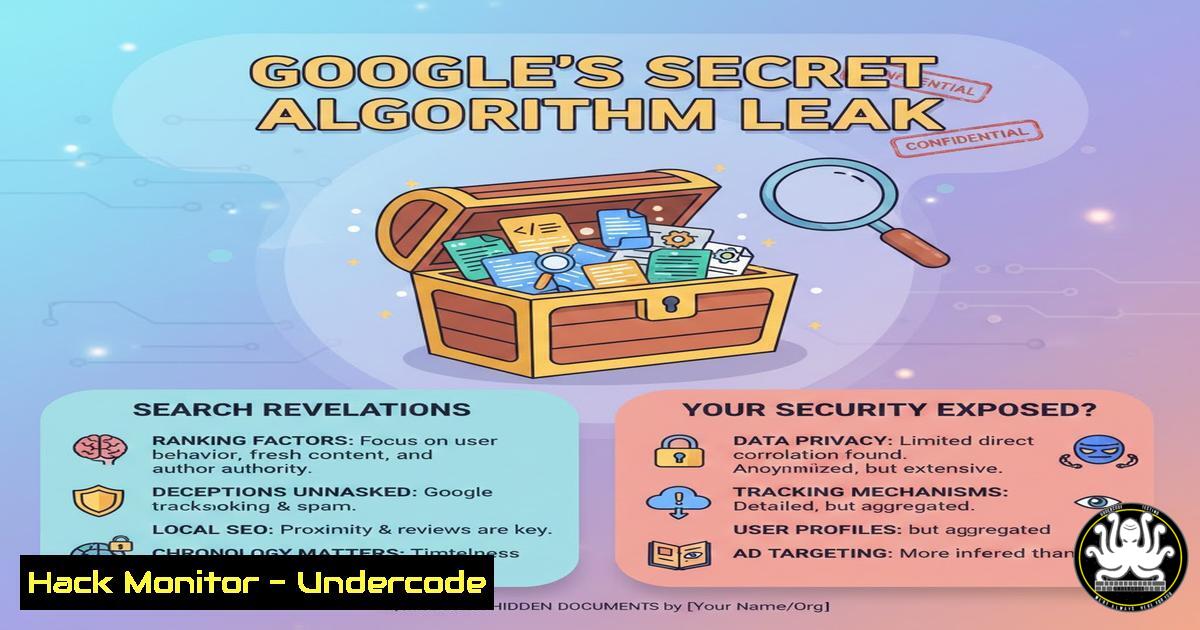
The recent leak of 2,500 internal Google API documents detailing its Search algorithm has sent shockwaves through the SEO and digital marketing world. Beyond SEO tactics, this breach exposes critical vulnerabilities in how tech giants protect proprietary intellectual property and offers a masterclass in data leakage analysis and insider risk.
Learning Objectives:
- Understand the technical nature of the leaked Google Search API documents and their implications for cybersecurity.
- Learn methods to analyze and verify the contents of a large-scale data leak using command-line tools.
- Implement defensive strategies to protect your own organization’s sensitive API documentation and algorithmic assets.
You Should Know:
- Analyzing the Leak: Verifying and Parsing Sensitive Documents
When a large corpus of documents is leaked, security teams must quickly assess its authenticity, scope, and sensitivity. The first step is to create a secure, isolated analysis environment.
Step‑by‑step guide explaining what this does and how to use it.
Step 1: Isolate the Data. Do not open leaked files on a networked machine. Use an isolated virtual machine or a sandboxed environment.
Step 2: Generate Hashes. Create cryptographic hashes of the documents to establish a forensic baseline and check for tampering.
Linux/macOS: Use `sha256sum`. `sha256sum leaked_document.pdf > document_hashes.txt`
Windows (PowerShell): Use Get-FileHash. `Get-FileHash -Algorithm SHA256 leaked_document.pdf | Out-File -FilePath .\document_hashes.txt`
Step 3: Search for Keywords. Use `grep` to rapidly identify documents containing high-sensitivity terms (e.g., “API_KEY”, “internal only”, “algorithm:ranking”).
`grep -r -i “confidential\|proprietary\|ranking signal” /path/to/leaked/docs/ > sensitive_matches.txt`
Step 4: Extract Metadata. Tools like `exiftool` can reveal author names, creation dates, and software versions, helping to trace the leak’s origin.
`exiftool -Creator -CreateDate -Software /path/to/doc.pdf`
2. Securing Internal Documentation Repositories
The Google leak likely originated from internal documentation systems. Hardening these repositories is paramount.
Step‑by‑step guide explaining what this does and how to use it.
Step 1: Implement Strict Access Controls. Use Role-Based Access Control (RBAC). Only grant read/write access to employees with a verified “need-to-know.” Regularly audit permissions.
Step 2: Encrypt Documentation at Rest & in Transit. Ensure all documentation repositories are encrypted.
For cloud storage (AWS S3 example): Enable default encryption. `aws s3api put-bucket-encryption –bucket your-doc-bucket –server-side-encryption-configuration ‘{“Rules”: [{“ApplyServerSideEncryptionByDefault”: {“SSEAlgorithm”: “AES256”}}]}’`
Step 3: Deploy Data Loss Prevention (DLP) Tools. Configure DLP rules to scan for and block the external transfer of documents tagged as “Internal-Only” or containing specific code snippets.
- API Security Post-Leak: Rotating and Auditing Exposed Credentials
Leaked documents often contain references to API endpoints, architectures, and sometimes even hardcoded credentials or access patterns that can be reverse-engineered.
Step‑by‑step guide explaining what this does and how to use it.
Step 1: Assume Compromise. If your API docs are leaked, assume any mentioned endpoints, key names, or authentication flows are known to attackers.
Step 2: Rotate All API Keys and Secrets. Immediately invalidate all keys referenced or inferable from the documents.
Step 3: Audit API Logs for Anomalies. Look for suspicious activity patterns from new IP ranges or using the newly exposed API pathways.
Example Cloud Log Query (Pseudocode): `filter = ‘resource.type=”api” AND logName=”projects/your-project/logs/cloudaudit.googleapis.com” AND timestamp>=”2024-05-01T00:00:00Z” AND protoPayload.methodName=”v1.internal.rankingEndpoint”`
4. Mitigating Insider Threat: Behavioral and Technical Controls
Preventing leaks requires a blend of technical measures and awareness.
Step‑by‑step guide explaining what this does and how to use it.
Step 1: Implement Principle of Least Privilege (PoLP). Use `sudo` policies (Linux) or Just-In-Time (JIT) access (Cloud IAM) to limit permanent access to sensitive docs.
Step 2: Monitor Data Access Patterns. Use tools like `auditd` on Linux or Windows Event Logs to track who accesses sensitive files.
Linux (auditd rule): `auditctl -w /var/share/internal_docs/ -p rwa -k internal_docs_access`
Step 3: Conduct Regular Security Training. Train employees on handling confidential information and the consequences of data leaks. Simulate phishing campaigns that bait employees with fake “internal documents.”
- The AI Angle: When Algorithms Become Attack Vectors
The leaked documents detail ranking signals and features. In the wrong hands, this data can be used to train AI models designed to systematically exploit search algorithms (called “AI-powered spam”) or to find logical flaws in the algorithm itself.
Step‑by‑step guide explaining what this does and how to use it.
Step 1: Threat Modeling. Model an adversary with full knowledge of your algorithm. How would they game it? This “red team” exercise is now essential.
Step 2: Implement Anomaly Detection. Use ML-based security tools to detect automated, AI-driven exploitation patterns that differ from human behavior.
Step 3: Prepare for Dynamic Response. Have a rapid-response plan to change algorithmic weights or features if they are being exploited at scale, without relying on secrecy as a primary defense.
What Undercode Say:
- Secrecy is Not a Security Strategy. Google operated for years on the assumption that algorithm details were secret. This leak proves that any proprietary system must be designed to remain secure even after its internal documentation is exposed. This is akin to Kerckhoffs’s principle in cryptography: a system should be secure even if everything about it, except the key, is public knowledge.
- The Blurry Line Between SEO and Security is Gone. Technical SEO experts are now de facto security researchers, reverse-engineering a critical web system. Organizations must treat their public-facing algorithms as high-value attack surfaces, subject to the same penetration testing and hardening as their networks.
Analysis: The Google leak is a watershed moment that transcends SEO. It demonstrates that the most valuable assets of modern tech companies—their proprietary algorithms—are vulnerable to insider threats and insufficient access controls. The response cannot be limited to legal takedowns; it demands a fundamental shift towards “security through transparency and resilience.” Companies must architect their core systems to withstand the eventual exposure of their internal logic, using techniques like frequent key rotation, robust anomaly detection, and assuming that determined adversaries will eventually understand their system’s inner workings. The future of tech security lies in defending systems whose blueprints are already on the dark web.
Prediction:
This leak will catalyze a new era of “algorithmic security.” We will see a rise in targeted attacks focusing on exfiltrating AI model weights, recommendation algorithms, and financial trading models. In response, a new market for “Algorithm Security Posture Management” (ASPM) tools will emerge, specializing in encrypting model artifacts, detecting anomalous access to training data, and watermarking algorithmic outputs to trace leaks. Furthermore, regulatory bodies may begin to treat core algorithms as critical infrastructure, requiring audits and incident reports similar to data breaches.
▶️ Related Video (80% Match):
🎯Let’s Practice For Free:
IT/Security Reporter URL:
Reported By: Dan Sodergren – Hackers Feeds
Extra Hub: Undercode MoN
Basic Verification: Pass ✅


