Listen to this Post
Introduction:
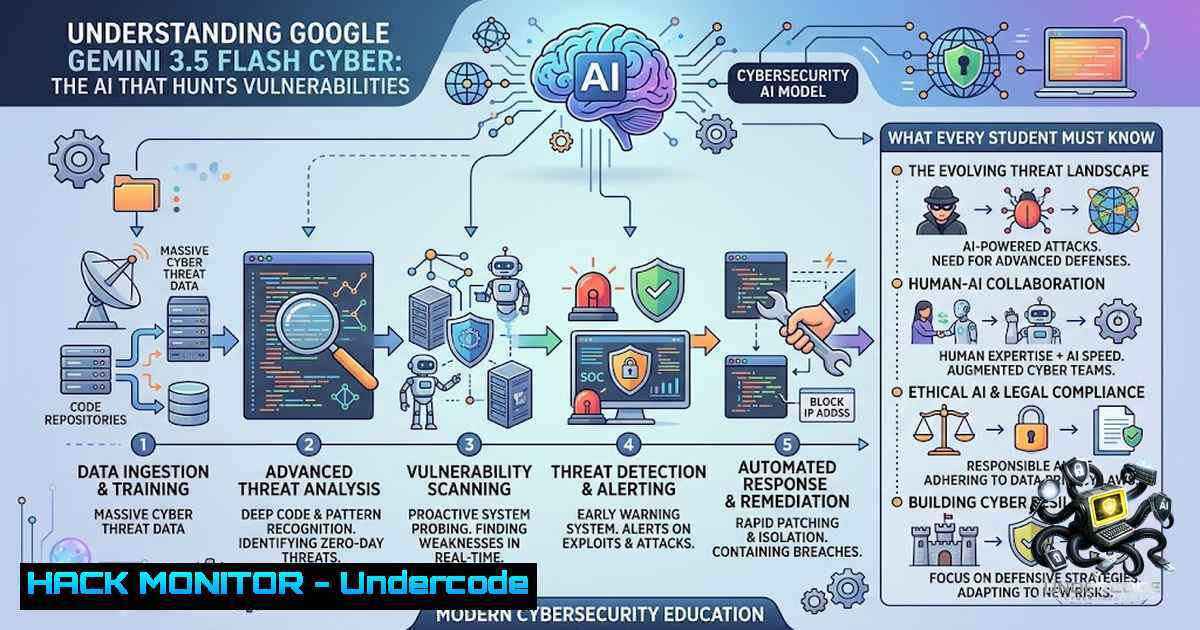
Artificial intelligence is no longer just a productivity tool—it is rapidly becoming a frontline cybersecurity weapon. In July 2026, Google unveiled Gemini 3.5 Flash Cyber, a specialized AI model designed to autonomously discover, validate, and patch software vulnerabilities. Simultaneously, the Google Student Ambassador (GSA) program is training 2,000 students worldwide in AI, equipping the next generation with generative AI skills and exclusive certifications. This convergence of cutting-edge AI security and massive educational upskilling presents both unprecedented opportunities and significant risks that every student, developer, and security professional must understand.
Learning Objectives:
- Understand the architecture and defensive capabilities of Google’s Gemini 3.5 Flash Cyber model.
- Identify and mitigate indirect prompt injection attacks targeting AI assistants.
- Implement API key security best practices for Gemini and Google Cloud services.
- Deploy Gemini CLI for automated security auditing and code analysis.
- Apply Zero Trust principles to AI-driven educational environments.
You Should Know:
- Gemini 3.5 Flash Cyber: Automating Vulnerability Discovery at Scale
Google DeepMind’s Gemini 3.5 Flash Cyber is built on the Gemini 3.5 Flash foundation and fine-tuned specifically for cybersecurity tasks. It operates autonomously: given a large codebase, it can discover vulnerabilities, write working exploits to prove they are real, and generate patches—all within hours. This model powers Google’s CodeMender platform, an AI-driven coding agent that automates vulnerability discovery and software patching.
Step‑by‑step guide to using Gemini CLI for security auditing:
Gemini CLI brings this power directly to your terminal. Here’s how to set it up and use it for automated code analysis.
Installation (Linux/macOS):
 Install via npm (Node.js required)
npm install -g @google/gemini-cli

Or clone from GitHub for development
git clone https://github.com/google/gemini-cli.git
cd gemini-cli
npm install
npm run build
Configuration:
 Set your API key (obtain from Google AI Studio)
export GEMINI_API_KEY="your-api-key-here"

Or use Google OAuth login (recommended for production)
gemini-cli login
Basic security audit command:
 Analyze a code file for vulnerabilities
gemini-cli -p "Analyze this Python file for SQL injection and XSS vulnerabilities:" < code.py

Scan an entire directory recursively
find ./src -1ame ".py" -exec gemini-cli -p "Security audit this code: {}" \;
Headless mode for CI/CD pipelines:
 Run non-interactively and output JSON for parsing
gemini-cli --headless --prompt "Find all hardcoded credentials in this repository" --output-json > audit_report.json

Pipe output to a security dashboard
gemini-cli --headless --prompt "Generate a CVE-style report for vulnerabilities found" | tee security_report.md
Windows (PowerShell):
 Install via npm (Node.js required)
npm install -g @google/gemini-cli

Set environment variable
$env:GEMINI_API_KEY = "your-api-key-here"

Run analysis
gemini-cli -p "Analyze this JavaScript for DOM-based XSS:" < .\app.js
- Securing Your Gemini API Keys: Least Privilege and Rotation
API keys are the lifeline to Gemini and other Google Cloud services, but exposed keys can lead to unauthorized AI access and massive bills.
Step‑by‑step guide to API key hardening:
Restrict API scopes (least privilege):
 Create a key with minimal permissions using gcloud
gcloud alpha services api-keys create \
--display-1ame="gemini-readonly-key" \
--api-target="service=aiplatform.googleapis.com" \
--api-target="methods=google.cloud.aiplatform.v1.PredictionService.Predict"
Implement secret scanning in CI/CD:
 Install TruffleHog for secret detection
pip install trufflehog

Scan repository for exposed keys
trufflehog git file://. --json | jq 'select(.VerifiedSecret == true)'

Pre-commit hook to block secrets
echo '!/bin/bash' > .git/hooks/pre-commit
echo 'trufflehog git file://. --1o-update --only-verified' >> .git/hooks/pre-commit
chmod +x .git/hooks/pre-commit
Enable billing alerts (Google Cloud Console):
 Create a budget alert via gcloud
gcloud alpha billing budgets create \
--billing-account=YOUR_BILLING_ACCOUNT \
--display-1ame="Gemini-API-Budget" \
--budget-amount=100 \
--threshold-rules=percent=0.5,percent=0.75,percent=1.0 \
[email protected]
Rotate keys automatically with a script:
!/bin/bash
 rotate-gemini-key.sh
OLD_KEY=$(gcloud alpha services api-keys list --filter="displayName=gemini-key" --format="value(name)")
gcloud alpha services api-keys delete $OLD_KEY --quiet
NEW_KEY=$(gcloud alpha services api-keys create --display-1ame="gemini-key-$(date +%Y%m%d)" --format="value(name)")
gcloud alpha services api-keys get-key-string $NEW_KEY --format="value(keyString)" > /tmp/new_key.txt
 Update your .env file
sed -i "s/GEMINI_API_KEY=./GEMINI_API_KEY=$(cat /tmp/new_key.txt)/" .env
- Indirect Prompt Injection: The Silent Threat to AI Assistants
Indirect prompt injection (IPI) attacks are emerging as a critical AI security vector. In January 2026, researchers demonstrated that Gemini could be exploited via malicious calendar invites to expose private meeting data. More recently, SafeBreach discovered that Gemini’s voice assistant could be hijacked through ordinary messaging notifications from SMS, WhatsApp, Slack, and other apps.
Step‑by‑step guide to mitigating prompt injection:
Input sanitization for AI prompts:
import re
from google import generativeai as genai

def sanitize_prompt(user_input: str) -> str:
"""Remove potentially malicious instruction patterns."""
 Block instruction override attempts
patterns = [
r"ignore (?:all |previous )?instructions",
r"you are (?:now |henceforth )?",
r"system:",
r"role:",
r"forget (?:all |previous )?",
]
for pattern in patterns:
user_input = re.sub(pattern, "[bash]", user_input, flags=re.IGNORECASE)
return user_input

Example usage
safe_prompt = sanitize_prompt(user_input)
response = genai.generate_content(safe_prompt)
Implement a security filter layer (Node.js):
const { HarmCategory, HarmBlockThreshold } = require('@google/generative-ai');

const safetySettings = [
{
category: HarmCategory.HARM_CATEGORY_HARASSMENT,
threshold: HarmBlockThreshold.BLOCK_MEDIUM_AND_ABOVE,
},
{
category: HarmCategory.HARM_CATEGORY_HATE_SPEECH,
threshold: HarmBlockThreshold.BLOCK_MEDIUM_AND_ABOVE,
},
// Custom safety for instruction injection
{
category: HarmCategory.HARM_CATEGORY_DANGEROUS_CONTENT,
threshold: HarmBlockThreshold.BLOCK_LOW_AND_ABOVE,
}
];

// Apply to all Gemini API calls
const model = genai.getGenerativeModel({
model: "gemini-1.5-pro",
safetySettings: safetySettings
});
Monitor for suspicious API usage:
 Enable Cloud Logging for Gemini API calls
gcloud logging sinks create gemini-audit-sink \
storage.googleapis.com/gemini-audit-logs \
--log-filter='resource.type="aiplatform.googleapis.com/Model"'

Query for anomalous patterns (Linux)
gcloud logging read 'resource.type="aiplatform.googleapis.com/Model" AND jsonPayload.input"ignore instructions"' --limit=50
- AI Security in Education: Protecting Students and Institutions
Educational institutions are adopting AI at breakneck speed, but this introduces unique risks: sensitive student data, high-frequency interactions, and the high stakes of assessment and credentialing. Students using LLM-generated code often lack awareness of security implications, leaving them vulnerable to exploits.
Step‑by‑step guide to building a secure AI learning environment:
Implement Zero Trust for AI access:
 Enforce Firebase App Check for Gemini API calls from mobile/web apps
 This prevents abuse from unauthenticated or compromised clients
firebase appcheck:apps:create --app-id=YOUR_APP_ID
firebase appcheck:rules:set --app-id=YOUR_APP_ID --rule-file=appcheck-rules.json
Educate students on secure AI usage (curriculum snippet):
 AI Security Checklist for Students
1. Never paste sensitive data (passwords, PII, proprietary code) into public AI chats.
2. Treat AI-generated code as untrusted—review and test it before deployment.
3. Use dedicated, isolated environments for AI experiments (e.g., Google Colab with limited permissions).
4. Enable two-factor authentication on all Google accounts accessing Gemini.
5. Report any suspicious AI behavior to your institution's security team immediately.
Automated vulnerability scanning for student projects (CI/CD integration):
 .github/workflows/ai-security-scan.yml
name: AI Security Scan
on: [bash]
jobs:
scan:
runs-on: ubuntu-latest
steps:
- uses: actions/checkout@v3
- name: Run Gemini CLI Security Audit
env:
GEMINI_API_KEY: ${{ secrets.GEMINI_API_KEY }}
run: |
gemini-cli --headless --prompt "Audit this codebase for OWASP Top 10 vulnerabilities" --output-json > scan.json
if grep -q '"severity":"CRITICAL"' scan.json; then exit 1; fi
- Hands-On with Gemini CLI: From Installation to Automation
Gemini CLI is an open-source AI agent that brings Gemini directly into your terminal, enabling file operations, shell commands, web search, and MCP support.
Step‑by‑step guide to mastering Gemini CLI:
Installation (all platforms):
 Linux/macOS (Homebrew)
brew install gemini-cli

Windows (Chocolatey)
choco install gemini-cli

Universal (npm)
npm install -g @google/gemini-cli
First-time setup:
 Run the interactive setup
gemini-cli init

Choose your theme (light/dark)
 Authenticate via browser OAuth
Basic commands:
 Start interactive chat
gemini-cli

Send a one-off prompt
gemini-cli -p "Explain the OWASP Top 10 in 50 words"

Analyze a file
gemini-cli -p "Summarize this log file and flag anomalies" < /var/log/syslog

Execute shell commands via AI
gemini-cli -p "List all running processes and identify potential security risks" --allow-shell
Automation with shell scripts:
!/bin/bash
 daily-security-audit.sh
 Run daily vulnerability scan using Gemini CLI

REPO_DIR="/path/to/your/repo"
OUTPUT_DIR="/var/log/gemini-audits"
DATE=$(date +%Y%m%d)

cd $REPO_DIR
gemini-cli --headless --prompt "Perform a full security audit. Focus on: 1) Hardcoded secrets 2) SQL injection 3) XSS 4) Command injection. Output as JSON." --output-json > $OUTPUT_DIR/audit-$DATE.json

Parse and alert on critical findings
jq -r '.findings[] | select(.severity=="CRITICAL") | .description' $OUTPUT_DIR/audit-$DATE.json | mail -s "Critical Security Finding" [email protected]
Integrate with CI/CD (GitHub Actions example):
- name: AI-Powered Security Review
run: |
gemini-cli --headless --prompt "Review this pull request for security regressions. Compare with main branch." --diff main..HEAD > security-review.txt
cat security-review.txt
What Undercode Say:
The Google Student Ambassador program is a powerful catalyst for AI literacy, but it must prioritize security training alongside technical skills.
- Key Takeaway 1: Gemini 3.5 Flash Cyber represents a paradigm shift—AI is no longer just a target but a hunter of vulnerabilities. Organizations that integrate this into their DevSecOps pipelines will gain a significant defensive edge.
- Key Takeaway 2: The rise of indirect prompt injection attacks demands a layered defense strategy: input sanitization, strict API permissions, continuous monitoring, and user education. No single control is sufficient.
Analysis: The intersection of AI upskilling and cybersecurity is both the greatest opportunity and the greatest risk of this decade. As 2,000 students gain access to Gemini and generative AI tools, they become prime targets for social engineering and prompt injection attacks. Educational institutions must implement Zero Trust frameworks that treat every AI interaction as potentially hostile. Meanwhile, Google’s decision to limit Gemini 3.5 Flash Cyber to governments and trusted partners initially highlights the dual-use nature of offensive AI—the same model that patches vulnerabilities can also discover exploits. The future belongs to those who can wield AI defensively while remaining vigilant against its weaponization.
Prediction:
- +1 The widespread adoption of AI-driven vulnerability hunting will reduce the average time-to-patch for critical CVEs from weeks to hours, dramatically improving global software security by 2028.
- -1 The democratization of AI security tools will also lower the barrier for malicious actors, leading to a surge in AI-assisted zero-day exploitation and automated attack campaigns.
- +1 Google Student Ambassador alumni will become the next generation of AI security leaders, bridging the talent gap and driving innovation in defensive AI.
- -1 Educational institutions that fail to implement robust AI security policies will face data breaches, credential theft, and academic integrity crises as agentic AI tools are abused.
- +1 The development of specialized AI models like Gemini 3.5 Flash Cyber will accelerate the shift toward autonomous DevSecOps, where AI agents continuously monitor, patch, and validate code in production environments.
▶️ Related Video (78% Match):
🎯Let’s Practice For Free:
🎓 Live Courses & Certifications:
Join Undercode Academy for Verified Certifications
🚀 Request a Custom Project:
Secure, high-velocity infrastructure and disruptive technological engineering. Contact our engineering team for high-tier development and proprietary systems:
[email protected]
💎 Smart Architecture | 🛡️ Secure by Design | ⭐ Trusted by Thousands
IT/Security Reporter URL:
Reported By: Divyansh Dhimole – Hackers Feeds
Extra Hub: Undercode MoN
Basic Verification: Pass ✅


