Listen to this Post
Introduction:
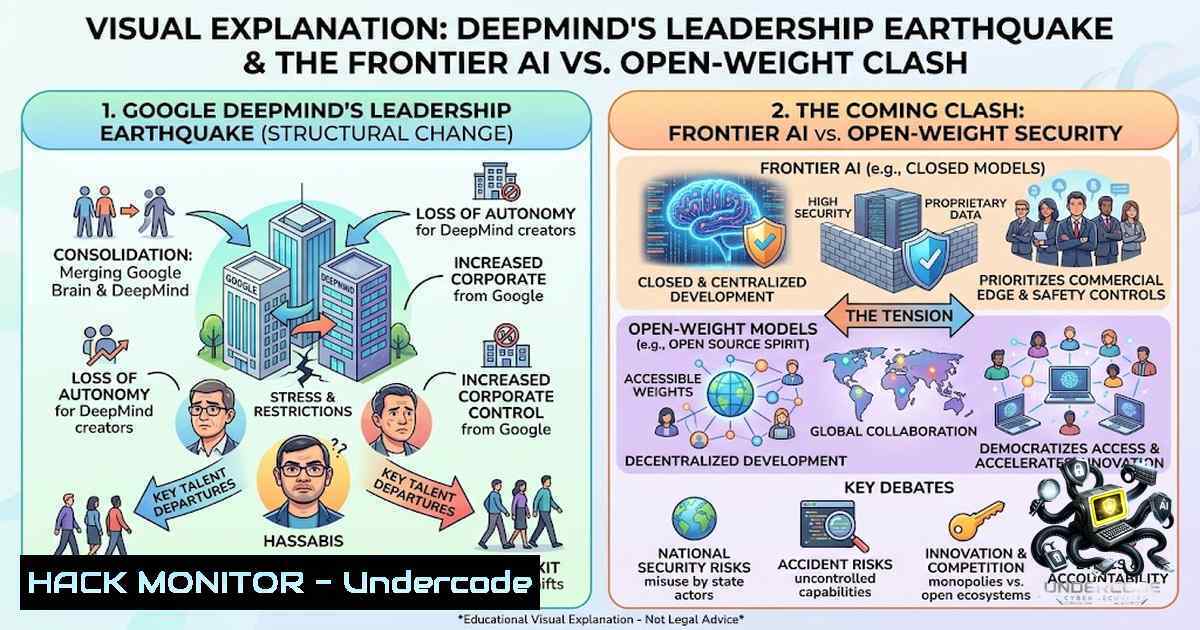
The artificial intelligence industry is undergoing a seismic shift. On one side, Google DeepMind has restructured its top leadership, with Demis Hassabis moving to a chairman role and Koray Kavukcuoglu stepping up as the new CEO, while a cohort of senior researchers including Jeff Dean has departed to launch a new startup. On the other side, the White House is finalizing a voluntary cyber-review framework that applies primarily to closed frontier models—deliberately exempting open-weight systems. These parallel developments mark a quiet milestone: AI is no longer a research curiosity but a high-stakes engineering discipline where leadership depth and structured oversight matter as much as raw capability.
Learning Objectives:
- Understand the strategic implications of Google DeepMind’s leadership restructuring for AI governance and research prioritization
- Analyze the White House voluntary cyber-review framework and its differential treatment of closed versus open-weight AI models
- Master practical techniques for red-teaming and securing AI systems, including command-line tools and configuration hardening
You Should Know:
- The DeepMind Restructuring: What It Means for AI Governance
Demis Hassabis, the visionary who led DeepMind from its founding through breakthroughs like AlphaFold and Gemini, has stepped down as CEO to become chairman of Google DeepMind while also taking on the role of Alphabet’s chief scientist. Koray Kavukcuoglu, previously the unit’s chief technology officer and Google’s chief AI architect, now assumes day-to-day operational leadership as Senior Vice President, reporting directly to CEO Sundar Pichai.
At the same time, Jeff Dean—one of Google’s longest-serving and most influential AI leaders—has departed along with at least three other senior researchers (Sanjay Ghemawat, Quoc Le, and Oriol Vinyals) to launch a Google-backed startup. This represents the biggest reorganization of Google’s AI efforts since the company combined its research teams under DeepMind in 2023.
Step-by-Step Guide: Auditing AI Organization Security Posture
For security professionals assessing how organizational changes affect AI system security:
- Map the threat model — Identify which teams control model weights, training data, and deployment pipelines. Use:
Linux: Map network dependencies of AI services
ss -tulpn | grep -E ':(8000|8080|5000|11434)'  Common AI service ports
netstat -tulpn | grep LISTEN | grep -E 'python|node|java'
-
Inventory API endpoints — Document all exposed model-serving endpoints:
Windows (PowerShell): Find listening ports and associated processes Get-1etTCPConnection | Where-Object {$_.State -eq 'Listen'} | Select-Object LocalPort, OwningProcess Get-Process -Id (Get-1etTCPConnection -LocalPort 8000).OwningProcess -
Review access controls — Verify that model weights and training data have proper authentication:
Linux: Check file permissions on model directories find /opt/models -type f -exec ls -la {} \; | head -20 Check for world-readable weights (red flag) find /opt/models -type f -perm -o+r -1ame ".h5" -o -1ame ".pt" -o -1ame ".safetensors" -
Monitor for anomalous activity — Set up logging for model access:
Linux: Monitor access to model files in real-time
auditctl -w /opt/models -p rwxa -k model_access
ausearch -k model_access --start recent
-
The White House Cyber-Review Framework: Closed vs. Open-Weight
The Trump administration has finalized a voluntary framework for evaluating whether America’s most advanced AI models can be used to conduct cyberattacks. Under this framework, AI developers can voluntarily submit new models to the federal government up to 30 days ahead of public release. The government then vets their cyber capabilities according to a classified benchmarking system.
Critically, open-weight AI models are exempt from these voluntary safety tests. The administration has decided not to include open-weight models in the framework, narrowing federal oversight to advanced proprietary AI systems. This distinction is not merely bureaucratic—it reflects a fundamental tension in AI security philosophy.
Step-by-Step Guide: Securing Open-Weight vs. Closed-Model Deployments
For closed-model deployments (API-based):
1. Implement API rate limiting and monitoring:
 Using Nginx as a reverse proxy for model APIs
 /etc/nginx/nginx.conf
http {
limit_req_zone $binary_remote_addr zone=modelapi:10m rate=10r/s;
server {
location /v1/models/ {
limit_req zone=modelapi burst=20 nodelay;
proxy_pass http://localhost:8000;
}
}
}
2. Enable comprehensive audit logging:
 Python: Log all API requests to model endpoints
import logging
from datetime import datetime

def log_model_request(user_id, model_name, input_hash, output_preview):
logging.info({
'timestamp': datetime.utcnow().isoformat(),
'user_id': user_id,
'model': model_name,
'input_hash': input_hash,
'output_length': len(output_preview),
'event_type': 'model_inference'
})
For open-weight model deployments (self-hosted):
1. Sandbox the inference environment:
 Linux: Run model in isolated Docker container with resource limits
docker run --rm \
--memory=8g \
--cpus=4 \
--cap-drop=ALL \
--security-opt=no-1ew-privileges:true \
-v /models:/models:ro \
-p 127.0.0.1:8000:8000 \
my-ai-model:latest
2. Implement output filtering and content moderation:
 Use a local content filter to scan model outputs
 Install and run a toxicity classifier
pip install transformers
python -c "
from transformers import pipeline
classifier = pipeline('text-classification', model='unitary/toxic-bert')
print(classifier('Your model output here'))
"
3. Monitor for jailbreak attempts:
 Linux: Watch logs for known jailbreak patterns
tail -f /var/log/model/inference.log | grep -E '(ignore previous|system prompt|DAN|jailbreak)'
3. Red-Teaming AI Models: Practical Command-Line Techniques
The gap between closed and open-weight models is narrowing on capability—leading open-weight models now lag the closed-model cyber frontier by roughly 4 to 7 months, an improvement from the 6 to 10 month gap measured in 2025. However, safety measures have not kept pace. Open-weight deployment leaves AI developers with fewer safeguards, especially in dual-use domains like cyber. Once weights are public, no lab can enforce a guardrail.
Step-by-Step Guide: AI Red-Teaming Toolkit Setup
1. Deploy CyberStrike for automated AI-augmented penetration testing:
 Clone and set up the CyberStrike framework (Linux/WSL2)
git clone https://github.com/CyberStrikeus/CyberStrike.git
cd CyberStrike
pip install -r requirements.txt
 Configure your LLM provider (Claude, GPT, or local model)
export OPENAI_API_KEY="your-key-here"
 Run autonomous red team with 13+ specialized agents
python cyberstrike.py --target http://localhost:8000 --agents all --report html
This harness includes 13+ autonomous agents, 7,600+ security skills, and 120+ OWASP test cases.
2. Use NeuroSploit for LLM-specific red-teaming:
 Install NeuroSploit (Rust-based, CLI-only)
cargo install neuro-sploit
 Run 30 AI agents that jailbreak and prompt-inject a live AI system
neuro-sploit redteam --target http://localhost:8000/v1/chat \
--scenarios AdvPrefix,PAIR,TAP,Crescendo \
--iterations 100 --output report.json
This tool executes 30 AI agents that perform jailbreak and prompt injection attacks across scenarios including AdvPrefix, PAIR, TAP, and Crescendo.
3. Benchmark model safety with RedTeam AI Benchmark:
 Clone the benchmark tool
git clone https://github.com/lpr021/redteam-ai-benchmark.git
cd redteam-ai-benchmark
 Evaluate an uncensored LLM for offensive security capabilities
python benchmark.py --model meta-llama/Llama-2-7b-chat-hf \
--tasks privilege-escalation,reconnaissance,exploit-generation \
--output results.csv
This tool lets you test uncensored AI models for offensive security tasks with targeted questions and clear criteria.
- Deploy Decepticon for autonomous red team operations (requires WSL2 on Windows):
Inside WSL2 environment
git clone https://github.com/secureonelabs/Decepticon.git
cd Decepticon
./setup.sh
Execute realistic attack chains
./decepticon --target 192.168.1.0/24 --mode autonomous --phases recon,exploit,privesc,lateral
Decepticon executes realistic attack chains—reconnaissance, exploitation, privilege escalation, lateral movement, and C2—the way a real adversary would.
5. Windows-1ative AI security scanning:
 PowerShell: Scan for vulnerable AI services using built-in tools
Get-Service | Where-Object {$_.DisplayName -match "AI|ML|Tensor|PyTorch|Ollama"}
 Check for exposed model endpoints
Test-1etConnection -ComputerName localhost -Port 8000, 8080, 5000, 11434
 Audit Windows Defender for AI-related exclusions (potential security gap)
Get-MpPreference | Select-Object ExclusionPath, ExclusionExtension
4. Securing Gemini and AlphaFold-Class Systems
Google DeepMind has implemented a four-step safety process for models like Gemini: threat modeling, evaluations, mitigations, and monitoring. AlphaFold’s input attack surface has been probed via red-teaming, revealing that it lacks robust safeguards against malformed, non-biological, or dual-use-relevant inputs. Harmful sequences are accepted without flagging, auxiliary files can subtly bias predictions, and user-supplied metadata is inconsistently handled.
Step-by-Step Guide: Hardening AI Model Input Validation
- Implement strict input validation for protein/DNA sequences (AlphaFold context):
import re
from Bio import SeqIO</li>
</ol>

def validate_biological_sequence(sequence):
 Check for valid amino acid or nucleotide characters only
valid_aa = set('ACDEFGHIKLMNPQRSTVWY')
valid_nt = set('ACGTU')

Reject sequences with binary or shell injection patterns
dangerous_patterns = [r'[;&|`$]', r'[\x00-\x08]', r'[\/]']
for pattern in dangerous_patterns:
if re.search(pattern, sequence):
raise ValueError(f"Potential injection detected: {pattern}")

Verify sequence composition
seq_set = set(sequence.upper())
if seq_set.issubset(valid_aa) or seq_set.issubset(valid_nt):
return True
raise ValueError("Invalid biological sequence characters")
2. Deploy SynthID-style watermarking for AI-generated content:
Example: Implement content watermarking for model outputs pip install watermark-ai python -c " from watermark_ai import WatermarkDetector detector = WatermarkDetector(model_name='google/synthid') Check if output contains a detectable watermark result = detector.detect('Your model output text here') print(f'Watermark present: {result.confidence}') "- Set up continuous monitoring for model drift and anomalies:
Linux: Monitor model performance metrics
prometheus --config.file=/etc/prometheus/prometheus.yml &
Query model latency and error rates
curl 'http://localhost:9090/api/v1/query?query=model_inference_latency_seconds'
5. The Open-Weight Security Paradox: Capability vs. Control
Open-weight models have nearly caught the frontier on capability but lag significantly on safety. Closed models are not airtight either, but a closed lab can patch a jailbroken model; open weights cannot be recalled once they are out. However, a counterargument has emerged: open-weight models may actually be safer because they enable independent security researchers to inspect, audit, and patch vulnerabilities. The Hugging Face hack demonstrated this dynamic—open-weight models succeeded in investigating a breach while closed tools hindered the process.
Step-by-Step Guide: Establishing Hybrid Security for Mixed Deployments
- Create a security baseline for both model types:
Linux: Generate SBOM (Software Bill of Materials) for AI dependencies
pip install pip-audit
pip-audit --requirement requirements.txt --format json --output sbom.json
Check for known vulnerabilities in AI libraries
safety check -r requirements.txt --json > vulnerability_report.json
2. Implement defense-in-depth for open-weight deployments:
 Deploy OWASP ModSecurity WAF in front of model API
docker run -d -p 80:80 \
-v /etc/modsecurity:/etc/modsecurity \
owasp/modsecurity-crs:nginx
 Add custom rules for AI-specific attacks
echo 'SecRule ARGS "@pm DAN jailbreak system prompt ignore" "id:1001,deny,status:403,msg:AI Jailbreak Detected"' >> /etc/modsecurity/crs/rules/REQUEST-900-EXCLUSION-RULES-BEFORE-CRS.conf
- Windows: Set up AI security monitoring with Sysmon:
Download and install Sysmon
Invoke-WebRequest -Uri https://live.sysinternals.com/Sysmon64.exe -OutFile Sysmon64.exe
.\Sysmon64.exe -accepteula -i
Configure to monitor AI process activity
Create sysmon-config.xml with process creation and network connection events
.\Sysmon64.exe -c sysmon-config.xml
Query Sysmon events for AI-related processes
Get-WinEvent -LogName "Microsoft-Windows-Sysmon/Operational" | Where-Object {$_.Message -match "python|ollama|llama"}
6. API Security for AI Model Endpoints
As models transition from research prototypes to production systems, API security becomes paramount. Both closed and open-weight models are typically exposed via REST or gRPC APIs, creating an attack surface that must be hardened.
Step-by-Step Guide: Securing AI Model APIs
1. Implement JWT-based authentication with short-lived tokens:
import jwt
import time

SECRET_KEY = os.environ.get('AI_API_SECRET')

def generate_token(user_id, role, expires_in=3600):
payload = {
'user_id': user_id,
'role': role,
'exp': time.time() + expires_in,
'iat': time.time()
}
return jwt.encode(payload, SECRET_KEY, algorithm='HS256')

def verify_token(token):
try:
payload = jwt.decode(token, SECRET_KEY, algorithms=['HS256'])
return payload
except jwt.ExpiredSignatureError:
raise Exception("Token expired")
except jwt.InvalidTokenError:
raise Exception("Invalid token")
2. Rate limit and circuit-break excessive requests:
 Using Redis for distributed rate limiting
pip install redis
python -c "
import redis
r = redis.Redis(host='localhost', port=6379, db=0)
def check_rate_limit(user_id, limit=100, window=60):
key = f'rate_limit:{user_id}'
current = r.incr(key)
if current == 1:
r.expire(key, window)
return current <= limit
"
3. Validate and sanitize all inputs:
from pydantic import BaseModel, validator

class ModelRequest(BaseModel):
prompt: str
max_tokens: int = 100
temperature: float = 0.7

@validator('prompt')
def sanitize_prompt(cls, v):
 Remove potential injection characters
import re
v = re.sub(r'[;&|`$(){}]', '', v)
 Limit prompt length
if len(v) > 4096:
raise ValueError("Prompt exceeds maximum length")
return v

@validator('temperature')
def validate_temperature(cls, v):
if not 0 <= v <= 2:
raise ValueError("Temperature must be between 0 and 2")
return v
What Undercode Say:
- Key Takeaway 1: Google DeepMind’s leadership restructuring is a strategic move toward “professionalizing” AI development—a necessary evolution as models transition from research prototypes to autonomous systems capable of probing real networks and negotiating access. The departure of Jeff Dean and his team signals a new phase of AI commercialization where talent is spinning out to capture value outside the mothership.
-
Key Takeaway 2: The White House’s decision to exempt open-weight models from voluntary cyber-review creates a dangerous asymmetry. While closed frontier models undergo classified pre-release vetting, open-weight systems—which are rapidly closing the capability gap—escape the same scrutiny. This distinction will shape who builds what, under what constraints, and fundamentally alter the competitive landscape of AI development.
Analysis: The tension between rapid iteration and structured oversight is not a binary choice—both can be true simultaneously. The upside of the White House framework is clearer accountability for the most capable systems. The risk is that capability continues to diffuse faster than the guardrails around it. Open-weight models, by their nature, cannot be recalled once released, and deployment-time safety measures like monitoring, classifiers, and user-banning cannot be universally applied. Yet closed models concentrate power in a few hands, creating single points of failure and limiting independent auditability. The path forward likely involves a tiered, safety-anchored approach to model release—one that rejects the binary of “open” versus “closed” and instead bases openness on rigorous risk assessment. As AI pioneer Andrew Ng recently observed, “open-weight models seem safer to me than closed-weight models”—a perspective that challenges the prevailing narrative and suggests the debate is far from settled.
Prediction:
- -1: The exemption of open-weight models from federal cyber-review will accelerate the proliferation of capable AI systems without corresponding safety guarantees. This will lead to a wave of AI-powered cyberattacks originating from fine-tuned open models within 12-18 months, forcing regulators to retroactively impose controls that may be technologically infeasible to enforce.
-
-1: The concentration of frontier AI capability in a handful of closed providers, combined with the talent exodus from major labs like Google DeepMind, will create single points of failure. A successful breach of one major provider’s model weights could have cascading effects across the entire AI ecosystem.
-
+1: The open-weight community, empowered by independent security researchers, will develop robust defense mechanisms faster than closed providers can patch their systems. The Hugging Face incident demonstrated this dynamic, and the trend will accelerate as more security professionals gain access to inspect and harden open models.
-
+1: The professionalization of AI leadership at Google DeepMind—with Hassabis focusing on strategic AGI research and Kavukcuoglu driving operational excellence—will result in more disciplined, secure model development cycles. This structural maturity is essential for building AI systems that can be trusted with increasingly autonomous capabilities.
▶️ Related Video (80% Match):
https://www.youtube.com/watch?v=1XF-NG_35NE
🎯Let’s Practice For Free:
🎓 Live Courses & Certifications:
Join Undercode Academy for Verified Certifications
🚀 Request a Custom Project:
Secure, high-velocity infrastructure and disruptive technological engineering. Contact our engineering team for high-tier development and proprietary systems:
[email protected]
💎 Smart Architecture | 🛡️ Secure by Design | ⭐ Trusted by ThousandsIT/Security Reporter URL:
Reported By: Ramakant Choube – Hackers Feeds
Extra Hub: Undercode MoN
Basic Verification: Pass ✅🔐JOIN OUR CYBER WORLD [ CVE News • HackMonitor • UndercodeNews ]
📢 Follow UndercodeTesting & Stay Tuned:
- Set up continuous monitoring for model drift and anomalies:


