Listen to this Post
Introduction:
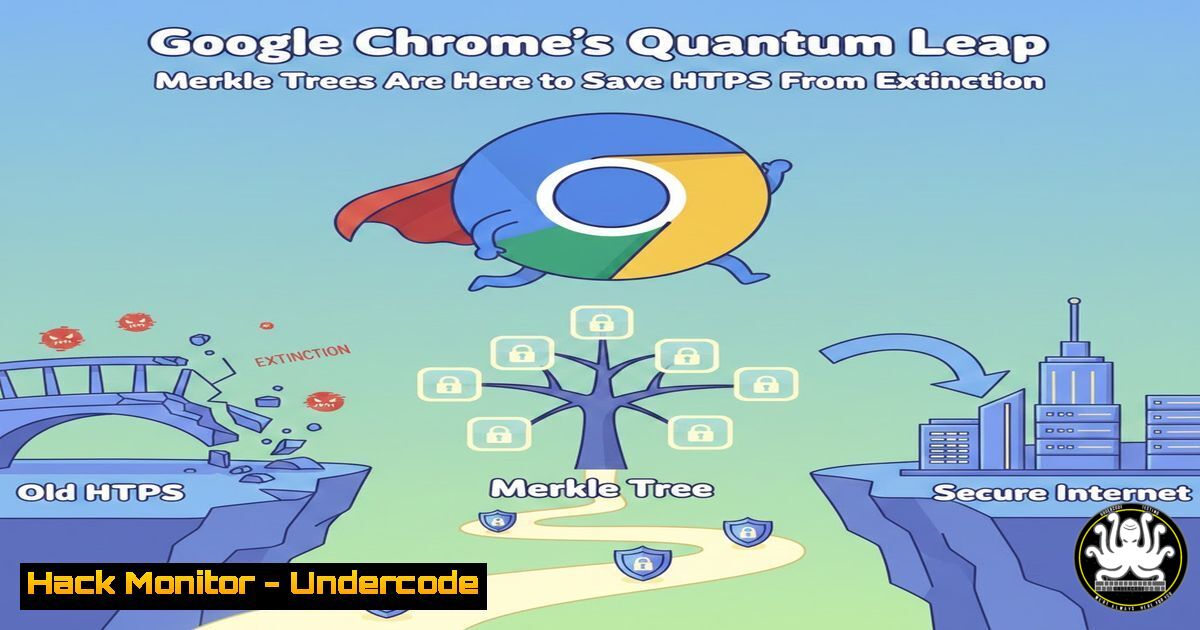
As the specter of cryptographically relevant quantum computers looms on the horizon, the foundational trust model of the internet—the HTTPS Public Key Infrastructure (PKI)—faces an existential threat. Traditional X.509 certificates, which rely on algorithms like RSA and ECC, are vulnerable to Shor’s algorithm, which quantum computers could use to derive private keys from public keys. To combat this, Google Chrome is pioneering a radical shift away from bulky post-quantum X.509 certificates towards a novel, ultra-efficient model based on Merkle Tree Certificates (MTCs) . This evolution promises to make certificate validation quantum-safe without sacrificing web performance, fundamentally re-architecting how browsers establish trust.
Learning Objectives:
- Objective 1: Understand the vulnerability of current PKI (X.509) to quantum computing attacks.
- Objective 2: Analyze the architecture of Merkle Tree Certificates (MTCs) and how they replace certificate chains with compact proofs.
- Objective 3: Explore the practical commands and tools to inspect current certificates and simulate the new trust model.
You Should Know:
- Why X.509 is Doomed in the Quantum Era
The current Web PKI relies on Certificate Authorities (CAs) signing a digital certificate that binds a domain name to a public key. When you visit a site, the server sends a chain of these X.509 certificates. The browser must validate each signature in the chain. These certificates are “heavy”—they can be several kilobytes in size and contain large cryptographic signatures.
In a post-quantum world, simply swapping out RSA for a quantum-safe algorithm (like CRYSTALS-Dilithium) isn’t a viable long-term fix. Post-quantum cryptographic (PQC) signatures are significantly larger than their classical counterparts. A certificate chain using pure PQC could balloon to hundreds of kilobytes or even megabytes, causing massive latency and bandwidth issues.
Chrome’s approach bypasses this bloat entirely. Instead of sending the full certificate and its signature, the server will only send a lightweight proof of inclusion (a Merkle proof) linking the certificate to a massive, publicly verifiable tree.
Step‑by‑step guide: Inspecting Current Certificate Overhead
To understand the problem, let’s look at the size of a standard certificate chain using OpenSSL on Linux/macOS.
- Connect to a server and grab the certificates:
openssl s_client -connect google.com:443 -showcerts </dev/null 2>/dev/null | sed -n '/--BEGIN/,/--END/p' > google_chain.pem
2. Check the size of the chain:
ls -lh google_chain.pem
Expected Output: You’ll likely see a file size around 3-5KB. Now imagine that with PQC signatures, where a single signature can be 10-20KB. A chain of 3 certificates could become 60KB+. MTCs aim to keep this proof size to a few hundred bytes, regardless of how many certificates are in the tree.
2. Understanding Merkle Tree Certificates (MTCs)
The concept, developed in the IETF PLANTS (Public Keying for Applications and Networks with Trees) working group, turns PKI on its head.
- The Tree: Instead of signing each certificate individually, a CA creates a Merkle Tree. The leaves of this tree are the hashes of all the certificates they issue.
- The Root of Trust: The CA signs only the Tree Head (the hash at the top of the tree). This single signature vouches for the integrity of potentially millions of certificates.
- The Proof: When a client (browser) connects to a server, the server does not send the certificate chain. It sends the specific certificate and a Merkle proof (a list of sibling hashes required to reconstruct the path to the Tree Head).
The browser, which has been configured with the CA’s signed Tree Head, can take the certificate hash, combine it with the provided sibling hashes, and compute the root hash. If it matches the signed Tree Head, the certificate is valid. The browser never needs to validate a heavy PQC signature per connection; it only validates a lightweight hash chain.
Step‑by‑step guide: Simulating an MTC Proof
While you cannot query a live MTC yet, you can simulate the logic of verifying a proof using a simple Python script. This demonstrates the core concept: verifying a leaf exists in a tree without having the whole tree.
1. Create a simulation script (`simulate_mtc.py`):
import hashlib

Simulate a CA's tree
leaf1 = hashlib.sha256(b"certificate_for_undercode.com").digest()
leaf2 = hashlib.sha256(b"certificate_for_example.com").digest()
leaf3 = hashlib.sha256(b"certificate_for_test.com").digest()
leaf4 = hashlib.sha256(b"certificate_for_demo.com").digest()

Build a simple 4-leaf tree (level 1)
node1 = hashlib.sha256(leaf1 + leaf2).digest()
node2 = hashlib.sha256(leaf3 + leaf4).digest()

The Tree Head (level 2 / Root)
tree_head = hashlib.sha256(node1 + node2).digest()
print(f"Tree Head (Signed by CA): {tree_head.hex()}")

Verification Phase
 Browser wants to verify leaf1. Server sends the certificate (leaf1)
 and the "proof": sibling leaf (leaf2) and the sibling node (node2)
 because leaf1 is in the left branch (node1).

provided_leaf = leaf1
proof_sibling_leaf = leaf2
proof_sibling_node = node2

Step 1: Hash the leaf with its sibling to reconstruct node1
reconstructed_node1 = hashlib.sha256(provided_leaf + proof_sibling_leaf).digest()

Step 2: Hash the reconstructed node with the sibling node to get the root
reconstructed_root = hashlib.sha256(reconstructed_node1 + proof_sibling_node).digest()

Step 3: Compare to the signed Tree Head
if reconstructed_root == tree_head:
print("[bash] Certificate verified via Merkle Proof.")
else:
print("[bash] Proof failed.")
2. Run the script:
python3 simulate_mtc.py
This script demonstrates how a small, fixed-size proof (two hashes in this case) can verify a certificate, regardless of the total number of certificates in the tree.
3. Checking for Quantum-Safe Readiness in Current Systems
While MTCs are the future, enterprises should currently be testing hybrid PQC implementations to prepare for the transition. You can check if your servers or browsers support experimental quantum-safe algorithms.
For Linux (using OpenSSL 3.2+ with oqs-provider):
If you have compiled OpenSSL with the Open Quantum Safe (OQS) provider, you can list available quantum-safe algorithms:
openssl list -signature-algorithms | grep -i dilithium
For Windows (Testing Browser Support):
Chrome often experiments with PQC via feature flags. You can check the current state of TLS 1.3 hybrid Kyber support.
1. Open Chrome and type: `chrome://flags/enable-tls13-kyber`
- If the flag exists, it will allow Chrome to negotiate a hybrid ECDHE + Kyber key exchange.
- To verify a connection, you can check the site info (lock icon) and look for “Connection secure” and the key exchange protocol (though UI for PQC is not always detailed).
4. Impact on Cloud and DevOps Security
For DevOps and Cloud Security engineers, this shift means rethinking how certificates are managed and distributed. In the MTC model, the “certificate” is ephemeral and lightweight, but the infrastructure must be able to query the CA’s tree to construct proofs.
- Kubernetes/Istio: Ingress gateways and sidecars will need to fetch Merkle proofs from a “Proof Provider” service rather than reading static X.509 secret mounts.
- CDNs: Providers like Cloudflare and Fastly will act as intermediaries, holding the tree state and attaching proofs to the TLS handshake on behalf of the origin server.
A potential debugging command on a future Linux server might involve querying the CA’s tree status:
 Hypothetical command for fetching a signed tree head
curl -H "Accept: application/json" https://ca.undercode.test/mtc/tree-head/latest
 Output: {"tree_head": "a1b2c3...", "timestamp": 1700000000, "signature": "xyz..."}
What Undercode Say:
- Key Takeaway 1: Efficiency is the Key to PQC Adoption. Google’s move acknowledges that security must not come at the cost of user experience. By moving the heavy lifting of signature aggregation to the CA (building the tree) and reducing the client’s workload to hashing, MTCs make quantum-safe cryptography palatable for the web.
- Key Takeaway 2: The CA Role Evolves, Not Disappears. Contrary to the decentralization ethos of blockchain, this model centralizes trust in a different way. CAs become guardians of massive trees. The security of millions of domains rests on the integrity of a single “Tree Head” signature and the CA’s commitment to transparency and correct tree construction.
- Key Takeaway 3: Prepare for a Hybrid Transition. We will not wake up one day in a pure MTC world. There will be a long transition period where browsers support both traditional X.509 chains and MTC proofs. Security teams must begin monitoring IETF PLANTS working group drafts and testing interoperability with cloud providers to ensure their infrastructure is ready to serve these new proofs.
Prediction:
The introduction of Merkle Tree Certificates will catalyze a split in the cybersecurity hardware market. We will see the rise of “Tree Signers”—Hardware Security Modules (HSMs) optimized for building and signing Merkle trees at scale. Simultaneously, endpoint detection and response (EDR) tools will need to evolve to monitor for malicious Merkle proofs, as attackers may attempt to forge inclusion proofs or compromise the tree head signing keys, leading to a new class of “Merkle tree poisoning” attacks where a single compromised root key invalidates millions of certificates instantly. This shift will make the transparency and auditability of the tree structures just as critical as the security of the signatures themselves.
▶️ Related Video (82% Match):
🎯Let’s Practice For Free:
IT/Security Reporter URL:
Reported By: Gvarisco Google – Hackers Feeds
Extra Hub: Undercode MoN
Basic Verification: Pass ✅


