Listen to this Post
Introduction:
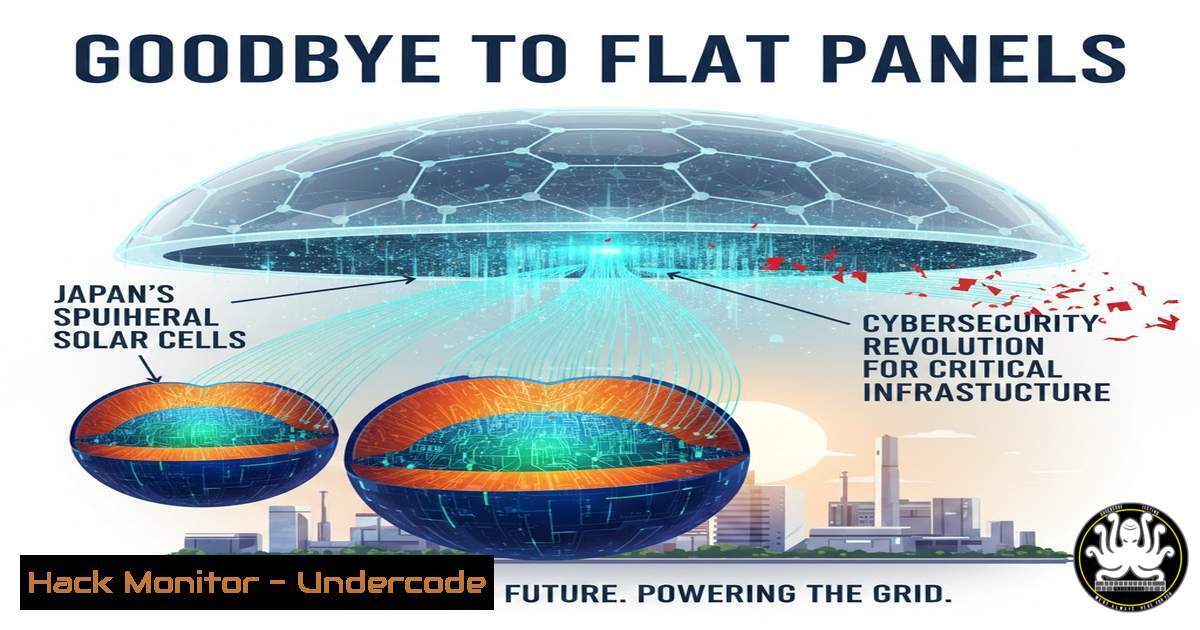
The announcement of Japan’s Kyosemi Sphelar®—a breakthrough in spherical, omni-directional solar cell technology—signals more than an energy revolution. For cybersecurity and IT professionals, this advancement represents a paradigm shift in powering distributed Internet of Things (IoT) sensors, remote monitoring systems, and critical infrastructure, thereby expanding the attack surface that must be secured. This evolution from static, flat panels to ubiquitous, miniaturized power sources necessitates a proactive reassessment of physical security, network hardening, and supply chain integrity for next-generation energy-aware systems.
Learning Objectives:
- Understand the cybersecurity implications of decentralizing power generation via spherical solar cells in critical infrastructure and IoT ecosystems.
- Learn to assess and harden systems that integrate novel, always-on power sources against physical tampering and network-based attacks.
- Develop a strategy for securing the extended supply chain and software stack of advanced renewable energy technologies from prototype to deployment.
You Should Know:
- The Expanding Attack Surface: From Centralized Grids to Ubiquitous Power
The core innovation of spherical solar cells is their ability to generate power from any direction, enabling their integration into buildings, vehicles, clothing, and remote environmental sensors. This creates a vast, geographically dispersed network of always-on, power-autonomous devices.
Step-by-step guide to mapping and securing this new surface:
1. Asset Discovery & Inventory: Use network scanning tools to identify all devices, including newly deployed sensor nodes powered by these cells. On Linux, utilize `nmap` for comprehensive discovery: `sudo nmap -sn 192.168.1.0/24` to find live hosts, followed by `sudo nmap -sV -O
2. Physical Security Audit: Assume these small, durable power sources can be placed anywhere. Conduct physical walkthroughs to catalog device locations, assess vulnerability to tampering, and ensure they are in tamper-evident enclosures.
3. Network Segmentation: Isolate all IoT and sensor networks powered by these cells from core corporate networks. Use firewall rules to strictly control traffic. On a Linux-based firewall, a basic iptables rule might be: iptables -A FORWARD -i iot_interface -o core_interface -j DROP.
2. Securing the Energy Harvesting IoT Device Lifecycle
Devices powered by spherical solar cells will often be deployed in unattended, harsh environments. Their security must be “baked in” from design through decommissioning.
Step-by-step guide for device hardening:
- Secure Boot & Firmware Integrity: Ensure each device uses cryptographic verification (e.g., RSA signatures) during boot to prevent unauthorized firmware flashes. Developers should sign firmware:
openssl dgst -sha256 -sign private_key.pem -out firmware.sig firmware.bin. - Encrypted Communication: Mandate TLS 1.3 or equivalent for all data telemetry. Never use plaintext protocols. For constrained devices, consider lightweight ciphers like ChaCha20-Poly1305.
- Secure Update Mechanism: Implement an over-the-air (OTA) update process that uses encrypted and signed packages. The device must validate the signature before applying any update.
-
API and Cloud Backend Security for Energy Data
The data from distributed solar-powered sensors will flow into cloud platforms for analytics, requiring robust API and cloud security.
Step-by-step guide for backend hardening:
- API Authentication & Rate Limiting: Use OAuth 2.0 with short-lived tokens for API access. Implement rate limiting (e.g., using AWS WAF or a Kubernetes Ingress controller) to prevent DDoS attacks and data exfiltration attempts.
- Cloud Configuration Hardening: Follow the CIS Benchmarks for your cloud provider. For AWS S3 buckets receiving sensor data, ensure they are not publicly readable:
aws s3api put-bucket-acl --bucket my-sensor-data-bucket --acl private. - Anomaly Detection: Deploy SIEM (Security Information and Event Management) rules to detect unusual data flows, such as a sensor transmitting data at night when its spherical cell cannot generate power, indicating potential compromise.
4. Supply Chain and Vendor Risk Management
The complex opto-semiconductor technology behind Sphelar® cells involves a global supply chain, introducing risks from malicious implants or compromised components.
Step-by-step guide for supply chain due diligence:
- SBOM (Software Bill of Materials) Requirement: Mandate that vendors provide a detailed SBOM (e.g., in SPDX format) for all software and firmware components to identify known vulnerabilities quickly.
- Hardware Trust Verification: For critical deployments, require hardware that supports TPM (Trusted Platform Module) or hardware security modules (HSMs) for secure key storage and attestation.
- Contractual Security Clauses: Contracts must include right-to-audit security practices, vulnerability disclosure processes, and requirements for prompt patch deployment.
5. Resilience Against Physical & Environmental Attacks
Spherical cells enable deployment in urban and natural environments, exposing hardware to novel physical attack vectors.
Step-by-step guide for building resilience:
- Tamper Detection and Response: Configure devices to wipe cryptographic keys or trigger alerts if enclosures are opened (using tamper switches). Code logic should include:
if (tamper_switch_activated()) { secure_key_erasure(); send_alert(); }. - EMI/EMC Shielding: Ensure devices are shielded against Electromagnetic Interference (EMI) to prevent fault injection attacks that could disrupt power management ICs.
- Redundancy and Mesh Networking: Design networks so that the compromise or failure of one node doesn’t break the system. Implement mesh networking protocols where nodes can relay data, ensuring network persistence.
What Undercode Say:
- Key Takeaway 1: The decentralization of power via technologies like spherical solar cells fundamentally decouples critical infrastructure from the traditional grid, creating a hyper-distributed and deeply embedded attack surface that cannot be protected by perimeter-based security alone.
- Key Takeaway 2: The convergence of novel hardware, pervasive connectivity, and complex global supply chains demands a shift-left security approach. Cybersecurity must be integral to the product design phase of these energy solutions, not a bolt-on feature, with a heavy focus on hardware-rooted trust and immutable integrity checks.
The Sphelar® technology is not merely an energy story; it is a cybersecurity catalyst. It forces the industry to confront security challenges at the intersection of hardware, software, and physical world. Defending these future systems requires a holistic blend of traditional IT security, OT (Operational Technology) resilience, and robust supply chain governance. The organizations that succeed will be those that build security into the very fabric of their energy-harvesting devices, from the semiconductor substrate up.
Prediction:
Within the next 3-5 years, as spherical and other novel form-factor solar cells become commercially viable, we will witness the first major cyber-physical attack targeting a large-scale deployment of this technology. Attackers will likely exploit vulnerabilities in the power management firmware or the mesh networking protocols to create widespread failures in smart city sensor networks or critical environmental monitoring systems. This will trigger the development of new regulatory frameworks and security standards specifically for “ambient power harvesting” devices, merging IEC 62443 (OT security) with IoT security benchmarks. The race will not only be for more efficient energy capture but for the most secure and resilient implementation.
▶️ Related Video (76% Match):
🎯Let’s Practice For Free:
IT/Security Reporter URL:
Reported By: Michael Tchuindjang – Hackers Feeds
Extra Hub: Undercode MoN
Basic Verification: Pass ✅


