Listen to this Post
Introduction:
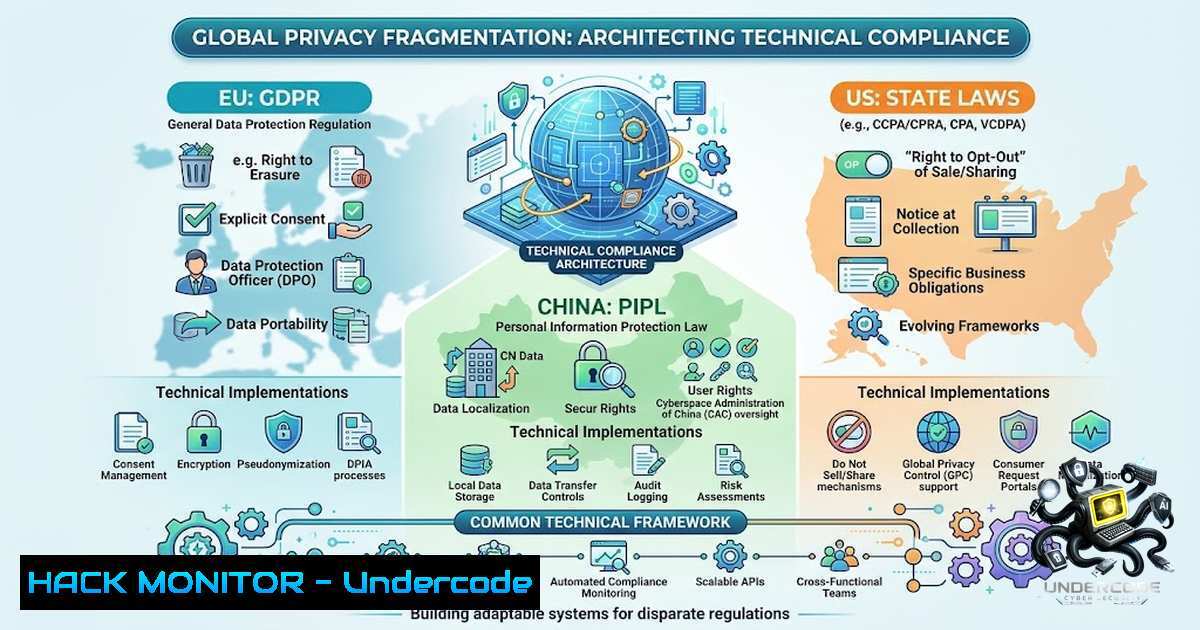
The global data privacy landscape has fractured into three distinct regulatory lineages—the rights-based GDPR model, the state sovereignty-first Chinese framework, and the fragmented US state-by-state approach—each imposing fundamentally different technical requirements on how organizations collect, store, process, and transfer personal data. For security and IT teams, this fragmentation means that a single API endpoint, database schema, or cloud deployment must simultaneously satisfy contradictory obligations: GDPR’s data minimization and portability rights, China PIPL’s localization mandates, and the patchwork of US state laws like CCPA/CPRA. This article provides a technical roadmap for architecting privacy-compliant systems across all three regimes, with verified commands, configuration examples, and step-by-step implementation guides.
Learning Objectives:
- Implement GDPR-compliant Data Subject Access Request (DSAR) APIs with audit logging and 72-hour breach notification workflows
- Configure data localization architectures for China PIPL compliance, including security assessments and cross-border transfer controls
- Build a unified privacy control plane that satisfies CCPA/CPRA, VCDPA, and other US state laws without defaulting to the most restrictive interpretation everywhere
- Deploy encryption, tokenization, and pseudonymization techniques to satisfy “privacy by design” requirements across all regimes
- Establish continuous compliance monitoring across AWS, Azure, and GCP multicloud environments
You Should Know:
- GDPR Rights-Based Architecture: Building DSAR APIs with Privacy by Design
The GDPR model treats privacy as an individual right enforced by independent regulators, built around access, correction, deletion, portability, lawful-basis testing, and breach notification duties. 25 requires data protection by design and by default, meaning an API should return only the personal data a specific request actually needs—not everything the underlying database contains. API logs are subject to the same retention limits, access controls, and security requirements as the primary data.
Step‑by‑step: Implementing GDPR-Compliant DSAR Endpoints
- Design explicit API contracts — Each endpoint must be predictable with clear data boundaries. A GDPR REST API must allow users to access, delete, and port their personal data on demand.
-
Implement authentication that’s airtight — Use OAuth 2.0 or OpenID Connect with scope-based access tokens. Log every action for audits and respond within the 30-day timeframe written into EU law.
3. Build the three core DSAR endpoints:
 Example: Data Subject Access Request API structure (pseudocode)
POST /api/v1/dsar/request
{
"subject_id": "[email protected]",
"request_type": "access|deletion|portability",
"verification_token": "jwt_or_2fa_code"
}

Response: returns structured data package or confirmation
GET /api/v1/dsar/status/{request_id}
- Implement data minimization at the query level — Never SELECT FROM users; instead, explicitly project only required fields based on the request scope.
5. Configure audit logging with retention policies:
 Linux: Set up auditd for API access logging
sudo auditctl -w /var/log/api/ -p wa -k gdpr_api_access
sudo auditctl -e 1

Configure log rotation with 30-day retention (GDPR 30)
cat > /etc/logrotate.d/gdpr_api << EOF
/var/log/api/.log {
daily
rotate 30
compress
delaycompress
notifempty
create 640 api_admins api_group
postrotate
systemctl reload api-server
endscript
}
EOF
- Implement breach notification workflows — GDPR 33 requires notification to supervisory authorities within 72 hours of becoming aware of a breach likely to result in risk to individuals’ rights and freedoms. Build automated detection pipelines:
 Linux: Monitor for anomalous data access patterns using fail2ban or custom scripts
 Example: Alert on >1000 records accessed in 5 minutes by single user
tail -f /var/log/api/access.log | awk '{print $1}' | uniq -c | while read count ip; do
if [ $count -gt 1000 ]; then
echo "ALERT: Potential data breach - $count requests from $ip" | mail -s "Breach Alert" [email protected]
fi
done
Windows PowerShell equivalent:
 Monitor API logs for breach indicators
Get-Content -Path "C:\Logs\API\access.log" -Wait | ForEach-Object {
if ($_ -match "ERROR|UNAUTHORIZED|BULK_EXPORT") {
Send-MailMessage -To "[email protected]" -Subject "Breach Alert" -Body $_
}
}
- State Sovereignty-First: China PIPL Data Localization and Security Assessments
China’s PIPL, paired with the Data Security Law and Cybersecurity Law, mandates strict data localization, explicit consent, and controlled cross-border transfers, enforced by the CAC. Personal data collected in China must remain in-country, with mandatory security assessments and additional consent requirements for cross-border transfers.
Step‑by‑step: Implementing PIPL-Compliant Data Localization
- Identify applicable data and thresholds — Determine whether volume thresholds trigger the CAC security assessment requirement. Critical Information Infrastructure (CII) operators must store “important data” locally.
-
Architect regional data planes — Deploy separate data storage in mainland China (e.g., AWS China regions, Azure China, or Alibaba Cloud) with logical and physical segregation of localized data.
3. Implement cross-border transfer controls:
 Linux: Configure iptables to restrict outbound data flows from China region
sudo iptables -A OUTPUT -d 0.0.0.0/0 -p tcp --dport 443 -m owner --uid-owner china-data-service -j DROP
sudo iptables -A OUTPUT -d 10.0.0.0/8 -p tcp --dport 443 -m owner --uid-owner china-data-service -j ACCEPT

Log all cross-border transfer attempts
sudo iptables -A OUTPUT -d ! 10.0.0.0/8 -p tcp --dport 443 -j LOG --log-prefix "CROSS_BORDER_ATTEMPT: "
- Deploy data classification and labeling — Use tools like Microsoft Purview or custom metadata tags to mark “personal information” and “important data” for PIPL compliance:
 Python: Data classification example
def classify_data(record):
if 'id_number' in record or 'phone' in record:
return 'PIPL_PERSONAL_INFO'
if 'financial' in record or 'health' in record:
return 'PIPL_IMPORTANT_DATA'
return 'PIPL_GENERAL'
- Implement CAC security assessment readiness — Document data flows, retention policies, and security controls. Prepare for on-site audits with:
 Generate compliance report
./compliance-audit.sh --jurisdiction=CN --output=caC_report_$(date +%Y%m%d).pdf
- Fragmented US State Laws: Building a Unified Compliance Layer
The United States lacks a single comprehensive privacy statute, filling the gap with 20+ state laws including CCPA/CPRA, VCDPA, CPA, and CTDPA. A single customer interaction may trigger obligations under several state laws, each with its own technical and procedural requirements.
Step‑by‑step: Multi-State Privacy Compliance Architecture
- Implement geolocation-based policy routing — Determine user jurisdiction at request time and apply the appropriate privacy policy:
 Nginx: GeoIP-based policy routing
geo $country {
default US;
EU EU;
CN CN;
}

map $country $privacy_policy {
EU gdpr_policy;
CN pipL_policy;
default us_state_policy;
}

location /api/ {
proxy_set_header X-Privacy-Policy $privacy_policy;
proxy_pass http://privacy-gateway;
}
- Build a unified DSAR orchestration layer — Handle access, deletion, correction, and opt-out requests across all state laws:
 Linux: DSAR orchestration script
!/bin/bash
 Handle CCPA/CPRA deletion requests across all data stores
for db in postgres mysql mongodb s3; do
./delete_user_data.sh --db=$db --user_id=$1 --jurisdiction=$2
done
 Log for CPRA-mandated Data Protection Impact Assessment (DPIA)
echo "Deletion completed for $1 at $(date)" >> /var/log/dsar_audit.log
- Implement “reasonable security procedures” — CCPA and CPRA require organizations to implement reasonable security procedures and practices. Deploy:
 Linux: Automated security hardening
sudo apt-get install -y fail2ban auditd lynis
sudo lynis audit system --quick
sudo fail2ban-client set sshd banip 192.168.1.100  Example
- Configure CPRA-mandated Data Protection Impact Assessments (DPIAs) — Required for high-risk processing activities:
 dpia_config.yaml
dpia_triggers:
- processing_volume: "> 100,000 consumers"
- sensitive_data: true
- automated_decisioning: true
- cross_border_transfer: true
4. Privacy-Enhancing Technologies: Encryption, Tokenization, and Pseudonymization
Across all three regimes, technical measures like encryption, tokenization, and pseudonymization are crucial for reducing privacy risks while keeping data useful for AI and analytics.
Step‑by‑step: Deploying PETs for Compliance
- Implement field-level tokenization — Replace sensitive identifiers with non-reversible tokens using cryptographic keys:
 Python: Tokenization with cryptography
from cryptography.fernet import Fernet
key = Fernet.generate_key()
cipher = Fernet(key)
token = cipher.encrypt(b"[email protected]")
 Store token in database, raw data in secure vault
- Configure pseudonymization for GDPR 25 — Use reversible cryptographic methods to de-identify and re-identify content when authorized:
 Linux: Pseudonymization using OpenSSL
echo "[email protected]" | openssl enc -aes-256-cbc -a -salt -pass pass:your_secret_key
 Output: U2FsdGVkX1/8xY3...
- Implement crypto-shredding for GDPR deletion — Delete the encryption key or mapping to make residual copies unusable, satisfying the “right to be forgotten” without physical deletion:
 Linux: Crypto-shredding
openssl rand -out /dev/null 128  Overwrite key storage
rm -f /etc/encryption_keys/.key
- Deploy data masking for AI training — Tokenization swaps sensitive information for safer placeholders while maintaining data relationships for effective AI training:
-- SQL: Dynamic data masking (Azure SQL example)
ALTER TABLE users
ALTER COLUMN email ADD MASKED WITH (FUNCTION = 'email()');
GRANT UNMASK TO privacy_officer;
5. Multi-Cloud Compliance Monitoring: AWS, Azure, and GCP
GDPR compliance in a multi-cloud environment means zero blind spots—every byte of personal data must be protected, tracked, and handled according to strict rules, no matter where it lives or moves.
Step‑by‑step: Continuous Compliance Posture Management
- Deploy Cloud Security Posture Management (CSPM) — Use tools that integrate via cloud APIs to monitor AWS, Azure, and Google Cloud for risky settings and compliance gaps continuously:
 AWS: Enable Config and GuardDuty
aws configservice put-configuration-recorder --configuration-recorder name=default,roleARN=arn:aws:iam::account:role/config-role
aws guardduty create-detector --enable

Azure: Enable Microsoft Defender for Cloud
az security pricing create -1 VirtualMachines --tier Standard
az security assessment-metadata create -1 "GDPR Compliance" --display-1ame "GDPR Compliance Assessment"

GCP: Enable Security Command Center
gcloud scc settings update --enable-security-center
- Implement data classification across clouds — Know which assets contain personal data:
 AWS Macie for data discovery
aws macie2 create-classification-job --1ame "GDPR_Scan" --s3-job-definition '{"BucketDefinitions":[{"AccountId":"123456789012","Buckets":["my-bucket"]}]}'
- Configure cross-cloud audit logging — Aggregate logs from all providers into a SIEM:
 Linux: Centralized logging with rsyslog
echo ". @192.168.1.100:514" >> /etc/rsyslog.conf
systemctl restart rsyslog

Windows: Configure Event Forwarding
wevtutil set-log "Security" /enabled:true /retention:false /maxsize:1073741824
- Design Azure Policy solutions that enforce compliance through preventive, detective, and corrective controls across AWS, Azure, and GCP.
6. Breach Notification and Incident Response
All three regimes require breach notification, but timelines and thresholds differ: GDPR requires 72-hour authority notification; CCPA requires notification “without unreasonable delay”; China PIPL requires immediate reporting to the CAC.
Step‑by‑step: Unified Breach Response
1. Build a 72-hour detection and notification pipeline:
 Linux: Automated breach detection script
!/bin/bash
 Detect unusual data export patterns
find /var/log/ -1ame ".log" -mmin -5 | while read log; do
if grep -q "EXPORT.[0-9]{5,}" $log; then
./trigger_breach_response.sh --log=$log --timestamp=$(date +%s)
fi
done
2. Configure forensic investigation workflows:
 Windows PowerShell: Capture forensic artifacts
Get-Process | Export-Csv -Path "C:\Forensics\processes_$(Get-Date -Format yyyyMMdd).csv"
Get-EventLog -LogName Security -After (Get-Date).AddHours(-72) | Export-Csv -Path "C:\Forensics\security_events.csv"
- Implement notification templates for each jurisdiction with required fields:
{
"gdpr_notification": {
"authority": "Supervisory Authority",
"timeframe": "72 hours",
"required_fields": ["nature_of_breach", "categories_of_data", "number_of_subjects", "consequences", "mitigation"]
},
"ccpa_notification": {
"authority": "California Attorney General",
"timeframe": "without unreasonable delay",
"required_fields": ["breach_description", "types_of_info", "notification_date"]
}
}
What Undercode Say:
- The global privacy fragmentation is not a legal abstraction—it’s a technical integration problem that demands API-level policy enforcement, data localization architectures, and continuous compliance monitoring across multicloud environments.
- Privacy by design is no longer optional; it’s a technical requirement encoded in 25 GDPR, CPRA DPIAs, and PIPL security assessments. Organizations that treat compliance as a reactive checkbox will fail audits and face fines up to 4% of global revenue.
The three lineages described—GDPR rights-based, PIPL state sovereignty-first, and US fragmented—represent fundamentally different philosophical approaches to data governance. But for the engineer building the API, the DBA designing the schema, or the cloud architect provisioning infrastructure, these differences translate into specific, actionable technical requirements: DSAR endpoints with 30-day response windows, regional data planes with cross-border transfer controls, and unified policy engines that can apply California’s opt-out rules alongside Virginia’s deletion rights alongside China’s localization mandates.
The technical debt of fragmentation is real, but it’s solvable. The organizations that succeed will be those that build privacy into the architecture from day one—not as a compliance burden, but as a competitive advantage in a world where trust is the new currency.
Prediction:
- +1 The “Brussels Effect” will continue to globalize GDPR-style rights, with more countries adopting similar frameworks by 2030, reducing fragmentation and enabling standardized technical compliance solutions.
- -1 The US will fail to pass comprehensive federal privacy legislation before 2028, leaving the 20+ state patchwork intact and increasing compliance costs for mid-market companies.
- +1 Privacy-enhancing technologies (PETs) like homomorphic encryption and federated learning will mature, enabling compliant data processing without raw data exposure, reducing the tension between privacy and AI innovation.
- -1 China’s PIPL enforcement will intensify, with the CAC requiring more frequent security assessments and imposing heavier penalties, forcing multinationals to either localize or exit the market.
- +1 API gateways and service meshes will embed privacy controls natively, making GDPR/CCPA/PIPL compliance a configuration option rather than a custom build.
- -1 The divergence between EU rights-based and China sovereignty-first models will create a “data iron curtain,” requiring completely separate technical stacks for each region and increasing operational complexity exponentially.
- +1 AI-driven compliance automation will emerge as a $10B+ market by 2028, with tools that automatically map data flows, classify personal information, and generate DPIA reports.
▶️ Related Video (78% Match):
🎯Let’s Practice For Free:
🎓 Live Courses & Certifications:
Join Undercode Academy for Verified Certifications
🚀 Request a Custom Project:
Secure, high-velocity infrastructure and disruptive technological engineering. Contact our engineering team for high-tier development and proprietary systems:
[email protected]
💎 Smart Architecture | 🛡️ Secure by Design | ⭐ Trusted by Thousands
IT/Security Reporter URL:
Reported By: Dataprivacy Dataprotection – Hackers Feeds
Extra Hub: Undercode MoN
Basic Verification: Pass ✅


