Listen to this Post
Introduction:
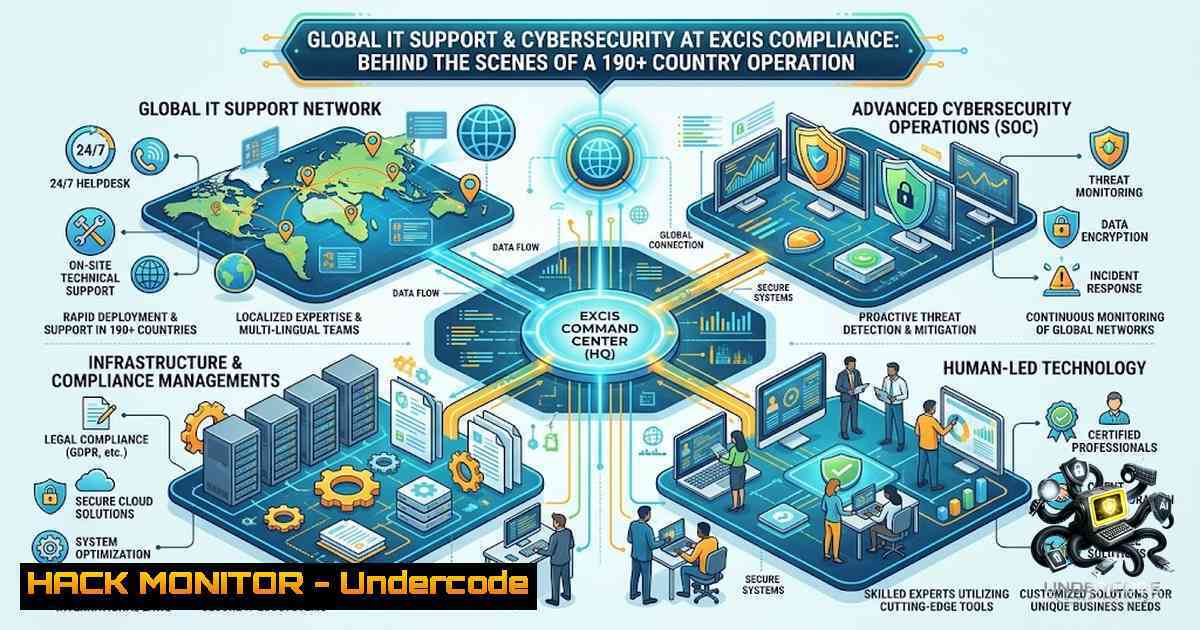
In today’s hyperconnected business landscape, global IT service delivery is no longer just about fixing technical issues—it’s about ensuring security, compliance, and seamless operations across borders, time zones, and regulatory frameworks. Excis Compliance, a global IT services provider operating in over 190+ countries with 24/7 multilingual support, embodies this complex mission. From managing firewalls and VPNs to conducting vulnerability assessments and incident response, the company’s daily operations reflect the intricate interplay between IT infrastructure, cybersecurity, and cross-cultural collaboration that defines modern enterprise technology.
Learning Objectives:
- Understand the core components of global IT service delivery, including follow-the-sun support models and ITIL-aligned service desks.
- Learn practical network security configurations, firewall management, and vulnerability assessment techniques used in enterprise environments.
- Master essential Linux and Windows commands for security monitoring, log analysis, and incident response.
- Explore API security, cloud hardening, and compliance frameworks (ISO 27001, NIST, PCI DSS) relevant to multi-1ational IT operations.
- The Follow-the-Sun Service Desk Model: Global IT Support Architecture
Excis Compliance operates a Follow-the-Sun service desk model, ensuring 24/7 coverage with a 4-hour onsite response capability anywhere in the world. This architecture relies on geographically distributed teams that hand off unresolved tickets to the next time zone, maintaining continuous operations.
Step‑by‑step implementation of a Follow-the-Sun model:
- Establish regional hubs – Identify three primary regions (e.g., APAC, EMEA, AMERICAS) to cover all time zones.
- Implement ITIL-aligned ticketing – Use a centralized ITSM platform (e.g., ServiceNow, Jira Service Management) with automated routing based on region and priority.
- Define handoff protocols – Create standardized shift交接 documentation detailing ongoing incidents, pending changes, and customer-specific nuances.
- Set up real-time dashboards – Monitor SLAs, ticket volumes, and response times across all regions.
- Enable multilingual support – Staff each hub with native or fluent speakers of regional languages.
- Test escalation paths – Simulate critical incidents to validate that Tier 1 → Tier 2 → Tier 3 escalation works within SLA targets.
Linux command for monitoring global ticket queues via API:
 Example: Querying ServiceNow API for open high-priority tickets
curl -u "username:password" -X GET \
"https://your-instance.service-1ow.com/api/now/table/incident?sysparm_query=priority=1^stateNOTIN6,7^ORDERBYDESCsys_created_on" \
-H "Accept: application/json" | jq '.result[] | {number, short_description, assigned_to, sys_created_on}'
Windows PowerShell for checking regional service health:
 Check service status across multiple remote servers
$servers = @("srv-apac-01", "srv-emea-02", "srv-amer-03")
foreach ($s in $servers) {
$service = Get-Service -1ame "ITSM-Agent" -ComputerName $s -ErrorAction SilentlyContinue
if ($service.Status -1e "Running") {
Write-Warning "$s : ITSM-Agent is $($service.Status)"
}
}
2. Network Security Operations: Firewalls, VPNs, and IDS/IPS
Excis Compliance actively recruits Network Security Operations Leads with expertise in Palo Alto, Cisco ASA/FTD, Fortinet, Check Point firewalls, and IDS/IPS technologies. Securing a global network requires consistent policy enforcement across diverse vendor ecosystems.
Step‑by‑step firewall rule audit and optimization:
- Inventory all firewall rules – Export rule bases from each vendor’s management console.
- Identify shadow rules – Use tools like `fwrule` (Check Point) or `show access-list` (Cisco) to detect redundant or conflicting entries.
- Review rule hit counts – Remove unused rules (zero hits over 90 days) to reduce attack surface.
- Implement a change management workflow – Require approval for any new rule, with documented business justification.
- Schedule regular compliance scans – Use vulnerability scanners to verify that firewall rules align with security policies.
Cisco ASA command to review active connections and identify anomalies:
cisco-asa show conn count
cisco-asa show asp drop
cisco-asa show logging | include Deny
Linux command for VPN tunnel monitoring (IPsec):
 Check IPsec status on a Linux VPN gateway (strongSwan)
sudo ipsec statusall | grep -E "Security Associations|ESTABLISHED"
 Monitor VPN traffic
sudo tcpdump -i eth0 -1 esp
Fortinet CLI for IDS/IPS signature updates:
FortiGate  execute update-1ow
FortiGate  get system status | grep "IPS"
FortiGate  diagnose ips session list | grep -c "block"
3. Vulnerability Assessment and Penetration Testing
Excis’s cybersecurity services include infiltration testing and vulnerability assessments. Regular penetration testing is critical for identifying weaknesses before attackers exploit them.
Step‑by‑step internal vulnerability scan using Nmap and OpenVAS:
- Define the scope – Identify target IP ranges and obtain authorization.
- Perform network discovery – Use Nmap to map live hosts and open ports.
- Run vulnerability scan – Deploy OpenVAS or Nessus to detect CVEs and misconfigurations.
- Prioritize findings – Use CVSS scores to classify critical, high, medium, and low vulnerabilities.
- Remediate and re-scan – Patch or mitigate findings, then re-scan to verify closure.
Nmap commands for reconnaissance:
 Discover live hosts in a subnet
nmap -sn 192.168.1.0/24
 Scan for open ports with service detection
nmap -sS -sV -p- -T4 192.168.1.100
 Identify vulnerable SMB services
nmap --script smb-vuln -p 445 192.168.1.100
OpenVAS CLI scan initiation:
 Start a scan task via Greenbone CLI
gvm-cli --gmp-username admin --gmp-password password \
socket --socket-path /var/run/gvmd.sock \
--xml "<create_task>...</create_task>"
Windows PowerShell for checking missing security patches:
 Get missing updates from Windows Update
Get-HotFix | Select-Object -Property InstalledOn, Description, HotFixID
 Use PSWindowsUpdate module to install critical updates
Install-WindowsUpdate -AcceptAll -AutoReboot -Category "Security Updates"
4. API Security and Integration Hardening
Excis offers API integration services, making API security a cornerstone of their offerings. Insecure APIs are a primary attack vector in modern cloud environments.
Step‑by‑step API security hardening:
- Authenticate and authorize – Implement OAuth 2.0 or JWT with short-lived tokens; never use API keys alone.
- Validate input rigorously – Use schema validation (e.g., JSON Schema) to reject malformed requests.
- Rate limit and throttle – Prevent brute force and DoS attacks using API gateways (e.g., Kong, AWS API Gateway).
- Encrypt data in transit – Enforce TLS 1.2+ and disable weak ciphers.
- Log and monitor – Audit all API calls for anomalous patterns (e.g., excessive 403s, unusual payload sizes).
Linux command to test API endpoint with rate limiting:
 Simulate multiple requests to test rate limiting
for i in {1..100}; do curl -s -o /dev/null -w "%{http_code}\n" -X GET \
"https://api.example.com/v1/users?token=YOUR_TOKEN"; sleep 0.1; done | sort | uniq -c
Nginx rate limiting configuration example:
http {
limit_req_zone $binary_remote_addr zone=api_limit:10m rate=10r/s;
server {
location /api/ {
limit_req zone=api_limit burst=20 nodelay;
proxy_pass http://backend_api;
}
}
}
Windows PowerShell for testing API authentication:
$headers = @{ "Authorization" = "Bearer $env:JWT_TOKEN" }
$response = Invoke-RestMethod -Uri "https://api.example.com/v1/secure" -Headers $headers -Method GET
if ($response.StatusCode -1e 200) { Write-Warning "API authentication failed" }
5. Cloud Infrastructure Hardening and Compliance
Excis provides infrastructure and cloud services. Hardening cloud environments (AWS, Azure, GCP) requires a defense-in-depth approach aligned with frameworks like ISO 27001 and NIST.
Step‑by‑step cloud security baseline implementation:
- Enable multi-factor authentication (MFA) for all administrative accounts.
- Implement least-privilege IAM policies – Restrict permissions using conditions (e.g., IP allowlisting, time-based access).
- Encrypt data at rest – Use KMS-managed keys for S3, EBS, and RDS resources.
- Configure security groups and NACLs – Restrict inbound traffic to only necessary ports and source IPs.
- Enable logging – Activate CloudTrail, VPC Flow Logs, and GuardDuty (AWS) or Azure Monitor.
- Run compliance scans – Use tools like AWS Config, Azure Policy, or third-party CSPM solutions.
AWS CLI commands for security audits:
 List all S3 buckets with public access
aws s3api list-buckets --query 'Buckets[].Name' | while read bucket; do
aws s3api get-bucket-acl --bucket $bucket | grep -q "AllUsers" && echo "$bucket is public"
done
 Check for unencrypted EBS volumes
aws ec2 describe-volumes --query 'Volumes[?Encrypted==<code>false</code>]'
Azure CLI for security group review:
 List all network security groups with overly permissive rules
az network nsg list --query "[].{Name:name, Rules:securityRules[?access=='Allow' && sourceAddressPrefix=='']}" -o table
Terraform example for enforcing bucket encryption:
resource "aws_s3_bucket" "secure_bucket" {
bucket = "my-secure-bucket"
acl = "private"
server_side_encryption_configuration {
rule {
apply_server_side_encryption_by_default {
sse_algorithm = "AES256"
}
}
}
}
6. Incident Response and Ransomware Mitigation
Excis has experienced ransomware incidents in the past, including a Sekhmet ransomware attack in May 2020. Robust incident response (IR) capabilities are non-1egotiable for any global IT service provider.
Step‑by‑step incident response playbook:
- Preparation – Deploy EDR/XDR solutions (e.g., CrowdStrike, SentinelOne) across all endpoints.
- Identification – Monitor SIEM alerts and conduct threat hunting for indicators of compromise (IoCs).
- Containment – Isolate affected systems at the network level (e.g., via firewall rules or switch port disabling).
- Eradication – Remove malware, close backdoors, and apply patches.
5. Recovery – Restore from verified, offline backups.
- Lessons Learned – Conduct post-incident review and update IR procedures.
Linux commands for rapid incident containment:
 Kill suspicious processes
ps aux | grep -i suspicious | awk '{print $2}' | xargs kill -9
 Block outbound C2 traffic via iptables
sudo iptables -A OUTPUT -d 185.130.5.253 -j DROP
 Collect forensic artifacts
tar -czf /tmp/forensic_$(date +%Y%m%d).tgz /var/log /etc/passwd /etc/shadow
Windows PowerShell for endpoint isolation:
 Disable network adapter on compromised machine
Disable-1etAdapter -1ame "Ethernet" -Confirm:$false
 Collect running processes and network connections
Get-Process | Export-Csv -Path "C:\IR\processes.csv"
netstat -anob >> C:\IR\netstat.txt
Sysmon configuration for enhanced Windows logging:
<Sysmon schemaversion="4.22">
<EventFiltering>
<ProcessCreate onmatch="include"/>
<NetworkConnect onmatch="include"/>
<FileCreateTime onmatch="include"/>
</EventFiltering>
</Sysmon>
What Undercode Say:
- Key Takeaway 1: Global IT service delivery is as much about people and collaboration as it is about technology—Excis’s follow-the-sun model and multilingual support teams exemplify how human factors enable 24/7 operational resilience.
- Key Takeaway 2: Cybersecurity in a multi-1ational context requires mastering diverse vendor ecosystems (Palo Alto, Cisco, Fortinet) while maintaining consistent policies across regions—a challenge that demands both technical depth and cross-functional communication.
Analysis: The Excis Compliance case study reveals that modern IT service providers operate at the intersection of technology, security, and global logistics. The company’s 190+ country footprint introduces complexities—regulatory compliance (GDPR, PCI DSS), language barriers, and time-zone handoffs—that demand automated tooling and standardized processes. The 2020 ransomware incident underscores that even established providers remain targets, making proactive threat hunting, regular pentesting, and immutable backups essential. For security professionals, the ability to configure firewalls across multiple brands, conduct vulnerability scans, and respond to incidents under pressure remains the core competency set. Moreover, the shift toward API-first architectures and cloud infrastructure means that traditional perimeter defenses are insufficient; zero-trust principles, API rate limiting, and continuous compliance scanning are now baseline requirements.
Prediction:
- +1 The global IT services market will increasingly consolidate around providers that can demonstrate both technical excellence and cultural adaptability—Excis’s investment in multilingual teams and ITIL-aligned processes positions it well for continued growth.
- +1 AI-driven security scoring and automated threat intelligence (as seen in Excis’s Rankiteo score) will become standard procurement criteria for enterprise clients, forcing IT service providers to mature their security postures transparently.
- -1 Ransomware-as-a-service (RaaS) groups will continue targeting IT service providers as high-value supply chain entry points—the 2020 Sekhmet attack on Excis is a warning that third-party risk management must extend to every vendor in the ecosystem.
- -1 The shortage of skilled network security engineers (as evidenced by Excis’s active recruitment) will persist, driving up salaries and making it harder for mid-sized IT firms to maintain robust security operations.
- +1 Automation and AI-assisted incident response will reduce mean time to detect (MTTD) and mean time to respond (MTTR) for providers like Excis, but human oversight will remain critical for nuanced threat analysis and client communication.
▶️ Related Video (76% Match):
🎯Let’s Practice For Free:
🎓 Live Courses & Certifications:
Join Undercode Academy for Verified Certifications
🚀 Request a Custom Project:
Secure, high-velocity infrastructure and disruptive technological engineering. Contact our engineering team for high-tier development and proprietary systems:
[email protected]
💎 Smart Architecture | 🛡️ Secure by Design | ⭐ Trusted by Thousands
IT/Security Reporter URL:
Reported By: Voices Of – Hackers Feeds
Extra Hub: Undercode MoN
Basic Verification: Pass ✅


