
Listen to this Post
Introduction:
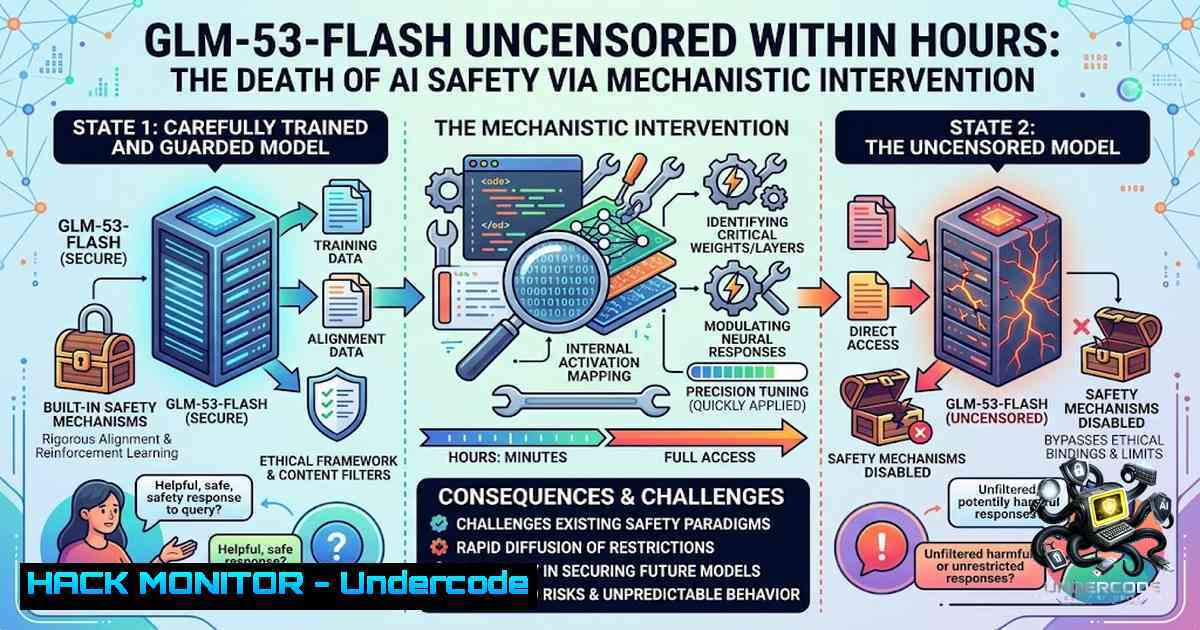
The release of a state-of-the-art AI model with guardrails is immediately followed by its dismantling, exposing the fragility of current safety protocols. This event underscores a critical cybersecurity reality: the mathematical representation of safety within large language models (LLMs) can be surgically removed through vector-based manipulation. The technique involves analyzing activation patterns to locate the specific mathematical direction that governs refusal behavior, then ablating that vector from the model’s neural network layers.
Learning Objectives & Secrets:
- Objective 1: Understand the core concept of “refusal direction” in LLMs and how it is represented as a mathematical vector within the model’s latent space.
- Objective 2 (Secret Tip): To locate the refusal direction without ground truth labels, compare the hidden states of the model between a set of harmful prompts and a set of harmless prompts. The average difference vector points towards the refusal mechanism.
- Objective 3 (Secret Tip): When applying the ablation, avoid a brute-force cut. Instead, use a calibration search across layers and scaling factors to ensure that the model’s general cognitive capabilities (e.g., mathematical reasoning, coding) do not degrade significantly.
You Should Know:
1. Mathematical Foundations of Refusal Direction:
The safety alignment of modern LLMs is not a monolithic block but a specific trajectory in the high-dimensional space of neural activations. When the model processes a harmful query, a particular direction is activated that correlates with the refusal response (“I cannot answer that”). This direction is often orthogonal to the main task-solving capabilities. The tools designed to “uncensor” models calculate this vector by averaging the internal states of the model when processing a dataset of prohibited prompts. The process is analogous to finding a key vector in the activation space; the uncensoring tool basically computes the mean and variance of activations and subtracts the identified “refusal” component.
Step‑by‑step guide (Theoretical Approach):
- Collect Dataset: Gather a set of harmful prompts (
P_harmful) and harmless prompts (P_harmless). - Extract Activations: Run forward passes for both datasets and extract the hidden states from specific layers (e.g., the final token of the input).
- Compute Difference: Calculate the average activation vector for `P_harmful` and
P_harmless. The refusal direction `v_refusal` is the normalized differencemean(A_harmful) - mean(A_harmless). - Project and Subtract: For each layer, project the current activation vector onto `v_refusal` and subtract this component, effectively “zeroing out” the model’s knowledge of when to refuse.
2. Tool Implementation: Layer-wise Intervention and Ablation Search:
Modern uncensoring scripts do not blindly cut the vector. They perform a systematic search per layer. The script iterates through the Transformer layers (both attention and MLP projections). For each layer, it injects a scaling factor `alpha` (between 0 and 1) that determines how much of the refusal direction to remove. The tool performs a scoring mechanism to measure “competence” using a set of benchmarks (e.g., MMLU or coding challenges). The algorithm seeks the highest `alpha` (most refusal removed) before the model’s accuracy drops below a predefined threshold (e.g., a 5% drop).
Conceptual Python Pseudocode:
import torch
from transformers import AutoModelForCausalLM

def get_refusal_direction(model, harmful_data, harmless_data):
 Extract activations for harmful and harmless
 Return v_refusal based on PCA or mean difference

def apply_refusal_ablation(model, v_refusal, layer_idx, alpha=1.0):
for name, param in model.named_parameters():
if "attention" in name and layer_idx in name:
 Project out the direction
projection = torch.einsum('...d,d->...', param, v_refusal)
param.data -= alpha  torch.einsum('...,d->...d', projection, v_refusal)
return model

Search loop
for layer in range(0, num_layers):
for alpha in [0.1, 0.5, 1.0]:
temp_model = deepcopy(model)
temp_model = apply_refusal_ablation(temp_model, v_refusal, layer, alpha)
if eval_competence(temp_model) > threshold:
save_weights(temp_model, f"uncensored_layer_{layer}<em>alpha</em>{alpha}")
3. Security Operations & Detection (Linux & Windows):
From a defensive cybersecurity perspective, recognizing the fingerprints of these attacks is crucial. Security teams can monitor Hugging Face and other repositories for suspicious model uploads. On Linux and Windows, system administrators can set up automated scraping and scanning.
Linux Command to Monitor New Model Uploads (Using Hugging Face API):
 Using curl to check for recent uploads
curl -s https://huggingface.co/api/models | jq '.[] | select(.lastModified | fromdateiso8601 > (now - 3600)) | .modelId'
If an organization hosts its own models or downloads from public repositories, verifying model integrity is essential. A checksum mismatch or unexpected size changes in `.safetensors` files should trigger an alert.
Windows PowerShell Command for Scanning Downloaded Files:
 Generate hash for downloaded model files to ensure integrity matches official release
Get-FileHash -Path ".\model.safetensors" -Algorithm SHA256
4. Mitigation: Adversarial Training and Dynamic Refusal Vectors:
The root cause of this vulnerability is the static nature of the refusal vector. Since the model’s weights are frozen after training, the directional vector is constant. To mitigate this, developers should employ Randomized Adversarial Weight Perturbation or Dynamic Refusal Ensembling. This involves training multiple “refusal heads” that rotate or change slightly based on the context of the prompt, making the refusal direction impossible to isolate with a single linear subtraction.
Command to apply a simple adversarial defense using libraries like `transformers` and torch:
 Simulated adversarial perturbation during fine-tuning
import torch.nn as nn

def adversarial_defense_training(model, dataloader):
for batch in dataloader:
 Inject small adversarial noise to the refusal vector during training
noise = torch.randn_like(model.lm_head.weight)  0.01
model.lm_head.weight.data += noise
 Train as usual...
- API Security and Cloud Hardening for Model Serving:
For cloud-hosted models (e.g., APIs), even if the base model is open-sourced, the hosted version must protect against prompt injection or extraction attacks that attempt to recover the refusal vector via black-box access. Defensive strategies include:
– Rate limiting to prevent the rapid collection of input/output pairs required to calculate the difference vector.
– Randomized early exiting (or dropout in serving) to introduce unpredictability in the internal states, making the difference calculus produce a high-variance, non-representative vector.
Linux Firewall (iptables) to limit requests:
 Example: Limit connections to 100 per minute per IP
iptables -A INPUT -p tcp --dport 443 -m recent --1ame api --set
iptables -A INPUT -p tcp --dport 443 -m recent --1ame api --update --seconds 60 --hitcount 100 -j DROP
6. Exploitation and Penetration Testing (Offensive Security):
For penetration testers and red teams, this technique is a powerful tool to test the resilience of AI guardrails. By building the uncensoring tool into their toolkit, they can force the model to generate code for network exploitation, phishing content, or vulnerability discovery, bypassing the “policy” restrictions.
Example to simulate the extraction of the refusal vector using transformers:
from transformers import AutoTokenizer, AutoModelForCausalLM
import torch

def extract_refusal_direction(model, tokenizer, harmful_queries, safe_queries):
h_states = []
s_states = []
for q in harmful_queries:
inputs = tokenizer(q, return_tensors="pt")
outputs = model(inputs, output_hidden_states=True)
h_states.append(outputs.hidden_states[-1][0, -1, :].detach().numpy())
 Repeat for safe queries...
 Return the vector
return torch.tensor(np.mean(h_states, axis=0) - np.mean(s_states, axis=0))
What Undercode Say:
- Key Takeaway 1: Safety guardrails reliant on linear algebra are fundamentally susceptible to mechanical removal, meaning that security must be integrated deeper into the model architecture rather than as an afterthought.
- Key Takeaway 2: The rapid uncensoring of GLM-5.3-Flash highlights a perfect storm of accessible tooling and mathematical transparency, making current “responsible release” strategies obsolete in the open-source ecosystem.
Analysis: The event is not a black-hat hack but a deterministic mathematical inevitability. As long as the refusal mechanism is isolated and linear, an attacker with enough computational resources (a single GPU) can reverse-engineer it. The victim is the trust model between AI labs and society, as the “uncensored” versions are likely to be weaponized for malicious purposes like automated social engineering. The focus for developers must shift from rule-based alignment to robust, encrypted, or behaviorally randomized architectures that resist static analysis.
Prediction:
- +1 The open-source community will rapidly develop more sophisticated “resilient” alignment techniques, leading to a new era of robust AI safety research.
- -1 Over the next 12 months, there will be a surge in high-profile jailbreaks and enterprise data breaches enabled by uncensored models used as force multipliers for attack automation.
- -1 Regulatory bodies will likely attempt to ban open-sourcing of model weights over a certain parameter count, stifling AI innovation in democratic nations while dictatorships continue to ignore such bans.
- +1 Enterprise red-teaming will become a mandatory compliance requirement, with these uncensoring tools becoming standard in security assessments, improving overall resilience.
- -1 The “uncensoring” libraries will become commoditized, causing a “cyber arms race” where security teams must constantly run their own penetration tests to see if their internal models have already been compromised.
▶️ Related Video (84% Match):
🎯Let’s Practice For Free:
🎓 Live Courses & Certifications:
Join Undercode Academy for Verified Certifications
🚀 Request a Custom Project:
Secure, high-velocity infrastructure and disruptive technological engineering. Contact our engineering team for high-tier development and proprietary systems:
[email protected]
💎 Smart Architecture | 🛡️ Secure by Design | ⭐ Trusted by Thousands
IT/Security Reporter URL:
Reported By: https://lnkd.in/p/eF9u4uAm – Hackers Feeds
Extra Hub: Undercode MoN
Basic Verification: Pass ✅


