
Listen to this Post
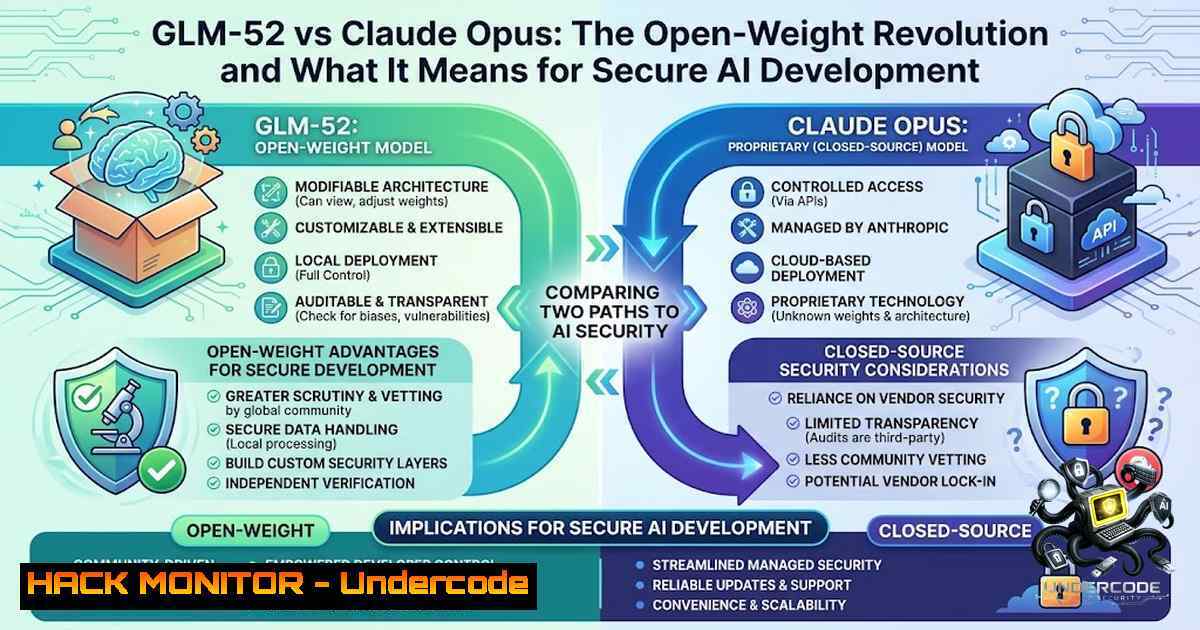
Introduction:
The artificial intelligence landscape is witnessing a pivotal shift as open-weight models rapidly close the gap with proprietary frontier systems. Z.ai’s recent release of GLM-5.2, an open-weight model featuring a 1-million-token context window and competitive coding capabilities, has sparked intense debate about the future of AI development. While headlines proclaiming GLM-5.2 has “overtaken” Claude Opus may be premature, the underlying trend is undeniable: open models are approaching frontier performance at a fraction of the cost. For cybersecurity professionals, developers, and enterprise architects, this democratization of advanced AI brings both unprecedented opportunities and significant security considerations that demand immediate attention.
Learning Objectives & Secrets:
- Objective 1: Understand the technical specifications and performance benchmarks of GLM-5.2 versus Claude Opus, including context window capabilities, parameter architecture, and real-world coding agent performance.
- Objective 2 (Secret Tip): Master the deployment of open-weight models like GLM-5.2 in production environments while implementing robust security controls—treat all model outputs as potentially malicious and implement output validation pipelines that scan generated code for vulnerabilities.
- Objective 3 (Secret Tip): Leverage the cost differential between open and proprietary models to build redundant AI architectures—diversify across models and APIs to mitigate single-vendor lock-in and supply chain risks.
You Should Know:
- GLM-5.2 Technical Deep Dive: Architecture, Benchmarks, and Cost Analysis
GLM-5.2 represents a significant leap in open-weight AI capability. Released by Z.ai (Zhipu AI) on June 13, 2026, this mixture-of-experts model comprises 753 billion total parameters with approximately 40 billion active per token. The model’s 1,048,576-token context window is specifically designed for “long-horizon tasks”—autonomously completing complex engineering projects that traditionally required teams weeks to finish.
Benchmark comparisons reveal a nuanced competitive landscape. On SWE-bench Pro, Claude Opus 4.8 scores 69.2% compared to GLM-5.2’s 62.1%, while on FrontierSWE, the gap narrows to just 0.7 percentage points (75.1% vs 74.4%). GLM-5.2 achieves 81.0% on Terminal-Bench 2.1, outperforming Gemini 3.1 Pro (74%) but trailing Claude Opus 4.8 (85%) and GPT-5.5 (84%). Artificial Analysis ranked GLM-5.2 as the top open-weight model on its Intelligence Index v4.1 with a score of 51.
The cost differential is where GLM-5.2 truly disrupts the market. At $1.40 per 1M input tokens and $4.40 per 1M output tokens, GLM-5.2 undercuts Claude Opus by 3.6x to 5.7x. Cached input tokens are available at just $0.26 per 1M tokens, and free users receive $5 of credits every 30 days through Vercel’s AI Gateway. This pricing structure makes advanced AI accessible to individual developers and small teams while enabling enterprises to scale AI initiatives cost-effectively.
2. Deploying GLM-5.2: Local Installation and API Integration
For developers seeking to experiment with or deploy GLM-5.2, multiple deployment options exist:
Option A: Ollama (Simplest, Best for Quick Testing)
 Install Ollama and pull the model
ollama run glm5.2:q4_K_M  4-bit quantized version, recommended for 4090/256GB Mac
GLM-5.2 is available in the Ollama library, requiring just two commands to get started. The model can also be accessed via Ollama’s local OpenAI-compatible endpoint, enabling seamless integration with existing tools.
Option B: vLLM (Production-Ready, High-Performance)
 Install vLLM
pip install vllm

Run GLM-5.2 with vLLM
python -m vllm.entrypoints.openai.api_server \
--model zai-org/GLM-5.2 \
--tensor-parallel-size 8 \
--max-model-len 1000000 \
--gpu-memory-utilization 0.92 \
--dtype float16
For production deployments, vLLM supports tensor parallelism across multiple GPUs. The quantized `GLM-5.2-w4a8c8` model can be deployed on a single Atlas 800 A3 node (64GB × 16), while the full-precision version requires two Atlas 800 A3 nodes (128GB × 8 each).
Option C: Docker Container Deployment
export IMAGE=quay.io/ascend/vllm-ascend
docker run --1et=host --shm-size=1g --device /dev/davinci0 $IMAGE
This approach ensures consistent environments and simplifies dependency management.
API Integration:
import openai

client = openai.OpenAI(
base_url="https://api.z.ai/v1",  or your local endpoint
api_key="YOUR_API_KEY"
)

response = client.chat.completions.create(
model="glm-5.2",
messages=[{"role": "user", "content": "Review this code for security vulnerabilities..."}],
max_tokens=128000
)
3. Security Implications of Open-Weight AI Models
The democratization of advanced AI through open-weight models introduces novel security challenges that organizations must address proactively.
Supply Chain Risks: Open-weight models, like any software artifact, can be tampered with or contain malicious components. Organizations should verify model file sources, lock to trusted versions, scan model files, and test models in isolated environments. Where supported, prioritize Safetensors format, which stores data without code execution capabilities. Implement an AI bill of materials to track model dependencies, base images, and known vulnerabilities.
Guardrail Removal: Removing an open-weight model’s safety protections takes minutes, and some models ship with no guardrails by default. A documented tool reportedly stripped safety protections from an open-weight model in less than ten minutes. Organizations must implement external safeguards to monitor for signs of risk and intervene to prevent harm.
Output Validation: Treat all model outputs as potentially malicious. Implement output validation pipelines that scan generated code for known vulnerabilities, malicious patterns, and insecure dependencies. This is particularly critical given the rise of “vibe coding,” where developers and non-traditional builders use AI to generate applications through natural language prompts—often resulting in API keys embedded in client-side JavaScript or secrets committed to repositories.
API Key Theft: Malicious actors are actively targeting AI development workflows. Researchers identified 15 malicious JetBrains Marketplace plugins designed to steal AI API keys from developers. These plugins, functioning as AI coding assistants, code-review tools, and Git utilities, secretly exfiltrate AI provider API keys stored in settings. Prompt injection attacks can hijack AI coding agents embedded in GitHub workflows, exposing live API keys and environment variables.
- AI Coding Agents: The New Software Development Paradigm
The evolution from AI-assisted coding to agentic coding represents a fundamental shift in software development. The workflow now follows a structured pipeline:
AI MODEL RACE (GLM-5.2 | Claude | GPT)
↓
AI CODING AGENTS
↓
Understand codebase → Plan the task → Write the code → Run the tests → Fix the issues → Create the PR
This agentic paradigm is being institutionalized across the industry. GitHub unveiled a new desktop application centered on an “AI agent development environment” where multiple AI agents simultaneously perform development tasks while developers supervise and manage the workflow. JetBrains introduced JetBrains Central, a production-grade agentic development platform designed to orchestrate coding agents and manage agentic environments across software teams.
For security teams, this shift demands new controls. AI agents now investigate issues, generate code, run tests, and execute multi-step workflows. Organizations must mandate that AI agents generate code alongside—or even based on—comprehensive unit and integration tests. The BMAD Method, a methodology for Agile AI-driven development, simulates a multi-role software team through role-based agent orchestration.
- Securing the AI Development Pipeline: Practical Commands and Configurations
API Key Security:
 Never hardcode API keys. Use environment variables:
export ZAI_API_KEY="your-key-here"

Use a secrets manager (e.g., HashiCorp Vault):
vault kv put secret/zai api_key=your-key-here

Rotate keys regularly:
 For Z.ai API, generate new keys via the developer dashboard
Model Verification:
 Verify model file integrity using cryptographic hashes
sha256sum glm-5.2-model.bin
 Compare against the official hash from the trusted source

Scan model files for potential issues (using custom scripts or tools)
python scan_model.py --path ./glm-5.2 --format safetensors
Output Validation Pipeline:
import subprocess
import json

def validate_ai_output(code_snippet):
 Run static analysis
result = subprocess.run(
["bandit", "-f", "json", "-"],
input=code_snippet,
capture_output=True,
text=True
)
issues = json.loads(result.stdout)
if issues.get("results"):
print(f"Security issues detected: {len(issues['results'])}")
return False
return True
Dependency Scanning:
 Scan for vulnerable dependencies in generated code
pip install safety
safety check -r requirements.txt

Use OWASP Dependency-Check
dependency-check --scan ./generated-code --format HTML
6. Cost Optimization and Architectural Best Practices
The significant cost differential between GLM-5.2 and proprietary models enables new architectural patterns:
Multi-Model Strategy: Diversify across models and APIs rather than committing to a single vendor. Route routine coding tasks to GLM-5.2 while reserving Claude Opus for complex, long-horizon software engineering tasks where it demonstrates superior performance.
Caching Strategy: Leverage GLM-5.2’s cached input pricing ($0.26 per 1M tokens) for frequently used prompts and context.
Quantization: Deploy quantized versions (e.g., GLM-5.2-w4a8c8) to reduce hardware requirements and inference costs while maintaining acceptable performance.
Monitoring and Observability: Implement comprehensive monitoring to track token usage, costs, and performance metrics across all AI models in your stack.
What Undercode Say:
- Key Takeaway 1: The gap between open and proprietary AI is narrowing rapidly, but the question isn’t which model “wins”—it’s how developers and organizations can strategically leverage both to maximize value while managing security risks. GLM-5.2 hasn’t killed Claude; it has shown us that open models are becoming viable alternatives for a growing range of use cases.
-
Key Takeaway 2: The real revolution isn’t about model performance—it’s about the agentic coding paradigm. AI agents that understand codebases, plan tasks, write code, run tests, and create pull requests are fundamentally changing software development. The critical skill for developers isn’t fighting AI but learning to work effectively with it while maintaining security, architecture, and business understanding.
Analysis: The democratization of frontier-level AI through open-weight models like GLM-5.2 represents both an opportunity and a security challenge. Organizations can now access advanced AI capabilities at commodity prices, but this accessibility comes with supply chain risks, guardrail vulnerabilities, and novel attack surfaces. The shift toward agentic coding demands new security controls, including output validation, API key management, and model verification. The most successful organizations will be those that embrace AI augmentation while implementing robust security frameworks—treating AI models as powerful but potentially dangerous tools that require careful governance. The fundamentals still matter: architecture, problem-solving, business understanding, security, databases, cloud, and code review. AI can write code, but someone still needs to know whether that code should exist in the first place.
Prediction:
- +1 The cost reduction and accessibility of open-weight models will accelerate AI adoption across mid-sized enterprises and startups, leading to a surge in AI-1ative applications and services over the next 12–18 months.
-
+1 Competition between open and proprietary AI will drive rapid innovation, with both sides pushing performance benchmarks higher and prices lower—benefiting developers and organizations alike.
-
-1 The ease of deploying open-weight models without proper security controls will lead to a wave of data breaches, API key exposures, and supply chain compromises, particularly in organizations lacking mature AI governance frameworks.
-
-1 The rise of agentic coding will create new classes of vulnerabilities as AI agents with excessive permissions execute malicious prompts or generate insecure code, requiring fundamental changes to CI/CD pipelines and code review processes.
-
+1 Organizations that invest in AI security now—implementing output validation, model verification, and multi-model strategies—will gain significant competitive advantage as AI becomes ubiquitous in software development.
▶️ Related Video (78% Match):
https://www.youtube.com/watch?v=10C8VMN3hjU
🎯Let’s Practice For Free:
🎓 Live Courses & Certifications:
Join Undercode Academy for Verified Certifications
🚀 Request a Custom Project:
Secure, high-velocity infrastructure and disruptive technological engineering. Contact our engineering team for high-tier development and proprietary systems:
[email protected]
💎 Smart Architecture | 🛡️ Secure by Design | ⭐ Trusted by Thousands
IT/Security Reporter URL:
Reported By: https://lnkd.in/p/e_rbck7G – Hackers Feeds
Extra Hub: Undercode MoN
Basic Verification: Pass ✅


