Listen to this Post
Introduction:
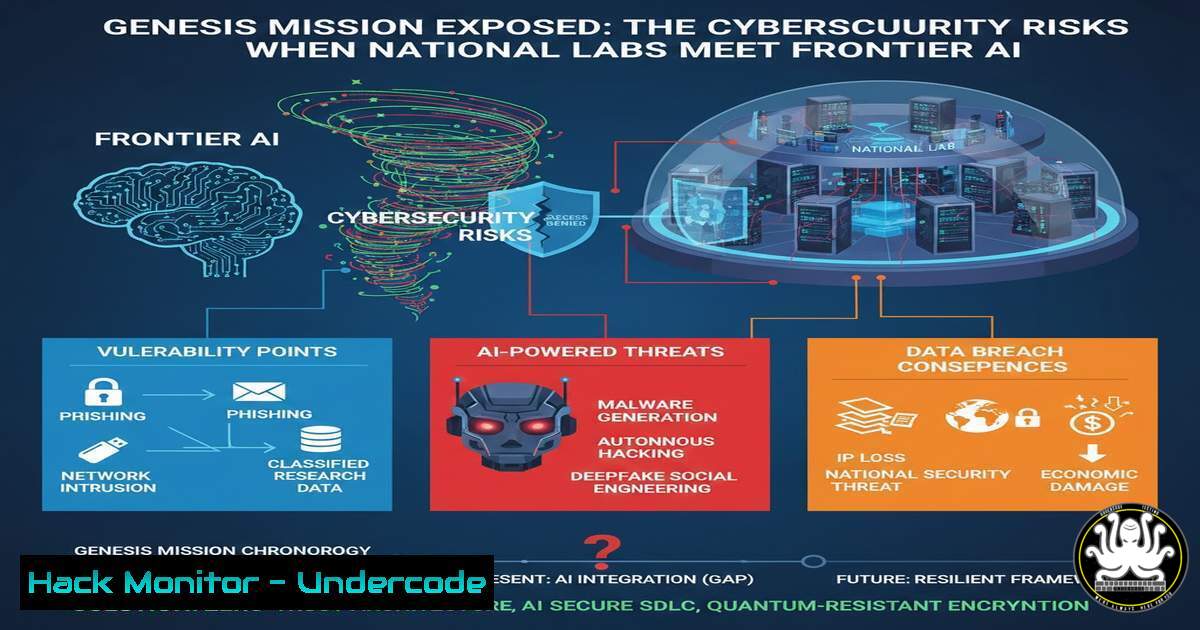
The U.S. Department of Energy’s Genesis Mission, forging a landmark alliance with 24 tech giants like OpenAI, NVIDIA, and Microsoft, aims to catapult research in nuclear, quantum, and energy security. This fusion of frontier AI with the nation’s most sensitive scientific environments—including supercomputers at Los Alamos—creates an unprecedented and high-value attack surface. For cybersecurity and IT professionals, this represents a paradigm shift where securing AI models, research data, and high-performance computing (HPC) infrastructure is no longer just about IP protection but a critical matter of national security.
Learning Objectives:
- Understand the novel cybersecurity attack surface created by integrating commercial AI into national lab supercomputing and research environments.
- Learn key technical strategies for hardening AI pipelines, managing sovereign data, and enforcing governance in high-stakes research settings.
- Analyze the critical tension between centralized, mission-driven innovation and the resilient, secure design of distributed systems.
You Should Know:
- The Expanded Attack Surface: AI Meets Operational Technology (OT)
The Genesis Mission directly connects AI training and inference pipelines to operational technology (OT) in environments researching nuclear technologies and quantum systems. This breaks traditional air-gapping assumptions and creates pathways for digital threats to impact physical systems. Adversaries, from state-sponsored actors to insider threats, will target these converged IT/OT/AI environments to steal intellectual property, manipulate research outcomes, or sabotage critical experiments.
Step‑by‑step guide explaining what this does and how to use it.
A primary defense is rigorous network segmentation and monitoring at convergence points.
1. Map the Data and Control Flow: Use tools like `nmap` and network diagrams to identify all data channels between AI compute clusters (e.g., NVIDIA DGX pods), lab instruments, and supervisory control and data acquisition (SCADA) systems.
 Example: Conduct a comprehensive port scan on a target research network segment
nmap -sS -sV -O -p- --script vuln <target_subnet> -oN genesis_network_scan.txt
2. Implement Microsegmentation: Deploy a next-generation firewall (NGFW) or software-defined perimeter (SDP) to enforce strict, application-aware policies. For example, only allow specific AI model containers to communicate with specific data historians on precise ports.
3. Monitor for Anomalies: Configure Security Information and Event Management (SIEM) rules to alert on unusual traffic patterns, such as SSH connections originating from an AI training node to a PLC controller. A sample Sigma rule logic might look for `event_source: “Firewall”` and `dest_port: 502 (Modbus)` and src_ip: "AI_Cluster_Subnet".
- Securing the AI Pipeline: Model Poisoning and Data Exfiltration
The AI models themselves—trained on immensely valuable, often classified datasets—become prime targets. Threats include model poisoning (inserting backdoors), model theft (extraction via APIs), and data inversion (reconstructing training data from model outputs). In a multi-vendor environment like Genesis, where OpenAI or Anthropic models are integrated into lab systems, ensuring the integrity and confidentiality of the AI pipeline is paramount.
Step‑by‑step guide explaining what this does and how to use it.
Harden the AI development and deployment lifecycle (MLSecOps).
- Secure the Model Registry: Use a private, secured registry (e.g., Azure Container Registry, NVIDIA NGC) with role-based access control (RBAC) and image signing. Enforce vulnerability scanning on all containerized models.
Use Trivy to scan a model container for CVEs before deployment
trivy image --severity HIGH,CRITICAL myregistry.azurecr.io/genesis/quantum-model:v1.2
- Implement Model Inference Firewalling: Deploy tools like Rebuff or Microsoft Guidance to detect and block prompt injection attacks against integrated LLMs. Configure input/output sanitization for all API calls to models.
- Audit and Log All Model Activity: Ensure immutable logging of all training jobs, data accesses, and inference requests. In Kubernetes, use Falco or native audit logs.
Tail Kubernetes audit logs for activities in a namespace 'ai-research'
kubectl logs -f --namespace=ai-research deployment/<model-serving-deployment> | grep -E "(POST|GET|exec)"
3. Sovereign Data Lakes in a Multi-Cloud World
The mission leverages cloud resources from AWS, Microsoft, and Oracle. Research data—nuclear schematics, quantum circuit designs, novel material formulas—must remain sovereign and protected across these environments. The risk of misconfiguration leading to exposed S3 buckets or Blob Storage containers is catastrophic.
Step‑by‑step guide explaining what this does and how to use it.
Enforce zero-trust data governance across hybrid clouds.
- Classify and Tag Data at Ingest: Use automated data classification tools (e.g., Microsoft Purview, AWS Macie) to tag all ingested research data with sensitivity labels (e.g., “CRITICAL: DOE-RESTRICTED”).
- Enforce Encryption Everywhere: Mandate client-side encryption before uploading to cloud storage. For Azure Blob Storage, use Customer-Provided Keys (CPK).
PowerShell: Upload a file to Azure Blob Storage using a customer-provided encryption key
$key = New-Object System.Security.Cryptography.AesCryptoServiceProvider
$key.GenerateKey()
Set-AzStorageBlobContent -File "fusion_design.sim" -Container "research" -Blob "project_theta/" -Context $ctx -CustomerProvidedKey $key
- Deploy Cloud Security Posture Management (CSPM): Use tools like Wiz, Orca, or native CSPM (AWS Security Hub, Azure Defender) to continuously detect misconfigurations, such as publicly accessible storage accounts or over-permissive IAM roles, and auto-remediate.
4. The Authority Boundary Problem: Human-AI Governance
As highlighted in the expert commentary on the Genesis post, the core challenge shifts from pure compute capability to “authority boundaries” and “human-system coherence.” When an AI model suggests a novel reactor modification or a quantum circuit configuration, who—or what—has the authority to approve its execution? This creates a critical software security interface.
Step‑by‑step guide explaining what this does and how to use it.
Build a technical governance layer for human-AI collaboration.
- Design a Four-Eyes Principle for AI Actions: Implement a workflow where any AI-generated command that interacts with physical lab equipment or alters core simulation parameters requires dual approval. This can be codified in a SOAR (Security Orchestration, Automation, and Response) platform like Splunk Phantom or Palo Alto XSOAR.
- Create an Immutable Decision Ledger: Use a blockchain or immutable database (like Amazon QLDB) to log every AI-suggested action, human approval/denial, and the final executed command. This provides an auditable trail for safety and security reviews.
Pseudocode for logging an AI-proposed action to an immutable ledger def log_ai_decision(ai_model_id, proposed_action, human_approver, decision): ledger_entry = { 'timestamp': time.time(), 'ai_agent': ai_model_id, 'action': proposed_action, 'approver': human_approver, 'decision': decision, "APPROVED", "DENIED", "MODIFIED" 'hash': generate_sha256_hash(ai_model_id + proposed_action + ...) } qldb.insert_document('AI_Governance_Log', ledger_entry) - Conduct Red Team Exercises: Regularly test these governance boundaries by simulating adversarial AI prompts or compromised model endpoints to see if safety controls prevent unauthorized actions.
5. Building Resilience: Avoiding the “Brittle Monoculture”
The collaboration centralizes around a handful of leading AI firms and hardware providers. As noted in the linked article on innovation models, this risks creating a “brittle monoculture”—a single software vulnerability or supply chain compromise could impact multiple national labs simultaneously. Resilience requires deliberate diversity and fail-safe design.
Step‑by‑step guide explaining what this does and how to use it.
Implement technical diversity and resilient fallbacks.
- Adopt a Multi-Model, Multi-Vendor Strategy: Insist that critical research workflows are not dependent on a single AI model provider. Design systems to run parallel inferences using models from different vendors (e.g., OpenAI and Anthropic and an open-source model) and compare results for critical decisions.
- Harden the Software Supply Chain: Use Sigstore for signing and verifying all software artifacts, including AI model weights and container images. Enforce Software Bill of Materials (SBOM) review for all components.
Use Cosign to verify a signed container image from a trusted entity
cosign verify --key cosign.pub myregistry.azurecr.io/genesis/simulation-engine@sha256:abc123
- Prepare Manual Override and Isolation Protocols: Maintain and regularly test “break-glass” procedures to disconnect AI systems from sensitive experiments. Ensure physical and logical isolation switches are accessible and functional.
What Undercode Say:
- Governance is the New Firewall: In the Genesis Mission environment, the most critical security layer is not at the network perimeter but in the governance protocols that define authority between human researchers and AI agents. Failure to technically enforce these boundaries is the single biggest existential risk.
- Resilience Trumps Pure Efficiency: A secure, resilient architecture for this mission must intentionally incorporate technical diversity—in AI models, cloud providers, and software stacks—even at the cost of some efficiency. The centralized “moonshot” model must be architecturally balanced with decentralized fail-safes to avoid systemic collapse from a single point of failure.
The Genesis Mission is not merely a research accelerator; it is a live-fire testbed for the cybersecurity principles of the next decade. Its success or failure will hinge on whether security and resilient design are baked into the collaboration’s fabric from the first line of code, or bolted on as an afterthought. The focus must expand from protecting data to governing the actions of the AI that will increasingly control the experiments themselves.
Prediction:
Within the next 3-5 years, the Genesis Mission’s converged IT/OT/AI environment will experience a significant cybersecurity incident—likely a novel AI supply chain attack or a compromised model leading to manipulated research data. This event will not halt the mission but will catalyze a massive investment in Adversarial AI Security and AI-Specific Governance, Risk, and Compliance (GRC) frameworks. It will force the creation of new cybersecurity roles, like “AI Safety Architects” within national labs, and lead to mandatory air-gapped “validation sanctuaries” where all AI-generated research directives must be verified by independent, non-AI systems before execution. The mission will ultimately prove that in the age of AI, national security is inextricably linked to cyber resilience.
▶️ Related Video (84% Match):
🎯Let’s Practice For Free:
IT/Security Reporter URL:
Reported By: Activity 7407848303536721921 – Hackers Feeds
Extra Hub: Undercode MoN
Basic Verification: Pass ✅


