Listen to this Post
Introduction:
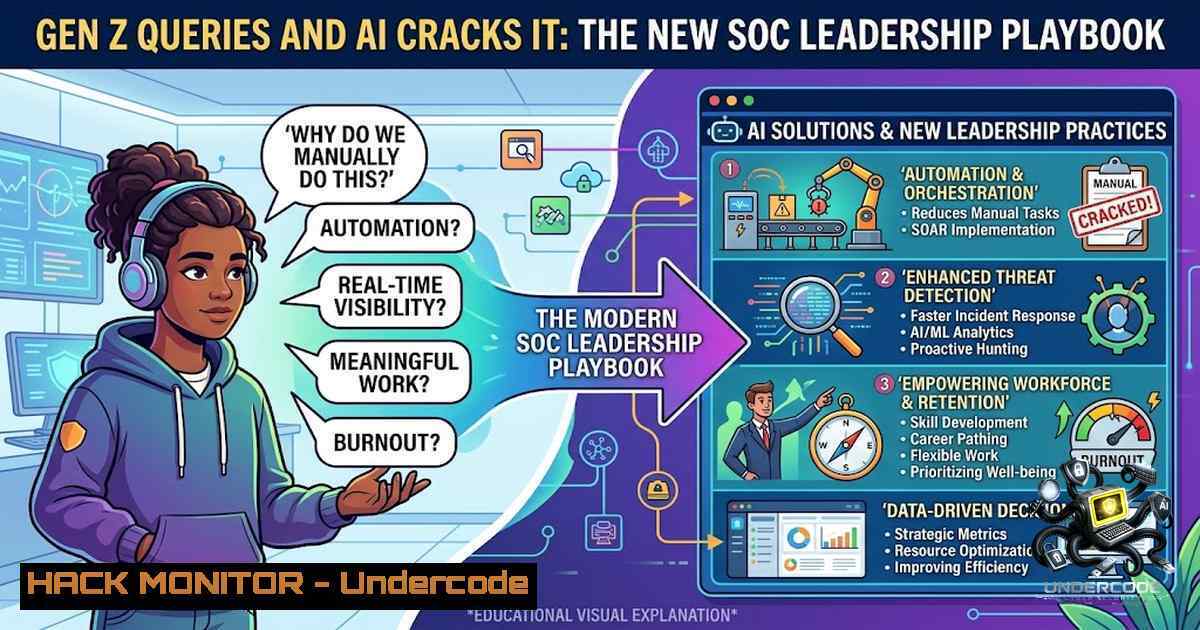
The modern Security Operations Center (SOC) is caught between the “Great Resignation” and the “AI Revolution.” As junior analysts challenge traditional workflows and demand purpose over process, the friction between generational work ethics and technological acceleration has never been more apparent. This tension, highlighted by leadership discussions on mentoring Gen Z, forces a critical evolution in how we secure infrastructure—moving from rigid “ticket-driven” security to adaptive, curiosity-based threat hunting.
Learning Objectives:
- Master the integration of AI copilots into SIEM workflows to satisfy the demand for “why” behind alerts.
- Implement adaptive security architectures that allow junior engineers to experiment without compromising integrity.
- Develop a hybrid leadership approach that blends “purpose-driven” questioning with unyielding delivery standards.
You Should Know:
- The “Curiosity-Driven” Alert Triage: Moving Beyond the Playbook
The modern analyst refuses to be a robot executing scripts; they demand context. To support this, we must transition from static runbooks to dynamic threat intelligence.
Step-by-step guide:
- Enable Detailed Logging: Ensure your Windows Event Logs and Linux `auditd` capture full process creation (
Event ID 4688for Windows, `execve` for Linux). This provides the “why” context. - Integrate OSINT via API: Use `curl` to pull threat intelligence directly into your SOAR platform. Example for checking an IP:
`curl -X GET “https://api.abuseipdb.com/api/v2/check?ipAddress=8.8.8.8” -H “Key: YOUR_API_KEY” -H “Accept: application/json”`
3. Implement AI Summarization: Use a locally hosted LLM (via Ollama) to summarize a 15-minute investigation into a 3-line overview for the analyst to validate, reducing burnout.
`ollama run mistral “Summarize this pcap: [paste base64 data]”`
4. FedRAMP Compliance Check: For Cloud Hardening, ensure S3 buckets are private. Command:
`aws s3api get-bucket-acl –bucket YOUR_BUCKET`
If `URI` shows `http://acs.amazonaws.com/groups/global/AllUsers`, immediately remediate.
2. Linux System Hardening for the “Questioning” Admin
Gen Z admins often ask, “Why do we run this legacy service?” This section helps them build a case for removal by exposing vulnerabilities in default configurations.
Step-by-step guide for baseline hardening:
1. Audit SUID Binaries: Check for unnecessary root privileges. Command:
`find / -perm -4000 -type f 2>/dev/null</h2>
If you see `ping` ormount, evaluate if they are needed. Remove permissions if not:chmod -s /bin/ping.
2. Implement Kernel Protections: Enable `sysctl` hardening to prevent buffer overflows.
echo "kernel.randomize_va_space = 2" >> /etc/sysctl.conf
echo "fs.protected_fifos = 2" >> /etc/sysctl.conf
sysctl -p
3. Firewall Configuration: Move from `iptables` to `nftables` for a more modern, less "tribal knowledge" syntax.
`nft add rule inet filter input tcp dport 22 accept`
4. Log Rotation Strategy: Explain why logs are kept for 90 days. Configure `logrotate` with compression to respect storage limits.
<h2 style="color: yellow;">
/var/log/audit/.log { daily; rotate 90; compress; delaycompress; }`
If you see `ping` or
2. Implement Kernel Protections: Enable `sysctl` hardening to prevent buffer overflows.
echo "kernel.randomize_va_space = 2" >> /etc/sysctl.conf echo "fs.protected_fifos = 2" >> /etc/sysctl.conf sysctl -p
3. Firewall Configuration: Move from `iptables` to `nftables` for a more modern, less "tribal knowledge" syntax.
`nft add rule inet filter input tcp dport 22 accept`
4. Log Rotation Strategy: Explain why logs are kept for 90 days. Configure `logrotate` with compression to respect storage limits.
<h2 style="color: yellow;">
- Windows Active Directory: Securing Kerberos Against “GoldEN” Attacks
When a junior asks, “Why do we still use NTLM?” you know you have a security advocate. This section addresses the compromise between legacy support and security.
Step-by-step guide to hardening AD:
- Disable NTLMv1: Group Policy Path:
Computer Configuration > Windows Settings > Security Settings > Local Policies > Security Options > Network Security: Restrict NTLM. - Manage Kerberos Delegation: Use PowerShell to identify constrained vs. unconstrained delegation to prevent lateral movement.
`Get-ADUser -Filter {TrustedForDelegation -eq $true} -Properties TrustedForDelegation`
- Turn on Advanced Audit Policies: Specifically, audit `Logon/Logoff` and `Object Access` to answer “who did what.”
`auditpol /set /subcategory:”Logon” /success:enable /failure:enable`
- LAPS Implementation: Deploy Local Administrator Password Solution to randomize local admin passwords. This removes the “same password everywhere” risk.
4. API Security and the “Purple Team” Mentality
Gen Z excels at cloud-1ative. The challenge is creating a “Purple Team” (Red + Blue) culture where testing is encouraged.
Step-by-step guide for API vulnerability scanning:
- Set up OWASP ZAP: Run a baseline scan against your dev API to generate a report.
`zap-cli quick-scan -s all -t https://api.dev.example.com` - Rate Limiting: Demonstrate resilience against brute force. In NGINX, define a limit zone:
limit_req_zone $binary_remote_addr zone=api_limit:10m rate=5r/s; location /api/ { limit_req zone=api_limit burst=10 nodelay; } - Exploitation Mitigation: Test for SQL Injection manually using `sqlmap` to “proof of value” for a WAF rule.
`sqlmap -u “https://api.example.com/product?id=1” –batch –risk=2 –level=2`
4. Hardening Secrets: Eliminate hardcoded credentials. Integrate HashiCorp Vault to inject secrets into containers.vault kv put secret/api username="admin" password="NewSecurePass!"
5. The “Reliability” Layer: DevSecOps CI/CD Pipelines
To satisfy the need for discipline, automate security testing. If the code fails, the pipeline fails. This provides the “meaning” (securing code) and the “performance” (meeting the pipeline gate).
Step-by-step guide for Pipeline Security:
- Trivy for Container Scanning: Scan the container image before deployment.
`trivy image python:3.8-alpine –severity HIGH,CRITICAL`
- Terrascan for Infrastructure as Code: Check Terraform for misconfigurations (e.g., open S3).
`terrascan scan -f main.tf`
- Pre-commit Hooks: Enforce security checks at the developer level (shift-left).
`echo “gitleaks detect –1o-git” > .git/hooks/pre-commit`
What Undercode Say:
- Key Takeaway 1: The demand for “purpose” is a net positive for security. When a Junior Analyst asks “Why?” they are inherently looking for threat context, which reduces false positives and improves Mean Time to Detect (MTTD).
- Key Takeaway 2: Leaders must bridge the gap between “meaning” and “repetition” by automating mundane tasks (log analysis, triage) and elevating Gen Z to strategic roles like Threat Hunting and IR planning.
Analysis:
The dialogue about Gen Z in the workplace is a mirror for the cybersecurity skills gap. It highlights that the industry is failing to retain talent because we focus on tools, not philosophy. By encouraging Gen Z’s inherent skepticism—questioning why a firewall rule exists or why a server isn’t patched—we cultivate a security posture that adapts faster than static compliance frameworks. However, the “repetition” they despise is often the foundation of security architecture; you cannot secure what you don’t understand. The solution is a hybrid model: use AI to handle the volume (data ingestion, alerts) and allow humans to focus on the complexity (lateral movement detection, zero-day analysis). This satisfies the need for mental stimulation while building the procedural memory required to spot anomalies instantly.
Prediction:
- +1 The adoption of AI “mentors” within SOCs will surge, allowing new analysts to query systems in natural language and receive code snippets (like those above), effectively shortening the learning curve from 6 months to 6 weeks.
- -1 The lack of foundational knowledge in networking and OS internals among the next generation may lead to a reliance on AI that fails to detect subtle, logic-based vulnerabilities (e.g., business logic flaws) that require deep, boring repetition to understand.
▶️ Related Video (84% Match):
🎯Let’s Practice For Free:
🎓 Live Courses & Certifications:
Join Undercode Academy for Verified Certifications
🚀 Request a Custom Project:
Secure, high-velocity infrastructure and disruptive technological engineering. Contact our engineering team for high-tier development and proprietary systems:
[email protected]
💎 Smart Architecture | 🛡️ Secure by Design | ⭐ Trusted by Thousands
IT/Security Reporter URL:
Reported By: Nishen Roy – Hackers Feeds
Extra Hub: Undercode MoN
Basic Verification: Pass ✅


