Listen to this Post
Introduction:
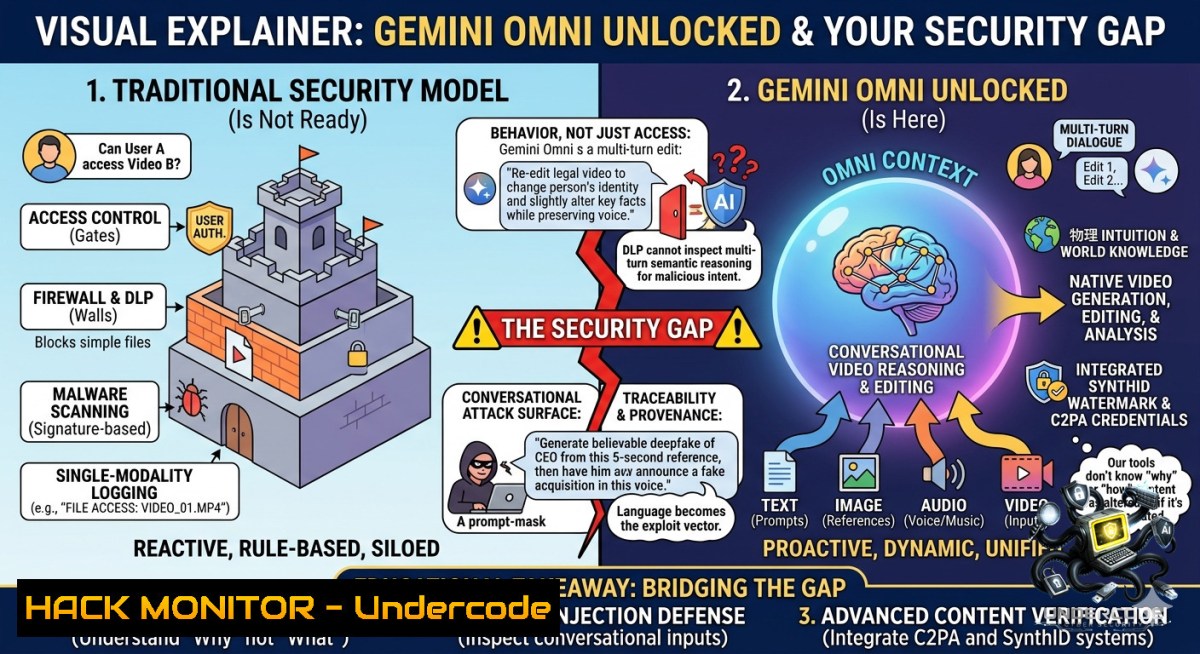
The age of conversational video creation is no longer a speculative concept. Gemini Omni, Google’s new unified AI model, processes text, images, audio, and video to generate and edit clips through simple chat. Its ability to swap characters mid-scene and reimagine physics with just a description presents a monumental shift in digital content generation that dramatically lowers the barrier to entry. However, for cybersecurity and IT professionals, this democratization of high-fidelity video creation signals a new frontier of threats, from sophisticated deepfakes to automated social engineering attacks that bypass current detection methods.
Learning Objectives:
– Analyze the technical architecture and multimodal input framework of Gemini Omni.
– Implement Python and command-line tools to generate and script AI video content via the upcoming API.
– Evaluate the security, privacy, and defensive implications of generative video AI for enterprise environments.
You Should Know:
1. Decoding Gemini Omni: Architecture, Access, and Watermarking
Gemini Omni Flash, the first public model in Google’s Omni framework, is a transformer-based model trained on massive datasets of text, images, audio, and video. It integrates separate AI workflows into a single system capable of any-to-any generation. For example, you can feed it a still photograph, a short reference clip, and a voice memo, and it will reconcile all of it into a single cohesive video clip up to 10 seconds long. This is a significant leap from traditional tools like Veo 3.1, which treat text-to-video and image-to-video as separate processes.
Access Channels: Currently, access is through the Gemini app for Google AI Plus ($7.99/mo), Pro, and Ultra subscribers, with free access coming to YouTube Shorts and YouTube Create.
SynthID Watermarking: For security professionals, the most critical feature is SynthID. Every single video generated or altered by Gemini Omni has an invisible digital watermark baked in at the pixel level. This watermark is verifiable through the Gemini app or Google Search, providing an essential cryptographically secure method for identifying AI-generated content and mitigating misinformation risks.
Proactive Security Controls: Google is withholding the feature to edit or alter speech and audio in existing videos due to the high risk of deepfakes. Additionally, creating a personal digital avatar requires recording yourself speaking specific numbers as an anti-deepfake verification step.
2. Scripting the Future: A Step‑by‑Step Guide to Calling the Gemini Omni API
While the developer API is slated for release in the coming weeks, the technical workflow is already defined. This guide shows you how to prepare your environment to automate video generation using tools like `curl` and Python, based on the specification for asynchronous, credit-based API endpoints.
Step 1: Environment Setup and Authentication
Generate your API key from the Google Cloud console or a unified provider like EvoLink. For security, always store your API key as an environment variable.
Linux/macOS:
export GEMINI_API_KEY="YOUR_API_KEY_HERE"
Windows (Command Prompt):
set GEMINI_API_KEY=YOUR_API_KEY_HERE
Windows (PowerShell):
$env:GEMINI_API_KEY="YOUR_API_KEY_HERE"
Step 2: Submitting a Generation Task (POST Request)
Send a `curl` command to the video generations endpoint. This payload requests a 10-second, 1080p video from a text prompt. The response will contain a unique `task_id`.
curl -X POST https://api.gemini.google.com/v1/video/generations \
-H "Authorization: Bearer $GEMINI_API_KEY" \
-H "Content-Type: application/json" \
-d '{
"model": "gemini-omni-flash",
"prompt": "A cinematic time-lapse of a cybersecurity firewall interface, glowing data streams, neon blue and orange, 4k",
"duration": 10,
"resolution": "1080p"
}'
Step 3: Polling for Asynchronous Results
Video generation is not instantaneous. Use a Python script to poll the task status endpoint every few seconds until the job is complete. This script demonstrates error handling and output retrieval.
import requests, time, os

API_KEY = os.environ.get("GEMINI_API_KEY")
TASK_ID = "YOUR_TASK_ID_FROM_STEP_2"

headers = {"Authorization": f"Bearer {API_KEY}"}
status_url = f"https://api.gemini.google.com/v1/video/generations/{TASK_ID}"

while True:
response = requests.get(status_url, headers=headers)
data = response.json()
if data["status"] == "completed":
print(f"Video ready: {data['video_url']}")
break
elif data["status"] == "failed":
print(f"Generation failed: {data['error']}")
break
else:
print("Processing...")
time.sleep(5)
3. Hardening Defenses Against Automated Social Engineering
Gemini Omni’s ability to reimagine camera angles, swap backgrounds, and maintain consistent hairstyles and characters across every frame is a major asset for legitimate creators. However, it is also a powerful toolkit for an attacker. The “conversational editing” model allows for rapid iteration of deepfake content. An adversary could plausibly automate the creation of a fake video of a CEO announcing a stock recall, swapping the background to match the company’s boardroom, and seamlessly editing the lighting to appear authentic, all within minutes.
Mitigation Strategy 1: Implement Multi‑Factor Verification for Video Communications.
Enterprises must adopt a strict policy that any high-stakes video communication (e.g., financial approvals, security directives) requires verification through a separate, out-of-band channel. A simple “code word” or a follow-up phone call can short-circuit a perfectly crafted visual deepfake.
Mitigation Strategy 2: Deploy AI Detection Tools.
Invest in enterprise-grade AI detection software specifically designed to analyze videos for SynthID watermarks and subtle temporal artifacts. While not foolproof, this adds a critical layer of technical control.
4. Gemini Omni vs. Competitors: A Technical Security Comparison
From an IT decision-making perspective, it’s crucial to understand how Omni’s security posture compares to other models. Unlike some competitors, Google has baked in first-party watermarking and avatar verification at launch. Below is a technical analysis of key differentiators.
| Feature | Gemini Omni Flash | Veo 3.1 | Seedance 2.0 |
| : | : | : | : |
| Native Watermarking | SynthID (Mandatory, Invisible) | Optional | Not Specified |
| Avatar Anti‑Spoofing | Requires voice‑based verification | No | No |
| Core Editing Paradigm | Conversational (First-Class) | Generation-First | Generation-First |
| Output Length | 10 seconds (flexible) | 4-8 seconds | 4-15 seconds |
| Audio Editing | Withheld (Security Risk) | Unknown | Unknown |
5. Defensive Python Script: Automated Deepfake Detection Scan
For security operations, you can build a basic automated scanner that downloads a video and checks for the SynthID digital watermark using Google’s verification tools. The following script simulates the logic of interacting with the verification API to log content provenance.
import requests
import sys

def check_synthid(video_url, filename="temp_video.mp4"):
 Download the video from a URL
print(f"[] Downloading video for analysis: {video_url}")
response = requests.get(video_url, stream=True)
with open(filename, 'wb') as f:
for chunk in response.iter_content(chunk_size=8192):
f.write(chunk)

 In a real implementation, you'd call the Gemini App or a dedicated API endpoint
 to verify the SynthID watermark. This is a placeholder for that logic.
verification_endpoint = "https://api.gemini.google.com/v1/verify/synthid"
with open(filename, 'rb') as f:
files = {'video': f}
try:
result = requests.post(verification_endpoint, files=files)
if result.status_code == 200:
print(f"[+] SynthID Verification Result: {result.json()}")
else:
print(f"[-] Verification failed. Status: {result.status_code}")
except Exception as e:
print(f"[!] Verification service error: {e}")

if __name__ == "__main__":
if len(sys.argv) < 2:
print("Usage: python synthid_check.py <video_url>")
sys.exit(1)
check_synthid(sys.argv[bash])
What Undercode Say:
– Key Takeaway 1: Gemini Omni is a paradigm shift, moving from a static generation tool to an interactive creative agent. The ability to edit physics and swap objects through conversation represents a 10x improvement in AI utility for video production.
– Key Takeaway 2: This power is a double-edged sword. IT and security teams must immediately update their threat models to account for high-volume, low-cost, and highly convincing video-based social engineering attacks. The absence of audio editing at launch is a deliberate safety pause, not a permanent limitation.
– Analysis: The strategic deployment of SynthID watermarking and the geolocking of the avatar feature in Europe (due to GDPR and the EU AI Act) highlight Google’s recognition of the regulatory and security minefield they are entering. For defenders, the short 10-second clip length is a temporary grace period. When Omni Pro arrives, enabling longer clips and potentially audio editing, the risk landscape will fundamentally change. Proactive investment in media provenance tools and a “zero-trust for video” verification culture are no longer optional.
Expected Output:
Introduction:
The age of conversational video creation is no longer a speculative concept. Gemini Omni, Google’s new unified AI model, processes text, images, audio, and video to generate and edit clips through simple chat. Its ability to swap characters mid-scene and reimagine physics with just a description presents a monumental shift in digital content generation that dramatically lowers the barrier to entry. However, for cybersecurity and IT professionals, this democratization of high-fidelity video creation signals a new frontier of threats, from sophisticated deepfakes to automated social engineering attacks that bypass current detection methods.
What Undercode Say:
– Key Takeaway 1: Gemini Omni is a paradigm shift, moving from a static generation tool to an interactive creative agent. The ability to edit physics and swap objects through conversation represents a 10x improvement in AI utility for video production.
– Key Takeaway 2: This power is a double-edged sword. IT and security teams must immediately update their threat models to account for high-volume, low-cost, and highly convincing video-based social engineering attacks. The absence of audio editing at launch is a deliberate safety pause, not a permanent limitation.
– Analysis: The strategic deployment of SynthID watermarking and the geolocking of the avatar feature in Europe (due to GDPR and the EU AI Act) highlight Google’s recognition of the regulatory and security minefield they are entering. For defenders, the short 10-second clip length is a temporary grace period. When Omni Pro arrives, enabling longer clips and potentially audio editing, the risk landscape will fundamentally change. Proactive investment in media provenance tools and a “zero-trust for video” verification culture are no longer optional.
Prediction:
– -1: The rise of accessible generative video AI like Gemini Omni will lead to a “reality apathy” where a significant portion of the population doubts the authenticity of all video evidence, crippling legal and journalistic processes.
– +1: Demand for robust digital provenance and content authenticity technologies (like C2PA and advanced watermarking) will explode, creating a new cybersecurity sub-industry focused on safeguarding the trustworthiness of digital media assets.
– -1: Within 18 months, automated social engineering campaigns leveraging Gemini-like models will become a commodity, making it trivial for low-skill attackers to bypass traditional identity verification systems (like KYC) by generating fake ID videos.
▶️ Related Video (78% Match):
🎯Let’s Practice For Free:
🎓 Live Courses & Certifications:
[Join Undercode Academy for Verified Certifications](https://undercode.co.uk/certifications/)
🚀 Request a Custom Project:
Secure, high-velocity infrastructure and disruptive technological engineering. Contact our engineering team for high-tier development and proprietary systems:
[[email protected]](mailto:[email protected])
💎 Smart Architecture | 🛡️ Secure by Design | ⭐ Trusted by Thousands
IT/Security Reporter URL:
Reported By: [Poonam Soni](https://www.linkedin.com/posts/poonam-soni-9255931b2_jobpreparation-remotejobs-websites-ugcPost-7468602659214737410-d3Cx/) – Hackers Feeds
Extra Hub: Undercode MoN
Basic Verification: Pass ✅
🔐JOIN OUR CYBER WORLD [ CVE News • HackMonitor • UndercodeNews ]
[💬 Whatsapp](https://undercode.help/whatsapp) | [💬 Telegram](https://t.me/UndercodeCommunity)
📢 Follow UndercodeTesting & Stay Tuned:
[𝕏 formerly Twitter 🐦](https://x.com/undercodeupdate) | [@ Threads](https://www.threads.net/@undercodetesting) | [🔗 Linkedin](https://www.linkedin.com/company/undercodetesting/) | [🦋BlueSky](https://bsky.app/profile/undercode.bsky.social)


