Listen to this Post
Introduction:
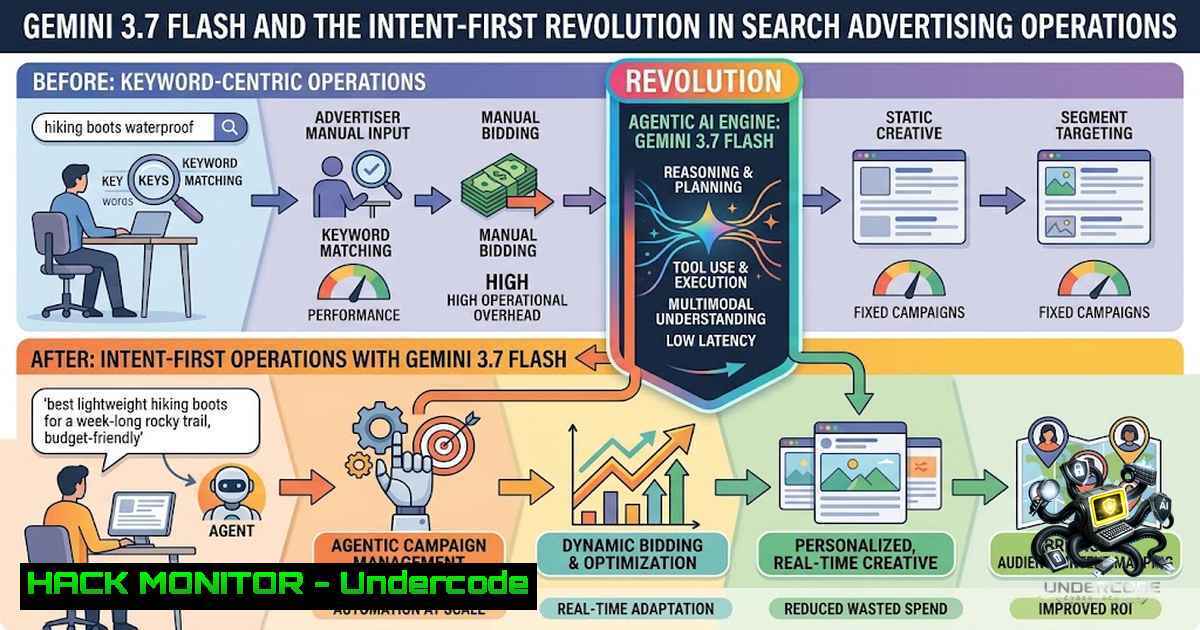
Google’s integration of Gemini 3.7 Flash into its Search AI Mode represents a fundamental architectural shift in how search engines process and respond to user queries—moving beyond rigid keyword matching toward nuanced, context-aware intent understanding. For advertising operations professionals, this transition demands a complete re-engineering of campaign workflows: media planning can no longer operate in isolation from creative strategy, and the era of relying solely on exact-match keyword hierarchies is definitively over. This article examines the technical implications of Gemini 3.7 Flash for ad operations, provides actionable implementation guidance, and outlines how structured data and unified campaign platforms can help organizations maintain competitive advantage in an intent-first advertising ecosystem.
Learning Objectives:
- Understand the architectural changes introduced by Gemini 3.7 Flash and their impact on search query processing and intent recognition
- Master the transition from keyword-centric campaign structures to intent-signal-based media planning and creative deployment
- Implement structured data frameworks and automated quality assurance workflows to operationalize precision at scale
- Leverage API-based automation and unified campaign operations platforms to reduce fragmentation and improve execution fidelity
You Should Know:
- Understanding Gemini 3.7 Flash: Architecture, Capabilities, and Advertising Implications
Gemini 3.7 Flash, released in August 2026, is positioned by Google as a “workhorse” AI model engineered for high-fidelity execution across software engineering, knowledge work, and complex agentic workflows. The model features a 1,048,576-token context window and supports grounding with Google Search and Google Maps, along with native code execution capabilities. Notably, Gemini 3.7 Flash is offered at approximately half the price per million tokens compared to its predecessor, Gemini 3.6 Flash, while delivering a reported 43.6% improvement in multi-step planning and tool-call reliability.
For advertising operations, the critical enhancement lies in the model’s improved ability to “follow instructions” and “understand your intent”—capabilities that directly translate to how Google Search processes and responds to user queries. In AI Mode, users can articulate more complex, conversational queries, and Google’s systems respond with greater precision. Search queries in AI Mode run two to three times longer than traditional searches, providing richer intent signals to Google’s systems while simultaneously making keyword-level attribution increasingly difficult to verify.
This shift means that Google’s ad auction dynamics have fundamentally changed. Rather than matching against explicit keyword strings, Google’s AI now evaluates the broader context of searches, including user behavior patterns, historical signals, and predicted needs. Campaigns built around rigid keyword hierarchies will inevitably bleed wasted impressions as the algorithm prioritizes intent-signal alignment over exact-match precision.
2. Transitioning from Keyword-Centric to Intent-First Campaign Architecture
The migration from keyword-centric to intent-first campaign structures requires a systematic approach to campaign re-architecture. Media planners must move beyond surface-level keyword research to identify underlying user needs and conversational patterns.
Step-by-Step Guide: Re-Engineering Campaign Structures for Intent-First Operations
Step 1: Audit Existing Campaign Architecture
Begin by exporting all existing campaign structures via the Google Ads API or through platform reporting. Identify campaigns that rely heavily on exact-match and phrase-match keywords with minimal negative keyword application. These campaigns are most vulnerable to performance degradation under the new intent-based matching paradigm.
Step 2: Map Intent Clusters, Not Keywords
Instead of organizing campaigns around keyword themes, organize around user intent clusters. For example, rather than a campaign targeting “project management software” keywords, structure campaigns around intent clusters such as “teams needing task coordination,” “agencies requiring client reporting,” or “enterprises seeking resource allocation.” Google Ads API now supports metrics for unique query intent clusters, enabling data-driven intent identification.
Step 3: Implement Broad Match with Intent Guardrails
Transition campaign keyword strategies to broad match with carefully constructed negative keyword lists acting as guardrails. This approach allows Google’s AI to surface relevant queries based on intent signals while preventing irrelevant traffic. Start with a 2-4 week learning period using Maximize Conversions bidding to gather sufficient intent-signal data.
Step 4: Deploy Structured Data for Intent Signal Enhancement
Implement schema markup across landing pages and content assets to provide Google’s AI with explicit intent signals. Use JSON-LD structured data per Schema.org standards to tag content types (articles, FAQs, how-to guides, product pages). This structured approach enables Gemini to quickly identify, understand, and cite your content when generating AI Overviews.
Step 5: Establish Intent-Based Performance Measurement
Replace keyword-level attribution reporting with intent-cluster performance analysis. Leverage the Google Ads API’s Smart Bidding exploration capabilities, which allow for target ROAS tolerance adjustments and automated bidding optimization based on intent signals.
- Operationalizing Precision: Structured Data, Creative Asset Management, and QA at Scale
As Google’s AI grows more sophisticated in intent recognition, the demands on internal campaign operations intensify proportionally. The increased complexity of user intent requires an equally sophisticated and error-free execution framework from ad operations teams.
Step-by-Step Guide: Building a Structured Data and QA Framework
Step 1: Centralize Creative Asset Management
Creative fragmentation is the primary operational risk in intent-first advertising. Each creative variation must be meticulously tagged with its target audience, associated intent signals, performance metrics, and deployment parameters. Implement a cloud-based digital asset management (DAM) system purpose-built for ad operations teams to store, tag, and retrieve creative assets with metadata precision.
Step 2: Standardize Media Planning Data
Transition media plans from spreadsheet-based management to standardized, machine-readable formats. Centralize and standardize media plans, enforcing governance across ad platform taxonomies, UTM variables, and campaign naming conventions. This standardization ensures that intent signals flow cleanly from planning through execution.
Step 3: Implement Automated Data Validation
Deploy automated validation rules across campaign creation workflows to enforce consistency and accuracy. Validate that all required fields are populated, creative assets are properly tagged, and intent signals are correctly mapped to campaign structures. Validation tools should check for compliance with platform-specific requirements and organizational governance policies.
Step 4: Establish Cross-Platform Integration
Implement native integrations between your campaign operations platform and major ad platforms including Meta Ads, Google Ads, and others. These integrations enable structured data synchronization, automated campaign trafficking, and real-time performance data flow, eliminating manual data entry and reducing error rates.
Step 5: Build Intent-Signal Feedback Loops
Configure your campaign operations platform to capture performance data and feed it back into the creative development and media planning processes. This closed-loop system enables continuous optimization based on real-world intent-signal performance.
- API Automation and AI Agent Integration for Campaign Operations
Gemini 3.7 Flash is explicitly designed for agentic workflows and automated operations. The model’s enhanced multi-step planning and tool-call capabilities make it suitable for automating complex campaign management tasks.
Step-by-Step Guide: Implementing API-Based Campaign Automation
Step 1: Set Up Google Ads API Access
Configure OAuth-based authentication for Google Ads API access. The Google Ads API enables programmatic campaign creation, performance reporting, and bid automation across thousands of accounts from your own code. For AI agent integration, consider implementing a Model Context Protocol (MCP) server that allows AI agents to read, analyze, and execute gated actions on Google Ads accounts—including pausing keywords, setting bids, and adjusting budgets.
Step 2: Deploy Automated Bidding Strategies
Implement automated bidding strategies through the Google Ads API, leveraging machine learning algorithms to optimize bids in real time. Configure Target CPA or Target ROAS strategies with exploration tolerance settings to allow the system to discover new intent-signal opportunities.
Step 3: Build Intent-Signal Monitoring Dashboards
Create custom dashboards that aggregate intent-signal performance data from the Google Ads API. Monitor query intent clusters, conversion attribution by intent type, and bid efficiency metrics to inform ongoing optimization.
Step 4: Automate Campaign Creation Workflows
Use the Google Ads API to create standardized campaign templates that can be programmatically instantiated with intent-specific parameters. This automation reduces manual setup time and ensures consistency across campaign launches.
5. The Role of Unified Campaign Operations Platforms
The complexity of intent-first advertising makes siloed operations unsustainable. Creative asset management, media planning, and ad platform activation can no longer operate independently.
Implementation Guide: Deploying a Unified Campaign Operations Platform
Step 1: Assess Operational Fragmentation
Audit current workflows to identify points of fragmentation: Where are creative assets stored? How are media plans managed? What manual processes exist between planning and activation? The average campaign operations team acts as a “human API connection” between disparate platforms, creating inefficiency and error risk.
Step 2: Select a Unified Platform
Choose a platform that unifies creative asset management (DAM), media planning, and cross-channel ad trafficking with native integrations to major ad platforms. The platform should provide a centralized workspace for global collaboration and enforce data governance across all campaign components.
Step 3: Migrate Assets and Workflows
Systematically migrate creative assets, media plans, and campaign templates to the unified platform. Establish governance rules for asset tagging, media plan standardization, and quality assurance.
Step 4: Activate Cross-Platform Trafficking
Configure native integrations to push campaigns and sync structured data with ad platforms including Meta Ads, Google Ads, and others. This eliminates manual trafficking and ensures consistent data flow across the campaign lifecycle.
What Undercode Say:
- Intent Signals Are the New Currency: The transition from keyword matching to intent-based processing represents a permanent structural shift in search advertising. Organizations that continue to build campaigns around rigid keyword hierarchies will experience deteriorating performance as Google’s AI prioritizes intent-signal alignment.
-
Unified Operations Are No Longer Optional: The complexity of intent-first advertising makes siloed operations unsustainable. Creative asset management, media planning, and ad platform activation must be unified into a single, cohesive workflow to maintain operational efficiency and campaign performance.
Analysis: The Gemini 3.7 Flash integration represents more than a routine algorithm update—it signals Google’s strategic direction toward AI-1ative search experiences where intent understanding supersedes keyword matching. For advertising operations professionals, this requires immediate investment in structured data infrastructure, creative asset management systems, and API-based automation capabilities. Organizations that successfully transition to intent-first operations will gain significant competitive advantage through improved ad relevance, reduced wasted spend, and more efficient campaign management. Conversely, those that maintain legacy keyword-centric approaches will face declining performance as Google’s AI increasingly favors intent-aligned content and advertisements. The technical demands of this transition—structured data implementation, API automation, unified operations platforms—are substantial but achievable with systematic planning and execution.
Prediction:
- +1 Search advertising will evolve toward fully automated, intent-driven campaign management within 18-24 months, with human operators transitioning from manual campaign setup to strategic intent analysis and creative development oversight.
-
+1 Unified campaign operations platforms will become standard infrastructure for enterprise advertising teams, replacing fragmented point solutions and spreadsheet-based workflows within 3-5 years.
-
-1 Organizations that fail to transition from keyword-centric to intent-first operations will experience 20-40% declines in advertising efficiency as Google’s AI increasingly prioritizes intent-aligned content over exact-match keyword targeting.
-
+1 API-based automation and AI agent integration will reduce campaign management labor costs by 60-80% while improving execution fidelity and reducing error rates.
-
-1 The complexity of intent-first advertising will create significant operational challenges for smaller teams without access to unified campaign operations platforms or API development resources, potentially widening the competitive gap between enterprise and SMB advertisers.
▶️ Related Video (86% Match):
https://www.youtube.com/watch?v=2jDtM3UE5qM
🎯Let’s Practice For Free:
🎓 Live Courses & Certifications:
Join Undercode Academy for Verified Certifications
🚀 Request a Custom Project:
Secure, high-velocity infrastructure and disruptive technological engineering. Contact our engineering team for high-tier development and proprietary systems:
[email protected]
💎 Smart Architecture | 🛡️ Secure by Design | ⭐ Trusted by Thousands
IT/Security Reporter URL:
Reported By: https://lnkd.in/p/eiw6KvFx – Hackers Feeds
Extra Hub: Undercode MoN
Basic Verification: Pass ✅


