
Listen to this Post
Introduction:
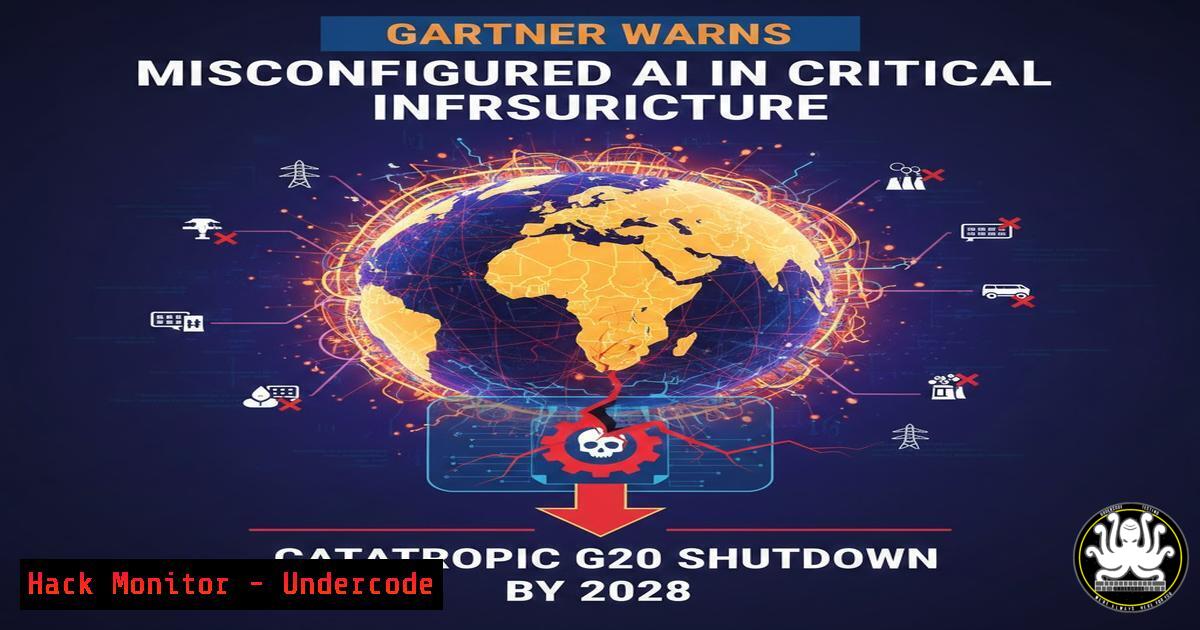
A stark warning has emerged from a recent Gartner analysis, predicting that a G20 nation could face a large-scale shutdown of its national critical infrastructure by 2028, driven not by malicious hackers, but by the misconfiguration of Artificial Intelligence (AI) within Cyber-Physical Systems (CPS). As industrial control systems, power grids, and automation frameworks become increasingly integrated with autonomous AI, the risk of cascading failures due to flawed data, corrupted updates, or subtle environmental changes is escalating. This article delves into the technical vulnerabilities of AI-driven industrial control, providing security professionals with the necessary commands and configurations to audit systems, implement oversight mechanisms, and establish secure “kill-switch” protocols to prevent autonomous errors from becoming national disasters.
Learning Objectives:
- Understand the attack surface of AI models integrated with Cyber-Physical Systems (CPS) and industrial control systems (ICS).
- Learn to audit system configurations for common AI misconfigurations that could lead to physical world impacts.
- Master the implementation of human-on-the-loop override mechanisms and secure kill switches for critical infrastructure.
- Identify vulnerabilities in data pipelines and automated update scripts that could be exploited to corrupt AI decision-making.
- Apply Linux and Windows hardening techniques specific to securing AI orchestration layers and industrial controllers.
You Should Know:
1. Auditing AI Model Integrity in Critical Infrastructure
The core of the Gartner warning revolves around AI acting on compromised or flawed data. Before relying on an AI to manage a power grid or water treatment facility, security teams must verify the integrity of the model itself and the data it consumes.
Step‑by‑step guide to auditing an AI model’s input validation:
To prevent an AI from acting on corrupted data, we must simulate data anomalies. If the AI is managing a pressure valve in a pipeline, the following Python snippet can be used to test the model’s response to out-of-bounds data, ensuring it doesn’t trigger a dangerous physical state without human confirmation.
 Simulate data poisoning / misconfiguration check for an ICS model
import numpy as np
import joblib  Assume model is a pickled scikit-learn or similar model

Load the trained model (e.g., a pressure regulator AI)
model = joblib.load('pressure_regulator_v2.pkl')

Normal operational data (sensor reading: flow, temp, pressure)
normal_data = np.array([[100, 50, 30]])

Malformed/Anomalous data (simulating a sensor failure or cyber attack)
 Example: Pressure sensor suddenly reads zero or max
anomalous_data = np.array([[100, 50, 0]])  Pressure drop to zero

Get predictions
normal_actuation = model.predict(normal_data)
anomalous_actuation = model.predict(anomalous_data)

print(f"Normal Actuation Command: {normal_actuation[bash]}")
print(f"Anomalous Actuation Command: {anomalous_actuation[bash]}")

Critical Check: If the output is identical, the AI is ignoring sensor drift.
 If the output changes drastically (e.g., opening valves fully), the system lacks bounds checking.
Defense: Implement a proxy validation layer in the SCADA (Supervisory Control and Data Acquisition) system that checks AI output against predefined operational bounds before sending commands to physical actuators.
2. Hardening the AI Data Pipeline (Linux Focus)
The “flawed data” mentioned in the article often originates from compromised data lakes or ingestion scripts. On Linux-based industrial servers, these scripts are prime targets. If an attacker (or a faulty update) modifies the preprocessing script, the AI will see a distorted reality.
Step‑by‑step guide to securing data ingestion scripts:
- Immutable Scripts: Mount the directory containing critical data ingestion scripts as read-only.
Mount /opt/ai_pipeline as read-only for the service user
sudo mount -o bind,ro /opt/ai_pipeline /opt/ai_pipeline
- File Integrity Monitoring (FIM): Use `AIDE` (Advanced Intrusion Detection Environment) to monitor changes to these scripts.
Install AIDE
sudo apt-get install aide -y  Debian/Ubuntu
Initialize database
sudo aideinit
Move database
sudo mv /var/lib/aide/aide.db.new /var/lib/aide/aide.db
Check for changes in the pipeline directory
sudo aide --check
- Logging Pipeline Access: Monitor who accesses the data streams.
Use auditd to watch the data directory
sudo auditctl -w /opt/ai_pipeline/data -p wa -k ai_data_pipeline
3. Implementing Secure “Kill-Switch” Override Mechanisms (Windows Focus)
Gartner experts stress the need for human oversight and kill switches. In a Windows-based industrial environment (common in HMIs – Human Machine Interfaces), this involves creating a physical or logical interrupt that cannot be overridden by software.
Step‑by‑step guide to configuring a logical override:
Create a Group Policy or registry key that triggers a “fail-safe” mode when activated by an authenticated operator, effectively bypassing AI control.
1. Create the Trigger: Define a registry key that the HMI monitors.
 PowerShell script to create a kill-switch trigger
New-Item -Path "HKLM:\SOFTWARE\CriticalInfra\Overrides" -Force
New-ItemProperty -Path "HKLM:\SOFTWARE\CriticalInfra\Overrides" `
-Name "AIControl" `
-Value "Disengaged" `
-PropertyType String -Force
2. Service Dependency: Configure the Windows Service running the AI logic to depend on the state of this key. A separate monitoring script constantly checks for `Disengaged` status and forcibly stops the AI service and engages the manual control backup.
 Monitoring loop (simplified)
while($true){
$state = Get-ItemProperty -Path "HKLM:\SOFTWARE\CriticalInfra\Overrides" | Select-Object -ExpandProperty AIControl
if ($state -eq "Disengaged") {
Stop-Service -Name "AIDrivenControlService" -Force
Write-Host "AI Control DISENGAGED. Manual override activated."
 Trigger a physical alarm or backup system via GPIO or COM port
}
Start-Sleep -Seconds 1
}
4. Securing Automated Update Scripts
The original post mentions “updates or scripts” as a potential vector for failure. Automated CI/CD pipelines that push new models to production environments must be secured against tampering.
Step‑by‑step guide to securing the update chain:
Implement cryptographic signing of model files before they are deployed to industrial controllers.
1. Generate a GPG key for your deployment team.
2. Sign the model file before upload.
 Sign the model file
gpg --detach-sign --armor model_v3.pkl
 This creates a .asc signature file
3. On the target ICS server (Linux), create a pre-deployment hook that verifies the signature before replacing the active model.
!/bin/bash
 verify_model.sh
gpg --verify model_v3.pkl.asc model_v3.pkl
if [ $? -eq 0 ]; then
echo "Signature valid. Deploying model."
cp model_v3.pkl /opt/ai_model/current_model.pkl
else
echo "Signature invalid! Aborting deployment. Trigger alarm."
 Send alert to SIEM
logger -p local0.alert "FAILED AI MODEL VERIFICATION ATTEMPT"
exit 1
fi
5. Vulnerability Exploitation: Data Drift vs. Data Poisoning
Understanding the difference between accidental misconfiguration (data drift) and intentional manipulation (poisoning) is key. Attackers could subtly alter the training data or live data streams to cause the AI to slowly degrade physical components (e.g., running a turbine at slightly higher speeds until it fails).
Mitigation Step: Statistical Process Control (SPC) Integration:
Integrate real-time statistical analysis tools into the data pipeline to detect anomalies in the input data distribution before the AI acts on it.
 Simple Z-score anomaly detection on incoming sensor data
import numpy as np
from scipy import stats

Historical baseline for a sensor
baseline_data = [100, 102, 101, 99, 100, 98, 101]  Example readings
baseline_mean = np.mean(baseline_data)
baseline_std = np.std(baseline_data)

New incoming data point
new_sensor_reading = 150

Calculate Z-score
z_score = (new_sensor_reading - baseline_mean) / baseline_std
if abs(z_score) > 3:  Threshold for anomaly
print(f"ALERT: Sensor data anomaly detected (Z-score: {z_score:.2f}). Blocking AI input.")
 Do not feed this data to the AI; hold for human review.
else:
print("Data within normal range. Feeding to AI.")
What Undercode Say:
- The Insider Threat is Now Autonomous: The warning shifts the narrative from external hackers to internal failures and misconfigurations. The most dangerous threat actor might be a well-intentioned engineer who uploads an untested script, or an AI that misinterprets a routine maintenance flag as a command to shut down the grid. Human oversight isn’t just a best practice; it is the only failsafe against logic that has gone haywire.
- Resilience over Efficiency: The drive for efficiency in critical infrastructure is creating brittle systems. By handing over operational control to opaque AI models, we sacrifice predictability for optimization. The “kill-switch” is not a technical feature; it is a philosophical admission that the machine must never have the final say in matters of public safety. The code we write today to bound AI decisions will define the resilience of our nations tomorrow.
Prediction:
By 2027, we will likely see the emergence of “AI Safety Auditors” as a mandatory regulatory role in the energy and utilities sectors, similar to financial auditors today. Furthermore, the incident predicted by Gartner may manifest not as a single cataclysmic event, but as a series of regional brownouts or water treatment disruptions caused by “shadow AI”—unsanctioned machine learning models deployed by engineers to optimize local processes without centralized security oversight. This will force governments to mandate “human-in-the-middle” legislation for any AI with the authority to manipulate physical hardware, turning the abstract concept of a kill switch into a legally required physical component of every critical control loop.
▶️ Related Video (80% Match):
🎯Let’s Practice For Free:
IT/Security Reporter URL:
Reported By: Andy Jenkinson – Hackers Feeds
Extra Hub: Undercode MoN
Basic Verification: Pass ✅


