
Listen to this Post
Introduction:
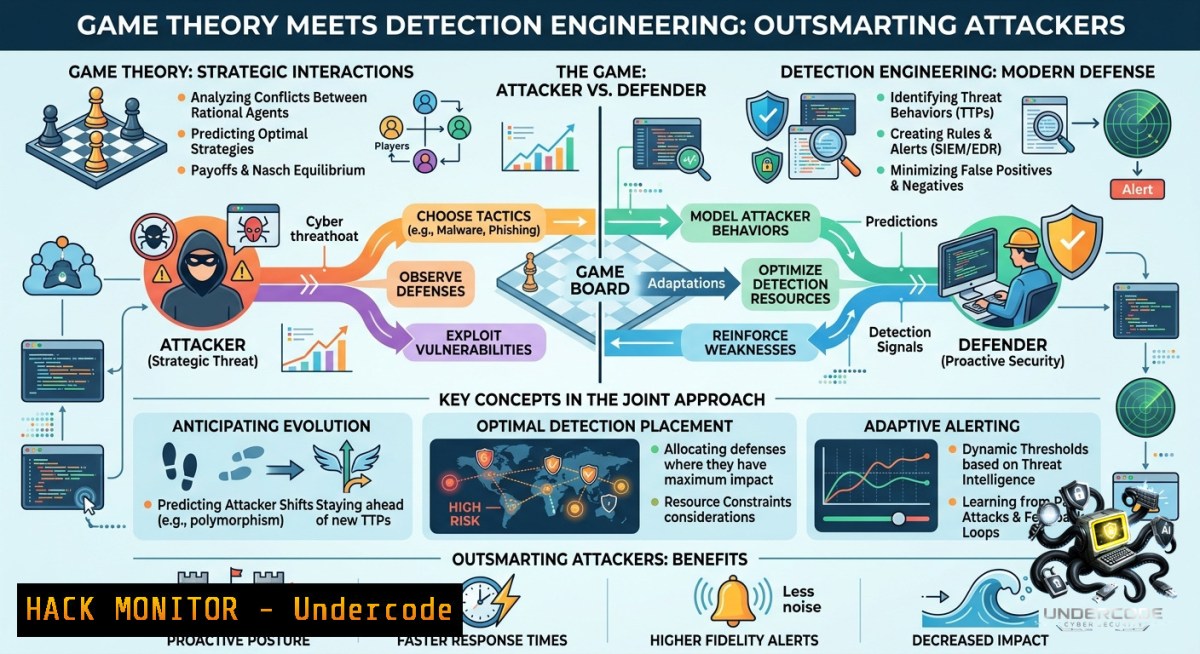
Detection engineering is the discipline of building and maintaining security detection rules to identify malicious activity across enterprise environments. Game theory, a mathematical framework for modeling strategic interactions between rational adversaries, offers a powerful lens for predicting attacker behavior and optimizing detection investments. When combined, these fields enable defenders to move from reactive alerting to proactive, mathematically-informed threat hunting.
Learning Objectives:
- Understand core game theory concepts (Nash equilibrium, zero‑sum games, payoff matrices) applied to cybersecurity.
- Learn how to design detection rules that account for attacker adaptation and cost‑benefit tradeoffs.
- Gain practical skills in implementing detection engineering pipelines with Linux/Windows commands and SIEM queries.
You Should Know:
1. The Attacker‑Defender Game: Core Principles
In cybersecurity, the attacker and defender play a repeated, imperfect‑information game. Attackers choose techniques (e.g., phishing, privilege escalation, lateral movement), while defenders choose detection controls (e.g., logging, rules, honeypots). Game theory helps find equilibrium strategies where neither side benefits from unilaterally changing tactics. For example, a defender might randomize which high‑value assets are monitored most heavily, forcing attackers to waste resources guessing.
Step‑by‑step guide to modeling a detection game:
- Identify assets (e.g., domain controllers, database servers) and likely attack paths (MITRE ATT&CK).
- Define payoffs: cost of control implementation, impact of successful breach, false positive cost.
- Construct a payoff matrix for two actions: “Enable rule X” vs. “Don’t enable” and attacker “Use technique T” vs. “Avoid T”.
- Solve for mixed‑strategy Nash equilibrium using linear algebra or simple Python script (see section 4).
2. Building a Detection Engineering Pipeline
A robust detection pipeline transforms raw logs into actionable alerts. It includes log source onboarding, parsing, rule authoring (SIGMA, YARA, KQL), testing, and tuning. Game theory suggests that defenders should prioritize rules that yield the highest “detection gain” relative to attacker adaptation cost.
Linux commands to verify log coverage:
 Check auditd status and rules
sudo auditctl -l
 Enable process execution logging
sudo auditctl -a always,exit -F arch=b64 -S execve -k process_exec
 Monitor critical file changes
sudo auditctl -w /etc/passwd -p wa -k passwd_changes
Windows PowerShell commands for detection readiness:
 Check current Sysmon configuration
Get-WinEvent -LogName "Microsoft-Windows-Sysmon/Operational" -MaxEvents 1
 Enable PowerShell script block logging
Set-ItemProperty -Path "HKLM:\SOFTWARE\Policies\Microsoft\Windows\PowerShell\ScriptBlockLogging" -1ame "EnableScriptBlockLogging" -Value 1
 Query security events for failed logins (Event ID 4625)
Get-WinEvent -FilterHashtable @{LogName='Security'; ID=4625} -MaxEvents 20
3. Optimizing Detection Rules Using Cost‑Benefit Analysis
Game theory teaches that not all detections are equal. A rule that triggers on rare, high‑impact attacks (e.g., Kerberoasting) may be more valuable than one that catches common but low‑impact malware. Use the “detection coverage vs. attacker evasion cost” curve.
Example: SIEM detection rule (SIGMA format) for suspicious LSASS access
title: Suspicious LSASS Process Access
status: experimental
description: Detects tools like mimikatz accessing LSASS memory
logsource:
product: windows
service: security
detection:
selection:
EventID: 4663
ObjectType: 'Process'
ObjectName|contains: 'lsass.exe'
AccessMask: '0x1010'  PROCESS_VM_READ | PROCESS_QUERY_INFORMATION
condition: selection
level: high
Step‑by‑step to tune rule thresholds:
- Collect baseline false positives over 7 days using the rule in log‑only mode.
- Compute cost per alert (investigation time) and cost per missed detection (expected breach damage).
- Adjust sensitivity (e.g., require two distinct source IPs or add exception for trusted backup agents).
- Re‑evaluate using a game‑theoretic payoff matrix to ensure tuning doesn’t create exploitable gaps.
4. Hands‑On: Simulating a Detection Game with Python
The following code models a simple attacker‑defender game where the defender chooses to monitor (M) or not monitor (NM), and the attacker chooses to attack (A) or not attack (NA). Payoffs are defined from the defender’s perspective (negative values indicate losses).
import numpy as np
import nashpy as nash  pip install nashpy

Defender's payoffs (rows: Monitor, Not Monitor)
 Attacker's payoffs (cols: Attack, Not Attack)
 Defender matrix (lower is better for defender? Actually we use standard form)
 Let's build a zero‑sum game: defender's loss = attacker's gain
 Costs: breach cost = 100, monitoring cost = 10, attacker gain if successful = 100
A = np.array([[ -10, -10],  Defender monitors: if attack -> loss 10, if no attack -> loss 10 (cost)
[-100, 0]])  Defender not monitor: if attack -> loss 100, if no attack -> 0
game = nash.Game(A)
eqs = game.support_enumeration()
for eq in eqs:
print("Nash equilibrium:", eq)
This script reveals the mixed‑strategy probabilities that minimize worst‑case loss. Run it to see how increasing monitoring cost shifts the equilibrium – a core insight for detection engineers.
- Linux & Windows Commands for Proactive Detection Engineering
Proactive detection relies on continuous monitoring and rapid investigation. Below are verified commands to collect forensic artifacts and hunt for anomalies.
Linux (log analysis and live response):
 Search for failed sudo attempts
grep "COMMAND" /var/log/auth.log | grep -i "fail"
 List recently modified files in /tmp
find /tmp -type f -mmin -10 -exec ls -la {} \;
 Monitor network connections from unusual processes
ss -tunp | grep ESTAB | awk '{print $6}' | cut -d'"' -f2 | sort | uniq -c
 Use auditd to track specific user activity
sudo auditctl -a always,exit -F uid=1000 -S all -k user1000_activity
Windows (PowerShell and wevtutil):
 Extract all PowerShell operational logs from last 2 hours
$start = (Get-Date).AddHours(-2)
Get-WinEvent -FilterHashtable @{LogName='Microsoft-Windows-PowerShell/Operational'; StartTime=$start} | Format-List
 Query Windows Defender detections
Get-MpThreatDetection | Where-Object {$_.DetectionTime -gt (Get-Date).AddDays(-1)}
 Collect autoruns from suspicious locations using Sysinternals autorunsc
.\autorunsc64.exe -a  -c -1obanner | Out-File autoruns.csv
6. Hardening Cloud Environments Using Game Theory Principles
In the cloud, attackers often target misconfigured IAM roles and overly permissive storage. Game theory suggests that defenders should randomize security audits and deploy “decoys” (honeytokens) to increase attacker uncertainty.
AWS CLI commands for detection hardening:
 Detect unused IAM roles (potential persistence vectors)
aws iam list-roles --query "Roles[?RoleLastUsed==null]" --output table
 Enable CloudTrail for all regions and log validation
aws cloudtrail create-trail --1ame security-trail --s3-bucket-1ame my-logs --is-multi-region-trail --enable-log-file-validation
 Deploy a honeytoken (S3 bucket that triggers alert on access)
aws s3 mb s3://honeytoken-secret-bucket-do-1ot-touch --region us-east-1
aws s3api put-bucket-policy --bucket honeytoken-secret-bucket-do-1ot-touch --policy file://alert-policy.json
Azure CLI example for Security Center alerts:
az security alert list --query "[?severity=='High']" --output table
 Enable Azure Defender for Key Vault
az security pricing create -1 KeyVaults --tier standard
- Training and Resources to Master Detection Engineering with Game Theory
The secKlub summer event on July 5th (registration: https://luma.com/tp45efup) is a prime opportunity to learn directly from Daniel Koifman and Vadim Volkov. Additionally, explore the following free and paid resources:
– Course: “Game Theory for Security Practitioners” (Cybrary, free tier available).
– Book: “A Dance of Red and Blue” by Daniel Koifman – covers detection engineering lifecycles.
– Tool: ATT&CK Workbench (MITRE) – map detection gaps and simulate attacker moves.
– CTF: “Blue Team Game Theory Challenge” on PicoCTF (seasonal).
Step‑by‑step to build a personal lab:
- Install Elastic Stack (ELK) or Wazuh on a VM.
- Inject attack simulations using Caldera or Atomic Red Team.
- Write SIGMA rules based on game‑theory prioritized ATT&CK techniques.
- Measure rule performance and iterate using the payoff matrix method.
What Undercode Say:
- Key Takeaway 1: Game theory provides a mathematical backbone for deciding which detection rules to implement – not all alerts are equally valuable, and attackers will shift tactics based on your defenses.
- Key Takeaway 2: Practical detection engineering requires a repeatable pipeline: log collection (auditd/Sysmon), rule authoring (SIGMA/KQL), tuning via cost‑benefit analysis, and continuous re‑evaluation as attackers adapt.
-
Analysis: The intersection of detection engineering and game theory is still underutilized in most SOCs. Traditional detection focuses on covering known techniques without considering that adversaries anticipate those rules. By adopting a game‑theoretic mindset, defenders can proactively randomize monitoring, deploy deceptive responses, and allocate resources to techniques where the attacker’s cost of evasion is highest. The secKlub lecture on July 5th will likely demonstrate real‑world case studies, such as tuning SIEM thresholds to achieve Nash equilibrium. Organizations that ignore this approach will suffer from predictable detection patterns, allowing skilled attackers to systematically bypass controls. Expect to see more open‑source tools and academic research merging these fields in the coming year.
Prediction:
- +1: Adoption of game‑theoretic detection optimization will reduce false positives by up to 40% in mature SOCs, freeing analysts to focus on genuine threats.
- +1: Automated detection rule generators powered by reinforcement learning (a game theory derivative) will emerge as commercial products by 2027.
- -1: Attackers will develop “detection‑aware” malware that probes for rule presence and adapts in real time, rendering static game models insufficient without frequent recalibration.
- -1: Most small‑to‑medium enterprises will lack the data science expertise to implement game theory, widening the security gap between large and small organizations.
▶️ Related Video (84% Match):
https://www.youtube.com/watch?v=3NPGopeAZeY
🎯Let’s Practice For Free:
🎓 Live Courses & Certifications:
Join Undercode Academy for Verified Certifications
🚀 Request a Custom Project:
Secure, high-velocity infrastructure and disruptive technological engineering. Contact our engineering team for high-tier development and proprietary systems:
[email protected]
💎 Smart Architecture | 🛡️ Secure by Design | ⭐ Trusted by Thousands
IT/Security Reporter URL:
Reported By: Koifman Daniel – Hackers Feeds
Extra Hub: Undercode MoN
Basic Verification: Pass ✅


