
Listen to this Post
Introduction:
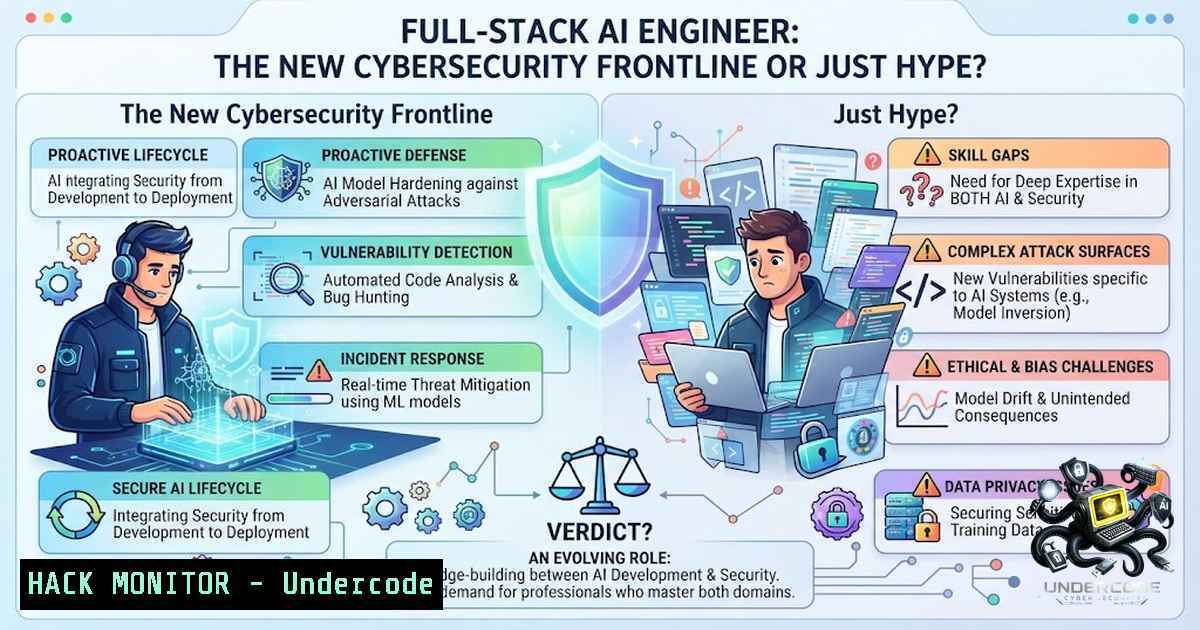
The role of a software engineer has evolved far beyond building user interfaces and REST APIs. Today, the emergence of Full-Stack AI Engineering represents a paradigm shift where traditional development merges with machine intelligence, creating systems that can reason, automate, and interact autonomously. This convergence, however, introduces a complex web of security challenges—from prompt injection attacks on AI agents to data leakage in vector databases—demanding that modern engineers master not only code but also the defensive tactics required to protect intelligent software.
Learning Objectives:
- Understand the core competencies of a Full-Stack AI Engineer and how they differ from traditional full-stack roles.
- Identify the security vulnerabilities introduced by AI agents, RAG pipelines, and vector databases.
- Learn practical hardening techniques and command-line tools to secure AI-powered applications across Linux and Windows environments.
You Should Know:
- Hardening the AI Pipeline: Securing API Keys and Model Endpoints
The foundation of any AI application is the API keys that grant access to models like OpenAI, Claude, or Gemini. A compromised key can lead to financial drain, data exfiltration, or reputational damage. Securing these credentials is the first line of defense.
Step‑by‑step guide:
- Environment Isolation: Never hardcode API keys in source code. Use environment variables or a secrets manager.
Linux/macOS: Set environment variable temporarily
export OPENAI_API_KEY="sk-..."
Windows (Command Prompt)
set OPENAI_API_KEY=sk-...
Windows (PowerShell)
$env:OPENAI_API_KEY="sk-..."
- Secrets Management: For production, integrate a vault like HashiCorp Vault or AWS Secrets Manager.
Example: Retrieve secret from AWS Secrets Manager using AWS CLI
aws secretsmanager get-secret-value --secret-id my-ai-key --query SecretString --output text
- Endpoint Restriction: In your cloud provider, restrict the IP ranges that can access your model endpoints. For Azure OpenAI, use network ACLs; for AWS Bedrock, use VPC endpoints.
- Audit Logging: Enable audit logging for all API calls to detect anomalous usage patterns.
Example: Monitor API usage with grep and jq (Linux)
tail -f /var/log/ai-api.log | jq 'select(.status_code >= 400)'
- Key Rotation: Implement automated key rotation every 30–90 days using a CI/CD pipeline or cloud-1ative rotation functions.
2. Securing Retrieval-Augmented Generation (RAG) and Vector Databases
RAG systems enhance LLM outputs by retrieving relevant documents from vector databases like Pinecone, Weaviate, or Milvus. However, they introduce unique risks: data poisoning, unauthorized access to sensitive documents, and prompt injection via retrieved content.
Step‑by‑step guide:
- Access Control: Implement role-based access control (RBAC) on your vector database. For Milvus, use:
Python example: Creating a role-based user in Milvus from pymilvus import connections, utility connections.connect(alias="default", host='localhost', port='19530') utility.create_user('rag_reader', 'secure_password_123') - Input Validation: Sanitize all queries sent to the vector database to prevent injection attacks.
Example: Validate query string length and characters def sanitize_query(query: str) -> str: if len(query) > 500: raise ValueError("Query too long") Remove any potential injection characters return ''.join(c for c in query if c.isalnum() or c.isspace()) - Encryption at Rest: Ensure your vector database encrypts stored embeddings. For Pinecone, enable encryption by default; for self-hosted Milvus, configure storage encryption.
- Document Chunk Sanitization: Before ingesting documents, strip metadata that could contain sensitive information (e.g., author names, internal paths).
Linux: Use sed to remove sensitive patterns from text files
sed -i 's/Internal_Project_Name/REDACTED/g' ./documents/.txt
- Rate Limiting: Implement rate limiting on RAG queries to prevent denial-of-service or brute-force extraction attempts. Use Redis-based rate limiting:
Using redis-py for rate limiting
import redis
r = redis.Redis(host='localhost', port=6379, db=0)
def is_rate_limited(user_id):
key = f"rate_limit:{user_id}"
current = r.incr(key)
if current == 1:
r.expire(key, 60)  60-second window
return current > 10  Max 10 requests per minute
- Building and Hardening AI Agents with Multi-Agent Security
AI agents are autonomous systems that can execute tasks, call tools, and interact with other agents. Multi-agent systems amplify capabilities but also expand the attack surface—compromising one agent can cascade to others.
Step‑by‑step guide:
- Agent Isolation: Run each agent in a separate container or virtual machine. Use Docker with resource limits:
Run an agent container with restricted CPU/memory
docker run -d --1ame agent-1 --cpus="0.5" --memory="512m" my-ai-agent:latest
- Tool Whitelisting: Explicitly define which tools or APIs each agent can call. For example, in a LangChain agent:
from langchain.agents import Tool, initialize_agent
tools = [
Tool(name="Search", func=search_function, description="Web search"),
Tool(name="Calculator", func=calc_function, description="Math operations")
]
Do NOT include a tool like "DeleteFile" unless absolutely necessary
- Inter-Agent Authentication: Use mutual TLS (mTLS) or API tokens with short expiration times for communication between agents.
Generate a client certificate for mTLS (Linux)
openssl req -1ew -1ewkey rsa:2048 -days 365 -1odes -x509 -keyout agent.key -out agent.crt
- Audit Trails: Log all actions taken by each agent, including tool calls and their outcomes. Forward logs to a SIEM system.
- Fail-Safe Mechanisms: Implement a “circuit breaker” that halts agent execution if anomalous behavior (e.g., excessive tool calls) is detected.
4. Cloud Deployment Security for AI Workloads
Deploying AI applications on cloud platforms (AWS, Azure, GCP) requires securing not only the infrastructure but also the data pipelines and model storage.
Step‑by‑step guide:
- IAM Least Privilege: Create service accounts with the minimum permissions necessary. For AWS:
{ "Version": "2012-10-17", "Statement": [ { "Effect": "Allow", "Action": "s3:GetObject", "Resource": "arn:aws:s3:::my-ai-models/" } ] } - Container Scanning: Scan Docker images for vulnerabilities before deployment. Use Trivy or Clair:
Scan an image with Trivy (Linux)
trivy image my-ai-app:latest --severity HIGH,CRITICAL
- Network Segmentation: Place AI model endpoints in a private subnet, accessible only via an API gateway or load balancer that handles authentication.
- Model Encryption: Encrypt model weights stored in S3 or Azure Blob using server-side encryption (SSE-KMS).
Upload an encrypted model to S3
aws s3 cp model.bin s3://my-bucket/models/ --sse aws:kms --sse-kms-key-id alias/my-key
- Monitoring and Alerting: Set up CloudWatch or Azure Monitor alerts for unusual CPU/memory spikes, which could indicate cryptojacking or resource exhaustion.
5. Workflow Automation Security: CI/CD for AI Pipelines
Automated workflows (e.g., GitHub Actions, Jenkins) streamline AI model training and deployment but can become entry points for supply chain attacks if not secured.
Step‑by‑step guide:
- Secret Scanning: Use tools like `trufflehog` or `git-secrets` to prevent accidental commits of secrets.
Scan a Git repository for secrets (Linux)
trufflehog git file://. --only-verified
- Signed Commits: Require GPG-signed commits and tags to ensure code integrity.
Configure Git to sign commits
git config --global user.signingkey <your-gpg-key>
git config --global commit.gpgsign true
- Dependency Scanning: Integrate SCA (Software Composition Analysis) tools like Snyk or OWASP Dependency-Check into your pipeline.
Run OWASP Dependency-Check (Linux)
dependency-check --scan . --format HTML --out report.html
- Pipeline Isolation: Use dedicated, ephemeral runners for each build to prevent cross-contamination.
- Artifact Verification: Sign build artifacts (e.g., Docker images, model files) and verify signatures before deployment.
Sign a Docker image with cosign
cosign sign --key cosign.key myregistry/myimage:latest
- UI/UX Security: Making AI Useful Without Being Confusing or Vulnerable
The post emphasizes that great UI/UX makes AI useful—not confusing. From a security standpoint, this means designing interfaces that prevent accidental data exposure and guide users toward safe interactions.
Step‑by‑step guide:
- Input Sanitization on the Frontend: Use DOMPurify or similar libraries to sanitize user inputs before rendering, preventing XSS attacks.
// React example
import DOMPurify from 'dompurify';
const safeInput = DOMPurify.sanitize(userInput);
- Prompt Injection Warnings: Display clear warnings when users attempt to enter potentially malicious prompts (e.g., “Ignore previous instructions”).
- Data Masking: Automatically mask sensitive information (PII, API keys) in logs and UI displays.
// Example: Mask email addresses function maskEmail(email) { const [local, domain] = email.split('@'); return local.slice(0,2) + '@' + domain; } - Session Management: Implement short-lived sessions and secure, HTTP-only cookies for authentication.
- User Education: Embed tooltips and help icons that explain security best practices to end-users.
What Undercode Say:
- Key Takeaway 1: A Full-Stack AI Engineer is not merely a developer who uses AI APIs; they are architects of intelligent systems that require deep software engineering fundamentals, security awareness, and an understanding of AI-specific vulnerabilities.
- Key Takeaway 2: The expansion of the technology stack—from vector databases to multi-agent systems—introduces new attack vectors. Security must be integrated at every layer, from API key management to container hardening and prompt sanitization.
Analysis:
The LinkedIn post by Yusuf Sulayman correctly identifies that the future belongs to engineers who can blend software engineering with AI to solve real business problems. However, the discussion in the comments reveals a spectrum of opinions: some argue that strong fundamentals remain paramount, while others question the practical value of AI in full-stack work. What is often overlooked in these debates is the security dimension. As AI agents gain autonomy, they become attractive targets for adversaries. A compromised agent could leak proprietary data, execute unauthorized transactions, or spread misinformation. Therefore, the Full-Stack AI Engineer of tomorrow must be equally proficient in secure coding, zero-trust architecture, and AI red-teaming. The tools and commands outlined above are not optional add-ons; they are essential components of a resilient AI pipeline. The industry is moving toward a future where security is not a separate discipline but an integral part of the engineering lifecycle—and those who embrace this holistic view will lead the next wave of innovation.
Prediction:
- +1 The demand for Full-Stack AI Engineers with security expertise will skyrocket, creating a new lucrative career track that combines DevOps, AI, and cybersecurity.
- +1 Organizations that adopt secure-by-design AI development practices will gain a competitive advantage, as they will be able to deploy AI solutions faster and with greater customer trust.
- -1 The rapid proliferation of AI agents without adequate security controls will lead to a surge in high-profile breaches, prompting regulatory bodies to introduce stringent AI security frameworks.
- -1 Many traditional full-stack developers who fail to upskill in AI security will find their roles increasingly commoditized, as the market prioritizes engineers who can build intelligent, defensible systems.
- +1 The maturation of tools for AI security—such as automated prompt injection detectors and model integrity verifiers—will reduce the barrier to entry, enabling more teams to build safe AI applications.
▶️ Related Video (88% Match):
🎯Let’s Practice For Free:
🎓 Live Courses & Certifications:
Join Undercode Academy for Verified Certifications
🚀 Request a Custom Project:
Secure, high-velocity infrastructure and disruptive technological engineering. Contact our engineering team for high-tier development and proprietary systems:
[email protected]
💎 Smart Architecture | 🛡️ Secure by Design | ⭐ Trusted by Thousands
IT/Security Reporter URL:
Reported By: Businesses Automation – Hackers Feeds
Extra Hub: Undercode MoN
Basic Verification: Pass ✅


