Listen to this Post
Introduction:
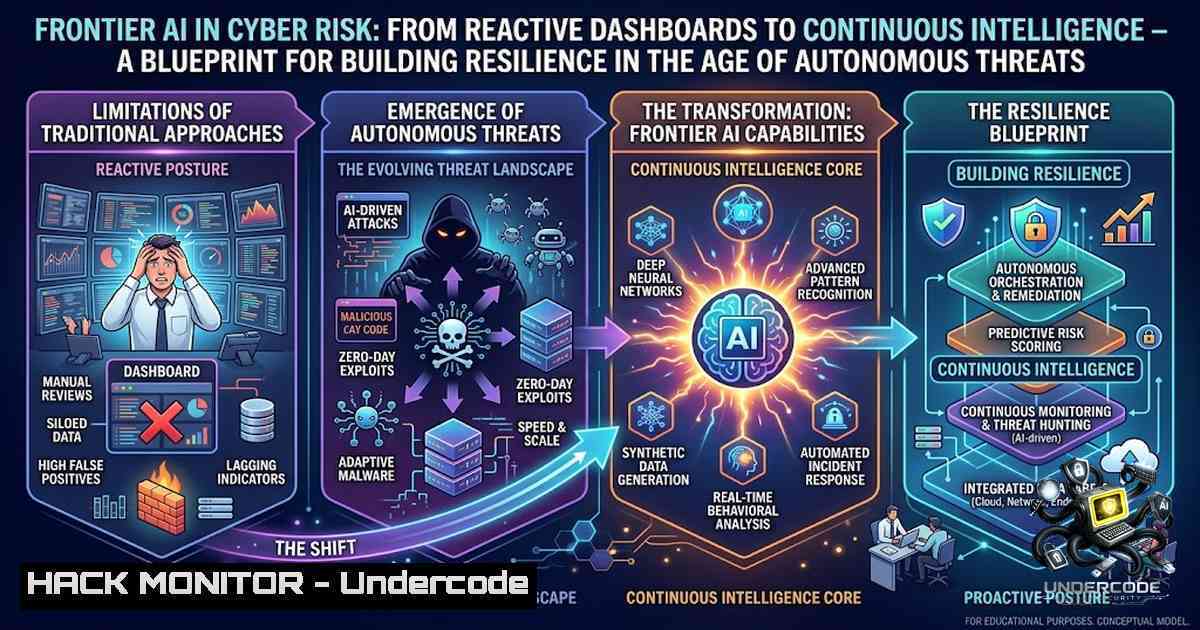
Frontier AI is fundamentally reshaping the cyber risk landscape—not through incremental improvements, but through a paradigm shift that most organizations are ill-prepared to handle. As AI-powered attacks become increasingly autonomous, capable of probing defenses and adapting in real-time, traditional security operations centers (SOCs) built around manual correlation and point-in-time compliance are rapidly becoming obsolete. This article provides a practical blueprint for building resilience through better visibility, trusted data, continuous monitoring, and risk-informed decision-making, drawing on insights from DataBee’s frontier AI cyber risk management webinar and industry best practices.
Learning Objectives:
- Understand the key barriers security teams face in defending against AI-powered threats and how to systematically address them
- Master the principles of continuous controls monitoring (CCM) and how agentic AI transforms compliance from periodic checkboxes to real-time assurance
- Learn to implement a unified security data fabric as the foundational layer for operationalizing AI safely and effectively
You Should Know:
- The AI-vs-AI Arms Race: Why Traditional Defenses Are Failing
The cybersecurity battlefield has fundamentally changed. Attackers are now using AI to automate phishing, social engineering, and vulnerability discovery at machine speed. Recent data shows a 340% jump in AI-assisted intrusion attempts compared to just two years earlier, with AI now driving 38% of credential-harvesting campaigns worldwide. An AI-driven intrusion can probe your defenses, notice what triggers an alert, and quietly change course before a human analyst even sees the activity.
This asymmetry creates a dangerous gap: attackers operate at machine speed while defenders still rely on human-centric, reactive processes. The gap between attackers and defenders is real, and 94% of global security leaders now identify AI as “the most significant driver of change in cybersecurity”. Organizations that fail to operationalize AI for defense will find themselves increasingly exposed.
Step‑by‑step guide to assessing your AI defense gap:
- Inventory your current detection capabilities: Map all existing security tools (SIEM, EDR, NDR, etc.) and document their average detection and response times. Benchmark these against known AI-powered attack timelines.
-
Conduct a red-team AI simulation: Use open-source adversarial AI tools like Adversarial Robustness Toolbox (ART) or Counterfit to simulate AI-powered attacks against your environment. Document which defenses held and which failed.
-
Measure your “mean time to adapt”: Unlike traditional MTTR (Mean Time to Respond), measure how long it takes your security team to adjust detection rules after observing a new attack pattern. AI-powered attackers adapt in seconds—can your team?
-
Deploy continuous controls monitoring: Implement a CCM framework that tests whether security and compliance controls are actually working across cloud, SaaS, and hybrid environments in real-time. This flags control drift as it happens and generates audit-ready evidence from current data sources.
-
Building the Foundation: The Unified Security Data Fabric
Agentic AI is redefining what’s possible in cybersecurity and compliance, but it requires a critical prerequisite: high-quality, connected, contextual data. Organizations have embraced the idea of continuous monitoring, but their processes, org design, and data foundations are still built for point-in-time audits. The result? Dashboards that glow green while material gaps persist, creating a false sense of confidence for leadership. Continuous monitoring without contextual intelligence is, effectively, continuous noise.
A unified security data fabric collects, normalizes, and correlates cybersecurity data across your entire environment. This provides the foundation enterprises need to safely operationalize AI, strengthen governance, and move from reactive compliance to always-on security assurance.
Step‑by‑step guide to implementing a security data fabric:
- Audit your data sources: Document all security-relevant data sources—firewall logs, cloud audit trails, endpoint telemetry, identity provider logs, vulnerability scanners, and configuration management databases (CMDBs). Identify which sources are structured, semi-structured, or unstructured.
-
Normalize your schema: Define a common data model that maps fields across disparate sources. For example, ensure that “source IP” from your firewall, “client_ip” from your cloud provider, and “src_addr” from your EDR all map to a single, unified field.
-
Implement entity resolution: Use deterministic or probabilistic matching to resolve the same entity (e.g., a device, user, or application) across different data sources. This is critical for accurate correlation and reducing false positives.
-
Establish data lineage tracking: For every piece of data ingested, track its origin, transformations, and any enrichment applied. This is non-1egotiable for defensible compliance and audit readiness.
-
Deploy continuous validation: Implement automated checks that validate data quality—completeness, accuracy, consistency, and timeliness—on an ongoing basis. Poor data quality quietly sabotages compliance; the fix is a unified security data fabric with normalization, entity resolution, and lineage.
Linux command example for log normalization using `jq`:
 Normalize JSON logs from different sources to a common schema
cat firewall.log | jq '{timestamp: .time, src_ip: .source, dst_ip: .destination, action: .verdict}' > normalized_firewall.json
cat cloudtrail.log | jq '{timestamp: .eventTime, src_ip: .sourceIPAddress, user: .userIdentity.userName, action: .eventName}' > normalized_cloudtrail.json
 Merge normalized logs for unified analysis
jq -s 'add' normalized_.json > unified_security_data.json
3. Agentic AI as Your “Data Expertise Assistant”
Agentic AI transforms the effort and processes behind investigation and compliance. Instead of analysts hopping between tools, hand-stitching timelines, and relying on undocumented institutional knowledge, agentic systems can interpret questions, traverse unified data, and return explainable, repeatable reasoning. Investigations that took hours can condense to minutes.
DataBee RiskFlow™ exemplifies this capability. It’s an agentic AI capability that lets users ask questions in plain language and receive transparent, traceable answers—helping them interpret issues, understand why something is failing, and know what to do next, without needing deep technical knowledge. Users can ask questions like “Which assets have critical vulnerabilities that haven’t been patched in the last 30 days?” or “Show me users with risky login patterns across cloud and on-prem environments” and receive clear, defensible answers complete with underlying logic and data lineage.
Step‑by‑step guide to operationalizing agentic AI for security:
- Define your use cases: Start with high-value, repetitive tasks. Common starting points include vulnerability prioritization, compliance evidence collection, and incident investigation triage.
-
Establish governance guardrails: Implement strict controls around what AI agents can access and what actions they can take. Ensure transparency, traceability, and deterministic logic in AI-assisted decisions.
-
Train on your data: Agentic AI only amplifies what’s in your data. If telemetry is inconsistent, duplicated, or schema-drifting, AI will deliver confident but wrong answers—worse than no answer at all. Invest in data curation before AI deployment.
-
Implement human-in-the-loop validation: For high-stakes decisions, require human review of AI-generated recommendations. The AI serves as an assistant, not a replacement for human judgment.
-
Measure and iterate: Track key metrics—time-to-insight, accuracy of AI-generated answers, and user adoption rates. Continuously refine your data models and AI prompts based on feedback.
Windows PowerShell command example for querying security events:
 Query Windows Event Log for failed login attempts (potential credential harvesting)
Get-WinEvent -FilterHashtable @{LogName='Security'; ID=4625; StartTime=(Get-Date).AddDays(-30)} |
Select-Object TimeCreated, @{Name='User';Expression={$<em>.Properties[bash].Value}},
@{Name='SourceIP';Expression={$</em>.Properties[bash].Value}} |
Export-Csv -Path failed_logins.csv -1oTypeInformation

Correlate with vulnerability data (simplified example)
$vulns = Import-Csv -Path vulnerabilities.csv
$failedLogins = Import-Csv -Path failed_logins.csv
$correlated = $failedLogins | Where-Object { $_.SourceIP -in $vulns.AssetIP }
$correlated | Export-Csv -Path correlated_risks.csv -1oTypeInformation
- Continuous Controls Monitoring: From Point-in-Time to Always-On Assurance
Compliance is moving beyond 12-month lookbacks and sample-based testing into full-population monitoring at the data source. This shift makes compliance auditable, repeatable, and defensible—and it’s the only way to support real-time executive reporting and board-level confidence. Leaders must now answer inquiries in hours, not weeks, and prove that controls are present and effective across hybrid environments.
Continuous Controls Monitoring (CCM) tests whether security and compliance controls are actually working across cloud, SaaS, and hybrid environments. It flags control drift as it happens, generates audit-ready evidence from current data sources, and maps a single source of truth for compliance.
Step‑by‑step guide to implementing CCM:
- Map your control framework: Document all security controls mapped to relevant frameworks (NIST CSF, PCI-DSS, CIS, ISO 27001, etc.). For each control, define the specific evidence required to demonstrate effectiveness.
-
Identify data sources for each control: For each control, identify which data sources provide the necessary evidence. For example, MFA compliance requires identity provider logs; patch compliance requires vulnerability scanner data and CMDB.
-
Automate evidence collection: Implement automated data pipelines that collect, normalize, and store evidence on a continuous basis—not just at audit time.
-
Define success criteria: For each control, define measurable success criteria (e.g., “100% of users with MFA enabled,” “critical patches applied within 7 days”).
-
Implement alerting and remediation workflows: Configure alerts for control failures and integrate with ticketing systems for automated remediation tracking.
Example control monitoring query (simplified):
-- Monitor MFA compliance across all users
SELECT
u.user_id,
u.email,
CASE WHEN mfa.enabled IS TRUE THEN 'Compliant' ELSE 'Non-Compliant' END AS mfa_status,
mfa.last_enabled_date
FROM users u
LEFT JOIN mfa_config mfa ON u.user_id = mfa.user_id
WHERE u.active = TRUE
AND u.last_login_date > NOW() - INTERVAL '90 days';
- The CISO’s New Mandate: Governance, Explainability, and Strategic Oversight
If an AI agent is going to produce evidence or make recommendations used in regulatory contexts, you must be able to show how it arrived there. Black-box outputs are not defensible. Organizations must emphasize traceable lineage and rationale—the auditability that stakeholders demand.
CISOs should push vendors to demonstrate adherence to secure AI development practices, including bias mitigation, adversarial robustness, and provenance tracking. A clear AI strategy is a first step, but it must include an AI governance framework that considers how risks will be managed.
Step‑by‑step guide to AI governance for security leaders:
- Establish an AI governance board: Include representatives from security, legal, compliance, and business units. Define clear roles and responsibilities for AI oversight.
-
Develop an AI risk inventory: Document all AI systems in use across the organization, their purpose, data sources, and potential risks. Include both internally developed and third-party AI.
-
Implement AI-specific controls: Extend your control framework to cover AI-specific risks—model poisoning, prompt injection, data leakage, and adversarial attacks. Reference the OWASP Top 10 for LLM Applications as a starting point.
-
Require explainability by design: Mandate that all AI systems used in security or compliance contexts provide traceable, auditable reasoning for their outputs. Black-box models are unacceptable.
-
Conduct regular AI risk assessments: Treat AI systems like any other critical asset—conduct regular vulnerability assessments, penetration testing, and compliance reviews.
6. Practical Defensive Measures: Commands and Configurations
Linux: Monitor for suspicious outbound connections (potential data exfiltration by AI-powered malware)
 Monitor established outbound connections to unusual ports
ss -tunap | grep ESTAB | awk '{print $5}' | cut -d: -f1 | sort | uniq -c | sort -1r

Set up real-time alerting for new outbound connections to known malicious IPs (using ipset)
sudo ipset create malicious_ips hash:ip
sudo iptables -A OUTPUT -m set --match-set malicious_ips dst -j LOG --log-prefix "MALICIOUS_OUTBOUND: "
 Populate malicious_ips from threat intelligence feeds
curl -s https://rules.emergingthreats.net/blockrules/emerging-Block-IPs.txt | \
grep -v '^' | sudo ipset add malicious_ips -exist
Windows: Enable advanced audit logging for AI-powered attack detection
 Enable PowerShell script block logging (detects malicious script execution)
Set-ItemProperty -Path "HKLM:\SOFTWARE\Policies\Microsoft\Windows\PowerShell\ScriptBlockLogging" -1ame "EnableScriptBlockLogging" -Value 1

Enable command line process auditing
auditpol /set /subcategory:"Process Creation" /success:enable /failure:enable

Enable Sysmon for advanced endpoint visibility
 Download Sysmon from Microsoft Sysinternals
sysmon64.exe -accepteula -i sysmon-config.xml
Kubernetes: Secure AI workloads with network policies
 Restrict egress from AI model pods to prevent data exfiltration
apiVersion: networking.k8s.io/v1
kind: NetworkPolicy
metadata:
name: ai-model-egress-restriction
spec:
podSelector:
matchLabels:
app: ai-inference
policyTypes:
- Egress
egress:
- to:
- ipBlock:
cidr: 10.0.0.0/8  Allow only internal network
ports:
- protocol: TCP
port: 443
What Undercode Say:
- The AI defense gap is real and widening. Traditional SOCs built around human correlation and point-in-time compliance cannot keep pace with AI-powered attacks that adapt at machine speed. Organizations must shift from reactive to proactive, from periodic to continuous, and from siloed to unified.
-
Data quality is the true differentiator. The real competitive advantage isn’t the AI model—it’s the quality, normalization, and lineage of the data fueling it. Agentic AI only amplifies what’s in your data; garbage in, garbage out, but with AI, the garbage comes with confident, wrong answers that are worse than no answer at all.
-
Agentic AI is an assistant, not a replacement. The most effective approach treats AI as a “data expertise assistant” that translates policy into queries, navigates complex schemas, and surfaces exceptions—while the human retains judgment, context, and accountability. This hybrid model delivers the speed of automation with the wisdom of human expertise.
-
Continuous controls monitoring is the new baseline. Compliance is moving from point-in-time, sample-based testing to full-population, real-time monitoring. Organizations that fail to make this transition will find themselves increasingly exposed to both regulators and attackers.
-
Explainability is non-1egotiable. Black-box AI outputs are not defensible in regulatory contexts. Organizations must demand traceable lineage and rationale from their AI systems, ensuring that every insight can be audited and every decision can be explained.
-
The window to adapt is closing. The gap between prepared and exposed organizations will already be visible by mid-2026. Organizations that operationalize AI for defense today will have a fighting chance; those that delay will find themselves increasingly vulnerable.
Prediction:
-
-1 The AI-vs-AI arms race will accelerate through 2027, with defensive AI struggling to keep pace with offensive AI due to the inherent asymmetry of attack versus defense. Organizations will face increasing pressure to deploy autonomous defense systems, but many will rush implementation without adequate governance, creating new vulnerabilities.
-
+1 Continuous controls monitoring will become a regulatory requirement within the next 18–24 months, driven by the EU AI Act and similar frameworks. Organizations that invest in CCM and unified security data fabrics today will have a significant compliance advantage.
-
-1 The skills gap will widen dramatically as AI-powered attacks become more sophisticated. Security teams will need new skills—data engineering, AI governance, and prompt engineering—that are currently in short supply. Organizations will struggle to hire and retain talent.
-
+1 Agentic AI will democratize security and compliance expertise, allowing non-technical stakeholders to access and act on security data. This will accelerate decision-making and reduce reliance on specialized analysts, but only for organizations with clean, unified data foundations.
-
-1 Shadow AI will become the next major attack vector, as employees deploy unauthorized AI tools that access sensitive data without proper governance. Organizations must implement AI discovery and governance controls before this becomes an unmanageable risk.
-
+1 The shift from point-in-time to continuous compliance will reduce the cost of audits by 40–60% for organizations that automate evidence collection and reporting. This will free up security teams to focus on proactive threat hunting rather than reactive audit preparation.
▶️ Related Video (62% Match):
https://www.youtube.com/watch?v=3jUQCcGa4yI
🎯Let’s Practice For Free:
🎓 Live Courses & Certifications:
Join Undercode Academy for Verified Certifications
🚀 Request a Custom Project:
Secure, high-velocity infrastructure and disruptive technological engineering. Contact our engineering team for high-tier development and proprietary systems:
[email protected]
💎 Smart Architecture | 🛡️ Secure by Design | ⭐ Trusted by Thousands
IT/Security Reporter URL:
Reported By: Cyberriskmanagement Cybersecurity – Hackers Feeds
Extra Hub: Undercode MoN
Basic Verification: Pass ✅


