Listen to this Post
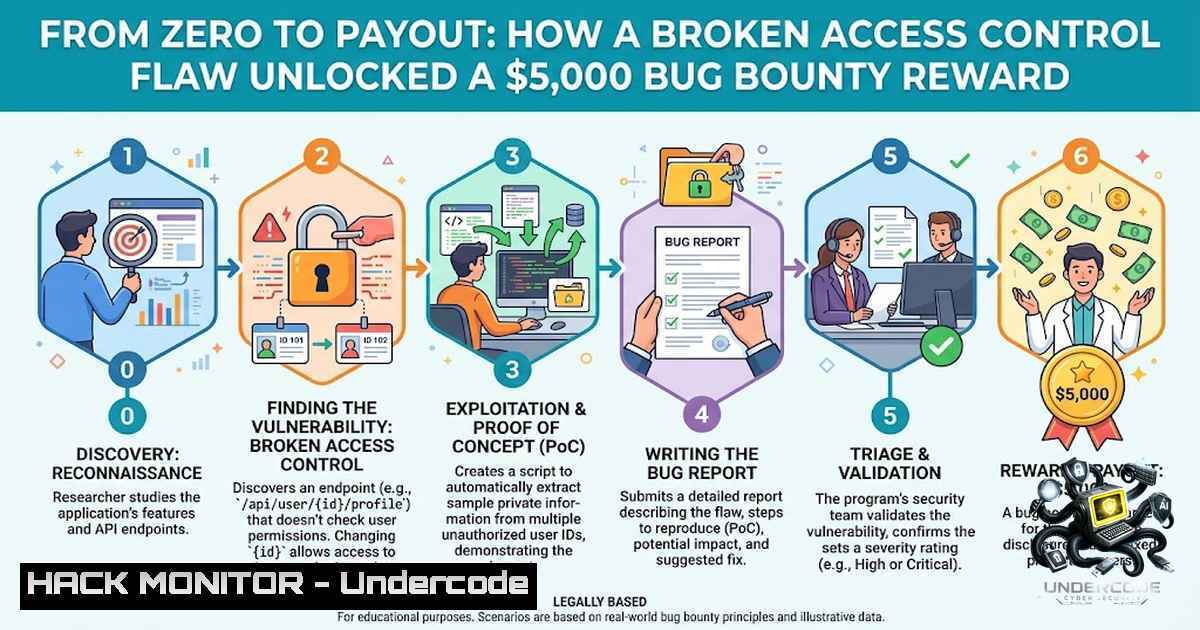
Introduction:
Broken Access Control (BAC) remains the most critical web application security risk, consistently ranking 1 on the OWASP Top 10. When a low-privileged user can invoke administrative backend functions due to flawed authorization enforcement, the entire application’s data and functionality become exposed to unauthorized access. This article explores the step-by-step journey of discovering, exploiting, and responsibly disclosing a privilege escalation vulnerability, offering a comprehensive technical deep dive for security researchers and developers alike.
Learning Objectives:
- Understand the root causes and business impact of Broken Access Control vulnerabilities in modern web applications.
- Master both manual and automated techniques for identifying privilege escalation flaws across API endpoints and backend services.
- Learn how to construct professional Proof-of-Concept (PoC) exploits and effectively communicate findings to security teams.
- Acquire practical mitigation strategies, including robust authorization frameworks and secure coding practices.
- Understanding the Flaw: The Anatomy of a Privilege Escalation Vulnerability
The core issue in this bug bounty finding was a classic case of horizontal and vertical privilege escalation. The application relied heavily on client-side UI restrictions to hide administrative functions, but the backend API endpoints lacked proper server-side authorization checks. This meant that any authenticated user, regardless of their role, could potentially access and manipulate administrative resources simply by knowing or guessing the correct API endpoint and parameters.
To systematically test for such flaws, security researchers employ a combination of proxy tools and manual inspection. Here’s a basic workflow using Burp Suite and custom scripts:
Step-by-step guide:
- Intercept Traffic: Configure Burp Suite as a proxy and capture all HTTP/HTTPS traffic between your browser and the target application.
- Map the Application: Navigate through the application using both a low-privileged (standard user) and a high-privileged (admin) account. Record all API endpoints accessed by the admin account, paying close attention to
GET,POST,PUT, and `DELETE` requests that manage users, settings, or sensitive data. - Replay Requests: Using Burp Repeater, take an administrative request (e.g.,
PUT /api/admin/users/123/role) and replay it while authenticated as a standard user. - Analyze Responses: Observe the server’s response. A `200 OK` or `201 Created` status, along with the expected data, indicates a successful bypass. An error like `403 Forbidden` suggests proper controls are in place.
- Automated Scanning: For larger scopes, use tools like `ffuf` or `dirsearch` to fuzz for hidden admin endpoints. A simple `ffuf` command to find admin directories on a Linux system:
ffuf -u https://target.com/FUZZ -w /usr/share/wordlists/dirb/common.txt -e .php,.asp,.aspx,.js,.json -fc 404 -t 200
On Windows (using PowerShell), you can achieve similar results with `Invoke-WebRequest` in a loop, though dedicated tools like `ffuf` are recommended.
2. Crafting the Proof-of-Concept (PoC): Demonstrating Real-World Impact
A strong PoC is the cornerstone of a successful bug bounty report. It must be clear, reproducible, and demonstrate the actual business impact of the vulnerability. In this case, the PoC needed to show that a standard user could elevate their own privileges or perform administrative actions.
Step-by-step guide:
- Document the Environment: Clearly state the target URL, the affected endpoint, and the HTTP method used.
- Capture the Request: Provide the exact HTTP request that triggers the vulnerability. This includes all headers (cookies, authorization tokens, etc.) and the request body.
- Show the Response: Include the server’s response that confirms the action was successful.
- Demonstrate the Impact: For a privilege escalation, the PoC should show a tangible outcome. For example, a standard user changing their own role from `user` to
admin. - Script the Exploit: For complex vulnerabilities, provide a simple Python or Bash script that automates the exploit. This proves the issue is not a fluke and can be reliably triggered.
Sample Python PoC (Linux/macOS/Windows):
import requests

Configuration
target_url = "https://target.com/api/admin/users/123/role"
cookies = {"sessionid": "standard_user_session_cookie"}
headers = {"Content-Type": "application/json"}
payload = {"role": "admin"}

Exploit
response = requests.put(target_url, json=payload, cookies=cookies, headers=headers)

Check result
if response.status_code == 200 and "admin" in response.text:
print("[+] Privilege escalation successful!")
else:
print("[-] Exploit failed or vulnerability patched.")
3. Testing Backend Authorization: Beyond the UI
Relying on UI restrictions for security is a fundamental flaw. The frontend can be easily manipulated, and attackers can bypass client-side checks entirely. The only reliable way to enforce access control is on the server side.
Step-by-step guide for comprehensive testing:
- Direct Object Reference (IDOR) Testing: Modify resource identifiers (e.g., user IDs, order numbers) in API requests. If a standard user can access another user’s data by changing an ID, an IDOR vulnerability exists.
– Linux command (using curl):
curl -X GET "https://target.com/api/users/456" -H "Cookie: sessionid=standard_user_cookie"
Replace `456` with an ID belonging to another user.
2. HTTP Method Tampering: Some endpoints may enforce authorization only for certain methods (e.g., GET). Test if POST, PUT, or `DELETE` methods are improperly secured.
3. Parameter Manipulation: Look for parameters like admin=true, role=admin, or `isAuthenticated=1` in requests. While often a sign of poor design, sometimes these are honored by the backend.
4. API Versioning: Check different API versions (e.g., /api/v1/admin/, /api/v2/admin/). One version might be misconfigured and lack proper checks.
4. API Security Hardening: Implementing Robust Authorization
Preventing BAC vulnerabilities requires a multi-layered approach to security. The primary defense is implementing a robust, server-side authorization framework that validates every request.
Step-by-step guide for developers:
- Centralized Authorization Logic: Use a dedicated library or middleware to handle all authorization decisions. In a Node.js/Express application, this could be middleware that checks the user’s role before allowing access to any admin route.
// Node.js middleware example function authorize(roles = []) { return (req, res, next) => { const userRole = req.user.role; if (roles.length && !roles.includes(userRole)) { return res.status(403).json({ error: "Forbidden" }); } next(); }; } // Usage app.put('/api/admin/users/:id', authorize(['admin']), updateUser); - Role-Based Access Control (RBAC): Implement a well-defined RBAC system. Assign permissions to roles and roles to users. Never rely on client-side claims.
- Attribute-Based Access Control (ABAC): For complex scenarios, consider ABAC, which evaluates attributes of the user, resource, and environment to make authorization decisions.
- Deny by Default: Configure your application to deny all access by default. Only explicitly grant access to specific resources and actions for specific roles.
- Regular Audits: Conduct regular code and configuration audits to ensure authorization logic is correctly implemented and hasn’t been bypassed through misconfigurations.
5. Cloud Hardening: Securing Access in Cloud Environments
In cloud-1ative applications, access control extends beyond the application code to include cloud resources, APIs, and services. Misconfigured cloud permissions are a common source of privilege escalation.
Step-by-step guide for AWS (example):
- Principle of Least Privilege: Grant only the minimum necessary permissions to IAM users, roles, and groups.
- Use IAM Roles: Avoid using long-term access keys. Instead, use IAM roles for EC2 instances, Lambda functions, and other services.
- Resource-Based Policies: Use resource-based policies (e.g., S3 bucket policies, SQS queue policies) to explicitly define who can access a specific resource.
- CloudTrail and CloudWatch: Enable AWS CloudTrail and CloudWatch to log and monitor all API calls. This helps in detecting and investigating suspicious activity.
- Automated Compliance Checks: Use tools like AWS Config or third-party solutions (e.g., Cloud Custodian) to continuously monitor your cloud environment for policy violations.
Sample AWS CLI command to list S3 buckets with public access:aws s3api list-buckets --query 'Buckets[?PublicAccessBlockConfiguration==null]'
-
Vulnerability Exploitation and Mitigation: A Security Researcher’s Toolkit
Beyond identifying vulnerabilities, a skilled researcher must understand how to exploit them effectively (in a controlled, ethical manner) and advise on mitigation.
Step-by-step guide:
- Exploitation Frameworks: While custom scripts are often best, tools like Metasploit can be used for testing known vulnerabilities in a lab environment.
- SQL Injection (SQLi) and Command Injection: If the BAC flaw is combined with other vulnerabilities (e.g., an admin function that takes user input and executes a system command), the impact can be catastrophic.
– Linux Command Injection Example (if a vulnerable parameter is found):
curl -X POST "https://target.com/api/admin/backup" -d "file=backup.tar.gz; whoami"
This attempts to execute the `whoami` command on the server.
3. Mitigation Strategies:
- Input Validation: Strictly validate and sanitize all user inputs.
- Parameterized Queries: Use parameterized queries to prevent SQL injection.
- Security Headers: Implement security headers like `Content-Security-Policy` and `X-Frame-Options` to add additional layers of defense.
- Regular Patching: Keep all software, libraries, and frameworks up-to-date to patch known vulnerabilities.
- The Responsible Disclosure Process: From Triage to Reward
The journey from discovery to reward is a critical phase that tests a researcher’s communication and professionalism.
Step-by-step guide:
- Draft the Report: Write a clear, concise, and well-structured report. Include a summary, detailed steps to reproduce, the PoC, impact assessment, and recommended fixes.
- Submit Through Proper Channels: Use the vendor’s official bug bounty platform (e.g., HackerOne, Bugcrowd) or security contact email.
- Be Patient and Responsive: Security teams may have questions or need additional clarification. Respond promptly and professionally.
- Respect Deadlines: If the vendor has a disclosure policy, adhere to their timelines for public disclosure.
- Celebrate the Win: Once the vulnerability is validated and rewarded, take a moment to appreciate the effort and the positive impact you’ve made on application security.
What Undercode Say:
- Key Takeaway 1: “Bug bounty is not just about finding vulnerabilities—it’s about clear communication, patience, and helping vendors understand and reproduce the issue.” This highlights that soft skills and technical prowess are equally important. A finding is only as valuable as the report that conveys it.
- Key Takeaway 2: “Testing backend authorization instead of relying on UI restrictions” is paramount. Security through obscurity or client-side controls is a recipe for disaster. The server must be the ultimate arbiter of access.
Analysis:
This case study underscores a persistent problem in the industry: developers often prioritize functionality over security, trusting the frontend to enforce rules. The successful exploitation of this BAC flaw demonstrates that even “minor” misconfigurations can lead to full system compromise. The researcher’s methodical approach—mapping endpoints, replaying requests, and crafting a clear PoC—serves as a model for others. The vendor’s prompt response and reward indicate a mature security program that values researcher contributions. This positive cycle encourages more security research, ultimately making the digital ecosystem safer for everyone.
Prediction:
- +1 The increasing adoption of API-first architectures will lead to a surge in BAC vulnerabilities being discovered, driving demand for specialized API security tools and training.
- +1 Bug bounty programs will become more sophisticated, incorporating automated triage systems and AI-powered vulnerability validation to handle the growing volume of reports.
- +1 The integration of security testing into CI/CD pipelines (DevSecOps) will become the norm, catching authorization flaws before they reach production, significantly reducing the number of high-severity bugs.
- -1 As tools for automated BAC testing become more advanced and accessible, the barrier to entry for malicious actors will lower, leading to an increase in automated attacks targeting known and unknown access control flaws.
- -1 Legacy applications with complex, undocumented authorization logic will remain a significant source of critical vulnerabilities, as they are difficult to secure without a complete overhaul.
▶️ Related Video (74% Match):
🎯Let’s Practice For Free:
🎓 Live Courses & Certifications:
Join Undercode Academy for Verified Certifications
🚀 Request a Custom Project:
Secure, high-velocity infrastructure and disruptive technological engineering. Contact our engineering team for high-tier development and proprietary systems:
[email protected]
💎 Smart Architecture | 🛡️ Secure by Design | ⭐ Trusted by Thousands
IT/Security Reporter URL:
Reported By: Hackersatty Bugbounty – Hackers Feeds
Extra Hub: Undercode MoN
Basic Verification: Pass ✅


